




Abstract
Facing the spread of coronavirus, the rapidly rising demand for hand sanitizer led to a short supply. In New York, Governor Cuomo's solution was to contract the Division of Correctional Industries. The profiting off of forced labor on the backs of incarcerated men and women is explained further in this policy brief.
Facing the spread of COVID-19 in the U.S. in early March 2020, hand sanitizer became a coveted item in short supply. In response to growing demand, New York Governor Andrew Cuomo unveiled a state-produced hand sanitizer called “NYS Clean.” Governor Cuomo was able to mobilize such vast manufacturing of sanitizer by tapping into prison labor. The Division of Correctional Industries (Corcraft), a company run by New York State Corrections and Community Supervision, would produce 100,000 gallons of sanitizer daily to be distributed to government agencies and schools, Governor Cuomo assured New Yorkers. At a press conference, Governor Cuomo said, “It’s much cheaper for us to make it ourselves,” pitching it as a low-cost solution to a public health problem.
This stop-gap measure of prisoner-produced hand sanitizer brought to light the central tensions around prison labor that have haunted the American correctional system for centuries.
NYS Clean is affordable because it exploits labor from a confined population. All U.S. prisoners are required to work as part of their punishment, unless they are housed in solitary confinement or are studying for their GED. In New York, incarcerated workers earn an average of $0.62 per hour. In 2019, Governor Cuomo vocalized support for a bill that would raise prisoners’ minimum wage to $3.00 per hour, still well below the state’s minimum wage of $11.80.
Damir Spanic on Unsplash
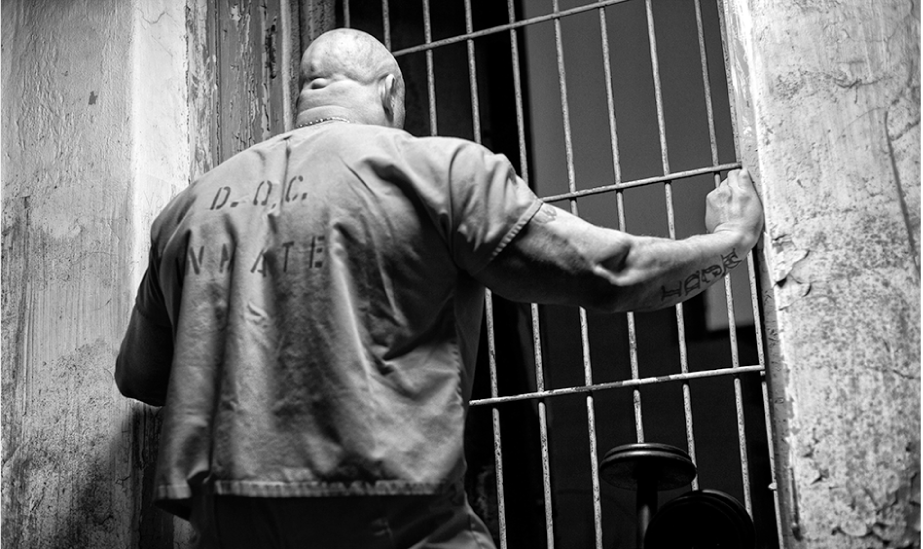
The state’s benefiting from forced labor on the backs of incarcerated men and women might sound familiar. As scholar Michelle Alexander explains, there is a clear historical link between slavery and modern-day imprisonment. People of color continue to be disproportionately represented in the prison population, with Black women’s incarceration rate double the rate of white women, and Black men’s incarceration rate nearly six times higher than that of white men. In most states, citizens’ right to vote is revoked while incarcerated. Their property may be confiscated. A felony conviction can be used as grounds for an at-fault divorce and the loss of parental rights. Access to social welfare is limited or denied.
Incarcerated populations are required to work for paltry wages while being excluded from the protections set in place by labor laws. Specifically, prisoners are exempted from federal workplace and labor protections such as the Fair Labor Standards Act, which sets the national minimum wage and overtime requirements, the National Labor Relations Act, which concerns collective bargaining and concerted actions by employees to improve their working conditions, and most federal and state workplace antidiscrimination laws. Meanwhile, productivity, sick days, and workplace grievances are overseen not only by their bosses—but also by their captors.
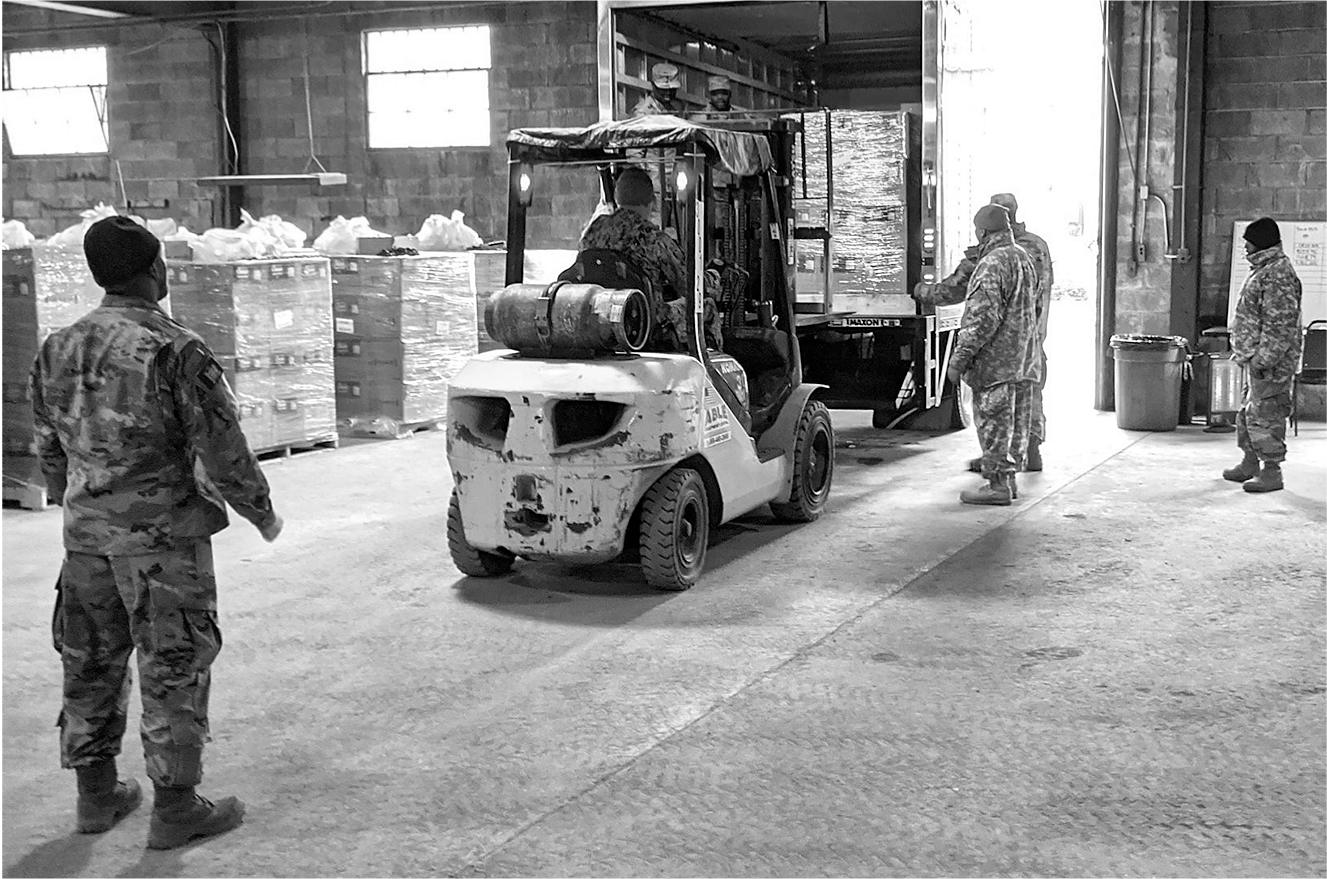
Members of the New York National Guard loading NYS Clean brand hand sanitizer onto a truck to go out for distribution. Camp Smith Training Site, N.Y. March 19, 2020. This state sponsored brand of sanitizer is manufactured through prison labor.
New York State Division of Military and Naval Affairs photo by New York Guard Sgt. Patrick Cafone. Posted by the New York National Guard via Flickr.
Americans encounter goods made by prisoners on a daily basis. Well-known examples are license plates and motor vehicle registrations. Less well-known, but equally insidious: incarcerated workers sew state flags and police officer uniforms. They build desks for state universities and furniture for governors’ offices. They risk their lives on highway cleanup crews and on the frontlines of wildfires. This labor is performed for well below minimum wage, for the state’s greater profit, and for society’s collective benefit. All too often, a criminal record bars formerly incarcerated workers from the very jobs they performed while in prison.
The production of hand sanitizer by incarcerated workers is especially cruel because the product itself is treated as contraband in prison. Whereas Governor Cuomo lauded NYS Clean for its 75 percent alcohol content compared to Purell’s 70 percent, its alcohol content is the reason that prisoners are prohibited access to the product. Being found to possess hand sanitizer or alcohol in any form could lead to disciplinary sanctions. This regulation prioritizes policing alcohol consumption over ensuring safety in the face of a global public health crisis.
After all, the conditions in which incarcerated populations live and work make them vulnerable during any epidemic. Jails and prisons are confined places with limited access to quick and thorough medical care. Hand soap is scarce. If an average cell is 7 by 10 feet, then “social distancing” among cellmates is impossible. With close quarters and compulsory physical contact with correctional officers, correctional facilities rank as hotbeds for some of the largest outbreaks in the country. As of November 2020, over 160,000 prisoners tested posted for COVID-19, with almost 1,400 deaths. Once contracted, incarcerated individuals face a mortality rate twice that of the broader population, taking into account race, ethnicity, age, and sex.
The problems presented by today’s U.S. prison labor system are not new. Rather, they harken back to a model of 19th century punishment known as the “Auburn system” or the “New York system,” which framed contract labor as an opportunity for rehabilitation. In exchange for subpar wages, prisoners were told that work could transform them into “productive” citizens and prepare them for their eventual release. Certainly, work can be deeply meaningful for incarcerated people. However, the employment that prisoners have access to frames them primarily as prisoners, not as workers. Echoes remain of the Auburn system, connecting mandatory, under-compensated labor to notions of reform and rehabilitation.
Much-needed hand sanitizer is being produced at a human cost. The inequality illuminated by NYS Clean is not a one-off problem. State and federal governments exploit incarcerated labor, paying a pittance and preventing prisoners from using the very products they have created. However, the proper solution is not to withhold the opportunity to work for months, years, or even decades. Instead, we must acknowledge that American capitalism has long benefited from prison labor. Wages should be commensurate with U.S. labor standards. Safety protections should be widespread and guaranteed. Draconian — even fatal — deprivations, like a lack of hand sanitizer, should not be part of what it means to be a prisoner in America. We must start treating incarcerated workers as workers—without any caveats.