




Abstract
Rebecca Krisel on Review of Class Attitudes in America: Sympathy for the Poor, Resentment of the Rich, and Political Implications by Spencer Piston.
Class Attitudes in America: Sympathy for the Poor, Resentment of the Rich, and Political Implications by Spencer Piston Cambridge University Press, 248 pp.
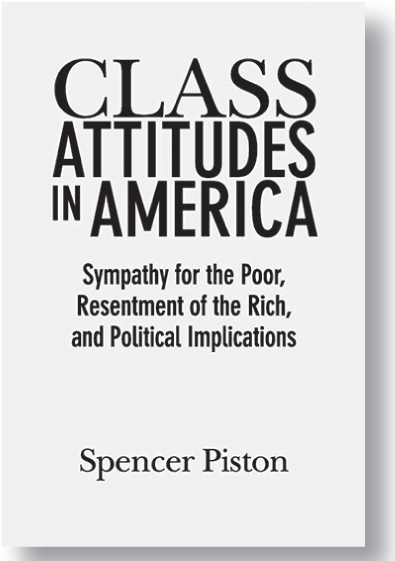
Americans do not think much about class, and when they do, they tend to admire the rich and disparage the poor—or so goes the myth. In Class Attitudes in America, Spencer Piston sets out to debunk this notion, challenging the correlated narrative that politicians will be rewarded for policies that favor the wealthy. His rigorous study of Americans’ perception of class suggests the public feels a great deal of sympathy for the poor because they have less than they deserve. Conversely, Piston finds that the public resents the rich because they have more than they deserve. This situation presents a puzzle about perceptions of class and inequality in America.
Concerned with policymaking, Piston seeks to solve two related questions. First, why do Americans who sympathize with the poor commonly vote for politicians who advocate for policies favoring the rich? Second, why do politicians advocate for policies that directly contradict this public opinion? Piston concludes that although public opinion matters, because the rich wield significant political power, politicians design policies that support their demands. In order to build support for their positions, politicians frame these policies in misleading ways and exploit the public’s ignorance about their adverse effects on the poor.
While Piston demonstrates that his theory is applicable in many policy examples, it remains mostly explanatory and cannot be used in a predictive model because of his relative categorizations of “rich” and “poor” lack granularity. In addition, his observation that Blacks who are poor receive less sympathy than their White counterparts leaves the reader wanting more information regarding the long-term policy implications of how class attitudes intertwine with racial prejudice, particularly as they relate to stereotyped welfare programs and their recipients. Nonetheless, his findings are critical to understanding the persistence of wide economic disparities in American society.
Piston’s most important contribution comes from his ability to highlight how “politicians will actually become less popular if their policies are perceived to hurt the poor” because a majority of Americans are sympathetic to those in poverty (p. 5). Piston verifies his hypothesis with three different types of evidence: (1) an analysis of open-ended questions from the American National Elections Studies (ANES) dating back to 1992, (2) a national survey asking people across the country if they believe the poor and the rich have more or less than they deserve, and (3) survey experiments with randomly assigned groups to examine people’s responses to different versions of a survey. His questions were designed to elicit responses related to the deservingness of the poor and the rich and uncover “stored affective reactions” such as anger, compassion, sympathy, and resentment (p. 45). Through each of these pieces of evidence, Piston is able to demonstrate that Americans not only care about class as a division of rich and poor, but also believe the poor deserve more than what they have.
How do we fix this class divide? Piston’s research shows that majorities of Americans support downward redistribution policies—policies that transfer wealth from the better off to the poor—based on the belief that government should do more to support the poor. For example, his analysis shows that “movement across the range of the sympathy for the poor scale is associated with a twenty-nine percentage point increase in support for assistance to the unemployed” (p. 70). Clearly then, these attitudes about class are not just general, but also applicable to policy programs and increased government intervention. In demonstrating approval for social policies such as social security, assistance to the elderly, and college affordability, among others, Piston is showing that scholars have overlooked class as “one of the most important determinants of public opinion about downwardly redistributive policies” (p. 70).
One policy area where the relationship between sympathy for the poor and support for downward redistribution policies is not strongly supported is welfare, particularly cash-transfers, food stamps, and other direct income programs. Piston’s research corroborates Martin Gilens’ conclusions in Why Americans Hate Welfare, demonstrating that welfare is unpopular based on widespread prejudice against Blacks and belief that welfare recipients are lazy. What Piston demonstrates is that while scholars have taken Gilens’ conclusions to mean that Americans disapprove of all policies that support downward redistribution, these attitudes only hold true for income subsidies.
Piston further demonstrates how racial prejudice influences class attitudes as Americans hold less sympathy for the poor who are Black. Still, while prejudice does appear in class perceptions, these racist attitudes are not strong enough to skew Piston’s overall findings: “this sympathy [for the poor] persists despite the fact that many Whites perceive the poor to be disproportionately Black” (p. 26). Nevertheless, racial prejudice explains why income subsidy programs are the only disfavored downward redistribution policies. As Piston points out, the media has maintained a mythologized image of the “Black welfare queen,” fueling distrust for welfare policies directly supporting incomes. Given the general support for downward redistribution policies, challenging public perceptions of who would benefit from direct income programs may shift Americans’ support for these programs.
If majorities of Americans support downward redistribution policies, then how can we explain the recurring elections of politicians who frequently support upward redistribution policies? In his final chapter, Piston sets out to explain the discrepancy between public opinion about class and the seemingly contradictory policies supported by politicians voted into office. He argues that when voters are able to understand the upward or downward redistributive consequences of policies, the majority of Americans will support policies—and candidates, by extension—that favor the poor. Yet, this assertion presumes that American voters have all the required information to make this educated judgment. At the same time, politicians strategically create narratives in order to frame policies in ways that obfuscate class lines and mislead voters. Piston provides the example of the “estate tax” on large inheritances, which in practice only affects the very wealthy. However, through a survey experiment Piston shows that “framing the policy as a ‘death tax’ deactivates resentment of the rich, in turn eroding public support for the policy” (p. 123). Additionally, he shows that while distinctions between rich and poor were clearly defined in the 2008 and 2012 presidential elections, these class lines were blurred during the 2016 presidential election. Since neither Donald Trump nor Hillary Clinton stood clearly for the rich or the poor, class did not play a central role in that election.
Piston’s research further argues politicians support policies that bolster the rich since these politicians rely on them for financial support and other special incentives for their careers. Given that politicians also rely on votes for reelection, Piston argues that it is also advantageous for activists to demonstrate the impact of policies along class lines in order to engage public opinion on key issues that impact wealth redistribution, which could place added pressure on politicians. As Piston notes, “participants in political efforts to distribute wealth more fairly would do well to view the American public not as an inevitable enemy but as a potential ally” (p. 151). By making it clear who benefits from specific policies, activists can work to foster a stronger representative government that can create progressive economic policies and minimize the ever-growing economic disparities in American society.
Class Attitudes in America offers a critical perspective for understanding how Americans conceive of class and how these perceptions impact wealth redistribution policies. Based on strong evidence and rigorous analysis, Piston is able to discredit two myths: first, class does not play a role in American politics, and second, when it does, Americans tend to support policies that favor the rich and disparage the poor. Instead, he shows that Americans want their government to do more to help the least well off. Of course, Piston acknowledges that the terms “rich” and “poor” are subjective and relative. Regardless, Piston’s research suggests the appearance of public opposition to progressive economic policies is primarily due to a lack of knowledge and understanding about who benefits from the policies, and not a general public opposition to downward redistribution. With this in mind, Piston places the responsibility for the lack of progressive economic policies on elected officials and their discourse as opposed to public opinion.
Piston believes that his conclusions about the attitudes Americans have towards class contradict claims made by past scholars like Anne Schneider and Helen Ingram in Deserving and Entitled: Social Constructions and Public Policy, who argued that politicians become more popular when they propose policies that are harmful to the poor. Yet, his findings do not seem to refute Schneider and Ingram who were less interested in the actuality (i.e., reality) of the target populations than in their construction (i.e., perception). Similar to Schneider and Ingram, Piston sees race and politics as confounding factors. Given his emphasis on the political framing of policies as a way to blur the impact of upward redistribution policies along class lines, it appears that Piston is also interested in the construction of target populations and its effects on policy-making.
While Piston’s argument does a great job of showing that class attitudes affect politics, his study is missing a framework for predicting support for downward redistribution policies. Given the lack of granularity in his conceptions of “rich” and “poor,” Piston’s theory is best used for explaining broad trends along class lines as opposed to digging into the weeds of specific policy outcomes. As Piston acknowledges, further research can be done to better understand class attitudes between and within specific groups in relation to race, gender, and sexual orientations, which could help build a framework for analyzing public policy outcomes. Even though his findings call attention to the obvious culprit of elite politics in the persistent growth of income inequality, his research marks a significant point of departure for the field of class attitudes in politics and provides a different lens for understanding why income inequality continues to grow in the United States. Looking back on the 2020 presidential election, it is interesting to note how some Democratic primary candidates like Senator Elizabeth Warren gained popularity by explicitly proposing policies to help the least well off. To what extent did class play a decisive role in the election cycle?