



Abstract
Jobless recovery or ever-more joblessness? George Ritzer reviews Shadow Work and Rise of the Robots.
Rise of the Robots: Technology and the Threat of a Jobless Future Martin Ford NY: Basic Books, 2015 334 pages.

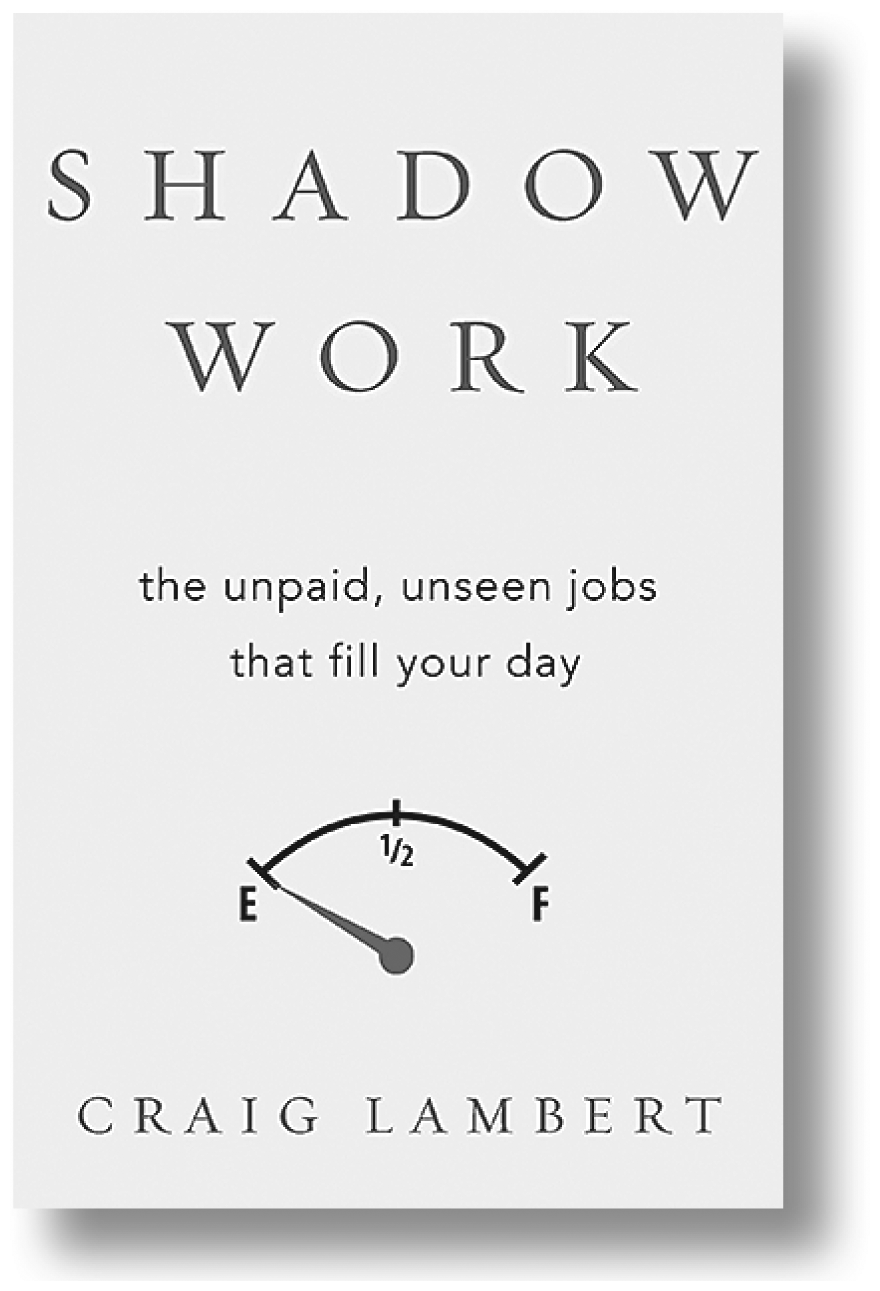
Shadow Work: The Unpaid, Unseen Jobs that Fill Your Day Craig Lambert Berkeley: Counterpoint, 2015 277 pages.
Experts point to both the stock market and housing prices to suggest that the United States has technically climbed out of the Great Recession. However, it is a “jobless recovery” as the job market continues to lag in terms of jobs created as well as wages. Claiming that the job market is lagging implies that it is destined to catch up with other economic indicators. But what if this is an overly optimistic perspective? What if current statistics are really harbingers of a future with far fewer paying jobs?
The issues raised by these questions are dealt with, at least implicitly, in two very important books on the post-Recession economy: Martin Ford’s Rise of the Robots and Craig Lambert’s Shadow Work. Both suggest ever-more joblessness in the future.
Ford deals with the effects of automation and artificial intelligence on the workforce. He recognizes that these technologies have been uniquely disruptive in the United States, resulting in the loss of millions of semi-skilled and un-skilled routine jobs, but Ford warns that the worst is yet to come. He believes that the effects of technological change will be truly staggering as more and more highly skilled workers in non-routine jobs are replaced by “machines …that are [themselves] turning into workers” (vii).
Both Martin Ford’s Rise of the Robots and Craig Lambert’s Shadow Work suggest ever-more joblessness in the future.
In contrast, Lambert’s focus is on “shadow work,” which he defines (on the book jacket) as “all of the unpaid tasks we do on behalf of businesses and organizations” and (in the book itself) as the work we do “outside our jobs” (22), but “generally for some profit-making purpose” (269). He is not primarily concerned with the impact of shadow work on joblessness. Rather, he is interested in the sociological issues associated with shadow work, such as increasing atomization and anomie, loss of spontaneity, decline in human contact, and the disappearance of true leisure.
Unlike Ford, Lambert does not directly address the full impact of automation on joblessness. Nonetheless, the linkages between shadow work, automation, and job loss are clear in many of his empirical examples.
For instance, he notes that recent technological changes have made it possible for many of us to accomplish tasks on our own without the assistance of paid workers. In this sense, we all do digital shadow work when we take online courses without directly interacting with teachers, when we shop online without using retail workers, and when we book our airline tickets without relying on travel agents. Other forms of shadow work occur in the material world, using ATMs, 3-D printers, self-service in fast food restaurants, self-check-in at airports and hotels, and self-monitoring of medical conditions. The key point is not simply that automation is eliminating paid jobs, but that it is also doing so by enabling the creation and the increasing utility of mostly unpaid shadow work.
Neither of these books offers a comprehensive account of joblessness in the post-Recession world: Ford has no sense of shadow work. and Lambert has only a limited understanding of the role of automation in job loss. So what might a more comprehensive theory look like?
First, it would need to make absolutely clear that automation, on its own, is a major cause of joblessness at all levels of the occupational hierarchy, as I argue in a forthcoming article in the Journal of Consumer Culture.
Second, it would need to recognize that job loss will continue at the lower end of the occupational spectrum. With many fewer paid employees, customers will almost certainly be asked to do ever-more shadow work. The fast food industry is a classic example; now we even see the use of tablets that allow customers to order their food, resulting in job loss among waitpersons and counterpersons. As Ford shows, the process goes beyond orders: Momentum Machines has developed a robot capable of producing 360 hamburgers an hour. It shapes the burgers (from fresh, not frozen, ground beef), grills them to order, “toasts the bun and then slices and adds fresh ingredients like tomatoes, onions, and pickles.” The burgers “arrive assembled and ready to serve on a conveyor belt.” Tellingly, the company’s co-founder says: “’Our device isn’t meant to make employees more efficient… It’s meant to completely obviate them’” (Ford, 12; italics added).
Third, it is important to point out that advanced, often automated technologies will increasingly make their way up the occupational hierarchy, leaving much job loss in their wake. Such technologies will create new possibilities (as well as new demands) for shadow work. At the lower end of the occupational hierarchy, shadow workers associated with Uber are creating chaos in the taxi industry, and more and more taxi drivers will lose their jobs as a result. It is possible that in the not-too-distant future, Uber drivers will, themselves, be supplanted by autonomous, driverless cars picking up passengers. At the upper end of the occupational structure, the Uberization of higher education takes place when massive online open courses (MOOCs) are taught by a handful of superstar professors at elite universities, reducing the need for full- and part-time professors, instructors, and teaching assistants.
Fourth, just as automation operates on its own to create joblessness, shadow work can cause joblessness unmediated by automation. For example, as supermarket customers become increasingly accustomed to operating in a do-it-yourself economy, they shun the help of workers who offer to help them by carrying their packages to their cars. This will likely lead supermarkets to hire fewer such workers in the future.
In summary, beyond discussing the independent impact of automation and shadow work on joblessness, we need to sort out the complex interrelationship between these two causal forces in producing an increasingly jobless future. Only then will we be able to think about the real nature and extent of the looming disaster in the work world.
Dealing only with the impact of automation, Ford suggests reforms, such as giving everyone a basic income guarantee and, at age 18, a diversified portfolio so that those who will no longer be able to find paid work will be able to become (mini-) capitalists. Such suggestions are either unlikely to get much support in today’s political climate or will serve to further buttress a capitalist system which can be seen as a source of increasing joblessness with its relentless pursuit of lower costs and higher profits through increasing automation and shadow work. While these may not be the optimal solutions to joblessness, we clearly need to give far more attention to what to do about the problem as the pace of automation accelerates and more and more paid work becomes shadow work.
The two books operate with old-fashioned, binary thinking and are in need of a more integrative approach and concepts such as prosumption.
These books, like most literature on the economy, have a productivist bias focusing on jobs and work. In fact, Lambert outrageously claims that “work is the main event” (5), even though the vast majority of the American economy is accounted for by consumption and not work. The two books also operate with old-fashioned, binary thinking and are in need of a more integrative approach and concepts such as prosumption (the combination of production and consumption in a single process). In fact, almost all of Lambert’s examples of shadow work are not work at all, but are better seen as prosumption. Automation is a key factor in the increasing importance of prosumption and of the job loss associated with it. Furthermore, it can be argued that we are living in the era of “prosumer capitalism” in which the exploitation of the largely unpaid prosumer is seen as preferable to, and is gradually replacing, the exploitation of paid workers (as I explored in a 2015 Sociological Quarterly article). This is clearest now in the lower reaches of the occupational hierarchy, but it is rapidly making its way up.