Abstract
The authors explore how newspaper articles engaging seven publicly prominent social science ideas develop from ideas in the public to public ideas when mediators and interpretants use them, and oscillate between these uses as part of an unfolding career.
Keywords

An existential question for those of us who conduct social science research is, “Does our work make a difference?” In our reflective moments, it is easy to wonder if anyone outside of academia pays attention to what we discover about the social world. Finding better ways to communicate our ideas to the general public is a crucial issue—in order to make a difference, social scientists must first be heard. Nevertheless, the gulf between social scientists and the public can be hard to bridge. Contexts magazine was created to provide such a bridge, and that effort remains central to its mission.
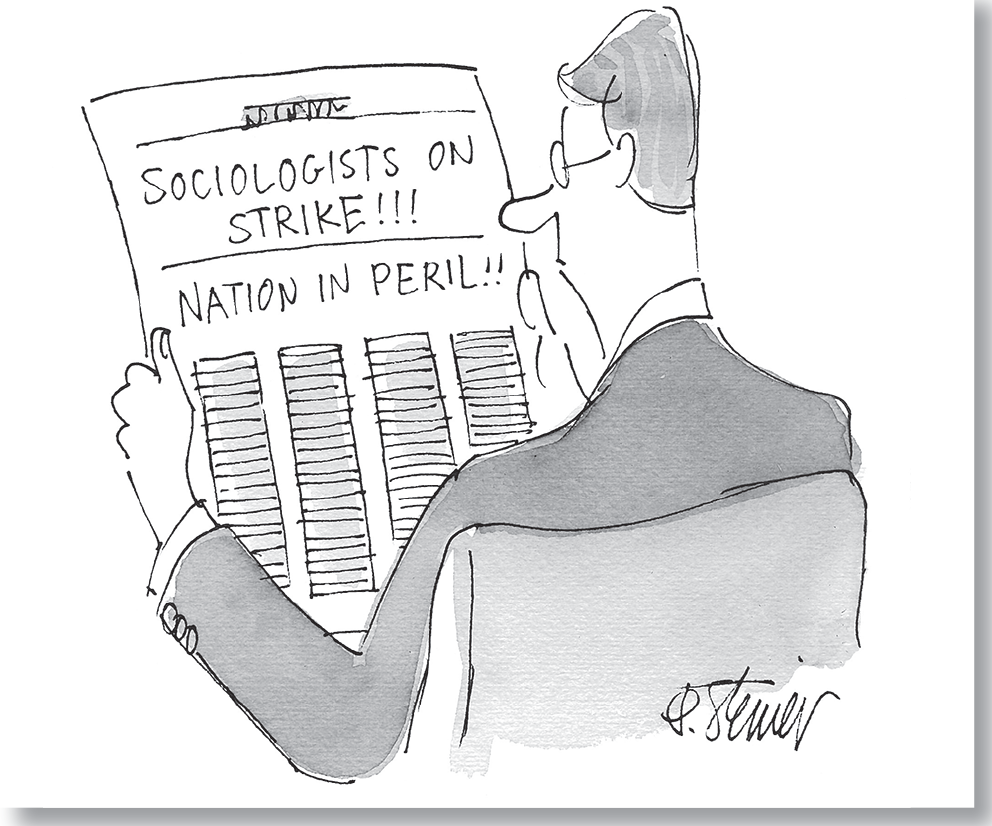
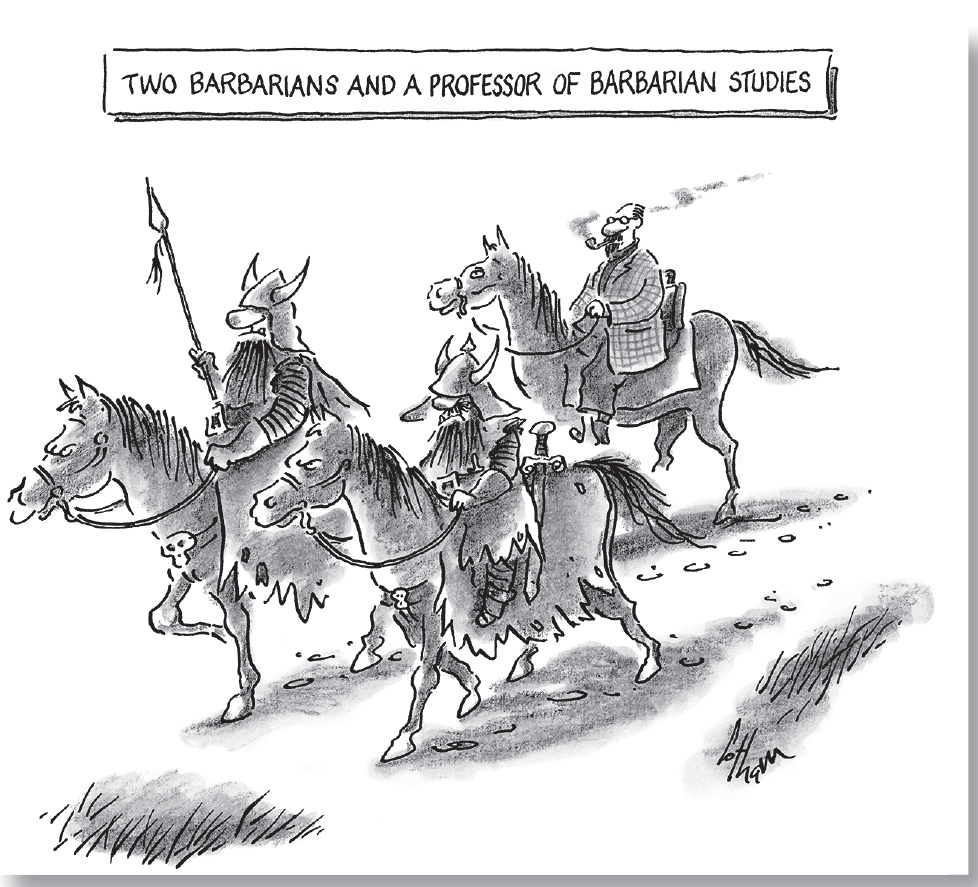
However, despite such efforts, the “Ivory Tower” perception endures and is often fodder for humor that delights the public at the social scientist’s expense. The New Yorker has published enough cartoons on the topic to—quite literally—fill a coffee table book. As much as social scientists like to think that we are in on the joke, so few of our ideas flourish once they make the leap from The Ivory Tower to the public arena, it may be that the joke is on us.
What, then, are public ideas, and how do social science ideas become public ideas? These questions are central to the practical utility of social science, but they are difficult to answer. We know that ideas can spread to the public “from the top down” (for example, through prominent book reviews, press coverage, op-ed pieces, or participation in prestigious policy centers) as well as “from the bottom up” (through introductory classes, textbooks, and social media). Yet our understanding of these processes can benefit from empirical evidence of how ideas transition from simply being in the public to being readily used to make sense of the world as public ideas. This evidence could both advance a sociology of public social science and, ultimately, enable scholars to improve their engagement with the public.
To demonstrate what a sociology of public social science could offer, we studied one prominent line of communication between academia and the public—traditional newspaper coverage. Our goal was to identify which ideas actually made it into the public (via newspapers), investigate how they were put to use, and how this use changed over time. Thus, the focus of our analyses was on the “publification” of ideas: the social processes that ideas go through after publication, especially the transition from being an idea in the public to becoming a public idea. (Pro Tip: If you would like your ideas to be translated into the public realm, coining an awkward term like “publification” is probably not the way to go).
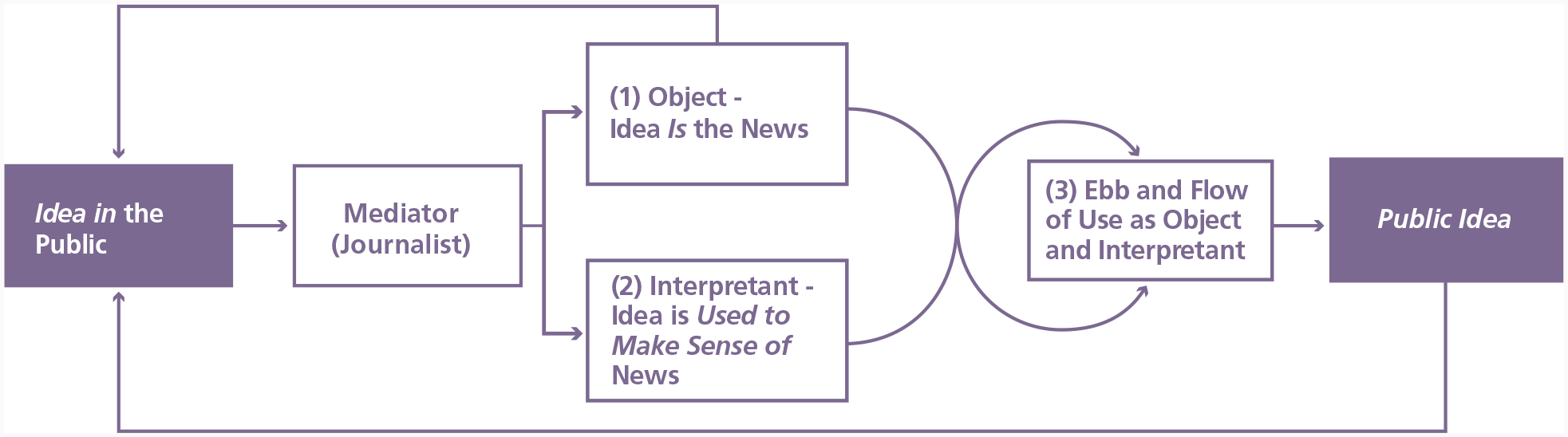
Our research identifies three components of the publification process: (1) The ideas are used by mediators (e.g., journalists) as an object (being the news), (2) they are used as an interpretant (making sense of the news), and (3) they ebb and flow between these uses as part of an unfolding career. The findings have important implications for the public accessibility and endurance of social science ideas.
The Study: Identifying Newspapers and Ideas
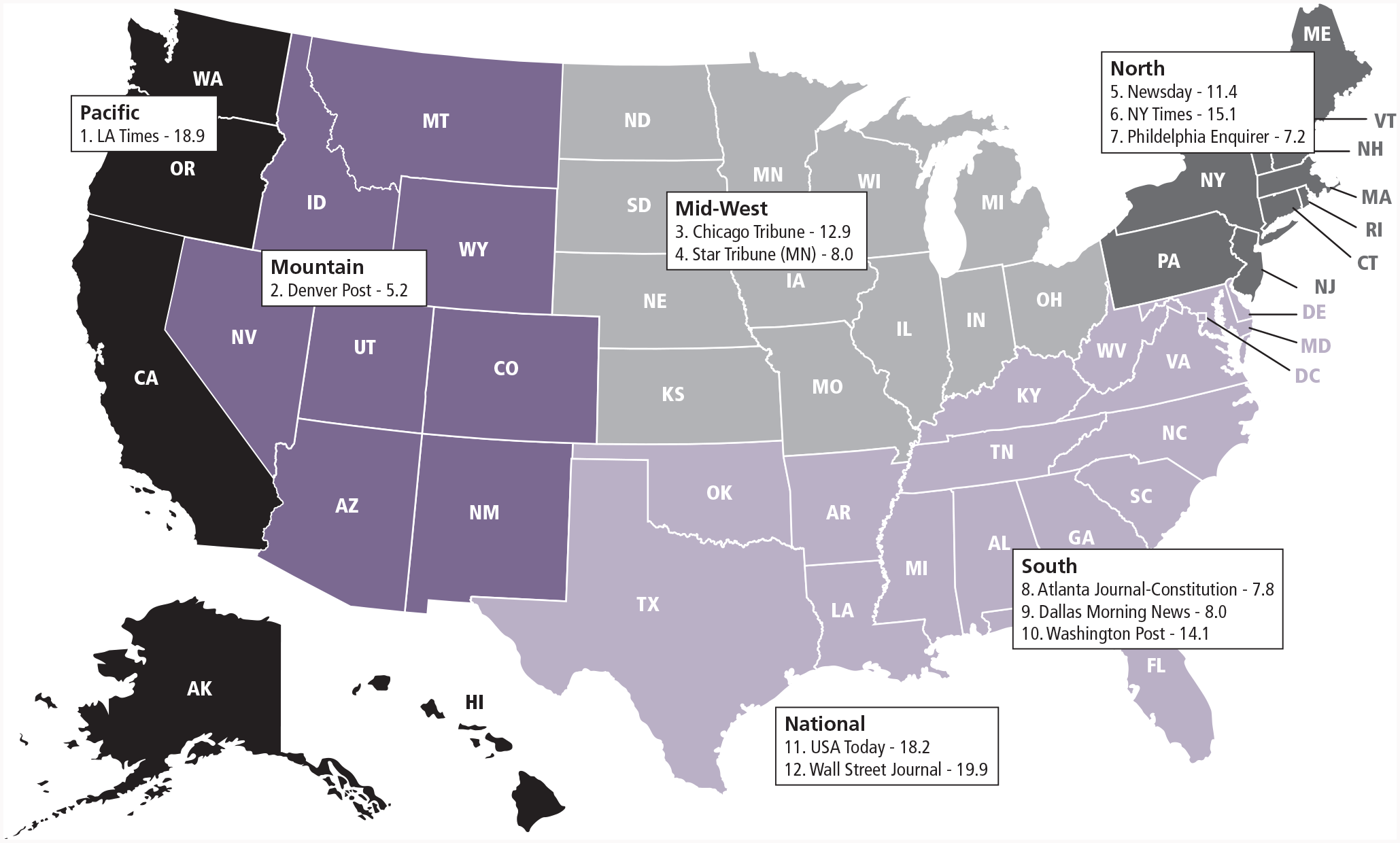
One of the first steps in our research involved selecting which newspapers to examine. To do so, we prioritized geographic spread and circulation. The final sample includes 12 newspapers. Region, Newspapers, and Readership illustrates the regional headquarters and readership (in 100,000s) of each newspaper.
This cartoon first appeared in the September 2003 edition of The New Yorker.
© Frank Cotham, used with permission
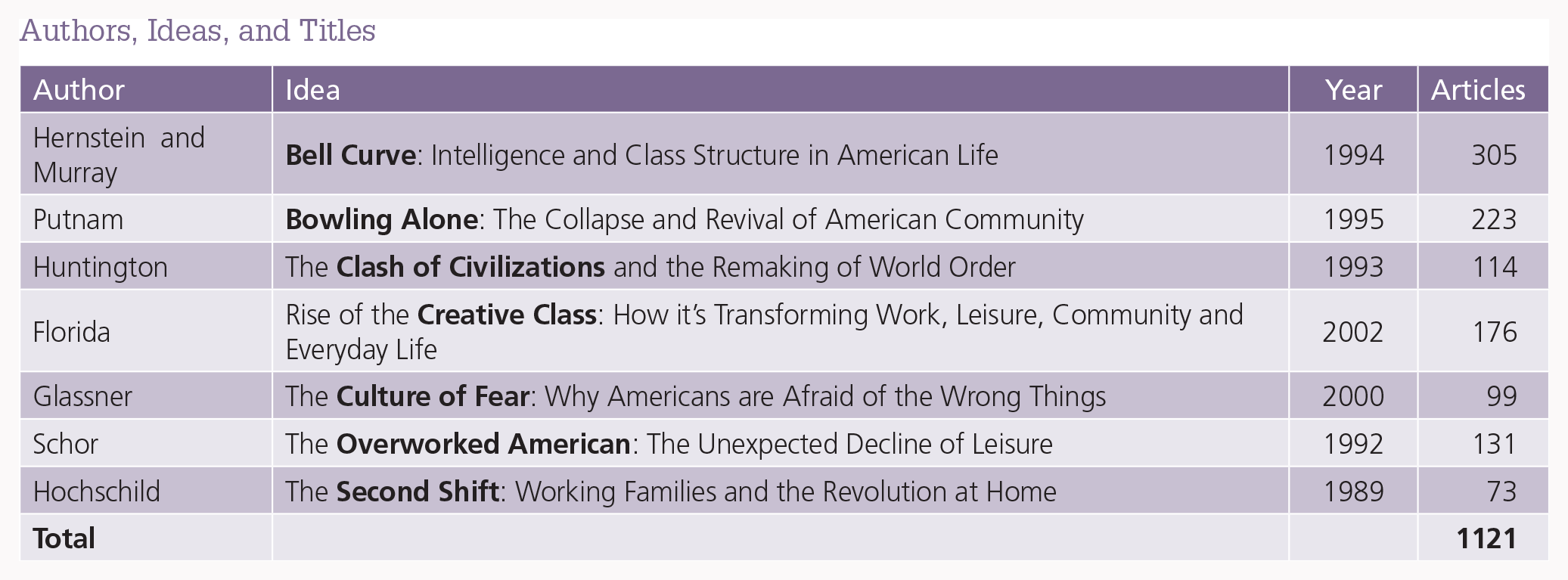
Another step involved the identification of prominent social science ideas, ideas which we could then examine as they appeared in these twelve high-circulation newspapers during the 10 years following the first publication of the idea. The ideas are “bell curve,” “bowling alone,” “creative class,” “clash of civilizations,” “overworked American,” “culture of fear,” and “second shift.” The table on page 49, Authors, Ideas, and Titles, illustrates the full titles containing each idea, their authors, the year they were published, as well as the total number of article hits each idea received in the newspapers.
The ideas we included in our sample are likely familiar because they did indeed make it into the public. The “bell curve” idea holds that different racial and socioeconomic groups are naturally positioned above or below the average intelligence of the nation, leading to divergent social and economic outcomes. “Bowling alone” is a metaphor for Robert Putman’s argument that social connectedness in America has declined over the past 40 years, leading to increased individualism as well as an erosion of civic engagement. “Creative class” interprets urban renewal through the lens of a particular demographic: diverse, tolerant, young professionals in creative industries. “Clash of civilizations” posits that a new paradigm has arisen to replace the East (Soviet) versus West (United States) paradigm of the Cold War. It involves conflict between the West on the one side and Islamic states, Confucian States, Japan, East Asia, and former Soviet nations on the other. “Overworked American” holds that, despite unprecedented advances in timesaving technology, Americans are working more as they become enveloped in a cycle of increased spending. “Culture of fear” encapsulates the idea that Americans are increasingly afraid and have been persuaded by politicians and the mainstream media to fear the wrong things, distracting them from the real problems affecting society. Finally, “second shift” refers to the unpaid labor that working women endure when they return home from the workplace.
Region, Newspapers, and Readership
It is worth noting that the titles of these works are the very ideas they promote. This suggests that “publification” is facilitated when ideas can be encapsulated and titled in a few catchy words. However, publification entails processes that are beyond the scholars’ control, and are shaped, in large part, by how other actors utilize the ideas.
The Publification of Ideas
The initial appearance of the social science ideas in the newspapers, what we call their “initial hits,” are critical because they ensure that the idea is available in the public to be retrieved and used in the future. With this, the publification process begins as the ideas are available for use by mediators who write news stories. Our analysis of the 10-year career of the seven social science ideas across 12 newspapers revealed three subsequent components to the publification process: (1) The ideas are used by mediators (e.g. journalists) as an object (being the news), (2) they are used as an interpretant (making sense of the news), and (3) they ebb and flow between these uses as part of an unfolding career (See The Publification Process on page 50).
Object—The Idea is the News
First, in one stream of use, journalists and other mediators comment on the idea primarily as an object of interest. In this stream the idea is the news, which is common in the early stages of their careers. Each time an idea is used as an object, it loops back to keep the idea in the public, thus extending its career. For example, the ideas often appear in the public via lists of bestsellers. They also appear in book reviews and opinion pieces that explore the idea as a focal object. Take for example this review in a 1992 Wall Street Journal article, where the idea of “the overworked American” is the centerpiece of the article: Whatever happened to the four-day workweek? The one the experts predicted more than 30 years ago. It was just over the horizon, they promised. It was to be a socioeconomic freebie, a byproduct of scientific achievement. America’s labor-intensive factories inevitably would be transformed into gleaming electromechanical wonders… The fate of this pipe dream is unsparingly documented in Juliet B. Schor’s “The Overworked American: The Unexpected Decline of Leisure.”
In news articles such as this, the idea is the topic of interest: the idea itself is the news, and this is an important part of the publification process.
Authors, Ideas, and Titles
Interpretant—The Idea is Used to Make Sense of the News
A second stream of use is characterized by mediators employing the idea to make sense of the news over time. We call this type of use an “interpretant.” Use as an interpretant is key to becoming a public idea (and not simply an idea in the public). It likewise serves to refresh the cultural archive, again creating a looping effect that keeps the idea in the public, extending its career. One type of interpretant occurs when the author of a news story retrieves an idea to create an understanding of a major event of national or international significance. In our sample, this occurred most dramatically in the aftermath of the 9/11 attacks on the World Trade Center. The events of that day reverberated around the globe and created a shocking new reality. Many writers retrieved “clash of civilizations” as a means of reflection. Take, for example, the following Los Angeles Times article: Little is more vital in the months ahead than retaining the support of moderate Muslim states… It is essential that we take no drastic actions that would please our own fire-eaters but would drive Arab states into the arms of the terrorists. The Harvard political scientist Samuel P. Huntington wrote a provocative article in Foreign Affairs some years ago forecasting a “clash of civilizations” that would determine the future. The Bush administration has no greater challenge than disproving Huntington. If we let the international police action against terrorism degenerate into a civilizational war of the West versus Islam, we are heading toward catastrophe.
In this example Huntington’s idea provided a foil to make sense of 9/11, and a means to ponder and debate how to move forward amid the unprecedented turmoil created by the attack.
The ideas in our sample are also used to make sense of phenomena that are more local in scope, or mundane in implication. Take for example, the use of “bowling alone,” as reported in a 2002 Atlanta Journal-Constitution article, to interpret the establishment of a website, meetup.com: Heiferman, 30, who created an online advertising agency when he was 22 and later sold it, says he was inspired to start meetup.com after reading Robert Putnam’s book “Bowling Alone: The Collapse and Revival of American Community.” In the book, the Harvard government professor says the nation has suffered “a major, almost catastrophic, decline in connectedness” since the 1950s, in part because of long commutes and the pervasiveness of television. “People watch TV and work more and are more stressed out and their lives are generally reported as not as satisfying,” Heiferman said. “The Internet is a great way for people to connect with people all around the world.”
The article applies “bowling alone” to re-conceptualize the everyday activity of creating a website in terms of its curative implications for the mental health and social connectedness of the population. The concept illustrates the flexibility-of-the-idea- in-use, and its position as a public idea.
Finally, some mediators flex the idea itself through creative use. Take, for example, this 2006 USA Today article about people going shoeless: Being barefoot is symbolic to a great degree of the informality in our society. The person who hit the nail on the head is Richard Florida in The Rise of the Creative Class. With creative people, you get a certain amount of latitude, and it gets expressed in how we dress and how we live.
In his research on urban revival, Florida never measured tolerance towards bare feet. Nevertheless, this writer retrieves the creative class idea to interpret the phenomenon.
These four examples illustrate the ideas’ uses as objects and interpretants. Typically, over the career of a public idea, its usage ebbs and flows between object and interpretant. We elaborate on this process in the following section, which examines the publification of a single idea, “culture of fear,” as an object and an interpretant throughout its 10-year career.
Culture of Fear
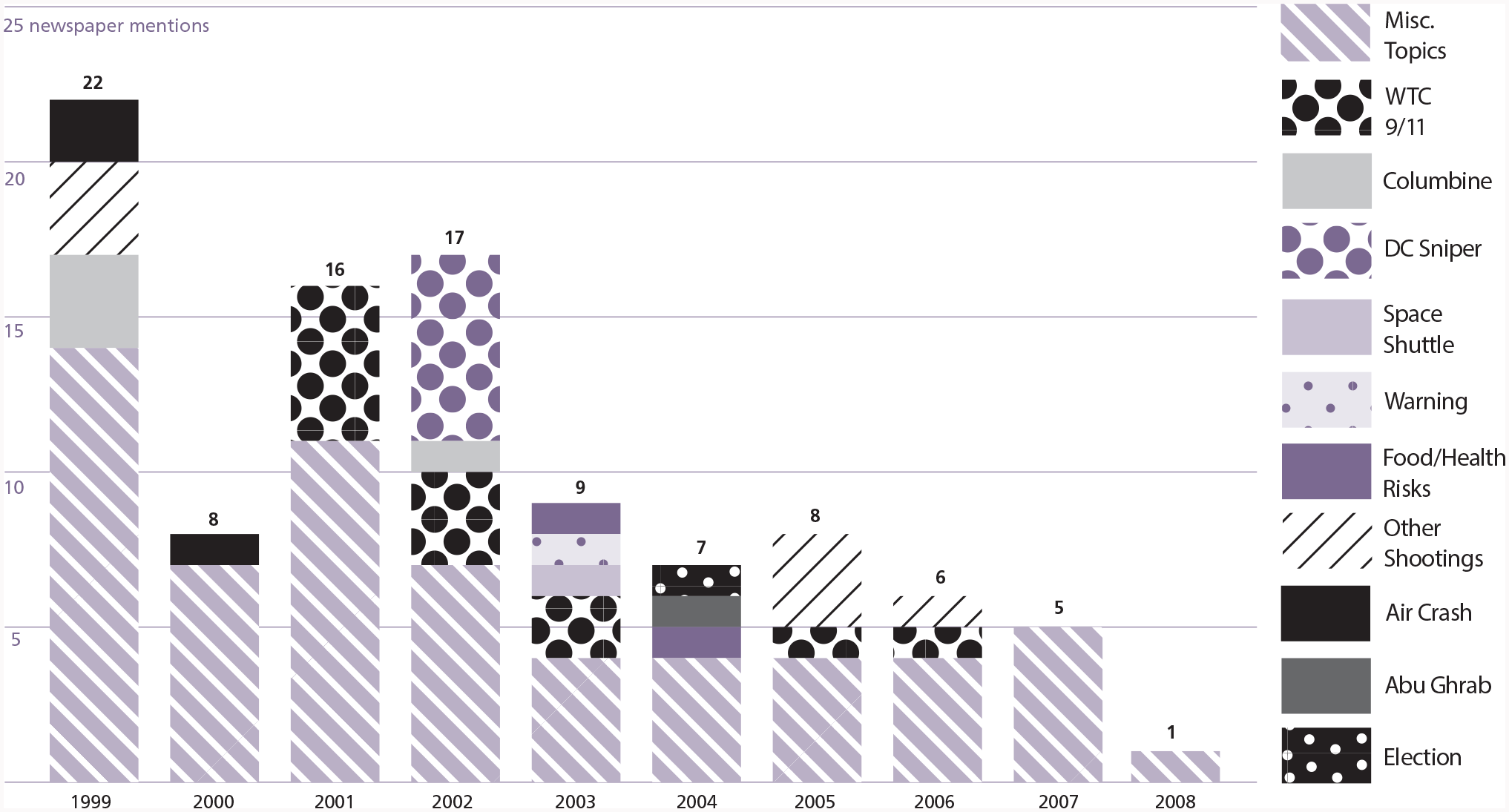
The “culture of fear” idea first appeared in Glassner’s book The Culture of Fear: Why Americans are Afraid of the Wrong Things. During its 10-year career, the idea usage ebbed and flowed between object and interpretant. Indeed, it was used by mediators to interpret a range of topics as diverse as food and health to the Abu Ghraib controversy (See The Publification Process).
The Publification Process
When the idea first appeared in 1999, it received 22 mentions across 10 newspapers in our sample. The 22 mentions combined usage as both an object—for example through book reviews—and interpretant. As its publication coincided with the shootings at Columbine High School, three of the articles used it to try to make sense of that tragedy. However, the idea was also used to comment on miscellaneous topics such as a child’s nightmares, as seen in this 1999 article from the Chicago Tribune.
Desmond’s 4th-grade teacher is reading scary Halloween stories and Desmond is spooked. How can parents Yvonne and Doug calm his fears? Ideas come from University of Southern California sociology professor Barry Glassner, author of “Culture of Fear”: “One of the tasks of childhood is to feel confident and competent,” Glassner explains. “But it’s hard to develop those senses in a culture of fear. The difficulty for many parents these days is that they themselves don’t feel they live in a safe world.” Glassner urges parents to convey to their children that their homes, schools and communities are safe and secure.
The mediator used the idea in a novel way that allowed its flexibility-in-use to be seen by the readers. Although the number of mentions fell to eight in six newspapers in 2000, the events of 9/11 and the D.C. sniper attacks fostered a revival. In 2001, “culture of fear” was retrieved 16 times across six newspapers, and in 2002 the culture of fear idea was retrieved 17 times across six newspapers. Three of those articles were about 9/11, and six focused on the sniper attacks. The following excerpt is from a 2002 Washington Post article, reflecting on public reaction to the sniper attacks.
“The normal reaction is to cower and hide and people who don’t have that reaction initially probably have more reason to question their response than those who do,” said Barry Glassner, a professor of sociology at the University of Southern California and the author of the book The Culture of Fear. “But that’s just the initial reaction. At some point, the question becomes, ‘Where do we go from here?’ The answer, he said, generally comes from leaders of area schools and local governments… “It’s only when public opinion changes with regard to whether children should be in school that I would expect decision- makers to do something other than continuing a lockdown,” Glassner said.
This mediator used the idea to ask his readership to think about the sniper in broader terms of how authorities deal with these incidents and how that affects public perception. In doing so, he extended the life and scope of the idea. From 2003 to 2007, the idea was retrieved 35 more times as both an object and interpretant.
Overall, the 10-year career of “culture of fear” is one of initial concentration followed by steady dispersion and leveled decline. It was used as both an object and interpretant for a wide range of topics. Furthermore, it ebbed and flowed between these two uses in the 10 years following its publication. Through this process of publification, “culture of fear” transitioned from being an idea in the public to a public idea. Although there is some variation in our sample of seven ideas in terms of timeline, peaks, valleys, and when and how the ideas are used as objects and interpretants, all of the ideas exhibit this general publification process. Importantly, much of this process is beyond the control of the scholar. However much they might attempt to package the idea for the public, ultimately the process depends on mediators such as journalists, who actively use the ideas to make sense of news events. If not random, these news events are spontaneous and hard to anticipate, be they school shootings, terrorist attacks, presidential elections, or smaller, more mundane events that nevertheless beg for interpretation.
Ideas in the Public to Public Ideas
Social science ideas become public ideas as they go through a publification process, and our goal has been to identify this process such that, ultimately, we can learn from a sociology of public social science to better engage the public. As a starting point, we have focused on traditional media in the form of news- papers, and in order to examine the use of ideas over time, we have focused on ideas which, through present eyes, may seem old. There is much more to be done in terms of online media and recent ideas. We hope that others will follow our call, not only to do research that is relevant to the public, but also to develop a sociology of public social science. We make this call because the stakes are high: The quest for social science ideas to be relevant, accessible, and enduring is also a quest to understand the mission of academic activities. In an era in which academia is under attack, and public skepticism about social science is high, public ideas have even greater import. If we want our ideas to leave the Ivory Tower and be heard by a broader audience, and if we want our ideas to be newsworthy objects of interest and used to make sense of the world, then it is worth understanding how our ideas are put to use in the public and the processes through which they develop over time.
Topics Covered in the 10-Year Career of “culture of fear”
This cartoon, originally commissioned by ASA, first appeared in The Sociologist’s Book Of Cartoons.
© Peter Steiner, used with permission