




Abstract
The impact of political events on media’s conflict coverage prism is widely established. To assess the role of mounting tensions between Muslims and non-Muslims in Europe in 2013–2014 on German media’s coverage prism of Muslim-related conflicts, this article compares coverage of the 2008 and 2014 Israeli military operations in Gaza by three major German newspapers. The empirical analysis indicates a dramatic rise in the use of religious terms in 2014, most notably in conservative newspaper Die Welt, and offers evidence of a shift from politics-centered framing of the 2008 Gaza operation to a more religious-centered framing of the 2014 Gaza War. We discuss wider implications of the findings, including their support for the relevance of the clash-of-civilizations theory to contemporary media’s conflict coverage modus operandi.
The impact of various political events on the paradigm within which journalists report on conflicts is a central issue in political communication studies. Several studies have established that major political developments and events can play a role in affecting journalists’ reporting prisms and sometimes even contribute to journalists’ paradigm shifts. Well-known examples of these studies include analyses that identified the impact of the 1967 Six-Day War on the transformation of Israel’s image in the global media from David to Goliath (Philo & Berry, 2004), through the role of the1968 Tet offensive in transforming US media coverage from expressing a supportive to a critical view of the Vietnam War (Hallin, 1986), continuing with the impact of the end of the Cold War on journalists’ embrace of a fresh global perspective (Volkmer, 1999), to the media polarization prism influenced by 9/11 (Kellner, 2002). In light of mounting tensions between Europe and the Muslim world in the past decade, this study aims to contribute to current knowledge via an analysis of German media’s coverage of conflicts that involve Muslims and the potential impact of these tensions on the nature of German media’s coverage of conflicts involving Muslims. To evaluate the potential role of such tensions in the framing of Muslim-related conflicts, in our case study we compare German newspapers’ coverage of the Israeli operation in Gaza in 2008 with that of the 2014 Gaza operation, the latter taking place against a backdrop of mounting tensions and the establishment of Pegida, the anti-Muslim Patriotic Europeans Against the Islamization of the West organization (in German, Patriotische Europäer gegen die Islamisierung des Abendlandes) in Germany.
The motivation for the study, then, is the fact that tension between Europe and the Muslim world has risen in the past decade, surrounding issues such as what are perceived as anti-Muslim European laws (banning of hijab in public in some European countries and a ban on the construction of new minarets in Switzerland) and European frustration at the success of the Islamic State in Iraq and Syria (ISIS) in persuading European Muslims to leave their homeland and join the organization’s operations in the Middle East and beyond. In the case of Germany, several events exacerbated tensions with the country’s Muslim population, including the 2010 ban on the Turkish-German international aid association Internationale Humanitäre Hilforganisation (IHH) on grounds of its use of donations to support projects in Gaza that are related to Hamas, which has been designated a terrorist organization by the European Union; an official decision forbidding Muslim teachers from wearing headscarves in public schools; and most obviously, ISIS’ operations and recruitment of German-Muslims. Concerns over the “Islamization” of Germany and Europe were also demonstrated by the large gain of populist and extreme right parties in Germany and Europe. Although the Alternative for Germany (AfD) was not as successful as the Front National in France, still it obtained more than 7% of the votes, after failing to pass the necessary threshold in the 2013 national elections. The election results for the European Parliament in 2014 gave an indication of the growing negative perceptions of the Muslim minority in Germany (Lopatin, 2016; see also Samuel-Azran, 2016).
Importantly, the heightened tensions between Germany and Islam in 2013–2014 are vividly reflected in public opinion polls that surveyed German people’s agreement with the 2010 statement of then-President of Germany Christian Wulff that “Islam belongs to Germany.” While in 2010 Germans were almost equally divided in their agreement with this statement (49% agreed and 47% disagreed: “Für die meisten,” 2016), only 19% of Germans agreed with this statement in a 2013 survey by the University of Bielefeld (“Why Germans distrust,” 2013). Another follow-up survey in 2014 confirmed that the majority of Germans disagreed with the former president’s statement (“Jeder Zweite lehnt,” 2014).
Accordingly, this study aims to examine whether the rising tensions between Islam and Germany are reflected in the terminology used by the German media in recent years to describe Muslim-related conflicts worldwide. To examine the impact of these tensions on the media’s reporting prism of Muslim-related conflicts, our case study will focus on media reports of the Israeli–Palestinian conflict, a protracted conflict that allows a comparison of media coverage of a Muslim-related conflict during periods of relative calm versus the more recent period of heightened tension. Specifically, the fact that Israel operated a military campaign against the Palestinians in Gaza following bombing of Israeli cities in both 2008 and 2014 and that the 2014 conflict coincided with the establishment of Pegida and rising anti-Islam sentiment in Germany, as indicated by the surveys mentioned above, offers a good foundation for a comparable analysis of the German media’s reporting prisms of Muslim-related conflicts in these two periods.
This study compares the coverage of the 2008 and 2014 Gaza campaigns specifically via analysis of the frequency of 5 religion-related terms (religion, Islam, Islamist, Jew, and anti-Semitism) versus 22 common political non-religion-related terms in the coverage of both campaigns. Accordingly, our research question is, “What terminology was used by German newspapers Die Welt (DW), Süddeutsche Zeitung (SZ), and Frankfurter Allgemeine Zeitung (FAZ) in their coverage of the 2008 and 2014 Gaza campaigns?”
This study aims to contribute to political communication as well as the international relations literature. To the political communication realm, it hopes to contribute to an evaluation of classical political communication theories regarding the modus operandi of the media covering foreign conflicts; to the international relations literature, it specifically aims to assess the relevance of the clash-of-civilizations thesis to contemporary news coverage.
The political communication prism: the media and the political environment
Most political communication studies on the sociocultural and political factors that affect media coverage have been conducted in the United States, where scholars are overall in agreement with the administration’s overwhelming power in influencing media reporting. The major debate between the three main theories—hegemony, indexing, and cascading activation—remains regarding the extent of such control. Hegemony theorists assert that although government officials are sometimes in conflict, there is stable, overall agreement, and even a state of harmony, on “first principles.” This consensus on “first principles,” they argue, prevents essential information from flowing to the public, produces propaganda, and subsequently generates public consent (Herman & Chomsky, 2002). In a similar yet less dogmatic manner, the indexing approach views media reporting as a reflection of elite debates. This theory was developed following Hallin’s (1986) findings that the US media followed governmental cues during the Vietnam War. Based on these findings and his own empirical research of media coverage of the congressional policy on Nicaragua over a 4-year period, Bennett (1990) developed the indexing hypothesis, which argues that the news is “indexed” to the range and dynamics of governmental debate with only minor reference to expressed public opinion. Thus, according to indexing theorists, the media follow (rather than, as we would expect, is independent of) elite debate and do not initiate critical analysis of White House policy unless it is first voiced by members of the government. For Bennett, journalists and media owners might consciously choose to “index” issues under the impression that, since the government represents its electorates, the government’s definition of reality represents the variety of voices within democracy. Importantly, both hegemony and indexing theorists agree that public opinion and polls play a limited role in media coverage. In contrast, the cascading activation theory (Entman, 2003) suggests a looser link to governmental cues, recognizing that cues are conveyed from the government to the media but then continue to trickle down to the public, which, in turn, feeds cues back up to the media and then to the highest echelons of government via public opinion polls and surveys.
However, studies have found that the above-mentioned theories do not necessarily apply to other countries and political systems (Wolfsfeld, 1997). In accordance with the perceived link between political systems and the media–political environment interplay, Hallin and Mancini (2004) conducted a global study of the political environment’s impact on media coverage and developed three models of media–politics relations: (a) the Mediterranean or polarized pluralist model, characterized by strong state intervention and periods of censorship, which was found applicable to France, Greece, Italy, Portugal, and Spain; (b) the North Atlantic or liberal model, characterized by strong professionalization and non-institutionalized self-regulation, which was found applicable to Britain, United States, Canada, and Ireland; and (c) the North/Central Europe or democratic corporatist model, to which Austria, Belgium, Denmark, Finland, Netherlands, Norway, Sweden, Switzerland, and Germany, the subject of this study, belong. The liberal model is characterized not only by strong professionalization and institutionalized self-regulation but also by strong state intervention (though with protection of press freedom), press subsidies, and public-service broadcasting. In a similar manner to the cross-national comparison and classifications of political systems, Esser (2008) also classified the cultural–political context of various countries and concluded that Germany’s mix of private- and public-sponsored media does not operate in a strongly interventionist environment, such as the US environment, or under a non-interventionist approach as in France, but rather somewhere in the middle, representing a moderately interventionist Anglo-German model. As a result, analyses of German media behavior are less predictable.
The international relations perspective: the clash-of-civilizations theory and the news media
The 9/11 attacks in 2001 strained relations between the West and the Muslim world, while several other events created Europe-specific tensions with the Muslim world. France’s decision in the early 2000s to ban conspicuous religious objects from French public primary and secondary schools triggered a furious response from the Muslim world: for example, Al-Jazeera, the leading network in the Arab world, launched a campaign against the decision (Cherribi, 2006), while European governments widely supported France’s decision to protect its secularism. Tensions were further heightened when Danish daily Jyllands-Posten famously printed 12 cartoons of the Prophet Mohammad in an article entitled The Face of Mohammad (30 September 2005). The publication sought to take a proactive stance against an overbearing consensual fear of offending Islam. The cartoons sparked outrage among members of the Islamic community, who considered the cartoons offensive and in violation of Islamic law, which forbids any pictorial representation of the prophet. What began as a largely unnoticed editorial quickly spiraled into an international scandal that triggered a controversial media debate on the freedom of expression and its limits. At the same time, for many, the editorial represented a civilizational conjecture centering on Islam and its compatibility, or rather incompatibility, with foundational Western values. Next, in November 2009, another West versus Islam incident was triggered in Europe when Switzerland passed a law (that would become part of its constitution) prohibiting the construction of minarets (the prayer towers of mosques).
Although the so-called Arab Spring revolts raised hopes for the emergence of democracy in the Middle East, their failure (expressed in the return of autocratic rulers in several countries and chaos in others; Pfeffer, 2016) further flamed existing Europe–Islam tensions. More notably, the rise of ISIS and its impact on Europe, and specifically the organization’s ability to successfully attract Muslim citizens in Europe and persuade them to abandon their countries and fight in Middle East wars in the name of Islam as part of a broader design to establish a global caliphate, were, for many, detrimental proof of the failure of European multiculturalism.
All these events fueled animosity between Muslims and the West, both in the United States and in Europe. In Europe, a clear illustration of anti-Muslim sentiment (beyond the traditional extreme right-wing parties) is the rise of Pegida. During the 2014 Gaza War examined here, Pegida organized demonstrations in Germany against what it called the “Islamization of the Western world.” Importantly, offshoots of Pegida were established in various European countries, suggesting that the trend identified in the German media in this study is indicative of changes that are taking place in other European countries.
Since 9/11, various voices have pointed to the relevance of Huntington’s clash-of-civilizations thesis for understanding Western media coverage of conflicts involving Muslims (Bantimaroudis, 2015). In the post–Cold War era, political scientist Samuel P. Huntington (1996) outlined his thesis on the clash of civilizations, in which he predicts how the post–Cold War era will comprise a world divided into seven or eight major civilizations—Sinic, Japanese, Hindu, Islamic, Orthodox, Western, Latin American, and possibly, African civilizations—each defined by a shared religion and culture. Conflict is predicted to develop as a result of direct clashes between these civilizations, most commonly on the fault lines or the borders at which civilizations meet (such as conflicts over the freedom to wear a hijab, as described above). Specifically, Huntington predicted that conflicts will mostly arise from Islamic resistance to the West’s determination to universalize its own values and culture.
Huntington’s thesis attracted wide criticism and wide support. Two notable critics are Noam Chomsky and Edward Said. Chomsky (2001) argues that the clash-of-civilizations paradigm is simply a pretext to justify the massive US military budget in the post–Cold War environment. Said (2001) criticized Huntington for formulating highly generalized labels for the different civilizations and their members, completely disregarding the internal dynamics and plurality of each civilization.
Huntington’s theory has been both supported and rejected by empirical analyses, with more studies refuting than supporting it. Several early studies that largely disproved the clash-of-civilizations thesis concluded that ethno-political conflicts and interstate wars in the immediate post–Cold War era were more likely to occur from within a civilization than between civilizations (Gurr, 2000). Fox’s (2005) empirical evaluation of Huntington’s contention found no statistically significant evidence that the intensity of civilizational ethnic conflicts has risen relative to other types of ethnic conflicts since the end of the Cold War. Additionally, contrary to the ideas laid out in Huntington’s book, interstate conflicts involving Western states in particular were found significantly more likely to involve other Western states, and core states were found to contribute little to keeping the peace within their respective civilizations (Russett, Oneal & Cox, 2000). Henderson and Tucker’s (2001) study also found that civilization membership was not significantly associated with the probability of interstate war during the post–Cold War era (1989–1992). In contrast, Charron’s (2010) study of interstate wars during the post–Cold War years from 1989 to 2004 (thus including post-9/11 conflicts) supports Huntington’s theses on fault lines and Islam’s “bloody borders,” indicating not only that conflicts are significantly more likely to occur along fault-line borders, as predicted by Huntington, but also that the odds of conflict between contiguous states are roughly five times greater when one of the states is Islamic.
Huntington’s theory is potentially of particular relevance for this study, and indeed, repeated attempts have been made to examine its validity with respect to media coverage of conflicts. In an article entitled “The news media and the ‘clash of civilization’,” Philip Seib (2007) posits that Huntington’s theory is important for understanding the modus operandi of news media after the end of the Cold War and the emergence of post-9/11 world, as “it helps shape their approach to covering the world” (p. 71) in search of a fresh news narrative. He specifically argues that the media appear to have begun to adopt a binary Islam versus West model that, in line with the clash-of-civilizations thesis, addresses the emergent political realm as a religious and cultural (rather than ideological) concern. Similarly, according to Kellner (2002), following 9/11 the US media adopted a clash-of-civilizations frame-of-mind, which “established a binary dualism between Islamic terrorism and civilization, and largely circulated war fever and retaliatory feelings and discourses that called for and supported a form of military intervention” (p. 143). Empirical research has found that a significant number of articles on terrorism published in The New York Times between 1992 and 2006 contained the words Islam, Arab, and conflict in the same paragraph (Bizri, 2007) and thus concluded that, on the whole, news reflected the Bush administration’s “us versus them” narrative frame. Outside the United States, similar trends were identified in the media coverage of other Western countries, including Canada. According to Ismael and Measor (2003), following 9/11, Islam was framed by Canadian media as a faith in which acts of unspeakable violence were acceptable and whose members were fundamentally different from the average Canadian. These scholars argue that growing prevalence of anti-Muslim sentiments in the Canadian media led to racist attacks on mosques and innocent Canadian Muslims.
Thus, while our analysis cannot fully refute or support the relevance of Huntington’s theory for the media context, it may indicate whether the current rising tension between Islam and Europe is promoting a media shift to a more religion-related prism of events, which, in turn, could offer some evidence of the relevance of Huntington’s theory’s to the contemporary European media environment. Next, to better contextualize the case study, the following section reviews how the German media portrayed the Israeli–Palestinian conflict examined in our article since Israel’s’ independence and until 2008, the year that our analysis began.
Coverage of the Israeli–Palestinian conflict
The Israeli–Palestinian conflict is one of the most widely studied international conflicts, and media coverage of the conflict has been a topic of study for decades (Friedmann, 1977; Lewan, 1970; Wolfsfeld, 1997). Previous studies illustrate how major political and military events significantly shaped global attitudes, including attitudes of the media, toward the Israeli–Palestinian conflict. In the 1950s and 1960s, following the Holocaust and Israeli independence in 1948, world media typically portrayed Israel in a favorable light, painting the conflict as a biblical David-and-Goliath confrontation or describing Israel as a tiny yet brave nation that extends its hand in peace only to be forced into war by its mighty Arab neighbors (Neureiter, 2012). However, the 1967 Six-Day War, in which Israel conquered significant territory, marks the beginning of an era that many see as the occupation of Palestinian territories and people, and Israel’s image transformed from underdog to fierce aggressor (Gutmann, 2005). The two Intifadas (Palestinian uprisings), the first of which was characterized by Palestinians throwing rocks at the mighty Israeli army, further contributed to the reversal of the David-and-Goliath account of the conflict. Analysis of the coverage of the Second Lebanon War (Israel vs Hezbollah) in 2006 also found that the global media reflected anti-Israel bias in reports of confrontations with Muslim organizations; the media even sided with Nasrallah’s organization (which is classified as a terror organization in many countries) at the expense of Israel (Kalb & Saivetz, 2007). Numerous explanations have been proposed for the reversal of Israel’s previous underdog image and its transformation into a force to be reckoned within the Middle East (Wolfsfeld, 1997), including fluctuating global economic interests (growing dependence on Arab oil), which have been shown to influence image building in the media (Belkaoui, 1978). It has also been suggested that since all military attempts to destroy the Jewish state have failed, Arab groups have made increasing efforts to dominate the conflict’s narrative in Western media (Gutmann, 2005).
Studies of German media’s coverage of the Israeli–Palestinian conflict, in line with coverage by other media, illustrate that the 1967 Six-Day War also marks a turning point in the coverage of the Israeli–Palestinian conflict by German media. Studies show that following the Holocaust and Israel’s independence in 1948, the German media generally portrayed Israel in a favorable light (Lewan, 1970; Friedmann, 1977). However, after the 1967 Six-Day War and the ensuing Israeli occupation of what many consider Palestinian territories, Israel’s image in the German media took a turn for the worse. German journalists shifted their focus to Israel’s foreign policy, which was increasingly depicted as ruthless and expansionist (Segev & Miesch, 2011). While there may be no scholarly agreement on the reasons, findings point to a decline in Israel’s image in the German media after 1967 (Behrens, 2003; Beyer, 2008; Hub, 1998; Jaeger & Jaeger, 2003; Koschwitz, 1984).
To illustrate the continued decline in Israel’s image in German media, consider Kempf’s (2014) study. Kempf compared the coverage of the Second Intifada with coverage of the 2008 Gaza War in five major German newspapers that represent the country’s entire political spectrum. The study’s results demonstrated a reverse David-and-Goliath paradigm during the Second Intifada, as Israel’s military strength evoked an image of Israel as a powerful bully. Consequently, Israeli actions were more often criticized than those of the Palestinians. Next, the study identified that this critical stance intensified during the 2008 Gaza operation, when German media focused on Israeli violence about twice as often as it had during the Second Intifada, while the extent of coverage of Palestinian aggression diminished. As a result, coverage in German media created the impression that Israel used excessive and disproportionate force against the Palestinians.
Similar results emerged from a content analysis performed by Dobernig, Lobinger & Wetzstein (2010) on four quality European print news media: Der Spiegel, Die Zeit, Profil, and The Guardian Weekly. These findings are in line with a qualitative study by Jaeger and Jaeger (2003), which demonstrates growing anti-Jewish and stereotypical reportage in German media following the Second Intifada, and with Wistrich’s (2004) qualitative study, which observed that Israel was often portrayed in German media as the aggressor, while Palestinian aggression was often trivialized.
In contrast, Maurer and Kempf conducted a comparative content analysis of reportage on the Second Intifada and the 2008 Gaza operation using a representative sample of newspaper articles from the national German quality press: DW, FAZ, SZ, Frankfurter Rundschau, and Die Tageszeitung. Their findings indicate that reports of Israeli intentions and actions during the Second Intifada and during the 2008 Gaza War were actually supportive. Their study concluded that critique of Palestinian behavior dominated the German media narrative. The differences between Maurer and Kempf’s findings and findings of previous studies may be attributed to differences in newspaper selection and methodological design. Nonetheless, the majority of studies point to a preference for the Palestinian narrative in German newspapers during the Intifada and until (including) the 2008 Gaza War.
Recent Israeli–Palestinian conflicts
The decade since the end of the Second Intifada in 2005 has been characterized by brief rounds of Israeli military operations in Gaza in response to Palestinian attacks. Fighting between Israel and the Hamas in the Gaza Strip began with Operation Summer Rains (June 2006) in response to the kidnapping of Israeli soldier Gilad Shalit, through Operations Warm Winter (February–March 2008), Cast Lead (December–January 2008–2009), and Pillar of Defense (November 2012), up to the recent Operation Protective Edge (July–August 2014).
As our analysis focuses on the 2008 Cast Lead and the 2014 Protective Edge operations, we briefly describe these events. Operation Cast Lead, also known by Hamas as the Gaza Massacre (مجزرة غزة) and the Battle of al-Furqan (معركة الفرقان), was a 3-week armed conflict between Palestinians in the Gaza Strip and Israel that began on 27 December 2008 and ended on 18 January 2009 in a unilateral ceasefire. Israel’s stated goal was to stop rocket fire into Israel and weapons smuggling into the Gaza Strip. In the opening assault, Israeli forces attacked police stations and military targets, including weapons caches, and suspected rocket firing teams, as well as political and administrative institutions, striking in the densely populated cities of Gaza. The conflict resulted in the deaths of between 1166 and 1417 Palestinians and 13 Israelis (four of the latter from friendly fire).
In a similar manner, although on a larger scale, the 2014 Israel–Gaza conflict, also known as Operation Protective Edge, was a military operation launched by Israel on 8 July 2014 in the Hamas-ruled Gaza Strip with the declared aim of stopping rocket fire from Gaza, which had increased after an Israeli crackdown on Hamas in response to the 12 June 2014 kidnapping and murder of three Israeli teenagers by two Hamas members. The operation was expanded to an Israeli ground invasion of Gaza with the stated aim of destroying Gaza’s tunnel system. Over 2150 Gazans died in ground fighting and bombardments by the Israeli Air Force; the Gaza Health Ministry, UN, and several human rights groups reported that 69%–75% of the Palestinian casualties were civilians, while Israeli officials estimated that only approximately 50% of the casualties were civilians. Seventy-one Israelis died during the operation, of which 66 were soldiers who were killed in ground attacks and 5 were civilians killed by Palestinian rocket attacks. The Israel Defense Forces (IDF) reported that Hamas, Islamic Jihad, and other militant groups had fired 4564 rockets and mortars from Gaza into Israel during the operation. The operation, which many also define as a full-scale war, ended with an Egyptian-brokered ceasefire on 26 August 2014.
Method
The basic premise of this study is that a change in framing by journalists would be reflected in changes in word choices in the articles they write. That is, a change from a political narrative when describing the 2008 Israel–Hamas conflict in Gaza to a more religion-based narrative describing the 2014 conflict would be indicated by a higher frequency of words with a religious content in articles describing the latter conflict compared to the former. Thus, comparing the frequency of words generally associated with religion in articles describing the two conflicts should provide a measure of validity of the hypothesis that a change in framing has indeed occurred. In line with the above, the study’s first hypothesis is that the findings of the analysis will illustrate a rise in German newspapers’ use of religion-related terms in the coverage of the 2014 conflict in comparison with the coverage of the 2008 conflict.
Our second hypothesis is that the conservative newspapers DW and FAZ will use religion-related terms more frequently to describe the 2014 operation in comparison with the liberal newspaper SZ, in line with conservatives’ stronger tendency to conform to a clash-of-civilizations prism.
To identify the terminology used by the three major German newspapers during the coverage of the 2008 and 2014 Israel–Gaza conflicts, we conducted a comparative keyword statistics analysis of the three major German newspapers’ coverage of the 2008 and 2014 Israel–Gaza conflicts. The aim of the comparison was to identify the use of political versus religion-related terms in leading German newspaper coverage of two major Israeli–Palestinian conflicts separated by 6 years, and by increased anti-Muslim public sentiment in Germany—the 2008 and 2014 conflicts. We searched all the articles published in these newspapers that discussed the conflicts in Gaza for the terms Gaza, war, Israel, and Palestinians during two periods of conflict: Cast Lead (27 December 2008–18 January 2009) and the 2014 Gaza War (8 July–26 August 2014). These periods were selected to reflect the reported increased animosity against Islam in Germany during or around the 2014 conflict, based on the 2013–2014 public opinion polls, indicating that the majority of Germans polled did not agree that Islam was compatible with German values. A comparison of newspaper coverage in these two periods should assist in evaluating whether mounting tension between non-Muslim and Muslim Europeans resulted in a shift in framing of the Israeli–Palestinian conflict, with greater emphasis on the religious rather than political nature of the conflict. We assume that a shift in framing toward a clash-of-civilizations prism will be reflected in a more frequent use of religion-related words in news media’s descriptions of the 2014 conflict, in comparison with their coverage of the 2008 campaign.
We conducted an analysis of the main keywords using Wordstat, a keyword statistics analysis software program produced by Provalis Research, to record changes in word frequencies in published articles on the Gaza conflict in 2008 and 2014. First, 22 words were selected for the study and fed to the Wordstat database based on a prior analysis by Wordstat of common words used in the articles covering the conflicts. Of these, 17 were considered to be non-religious terms traditionally used to describe conflicts, and 5 were religion-related terms, referring specifically to Islam and Judaism. It should be pointed out that these words represent roots, so, for example, the word fanati includes all forms of this root, such as fanatik (fanatics) or fanatismus (fanaticism). The politics-related words were radikal (radical), extrem (extreme), fanati (fanatical), faschis (fascist), konflikt (conflict), krieg (war), besatzung (occupation), besetz (occupy [verb]), attack, anschl ([terrorist] attack), angr (attack), offensive, kämpfer (fighter), hamas-kämpfer (Hamas-fighter), unschuld (innocent), blut (blood), and friede (peace). Religion-related words were Islamis, Islam, antisem (anti-Semitism), relig (religion), and Juden (Jews). Next, we collected all the articles published during the two conflicts for each news outlet (27 December 2008–18 January 2009 for Operation Case Lead and 8 July 2014–26 August 2014 for Operation Protective Edge), creating a total of six master lists. The list contained 84 (2008) and 129 (2014) articles for DW, 89 (2008) and 217 (2014) articles for FAZ, and 183 (2008) and 185 (2014) articles for SZ. Word frequency was calculated as the total number of occurrences for each word divided by the total number of occurrences of all the 22 words to obtain relative word occurrence, which is the basic measure used to report word frequency in this study. We assumed that an increase in the frequency of words with religious meaning indicates a shift in the prism of German journalists covering the conflict.
The three daily newspapers were selected as representatives of the German media that covered the 2008 and 2014 Israeli–Palestinian conflicts on the basis of their reported circulation data. These newspapers span the political spectrum from left to right: SZ is identified with left-wing proclivities; FAZ is defined as center-right; and DW is often described as a conservative newspaper. These newspapers are described in greater detail below. Note that the fact that our sample comprised one left-wing versus two right-wing newspapers is insignificant in the analysis because we looked at changes in word frequency within each newspaper.
With 1.1 million daily readers, SZ is the largest daily newspaper in Germany. SZ typically supports the Social Democratic Party (SPD) of Germany and is economically oriented toward social market theory. FAZ, a conservative or center-right newspaper (Koopmans & Pfetsch, 2007), is the German newspaper with the largest overseas circulation and an extensive global network of correspondents. It normally supports established liberal-conservative parties, such as the Christian Democratic Party (CDU/CSU) or the Free Democratic Party (FDP). Compared to SZ, FAZ places greater emphasis on economic topics, argues from a rather neoliberal point of view, and tends to defend the theory of free markets. Finally, DW is Germany’s third largest daily newspaper. It prides itself on sharply separating fact from commentary (Hess, 2009). This newspaper is usually known to be conservative and a defender of a liberal market economy, although it portrays itself as liberal cosmopolitan (Hess, 2009). It is a founding member of the Leading European Newspaper Alliance (LENA) and works in collaboration with foreign newspapers, such as the Italian La Repubblica, the French Le Figaro, and the Swiss Tribute de Gèneve.
Results
The main part of the analysis, which examines the frequency of religious terms in the coverage of the two conflicts, was conducted via measurement of word frequency. Results for the 22 words are shown in Figures 1 to 3, which contain a comparative analysis of DW, FAZ, and SZ, respectively. The actual numbers are shown in Tables 1 and 2. Figure 1 illustrates a significant rise in usage of the terms Islam and Islamists (from 0.67 to 1.71 and from 0.64 to 1.57, respectively) as well as Juden and antisem in DW’s coverage of the 2014 conflict. In the non-religious terms category, only the term radical shows such a large increase in frequency (from 0.39 to 0.79).
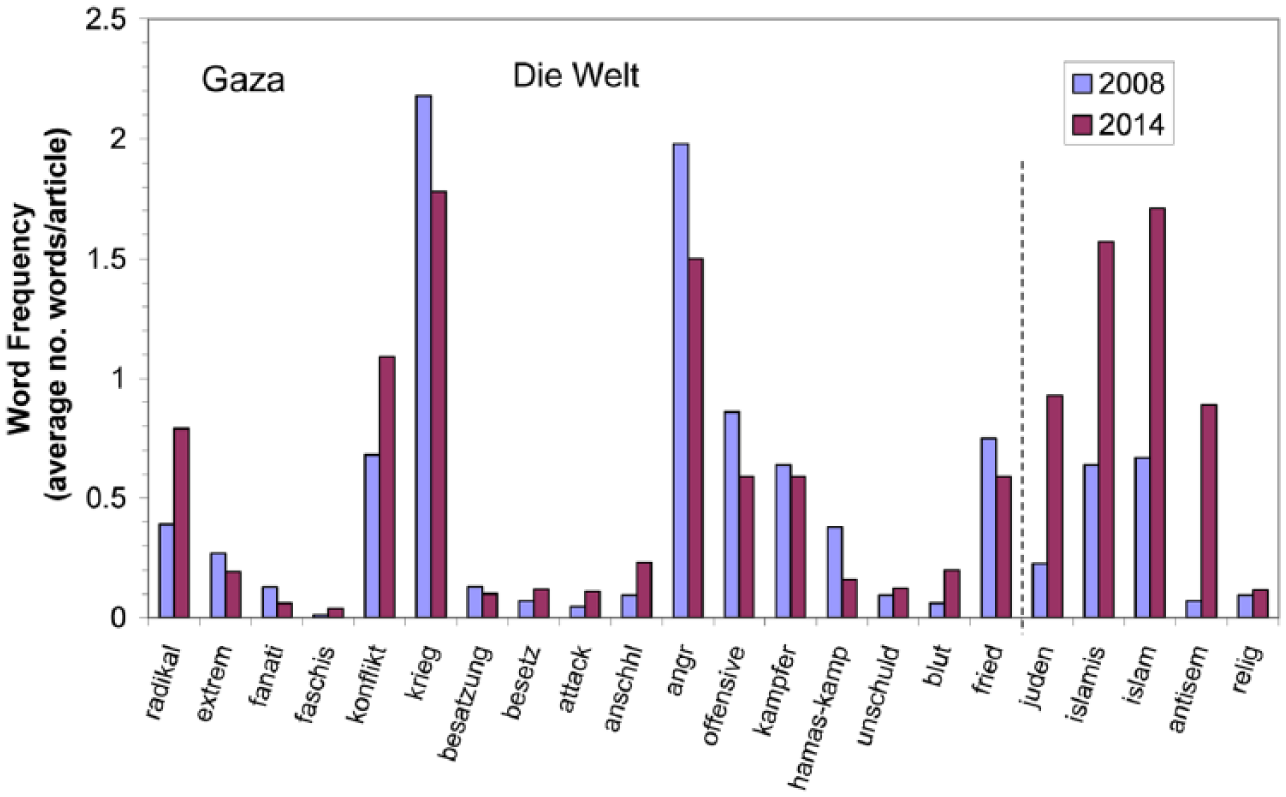
Die Welt’s terminology during the 2008 versus the 2014 Gaza campaigns.
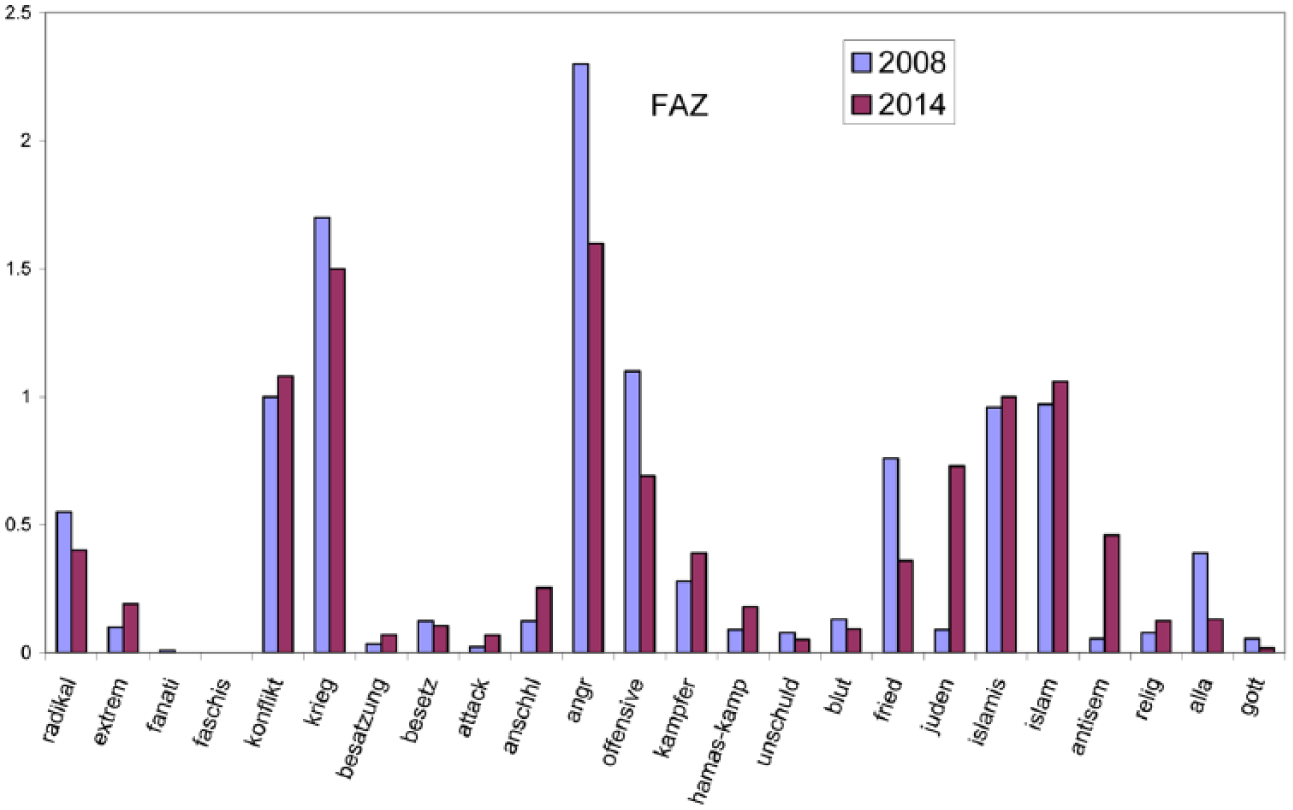
FAZ’s terminology during the 2008 versus the 2014 Gaza campaigns.
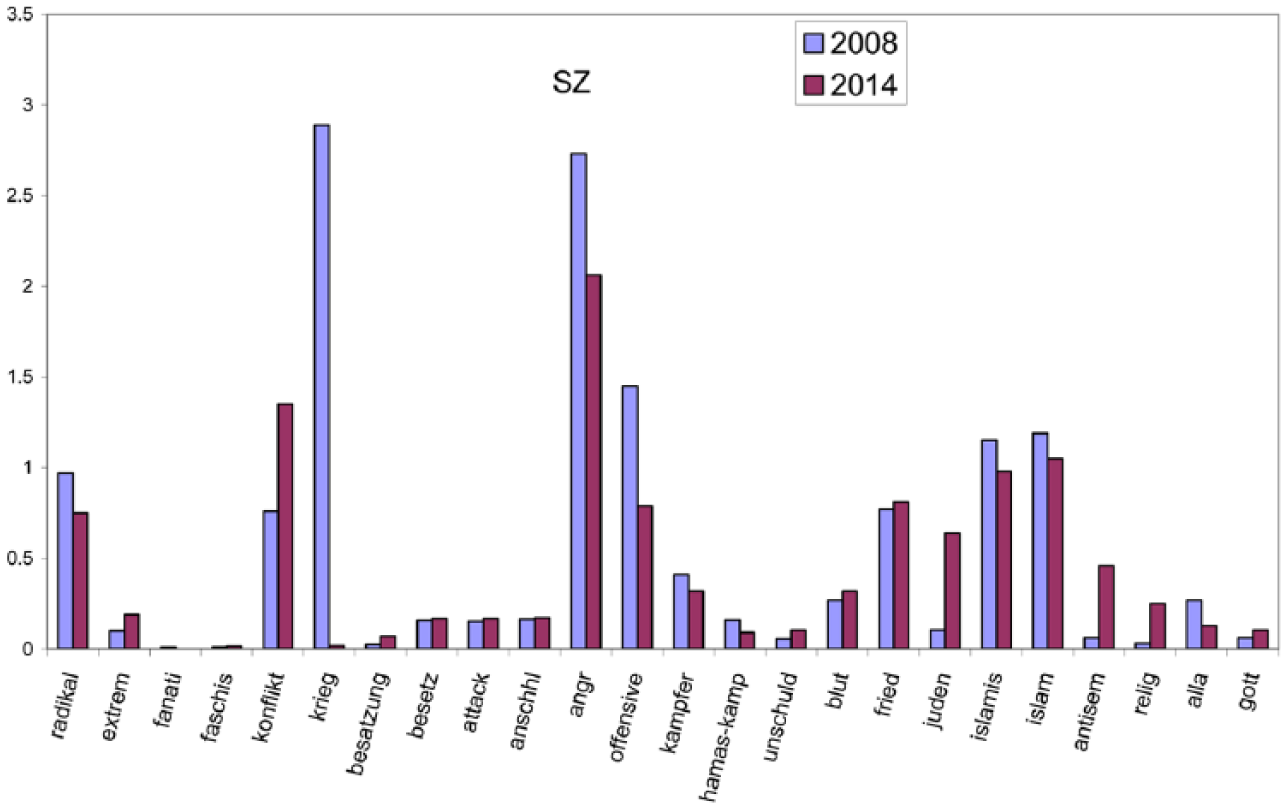
SZ’s terminology during the 2008 versus the 2014 Gaza campaigns.
Word frequency.
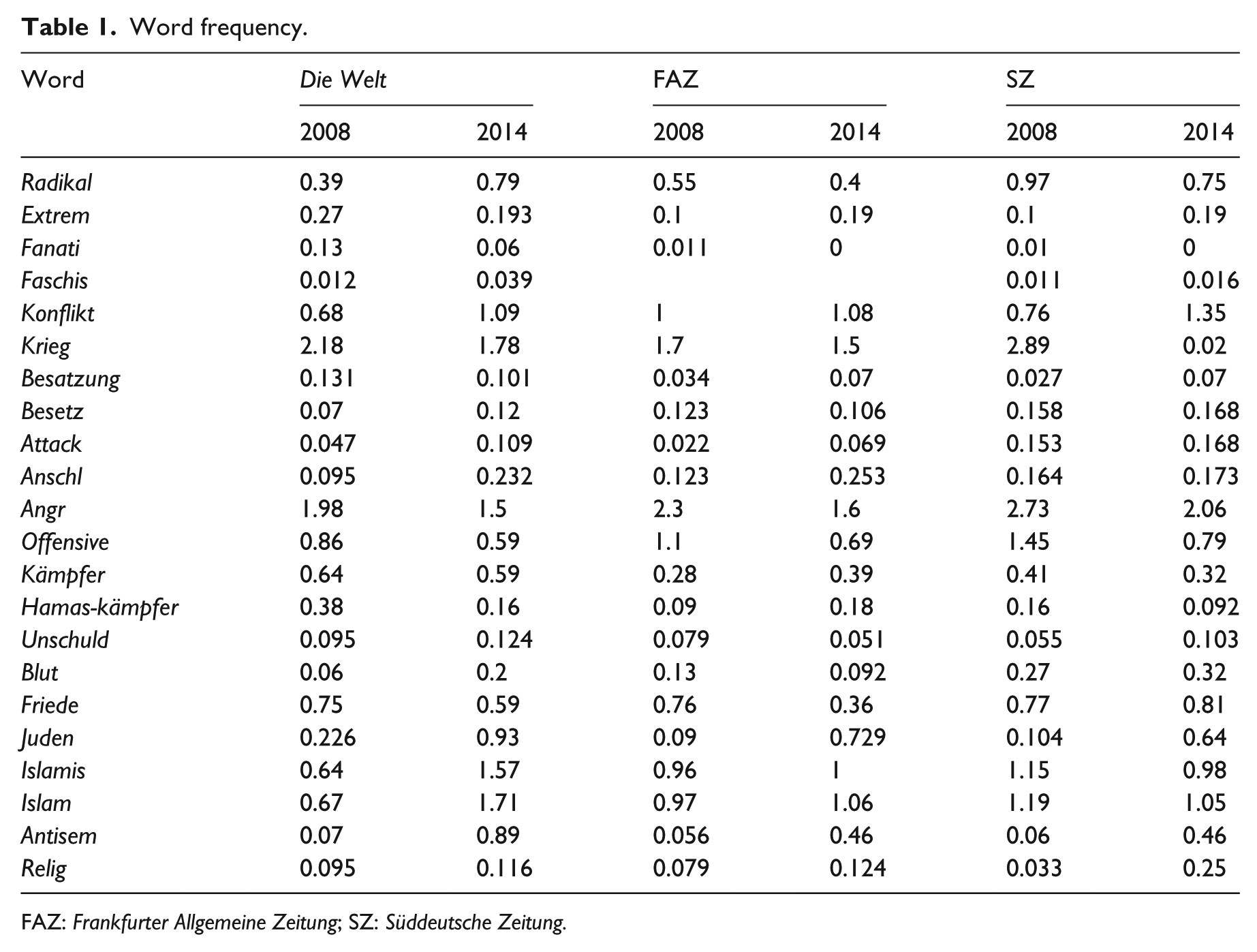
FAZ: Frankfurter Allgemeine Zeitung; SZ: Süddeutsche Zeitung.
Change in word frequency.
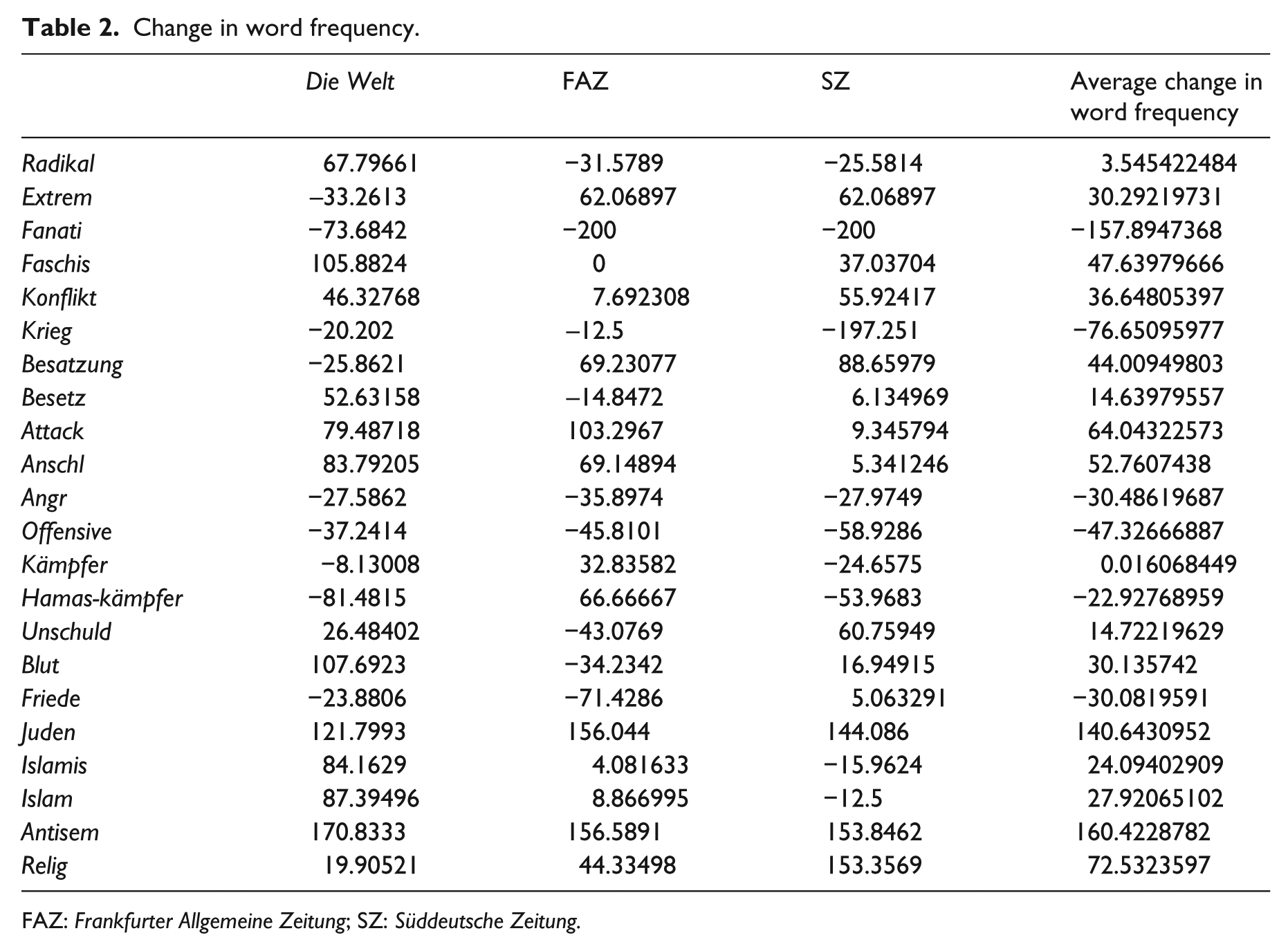
FAZ: Frankfurter Allgemeine Zeitung; SZ: Süddeutsche Zeitung.
Figure 2 examines center-right FAZ coverage of the 2008 and 2004 Gaza campaigns. The analysis shows a significant rise in usage of the terms Juden (from 0.09 to 0.73) and antisem (from 0.056 to 0.46).
Figure 3 examines liberal SZ’s coverage of the 2008 versus the 2014 campaign and shows a significant rise in the frequency of the words religion (from 0.033 to 0.25), Juden (0.104 to 0.64), and antisem (from 0.06 to 0.46).
Figure 4 shows results from the three newspapers, presenting the changes (in percent), in the word frequencies of each of the 22 terms in each newspaper between the 2008 and 2014 articles. From this figure, it is evident that (a) all three newspapers exhibited a significant increase in the use of three out of the five religion-related terms in their coverage of the 2014 conflict compared to coverage of the 2008 conflict; (b) all three newspapers exhibited an increase of over 120% in the use of the word Juden. DW exhibited an increase of 121%; FAZ, 156%; and SZ, 144%; and (c) all three newspapers exhibited an increase of over 150% in the use of the word antisem. DW exhibited an increase of 170%; FAZ, 156%; and SZ, 153%
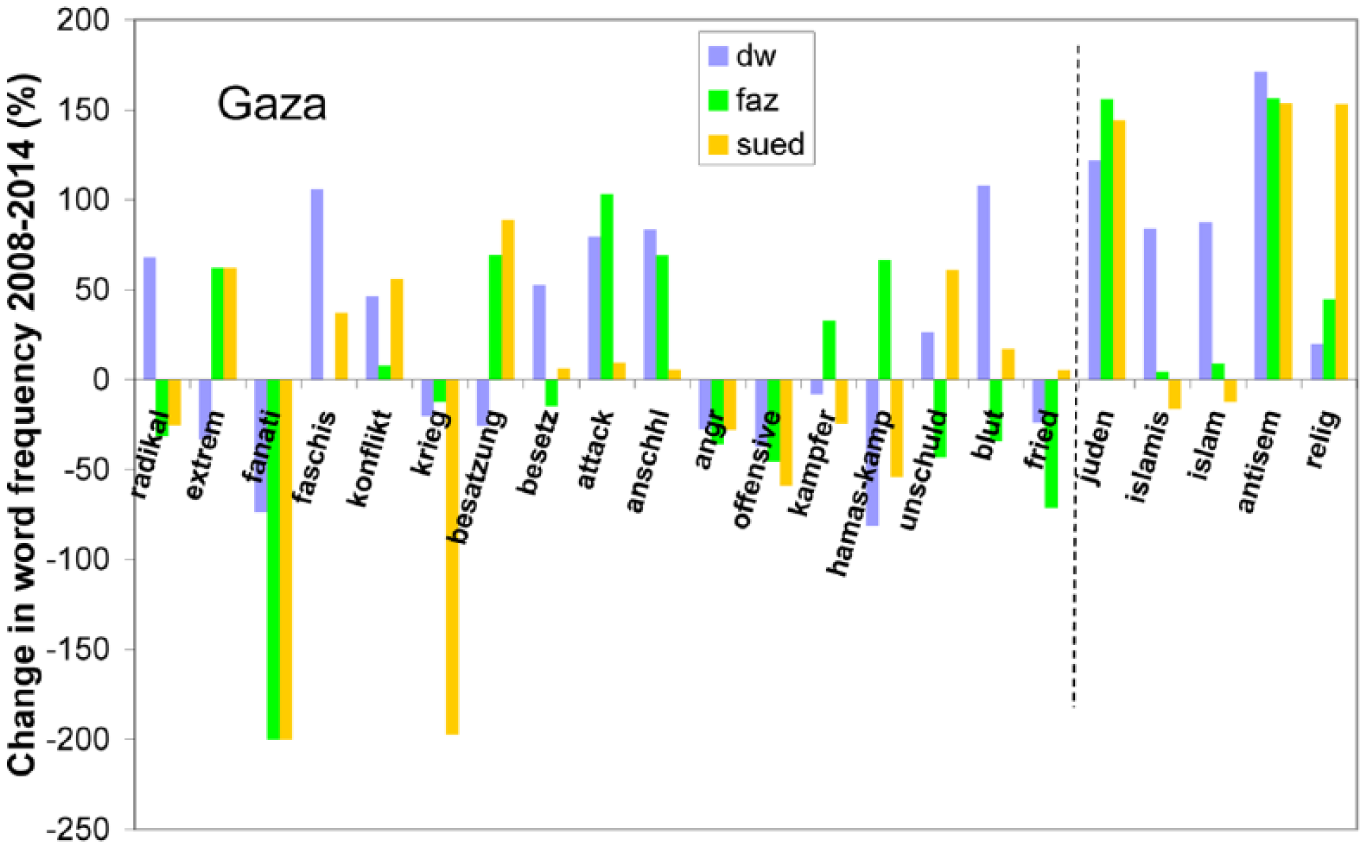
Changes in word frequency between two Israel–Gaza conflicts in DW, FAZ, and SZ.
Figure 5 shows the combined change in word frequency for all three newspapers. The figure corroborates the large positive changes in the frequencies of all religion-related words, with the largest changes in the words Juden, antisem, and relig. Over all three newspapers, the average change in religion-related words is 85%. Figure 5 thus most clearly validates the hypothesis that a change in framing occurred in German media between the 2008 and the 2014 Israeli–Gaza conflicts, reflecting a shift from a political description of the events to one invoking a clash of cultures and religions perspective.
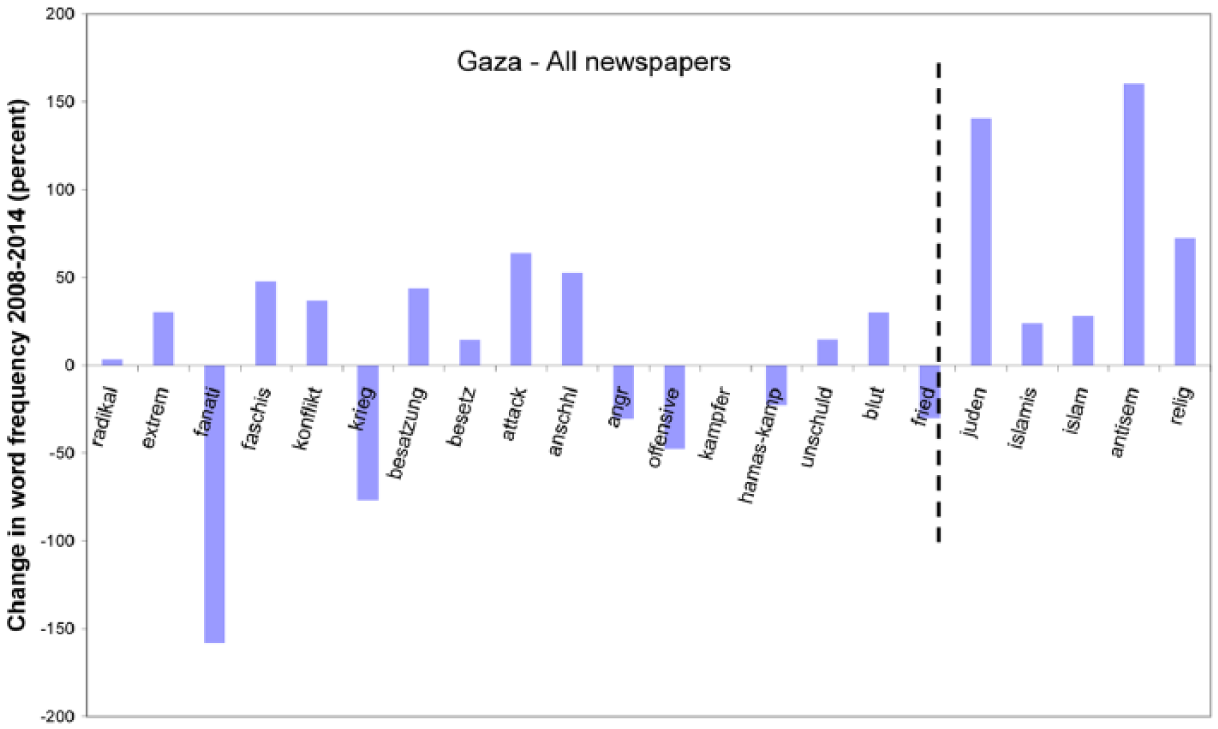
Average change in word frequency between the two Israel–Gaza conflicts.
Overall, the findings show that a shift occurred in German media’s descriptions of Israeli–Arab conflicts, indicating a move from a description of a territorial-political conflict to a description of a conflict involving religion. The shift is reflected in the changing frequency of use of religion-related and non-religion-related terms in the coverage of the 2008 and 2014 Israeli–Gaza conflicts. Findings show that religion-related words featured more extensively in the coverage of the 2014 Israel–Gaza conflict than in the coverage of the 2008 conflict. Findings also confirm our second hypothesis, as the change was exhibited most strongly in DW and FAZ. The impact of these tensions on the coverage frame, although significant, was much smaller in SZ.
Discussion and conclusions
This article documents the central role of religion in the media coverage of the 2014 Gaza War versus the 2008 Gaza War. In line with our first hypothesis, which predicted that rising anti-Islam sentiment would lead to wider use of religion-related terminology in the German media coverage of the 2014 Gaza War in comparison with the 2008 Gaza War, the analysis clearly points to a dramatic rise in the use of religion-related terms in 2014. Thus, whereas the 2008 conflict was portrayed as a political clash between Israelis and Palestinians, the empirical analysis identified a shift to a focus on the relevance of religion to the conflict in the coverage of the 2014 Gaza War. Analyses of word frequencies indicate a shift from an interpretation of the conflict as involving Israelis versus Palestinians to a conflict between Jews and Muslims. In line with our second hypothesis, which predicted that the conservative newspapers DW and FAZ would use religion-related terms more frequently to describe the 2014 operation in comparison with the liberal newspaper SZ, findings show that the rise in religion-related terms was more clearly evident in the more conservative media, most notably in the conservative newspaper DW, and less so in the center-right FAZ, with the smallest change in SZ. Previous studies (e.g., Seib, 2004) argue that media in different countries, particularly North American media and Arab media, moved to a clash-of-civilization reporting framework after 9/11. Findings of this study confirm that such a shift also occurred in German media, most notably in Germany’s conservative newspapers, which also moved toward a similar framing in Muslim-related conflicts, as illustrated in our analysis of the portrayal of the 2014 Gaza War.
Furthermore, although this was not the main aim of the study, the analysis contributes to our understanding of the portrayal of the Israeli–Palestinian conflict, which served as our case study. While our analysis did not analyze tone, the word frequency results that reflect the growing relevance of anti-Semitism and Islamism in coverage of the conflict indicate that religious terms were highly salient for German media coverage of the more recent 2014 conflict.
Arguably, the growing use of religious terms, particularly antisem and Juden, may be attributed to the increasing frequency of demonstrations against Israel, including activities by anti-Israel movements, such as the Boycott, Divest, Sanctions (BDS), which has become increasingly vocal since its establishment in 2008, and to the rise of Pegida, whose coverage of the conflict emphasizes the relevance of religion. More notably, the fact that this change is mostly evident in DW suggests that this shift may be mostly characteristic of conservative media outlets.
As the motivation for the study was rising tensions between Europe and Muslims, we suggest that the shift in journalistic frames identified in this study may be attributed to the impact of ISIS on the European psyche, in light of the continent’s shock at the number of European Muslims who left Europe to join Muslim extremists in the Middle East and plan attacks not only in the Arab region world but also against Western targets. Such an interpretation is supported by the results of the 2013 and 2014 polls in Germany, mentioned above, which indicate that these events resulted in rising anti-Islam sentiment.
Based on the findings of this study, we contend that Huntington’s arguments, while provocative and controversial, maintain relevance as a frame of reference, and we suggest that future studies examining conflict coverage in the contemporary news environment should also examine this prism of coverage. Whereas the previous literature focuses mainly on US, Canadian, and Arab media, findings of this study indicate that the recent series of Muslim-related political events may have driven European media to embrace a news frame in which religion constitutes one of, if not the most, relevant explanations of Muslim-related political conflicts, thus subscribing to Huntington’s ideas. We hope that the evidence presented here contributes to the global mapping of the relevance of Huntington’s thesis.
In addition to a contribution to the international relations literature, from a political communication theories perspective, the analysis indicates that public polls in Germany may have affected media coverage. Thus, findings suggest the relevance of theories that point to the important role of public polls in determining the terminology used by media when covering foreign conflicts, such as the cascading activation theory (Entman, 2003), one of the main political communication theories that consider public opinion and polls as a major determinant in media output, as these political cues trickle not only from top to bottom but also from bottom (the public) up to the media.
Finally, we advise future studies to examine the trend identified in this article in other countries and to continue to examine whether the shift to religion-focused terminology continues to characterize German media coverage of Muslim-involving conflicts. Indeed, based on recent polls, it appears that the growing negative perception of Muslims in Germany has only been reinforced by the terrorist attacks conducted by second-generation and incoming refugees in Europe. Polls indicate that growing numbers of Germans believe that the Muslim minority in Europe is unable to integrate into the German society or accept the fundamental values on which German society is based, and therefore constitute a threat to Germans’ national identity and personal security. In a recent poll published in May 2016, no less than 70% of Germans stated that “Islam does not belong to Germany” (“Für die meisten,” 2016), which emphasizes the need to continue to examine the media framework in Germany as well as in other European countries with similar trends.
Footnotes
Funding
The author(s) received no financial support for the research, authorship, and/or publication of this article.