



Abstract
Saida Grundy on Gone Home: Race and Roots Through Appalachia.
Gone Home by Karida Brown University of North Carolina Press 264 pages
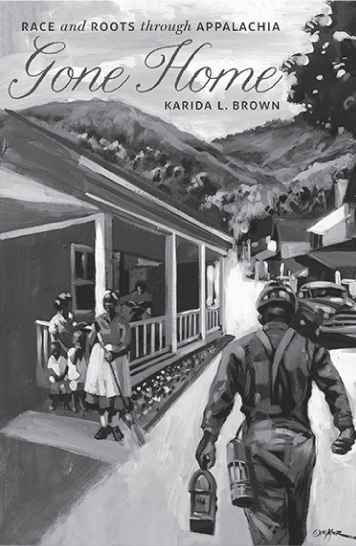
There is a luscious rolling prose to Gone Home that mimics the verdant hills and valleys of Appalachia. It is writing far more beautiful than sociology perhaps deserves, with a rich narrative that invoked all the sensory memories of a place I know well. I am a bit of an expert, you see, on being Black and from the Bluegrass. Karida Brown’s convention-busting oral history on Black migrants to eastern Kentucky’s coal mining towns (for which she won the 2017 ASA Best Dissertation Award) provides an authentic take of families often rendered invisible by the presumed uniform poverty and whiteness of the region. Her elaborate descriptions seem similar to the way that one from the old country might taste and approve of an authentically cooked dish. This is a book about my folk.
I recognized the names of several interviewees throughout its eight chapters, and aside from my biographical attachment, this book is one of the few sociology texts I would have read even if I were not a sociologist. The importance of Brown’s work to the community is made evident in how far this book has spread across communities in those hills and valleys. My parents read Gone Home and mailed copies to their childhood friends. It is, for perhaps an entire generation of Black people from a small and often forgotten place, a way of finding each other again that social media and emails will never capture. For those African Americans whose lives map a migratory pattern that social scientists would otherwise reduce to a footnote, Gone Home must feel like redemption. For the children and grandchildren of Black coal miners, who left Harlan County behind or struggled through decades of late capitalism to stay put, Gone Home tells the story of a time and place to which they can return only in their memories. Brown seasons this reunion with a wealth of historical photos. My Aunt Sandy came across a picture of her hometown’s Colored Public School circa 1950 and physically hugged the book in her arms.
What Brown’s work does emotionally for these descendants weighs equally with what the work contributes sociologically. The Great Migration, as Brown maintains, was not a massive homogenous event. Rather, as the largest demographic transition of 20th century America, the Great Migration was a finely textured and multi-directional experience that cannot be abbreviated to a family leaving Mississippi and landing in St. Louis. Gone Home is a quilted oral history about a critical but often understudied process of Black migration in the U.S.–“stepwise” migration, in which inter-generations of African-Americans stopped over in various regions and communities for what would often turn out to be a temporary industry in U.S. labor history. Brown’s exhaustive 153 interviews are drawn primarily from current and former residents of Lynch and Benham—two Appalachian company towns born on the desks of east coast steel executives. Brown unmasks the savvy of these corporate profiteers who waged their bets on suppressing strikes and union organizing by balancing brute violence with offering just enough of the good life in the newly paved streets, playgrounds, and movie theatres of these towns. Cross-racial labor alliances were staved off by providing poor whites with the better wages, schools, and houses they needed to feel superior
However, it is in her mastery of oral histories that Brown’s work tells the other half of the story. Brown contributes a cartographic level of attention to scale rarely seen in qualitative studies of this size, reinforcing the narrative constructed from these families’ experiences. It would be sufficient, for example, to tell her readers that a steady stream of Black miners escaping racial terrorism arrived to Appalachia from Alabama beginning in the early 1900s. Instead, Brown zooms all the way in and names the actual actors in migration—a lone White transient named Limehouse who turned a profit trucking hundreds of Black Alabamians for a steep cut of their future wages in the mines. He doubled his earnings when they sent for relatives back home. In presenting the data, Brown often breaks convention with the standard format of quotes followed by explanatory analysis. Instead, the story of Limehouse is presented to us through dozens of speakers that Brown threads into a thick narrative tapestry where “an ole’ funny looking hillbilly” and his truck filled with corn, are echoed throughout (40). A compelling case is made as to why oral histories are a powerful methodology deserving more attention from sociologists. Such a reliable and detailed account of a single actor could otherwise have been lost, and with it, the detailed context of how Whites exploited and profited from labor migration well before Black people arrived on the hiring lines of these company towns.
Brown zooms all the way in and names the actual actors in migration—a lone White transient named Limehouse who turned a profit trucking hundreds of Black Alabamians for a steep cut of their future wages in the mines.
The capacity for texture and scale is not the only statement Brown makes about oral histories; it is her tacit epistemological message that speaks loudest. In placing the narrative voice of rural blue collar Black people on par with the rich theoretical tradition that contextualizes her argument, Brown upholds Gone Home as a mirror onto the field itself. Participant-respondents are named, located, and speak for themselves instead of having their stories mined and extracted to be displayed as proof of the validity of the theoretical canon. She spares us a sad and hackneyed journalistic expose on the decline of American industry and the rise of Big Coal ghost towns and instead captures an intimacy in the lives of Black Appalachians that can be credited in equal parts to her skill as a researcher and her family’s roots in Lynch.
Throughout the book, it is obvious that these communities want to give her their story, as they entrust her to tell it right. This relationship between researcher and community shows us that it is Brown who is ‘gone home’ as much as they are through this work. There are many ways to learn about the confluence of the most significant industrial, racial, and demographic shift of the 20th century, but in Gone Home we are invited to sit down to a glass of ice water at the kitchen table to learn of its primary sources. We leave knowing for certain that the story is incomplete without them. Brown has perhaps set the new standard for how sociologists must consider the enduring humanity of successive generations from whence our participants came, and from which many more will follow. These new generations will look to our work to tell them of their pasts. For the Black descendants of coal country—long after the coal is depleted and the towns will return to the hills from which they were carved, Gone Home will last as a testament that our people were there, and this was their story.