



Abstract
Jacob Rugh on Christopher Mele’s Race and the Politics of Deception.
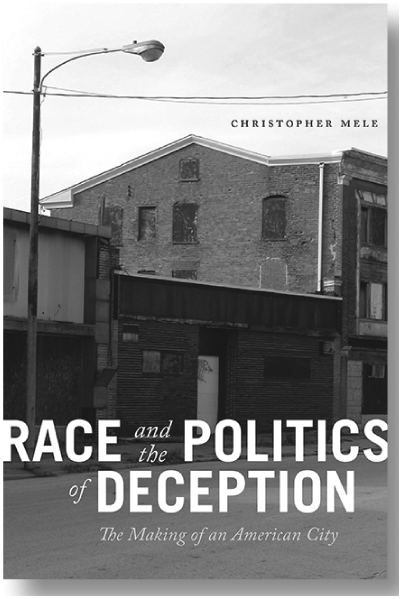
Race and the Politics of Deception: The Making of an American City by Christopher Mele New York: New York University Press 208 pages
In 1985’s Back to the Future, a scene depicting a token Black character, Goldie Wilson, reveals White American society’s dominant narrative—and collective amnesia—about race and small city life. Set in Lou’s Café, a White-owned establishment in the center of the fictional town of Hill Valley, in 1955, we see the young Wilson on screen with lead characters Marty and George McFly for just 72 seconds:
Say! Why do you let those boys push you around like that for?
Well, they’re bigger than me.
Stand tall, boy. Have some respect for yourself. Don’t you know, if you let people walk over you now, they’ll be walking over you for the rest of your life. Look at me. You think I’m gonna spend the rest of my life in this slop house?
Watch it, Goldie.
No, sir! I’m gonna make something of myself. I’m going to night school, and one day, I’m gonna be somebody!
That’s right! He’s gonna be mayor.
Yeah, I’m… mayor! Now that’s a good idea! I could run for mayor.
A colored mayor. That’ll be the day.
You wait and see, Mr. Caruthers. I will be mayor! I’ll be the most powerful man in Hill Valley, and I’m gonna clean up this town.
Good. You can start by sweeping the floor.
Mayor Goldie Wilson. I like the sound of that.
This scene is jam-packed with widely held racial fallacies and myths: The rags-to-riches mobility frame obfuscates structural racism; the intimation that Blacks in the 1950s conceived of their systemic oppression as school-yard bullying and spontaneously approached White strangers absent collective action to tell it this way; the notion that Black newcomers to politics enjoy the same prospects as White newcomers; the flattening of Black residents to a single character and a lowly social class standing; and the insidious and pervasive belief that racial discrimination was primarily an issue of anomalous individual prejudices in private spheres, easy to shrug off and overcome with a dash of grit and a spark of aspiration. The most striking fiction of this scene is that it betrays the reality of 1985 and even 2015, not just 1955.
Flint, Michigan. Gary, Indiana. East Saint Louis, Illinois. Wilmington, Delaware. Chester, Pennsylvania. Despite their modest size, many of these cities are familiar. And ongoing racial exclusion in housing, schools, and urban development still governs their fates. About 1.5 million Black Americans live in four-dozen majority-Black, smaller cities (population 25,000-100,000). Their combined population is greater than that of any single city outside New York and twice that of Chicago’s Black community.
Many of these cities receive media attention due to the effects of long-term urban decline—joblessness, the lack of clean drinking water, crime, poverty, single parenthood, failing schools, and the perception of dysfunctional government. Even the most casual news consumers would recognize many of these cities as struggling and as Black, and not necessarily in that order. The conventional wisdom often ascribes these effects, by proximity and association, to stereotypes about cultural or economic deficiencies of Black spaces and Black people.
Existing scholarship (mainly on larger cities) has uncovered key causes of urban decline and sought, with a mixed degree of success, to disprove the effects-as-causes storyline. Yet, some compelling questions remain: Does the consensus structural racism story still go on? If so, how is it actively reproduced? In his new book, Race and the Politics of Deception: The Making of an American City, Christopher Mele offers insightful answers based on his deep-dive into the history one of these smaller Black cities, Chester, Pennsylvania. Mele argues that, regardless of boom, bust, or decline, the politics of urban development rests on the “consistent, intentional, and deliberate strategy” of deception (p. xiii).
The deception lies mainly in the manipulation of race and dominant racial ideologies by public and private actors and institutions. Mele offers an ambitious sweep of Chester and its county suburban environs in the 20th and 21st centuries, up to the present moment. A key innovation is in his persuasive account of the politics of deception spanning both the ideologies of a historical, principled racism and contemporary colorblind racism. By showing the continuity of deception across eras, he reveals how the racialized symptoms of urban decline become the accepted cause.
Mele’s account of racial deception spirals downward from the late 19th century. At each step, White politicians and industrialists wield White fears to shape and manage growth or decline. White fear transforms, but never lessens as a force to exploit. Fears of racial inferiority, later racial integration and racial unrest, and later still, racial disparities in crime and poverty forever shape the destiny of Chester. Distant historical forces, due to their incredible longevity, are not so distant. A prime example is the Republican political machine that eventually controlled all of surrounding Delware County, PA, compromised the civic capacity of the city’s Black community for generations, and locked Democrats out of power for over 100 years. The tale of the machine busts the myth that all machines were Democratic alongside the myth of nonpartisan suburban management (instead a manifestation of the scale and success of the machine in manipulating race).
Although in the geographic North of the U.S., Chester leaders used race deception to maintain near complete racial segregation of housing and schools well into the 1970s, despite court rulings. This was at a time when many school districts in the South were de-segregating, sometimes rapidly. Importantly, Black leaders disagreed both with Whites and with one another, but any resistance was sabotaged by patronage along party, class, and other lines. Mele joins other recent authors in restoring the agency of Black citizens (and White Quaker allies) in this narrative, especially in his chapter on civil rights activism, “The Birmingham of the North.” Yet, even when civil rights struggles eked out a modicum of federal support, Chester’s history casts doubts on the loyalties and sponsorship of one of the most prominent Black activists. The eventual cooptation and embezzlement of War on Poverty program funding meant another steep drop down the racial spiral.
Mele argues that, regardless of boom, bust, or decline, the politics of urban development rests on the “consistent, intentional, and deliberate strategy” of deception—mainly in the manipulation of race and dominant racial ideologies by public and private actors and institutions.
Not to be outdone by the past, the more recent incredible tale of $7 million spent by the 1990s for a waste incinerator that was never built shows just how destructive the disinvestment of race deception has become. The denouement to Mele’s tale centers around the current hyping of waterfront development that is built on an ahistorical, colorblind, and neoliberal premise. Redevelopment in turn builds a road and other tax-abated amenities for White commuters to avoid Black space at all costs, both figuratively and financially. Meanwhile, local infant mortality rates rise to the highest in the state. In countless other ways, Black lives are decimated, not by amorphous national forces, but by the continued use of race as a strategy for (re)development.
As fans of the Back to the Future series are aware, there is also an alternate dystopian future of Hill Valley (aka Hell Valley). This future finally features more than one token Black resident, but the bars on windows, firearms, and fires in the street leave no doubt that the town has effectively become a crime-ridden ghetto. Hill Valley, like Chester and most of the cities listed above, makes the shift from White to Black. On Wikipedia, the history of this fictional town is longer than the combined word counts of the Wikipedia local history entries of all seven real-world small cities, from Flint to Chester, listed above. To the best of my knowledge, none of the publicly curated entries mentions the role of racism in shaping their local fortunes.
In our current political moment, Race and the Politics of Deception reminds us exactly how racial deceptions continue to make America unequal, not just unequal American cities. Indeed, the microcosm of Chester illustrates exactly how the White political manipulation of race transformed Black urban spaces into a powerful source of symbolic racism. Ironically, and tragically, as Elijah Anderson recently argued in a Vox editorial, the iconic Black ghetto trope transcends space and time to diminish, devalue, and endanger Black lives all across America. Ultimately, Mele’s careful analysis warns us that the strategic manipulation of race and racist ideologies for profit not only undermines cities like Chester, but poses a growing threat to American democracy itself.