



Abstract
Elizabeth Hordge-Freeman on Getting Respect.
Getting Respect: Responding to Stigma and Discrimination in the United States, Brazil, and Israel by Michèle Lamont, Graziella Moraes Silva, Jessica Welburn, Joshua Guetzkow, Nissim Mizrachi, Hanna Herzog, and Elisa Reis Princeton University Press 400 pages
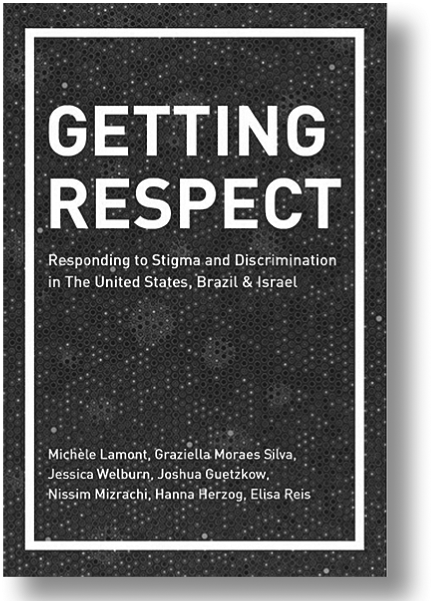
Getting Respect is a sociological tour de force that takes readers on a journey to three different continents to unpack the complexities of “ethnoracial exclusion,” described as stigmatization and discrimination based on racial appearance, ethnic/national background, or other ascribed characteristics (p. 7). This expansive, multi-national study is based on in-depth interviews conducted from 2007-2008 of five highly stigmatized groups in three countries: 150 African Americans (New York City), 160 Black Brazilians (Rio de Janeiro), and 137 people from three stigmatized groups who live in and around Tel Aviv in Israel: Arab Palestinians, Ethiopian Jews, and Mizrahi. The inclusion of Brazil and the U.S. in this study is most obviously connected to their shared history of slavery and the racial stigmatization of African-descended people. Israel, however, presents an unlikely comparative case, because it seemingly falls outside the purview of race-based stigmatization. Specifically, in Israel, Arab Palestinians are stigmatized based on the historical Israel-Palestine conflict and the Zionism movement, Ethiopian Jews are stigmatized based on race and immigrant status, and Mizrahi are stigmatized based on class status. According to Lamont and colleagues, these considerable cross-national and intra-national differences are not barriers to analysis, but opportunities to reconsider taken-for-granted assumptions about experiences of stigmatization that so often privilege race while underestimating the interplay of ethnicity, class, gender, and sense of national belonging in people’s day-to-day lives. Ultimately, Getting Respect reveals how highly stigmatized groups experience and interpret their stigmatization in diverse ways; and, most importantly, it offers a multilevel explanatory model illustrating that responses to stigmatization “are neither haphazard nor idiosyncratic, but rather empowered and constrained by [a] range of cultural and contextual elements” (p. 115). The authors make a compelling argument that specific considerations, including historical/national context, group identification, boundary-making processes, and cultural repertoires are central to understanding why groups respond to stigmatization in certain ways.
Given the scope and sheer complexity of the data presented in this book, the authors present an impressively simplified, overarching conceptual model in a tightly written introduction chapter. This provides clarity for researchers who may not be familiar with these specific case studies. Methodologically, the research emerges from the authors’ inductive content analysis of respondents’ in-depth interviews. One of their main initial findings is that stigmatization was reported significantly more than discrimination for all respondents. They operationalize stigmatization as “incidents in which respondents experienced disrespect and their dignity, honor, relative status, or sense of self as challenged” (p. 6), then introduce the term “assaults on worth” to capture microaggressions, blatant stereotyping, and other instances of being ignored or rendered invisible. “Ethnoracial exclusion” is deployed as a useful conceptual tool highlighting the coexistence of discrimination, stigmatization, and “assaults on worth”, and the term is used throughout the book.
Each major chapter presents empirical data on interpretations of ethnoracial exclusion and groups’ responses to their experiences of stigmatization (including their actual and ideal responses). Stigmatized group members’ responses are organized into five main categories: “confronting the stigmatizer (including taking legal recourse), management of the self, not responding, a focus on hard work and demonstrating competency, and self-isolation/autonomy” (p. 10). Beyond categorizing their responses, the authors’ most significant contribution is their examination of the “dimensions of enabling and constraining narratives,” explaining why certain group strategies and responses emerge (p. 20).
In Chapter 2, the authors present data from interviews with African-American respondents who reported more experiences of ethnoracial exclusion than all other groups in the study. A significant proportion of these experiences were blatant. They also reported experiencing racial discrimination more than any other form of discrimination (such as class and gender). Though middle-class African-Americans expressed frustration over their “misrecognition” as a member of lower socio-economic status, there were minimal other differences between the experiences reported by lower and high-income African Americans. African Americans’ responses to ethnoracial exclusion most often involved confrontation, though middle-class African Americans tended to use this response most often and in more diverse contexts.
Helpfully, in each chapter, the authors explain group members’ responses using a model including three dimensions: historical/national context, groupness, and cultural repertoire. Bringing all of these dimensions together for African Americans, the authors suggests that the tendency for this group to use confrontation as a response to stigmatization reflects their familiarity with the history of American slavery, the legacy of Jim Crow, and ongoing racial inequalities which provide evidence for the centrality of race in the U.S. Moreover, African Americans display a high level of what the authors conceptualize as “groupness” which, when is paired with “readily available scripts about the racist character of American society as well as feeling empowered by the legal gains made by the Civil Rights Movement,” allows confrontation to be considered both an ideal and legitimate response to racism (p. 83).
In Chapter 3, we learn that Black Brazilians reported less experiences of stigmatization than African Americans and often “interpret incidents of assaults on worth as being about negative stereotypes about being poor, having low status, or being uneducated,” rather than about race (p. 28). They were also more likely than other groups to dismiss insults as jokes. Middle-class Brazilians, however, were more likely to provide racialized explanations of ethnoracial exclusion. The authors explain these trends by examining Black Brazilians groupness: though many embrace a Black identity, they do not see the group as having a distinct culture. This focus on class-related explanations over race-based explanations of stigmatization reflects, the authors write, “the greater availability of repertoires of class disadvantage and scripts of socio-economic exclusion” (p. 188). Moreover, these individuals’ investment in the Brazilian myth of racial democracy and access to repertoires about class disadvantage lead them toward responses to inequality that focus on interventions addressing socioeconomic inequality rather than reforms supporting institutionalized racebased actions.
Chapter 4 presents the complex cases of Arab Palestinians, Ethiopian Jews, and Mizrahi whose interpretation of and responses to stigmatization in Tel Aviv were all connected to their “different positions with regard to the Zionist national narrative” (p. 192). Arab Palestinians experience frequent stigmatization, and readily attribute these negative experiences to the longstanding Israeli-Palestinian conflict. Their groupness and sense of group identity is “defined primarily through their alienation from the Israeli Jewish state,” further reinforced by the institutionalized boundaries limiting their rights (p. 229). Their most common responses to incidents of ethnoracial exclusion were non-responses. The authors’ explanatory model suggests that Arab-Palestinian’s strong group identity and collective memory of the 1948 war, along with the availability of “a collective historical narrative of national dispossession and the ongoing sense of exclusion from the Israeli polity,” leads them to believe that confrontation is futile (p. 214). This group has no cultural repertoires or precedents for successfully using legal mechanisms to achieve equality in Israel; therefore, there is no reason for them to believe that their grievances will be heard or considered legitimate. Arab-Palestinian cynicism must be understood in this context, and it stands in direct contrast to Ethiopian Jews and Mizrahi who, because of their unique cultural repertoires and sense of national belonging to the Jewish state, respond in ways that suggest that inclusion is a goal, even if it is considered a distant one.
Getting Respect is a sociological tour de force that takes readers on a journey to three different continents to unpack “ethnoracial exclusion.”
Getting Respect charts new territory by decentering contemporary debates on inequality toward the subjectivity of stigmatized groups. The major strengths of this book rest in how it seamlessly illustrates “how macropolitical and meso-level explanations help account for microlevel experiences” of stigmatization and encourages sociologists to prioritize the development of structurally based explanations of behavior (p. 4). The book makes substantial contributions to the field with only a few minor limitations.
First, the project was ambitious in its scope and, ultimately, the two secondary groups in Israel (Ethiopian Jews and Mizrahi) did not receive consistent comparative attention. The authors suggest that the inclusion of Ethiopian Jews provides a promising avenue to explore “three phenotypically black groups living in different national contexts” but that comparison is not fully realized (p. 5). Second, the authors reference theorists including Pierre Bourdieu and Erving Goffman, but the book would benefit from an explicit theoretical framing. As a Brazilianist, I consistently felt that the inclusion of more recent sociological works that specifically address race and stigma among Black Brazilians could have contributed to and substantiated some of the arguments posed by the authors. Related to the Brazil chapter, on two occasions the authors refer off-puttingly to Black Brazilians as “our” Black Brazilians. Finally, the authors endeavor to examine stigmatization in three different sites and though they considered numerous variables, the breadth of the study necessarily precluded the full consideration of all variables. It is laudable, for instance, that the authors note the significance of gender to stigmatization, yet there is little sustained engagement with the ways gender shaped respondents’ experiences and responses to stigmatization.
Overall, Getting Respect serves as an exemplar for the way multinational and collaborative teams can harness their resources to advance comparative research. The volume is exceptional and groundbreaking because of its multidimensional conceptual frameworks, attention to the subjectivities of stigmatized individuals, and ability to offer structural explanations for the diverse interpretations and responses to stigma and discrimination in the U.S., Brazil, and Israel. For these reasons and many others, it will certainly take its place among the most significant books written about global perspectives on stigmatization and discrimination.