



Abstract
Jean Beaman on 20 Questions and Answers on Black Europe.
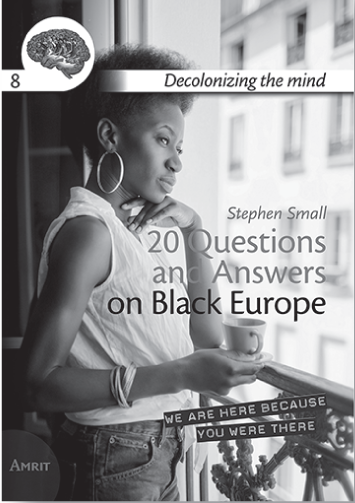
20 Questions and Answers on Black Europe by Stephen Small Amrit Publishers 240 pages
In July 2018, I attended a screening of Mariannes Noires at a cultural center in the quartier of Barbes in Paris’s 18th arrondissement. Directed by Mame-Fatou Niang, this documentary beautifully recounts the stories of seven successful Black (or Afro-French) women who continually confront a France slow to accept them. Perhaps unsurprisingly, the audience was also mostly Black women, and the screening and subsequent discussion panel were both well-attended. To those unfamiliar with the history of Black people in France or Europe more generally, such a sight—both the documentary and the demographics of the audience—might seem surprising or strange. However, due to the history of European domination across the African continent, Black people have been a part of Europe for as long as we have conceived of Europe, even if their presence has been continually minimized or ignored.
Such is the topic of Stephen Small’s important and comprehensive book, 20 Questions and Answers on Black Europe. As the book’s cover states, “we are here because you were there,” which is one of Small’s propositions of Black Europe (the other proposition is “There is no you without me!”). Therefore, we cannot or should not speak of Black individuals in Europe without acknowledging the history of European colonialism, imperialism, and slavery in Africa enabling both the construction of Europe as we presently understand it as well as the presence of Black people within Europe. Written in a simultaneously lighthearted and somewhat sardonic tone, the book also conveys urgency. Small argues on page 217 of the book that “Black Europe is not just Black people in Europe. It did not begin in the second half of the twentieth century, when Europe actively recruited more Black people than ever before to fight and work and live here. It began with the invasion of Africa by Europeans; it continued with the kidnap, transportation, and enslavement of millions of Africans; and with the encompassing grasp of colonialism and imperialism across Africa, the Americas, and elsewhere.” Such a discussion of Black Europe exists amid anxiety about threats of foreign or non-white cultures, the rise of Far-Right parties, and rising austerity policies throughout Europe.
Small estimates about seven million Black people currently living in Europe, roughly less than 1 percent of all of Europe (he does acknowledge data issues in terms of getting these numbers). This presence dates back to ancient Rome and Greece, though dramatically increased in the middle of the 20th century. Black Europeans include individuals who are defined or define themselves, as Black, African, African descent, African-Caribbeans, and Afro-Europeans. Specifically, as more than 90 percent of Black Europe reside in 12 nations (the United Kingdom, France, the Netherlands, Portugal, Belgium, Spain, Germany, Italy, Denmark, Norway, Sweden, and Ireland), Small focuses his analysis on these nations. He delineates different nation clusters including strident imperialists with relatively large Black populations including the U.K. and France, strident imperialists with relatively small Black populations including Spain and Italy, and peripheral colonial beneficiaries with negligible Black populations including Denmark and Norway. Yet while Black Europe (hereafter, BE) is small, it is not insignificant.
As the book title suggests, each of the 20 chapters is devoted to a question about BE, including “What are the relations between Black people and other people of color in Europe?” and “What are the politics of racism in BE?” Small begins by outlining four dimensions of BE. First, “race-thinking and racist thinking,” or the processes of racialization which shaped how Europeans see themselves as white and others as non-white. Second, the institutional pillars of racialization, or the different ways that racism is institutionalized. Third, the diverse Black cultural presence in Europe, including literature, music, religion, and the arts. Lastly, the Black human presence.
Among the many interventions of this text is Small’s usage of a “Decolonizing the Mind” framework. This framework allows him to consider the centrality of race and racism in Europe, and how the construction of knowledge about BE is influenced by, as he states on page 59, the “invasion and intrusion” of Africa by Europe. Small emphasizes how most Black people in Europe are not, in fact, immigrants themselves. He argues that the continued use of an immigration lens to examine BE reflects a “colonized mind.” He states on page 79 that in Europe, “all Black people wear our passports on our faces, and are regarded as permanent strangers.”
Part of Small’s focus on decolonizing the mind draws upon knowledge created outside of formal academic structures. Universities and other educational institutions need to be decolonized, particularly in relation to curricular foci on slavery and colonialism and increasing number of Black professors throughout Europe. Small critiques much existing academic research on BE as racist and perpetuating “epistemic violence,” and lauds “alternative” educational structures, such as the Black Europe Summer School in Amsterdam. Small addresses both the existence of Black populations in Europe and the academic study of such populations. We cannot understand existing research on BE without acknowledging how much of it is produced by white men in Italy, Germany, France, the United States, and the United Kingdom. At one point, Small notes the difficulty of conducting “rigorous research” on institutional racism or colonialism, while studies of Black criminality are more easily accepted in academia.
Another important intervention is Small’s focus on the whole of Europe (or at least the 12 nations with the highest numbers of Black people) rather than offering a nation-specific overview of Black presence. This focus makes it easier to identify similarities for Black individuals across countries, including institutional racism, “ambiguous hypervisibility” or the over-concentration of Black individuals at the lower ranks of society, and enduring legacies of slavery, colonialism, and imperialism. This also reveals how knowledge and ideas are spread among Black populations across Europe.
BE continually confronts problematic representations and stereotypes. Why do we still see Black Pete in the Netherlands or “Nogger Black” ice cream in Sweden or lackluster engagement with colonial history in national museums throughout Europe? Such representations of Black inferiority are normalized and exist simultaneously with statues of Christopher Columbus across Spain or the continued disavowals of reparations for slavery in France or the U.K. Such representations illustrate how Europe (and European identity) is seen as white and demonstrate opposition to discussing race or racism at all. Indeed, much of Europe—the U.K. being an interesting exception—embrace colorblind ideologies. Many of these countries do not collect so-called ethnic statistics. Best to not discuss race, less people be divided further, the thinking goes. Such ideologies are buttressed by anti-discrimination laws at both the European Union and country levels which often have “no teeth” (this is in contrast to immigration and citizenship laws which are stricter and created “Fortress Europe”). When concerns about racism and discrimination are raised, Small indicated on page 206 that Black Europeans are repeatedly told, “we should be grateful—and try harder if we wish to succeed!”
All Black people wear our passports on our faces, and are regarded as permanent strangers.
There were only 22 nationally elected Black politicians throughout the European Union in 2017 (although there is more Black representation in local politics). Black individuals have resisted oppression through social mobilization, faith communities, and community organizations, which have developed in response to exclusion from mainstream institutions. One example is the Nappyitalia project, an initiative that began in Italy in 2012 as a way to build community around resisting negative messages about Black Italians and their hair. Small argues that such projects are necessary to combat enduring legacies of colonialism and slavery that repeatedly reminds Black individuals that they do not belong in Europe or will always be seen as foreigners.
Another strength of the book is its intersectional perspective, especially its focus on the contributions and mobilization of Black women throughout Europe. Small argues that BE is also gendered; Black women across Europe face racial and gendered stereotypes. He repeatedly highlights the work of Black feminists such as Philomena Essed, and organizations such as the MWASI Afro-Feminist Collective in France, exemplifying decolonial perspectives. Black feminist mobilization has been at the forefront of social mobilization for Black populations, and the intersectional focus is also helpful for not reducing Black individuals to only immigrants.
While there is much to laud in this text, there are questions that remain. While the Europe-wide focus is important, some of the questions or chapters are weaker for having this focus. For example, Question 8 on the economics of BE was general and lacked a more useful analysis found by focusing on specific nations. I also wish Small had unpacked his definition of Black to consider how populations who are racialized as Black —I’m particularly thinking about North African-origin individuals—can relate to this category. Moreover, he briefly mentions politically black populations, such as Indians or Pakistanis in the U.K., but does not elaborate, nor is there much included about the experiences and conditions of Black Muslims across Europe or how Muslims are racialized. Further, Small critiques U.S. dominance in discussions of the African diaspora yet, I still wondered about BE’s connections to Black populations outside of Europe. Furthermore, Small stresses the importance of organizing with non-Black individuals for improving the conditions of Black individuals, but I wondered about the feasibility of such alliances across Europe in a broader context of anti-blackness. For example, police violence against Black populations across Europe is a growing problem, but it is not always evident to mobilize around this issue, especially given Europe’s denial of race and racism.
This book is not especially optimistic—nor does it need to be— Small does not predict any significant improvement in the condition of BE. What is inspiring is the persistence of BE despite slavery, colonialism and imperialism, and racism and discrimination against its existence for the past few centuries. As Small quotes Bob Marley, “we refuse to be what you want us to be!” he (and Marley) remind us all—Black and non-Black—of the importance of resistance, whether it be within academia, the discipline of sociology or elsewhere.