



Abstract
Megan R. Underhill on Whitewashing the South.
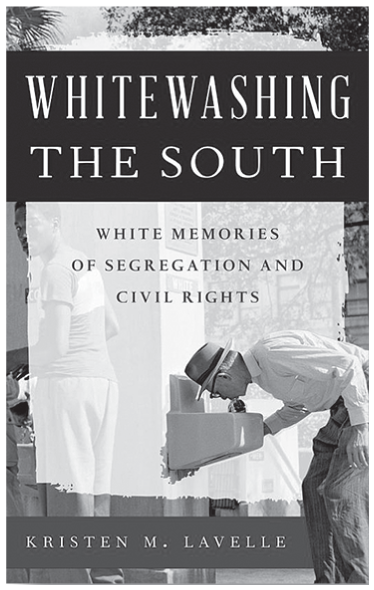
Whitewashing the South: White Memories of Segregation and Civil Rights by Kristen M. Lavelle Rowman & Littlefield, 2014 238 pages
For many White southerners, the process of remembering the past is contentious and deeply emotional. Public debates about the appropriateness of flying Confederate flags on state grounds or the removal of monuments from city squares leave White southerners feeling attacked and vilified for their embrace of Confederate history, which they often maintain is about “heritage not hate.” Certainly, many people of color disagree; to them, both the Confederate flags and monuments are mute celebrations of White supremacy and the long legacy of racial terror facing their communities. Critics of the “heritage not hate” line further contend that White southerners’ desire to uphold the memory of the White supremacist past condones and supports the preservation of a racist White identity and contributes to what sociologist Joe Feagin names a “collective forgetting” about events that contradict or undermine White America’s positive self-image.
A 2018 Southern Poverty Law Center report (SPLC) titled “Teaching Hard History: American Slavery” offers strong support for the idea of “collective forgetting,” particularly as it relates to the study of slavery in American public schools. Within the American high school curriculum, the SPLC notes, slavery receives only brief and superficial curricular attention. Surveyed seniors evidenced poor learning outcomes; only 8% correctly identified slavery as the impetus for the Civil War. The SPLC findings demonstrate how American schools contribute to the reproduction of racial ignorance in the United States. They may also help us make sense of why a contingent of White Americans continues to celebrate the memory of the Confederacy—some violently and vehemently—despite the pain and terror endured by millions of people of color under Confederate rule. And though we have some understanding of the depth of White America’s racial ignorance with regard to slavery, we know little about how Whites remember more recent racial events or how their memories shape their racial identity.
Enter Kristen Lavelle’s fascinating Whitewashing the South: White Memories of Segregation and Civil Rights, which interrogates elder White southerners’ memories of Jim Crow segregation, the civil rights movement, and the federally mandated desegregation initiatives that followed. By examining the histories and memories of Whites who came of age during Jim Crow, Lavelle successfully demonstrates the connection between memory and racial identity construction within distinct and changing racial eras. Further, her findings highlight how memory is inherently political. People selectively employ memories to justify or challenge the status quo and to make sense of their place in the world as “good” people, reflecting an important tenet of identity formation—the need for a positive self-concept. For example, Lavelle’s study documents how participants frequently asserted a sense of moral, White, southern identity across multiple eras of racial inequality.
To investigate, Lavelle interviewed 44 “ordinary” (i.e., neither “rabid racists” nor ardent anti-racists) elder, White southerners from Greensboro, NC. What’s special about her research participants is how they have been socialized according to the norms and ideologies of multiple racial eras and have been party to significant changes in both. They came of age during an era of overt interpersonal and institutional racism and then, as teenagers and young adults, witnessed civil rights activism and the desegregation and anti-discrimination reforms that followed.
Lavelle’s data are rich and troubling. Her findings suggest that elder White southerners downplay or ignore the enormity of interpersonal and institutional racism during and after Jim Crow segregation. Lavelle pays particular attention to the racial lessons children learned within the Jim Crow home. Overwhelmingly, participants described their family homes as untouched by racial prejudice. Further, they presented themselves and their family as passive segregationists who understood that Jim Crow was wrong, but saw no clear alternative to the racialized social system in which they were immersed. Participants insisted that they and their relatives were “good” people who treated Blacks respectfully and equitably, even though not all Whites did. When participants did acknowledge the racism of a family member, they quickly reframed their response to downplay their family member’s actions, noting that their relative was not “that racist.” By creating symbolic distance between themselves and “racist” Whites (i.e., those who openly espoused views of White superiority and actively pursued or condoned overtly racial discriminatory behavior) Lavelle contends that participants were able to retrospectively acknowledge racism during Jim Crow and simultaneously assert their family’s moral goodness.
Elder White southerners also offered charitable accounts of race and racism within the public realm. Despite acknowledging racial discrimination, few remembered Jim Crow segregation as an era characterized by tense and inequitable race relations. Instead, most spoke favorably about the “good ole days” of Jim Crow, often describing it as a peaceful, safe time in history, when parents allowed children to roam their neighborhoods at will and walk to school unattended. Almost no one reflected on how these childhood freedoms were racialized or how their perceptions of safety were informed by their dominant racial status. From this conversation, Lavelle develops the concept of White protectionism: a narrative strategy offering a charitable construction of the past to protect Whites’ sense of morality and view of themselves as “upstanding people” despite the pervasiveness of White violence and discrimination during this period.
Throughout Lavelle’s volume, the selective remembering of participants is well documented and extends to their fuzzy recall of the civil rights movement. One of Lavelle’s most curious findings was how few of her participants had any recollection of the civil rights activism that occurred Greensboro, including the famous sit-in movement at the Woolworths lunch counter in 1960. For Lavelle, participant responses exemplify “the symbolic distance separating segregation era Whites from their Black neighbors and the movement.” This is particularly striking when contrasted with participants’ vivid memories of school desegregation. Most were parents by the time school desegregation occurred in Greensboro, and, in contrast to the free and easy recollections of their own childhoods, they described their children as victims of government mandated busing programs.
Memories influence not only how people reflect on racism and inequality within the past, but how they understand these features of society today. Lavelle notes how few participants offered critical accounts of contemporary racial inequality or suggested additional racial reforms were warranted. Instead, elder White southerners discussed the racial progress that had been achieved since their childhood. They effectively truncated racial progress to their memories of Jim Crow. Participants proudly proclaimed to “focus on the positive” and, echoing anti-civil rights rhetoric, depicted individuals who spoke out about racial inequality as divisive race-baiters. Though their reflections on race may have changed throughout their lifetimes, their perception that “White society [w]as good… Black culture [w]as deficient and social institutions… [were]… race neutral” were unchanged.
Memories influence not only how people reflect on racism and inequality in the past, but how they understand these features of society today.
Whitewashing the South is an analytically important and pedagogically valuable book that challenges readers to consider how White supremacy is maintained on a micro-level when Whites simultaneously espouse racially egalitarian beliefs and ambivalence or upset about the changes required of Whites to achieve this goal. In this way, Lavelle’s volume elaborates how the “principle-policy” paradox reflects the projects of memory and identity construction among Whites over time. Further, Lavelle’s data showcase how elder White southerners create practices of not-knowing to protect their individual and collective sense of moral goodness as part and parcel of Whiteness. Her findings deepen our understanding of how and why Whites produce and maintain racial ignorance in the United States and help us identify possible interventions that might diminish White protectionism and increase the collective remembering of America’s racial past and present.
Upon completing Lavelle’s book, I was left with a distinct desire to learn more about White southerners’ accounts of Jim Crow, the civil rights movement, and desegregation. This book represents only a partial view of White, southerners’ memories of the racial past, and it would be fascinating to replicate this study in other southern cities with vibrant civil rights histories. Do other older White southerners engage in similar non-remembering practices? Sandra Gill’s work in Birmingham, AL suggests they do—her White respondents had, for example, few memories of the 16th Street Baptist Church bombing, despite having attended high school just a few blocks away. In addition to studying the extent of White ignorance, future conversations should also investigate White practices of remembering the recent racial past, interrogating how these practices influence the construction of a potentially different kind of White southern identity than the one presented in Lavelle’s book.