




Abstract
Junia Howell, Marie Skoczylas, and Shatae’ Devaughn on the long-standing practice of policing black people for mundane actions.
Waiting for their business associate in a Philadelphia Starbucks, Rashon Nelson and Donte Robinson were caught off-guard when the police showed up and arrested them. An employee had called the police because the pair had not yet purchased drinks. Caught on camera, their interactions with police and nearby customers highlighted how their only crime was being Black in a predominately White space. The video quickly spread across social and news media, inciting boycotts. Although the outrage was justifiable, the protest and proposed action steps overlooked the ubiquity of Black arrest and the larger structural causes of this inequity.
In fact, within 16 weeks of this incident, the police were called on Black residents doing a wide variety of everyday activities: a graduate student sleeping in her dorm lounge, an eight-year-old selling water, a family barbequing in the park, a politician canvassing her district, golfers progressing too slowly, local residents using their neighborhood pool, teenagers shopping for prom dresses, customers using coupons at CVS and the Dollar Store, two men working out at their own gym, a group of filmmakers staying in an AirBnB, a real estate agent entering a house he was selling, Subway customers using the restaurant bathroom, a firefighter conducting a routine inspection, and a twelve-year-old mowing a lawn. Yet, these incidents are only the most public in a pervasive phenomenon of Black bodies being policed for being “out of place.”
It is well noted, thanks to scholars like Michelle Alexander, that Blacks are more likely to be arrested for drug related crimes. However, what has been less examined is the propensity for Blacks to also be arrested for mundane acts. The inflated federal funding to national and local law enforcement agencies associated with the War on Drugs has also increased the number of Black residents being arrested for minor nonviolent non-drug offenses such as vandalism, vagrancy, curfew, loitering, suspicion, runaways, disorderly conduct, gambling (including sports), prostitution, commercialized vice, drunkenness, violating liquor laws, and other nonviolent offenses.
To examine how these trends have changed over time, we combine the FBI’s Uniform Reporting Data with Census data on the metropolitan areas to calculate the rate at which Blacks and Whites were arrested for minor nonviolent non-drug offenses from 1980 to 2015.
Average Black minor offense arrest rates, 1980-2015
Average Black and White arrest rates for minor offenses by year for all U.S. metropolitan areas
Source: FBI Uniform Reporting data, U.S. Census
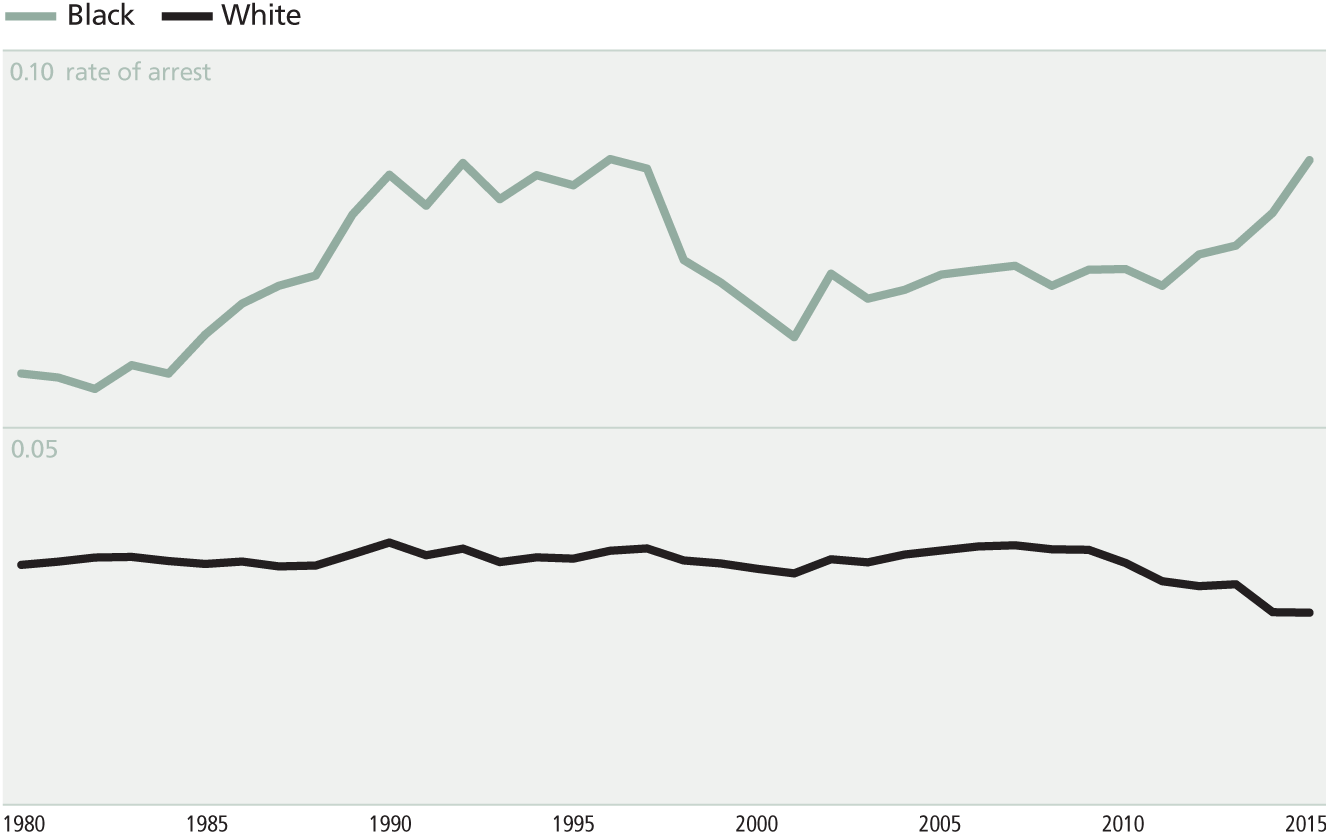
As visualized above, from 1980 to 2015 Blacks were arrested at higher rates than Whites. This inequality rose dramatically after President Ronald Reagan’s new drug policies were implemented in the mid-1980s. During the late 1990s, the Black arrest rate began to fall. Yet, it started climbing again in recent years. In fact, in 2015 the Black arrest rate for minor offenses was the highest recorded in the last 35 years. However, the White arrest rate—which has been relatively constant since the 1980s—has recently started to fall, exacerbating the already substantial inequality between Black and White arrest rates.
These national trends suggest recent, well-publicized arrests of Black residents living their daily lives are not anomalies. Instead, they reflect the growing number of Blacks arrested for minor nonviolent, non-drug related offenses. This longitudinal perspective illuminates that recent well publicized arrests are not a new phenomenon attributable to the recent rise of White supremacy or the Trump presidency. Instead, they are part of a long-standing pattern of Blacks being policed for mundane actions.
Well publicized arrests for living while Black are not new, attributable to the recent rise of White supremacy or Trump’s election, but part of a long-standing pattern.
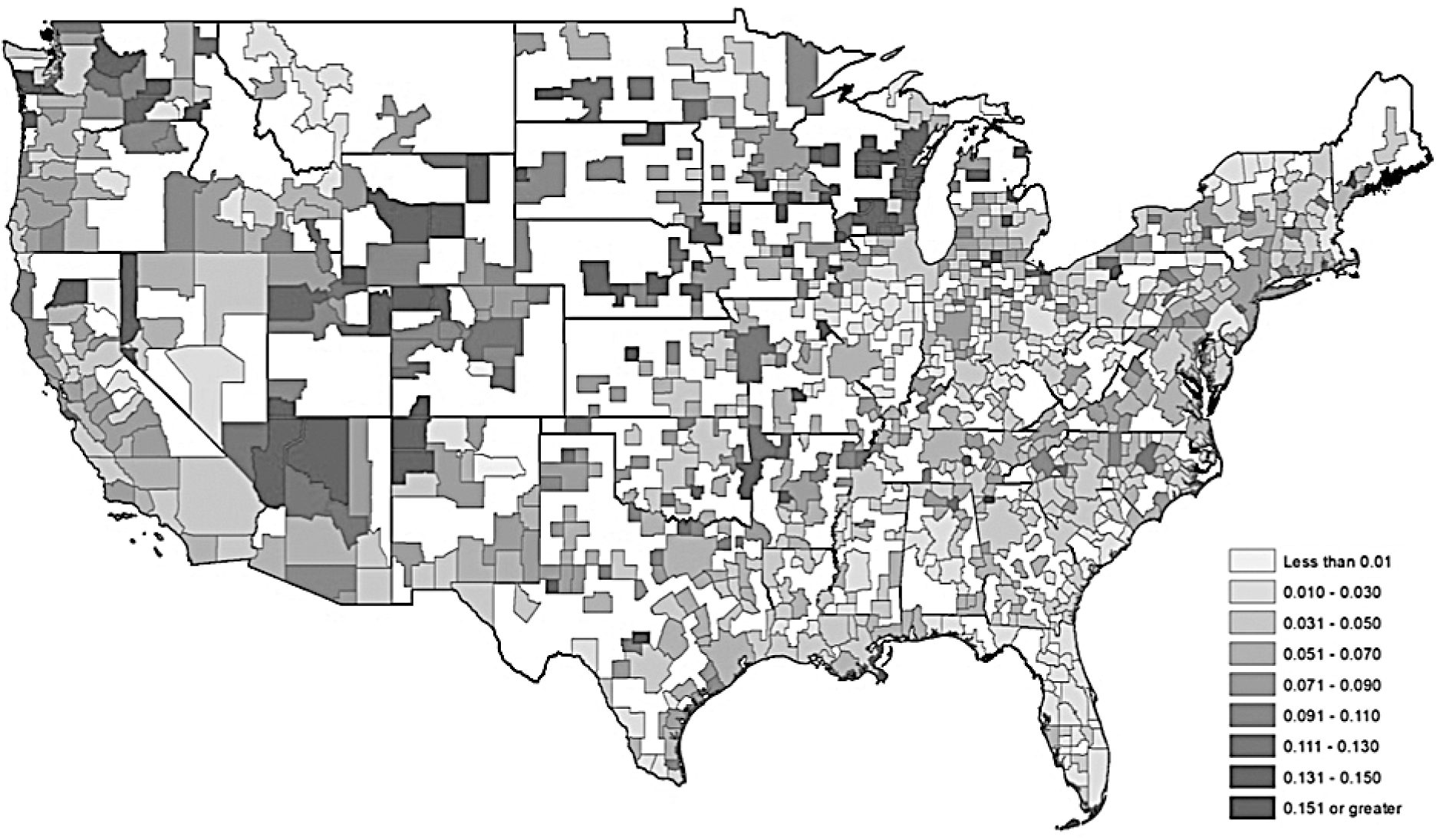
However, it is important to note the inequality between Black and White arrest rates vary across the country. As visualized on p. 68, smaller metropolitan areas in the West and Midwest, like Madison, Wisconsin, Flagstaff, Arizona, and Reno, Nevada, have some of the highest Black arrest rates. In each of these communities, an average of over 15% of the Black population is arrested for minor offenses every year. This is juxtaposed with metropolitan areas like Philadelphia whose Black arrest rate is as low as 2%. Two percent is still notable and as evidenced by the Starbucks incident these arrests can disturb lives and evoke protest. Yet, they are only a piece of the larger trend.
Black-White minor arrest inequality is strongly correlated with Whiter metropolitan areas. In other words, Blacks are arrested at disproportionately higher rates in “White spaces”—be they White metropolitan areas or White neighborhoods. Moreover, the relationship between White space and high rates of Black arrest is becoming stronger over time. Blacks are more likely to be arrested for minor nonviolent non-drug related offenses in White spaces now than they were in 1980.
It is well documented that when Black bodies are in White spaces they are seen as “out of place” and subject to state-sanctioned regulation and sometimes even violence—as evidenced by the 2012 killing of Trayvon Martin. Outrage, boycotts, and protest, like those after highly publicized shootings and the Starbucks arrests, are in order. Still, we must realize these incidences are not the exception—they are the norm.
What these data demonstrate is the recent public attention to the hyper-regulation of Black bodies in White spaces is warranted. Yet, addressing these inequities will require more than singular interventions and sensitivity trainings. We must challenge the very notions of state-sectioned institutionalized racial segregation.