




Abstract
Lance Hannon and Aaron Siegel on profiling and policing physical space as well as people.
Racial profiling is usually described as the act of suspecting an individual of wrongdoing based on racial stereotypes. To prove illegal racial profiling by the police, courts often require evidence that “similarly situated” individuals have experienced unequal treatment. Yet, this emphasis on comparing different individuals in the same context ignores how the context itself can be racially profiled. For example, if police officers form opinions about the dangerousness of a neighborhood based on whether or not the area is predominately Black, those preconceptions can affect how they interact with everyone they meet in that neighborhood. In this sense, police officers can racially profile places, not just people.
Imagine a low-crime majority Black neighborhood. In that neighborhood, one out of every ten Black pedestrians gets stopped for questioning, as does one out of every ten White pedestrians. Across town, in a low-crime majority White neighborhood, only one out of every hundred people—both White and Black—gets stopped for questioning. Despite being ten times more likely to be stopped in the predominantly Black neighborhood, an analysis focused on similarly situated individuals would conclude a lack of racial profiling by the police because the race-specific stop rates were the same within neighborhoods.
We found a comparable phenomenon occurring in Philadelphia where an examination of similarly situated individuals would fail to uncover an important injustice. The two-panel figure at right displays the violent crime rate in a Police Service Area on the horizontal axis and the percentage of vehicle stops with frisks on the vertical axis. Panel A plots those Police Service Areas in which Black residents were not in the majority. About two out of every five stops in Philadelphia took place in such communities (most of which involved Black and Latinx vehicle occupants). We estimated the line that best fit the relationship on top of the individual data points. For the areas displayed in Panel A, higher violent crime rates were associated with higher frisk rates. One should expect this relationship, since the lawful purpose of a frisk is to check for weapons on or near a dangerous suspect and “high crime area” is a common justification for police actions.
The link between frisk rates and violent crime rates varies by area racial predominance
Panel A: Vehicle and/or occupant frisk rates and violent crime in areas less than 50% Black
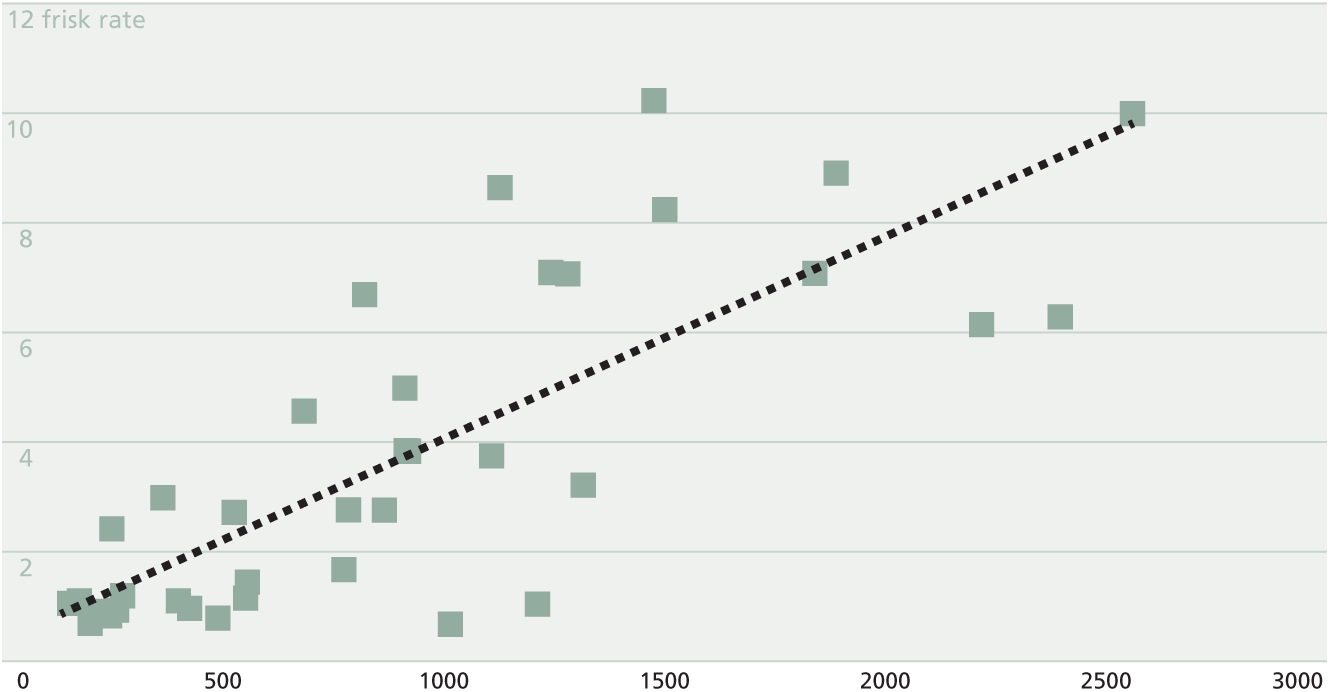
Panel B: Vehicle and/or occupant frisk rates and violent crime in areas greater than 50% Black
Note: n=65 Philadelphia Police Service Areas (PSA). PSA 7700 (the airport) is omitted. Based on publicly available data for 1,205,033 motor vehicle stops (January 2014-April 2018) and 31,710 violent crimes (2014-2015).
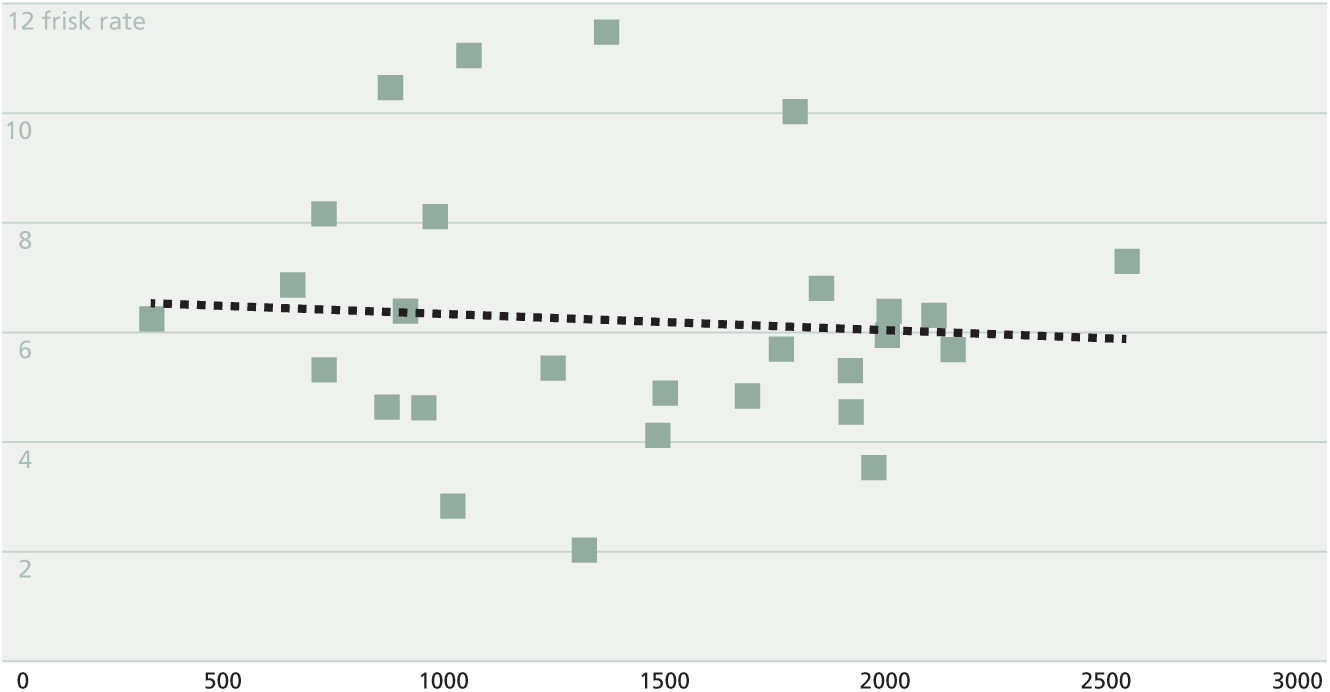
The trend in Panel B defies this expectation. Panel B plots the relationship between violent crime rates and frisk frequency for Police Service Areas in which a majority of the residents were Black. These places exhibited a median frisk rate that was twice as high as that seen in non-majority Black areas. Here, we found no discernible relationship between the violent crime rate and the rate at which motorists were frisked. In other words, going from one of the city’s most violent to least violent areas did not affect a person’s chances of being pulled out of the car and frisked during a routine traffic stop.
One potential explanation for these trends is that police officers may not perceive differences in levels of dangerousness among Black neighborhoods in Philadelphia. As is evident in our graphic, majority Black areas tend to have higher average violent crime rates than other spaces. Yet it is also true that many predominately Black places have violent crime rates significantly below the city’s average. Consider the case on the far left in Panel B. It has a violent crime rate that is only one third of the city’s average, but a frisk rate that is three times that of the comparable low-crime places in Panel A (places that are not predominately Black). It is possible that low-crime Black areas end up being painted with the same brush as high-crime Black areas due to neighborhood-level racial stereotypes.
An alternative explanation could be that it is not racialized neighborhood stigma driving the dynamic, but that Black people comprise a larger proportion of all detainees in predominately Black neighborhoods and frisking is more arbitrary for Black people than for other individuals. However, when we examined the relationships between violent crime and frisk rates by individual racial/ethnic classification, we found that they were similarly weak for all people stopped in predominately Black places. Thus, simply comparing similarly situated Black, White, and Latinx individuals obscures evidence of racial profiling at the neighborhood level.
Our findings correspond to some of our own previous Philadelphia-based research as well as research by others using data from different cities. For example, using data from Baltimore, Chicago, and Seattle, Lincoln Quillian and Devah Pager found that neighborhood racial composition mattered more than the crime rate for determining perceptions of local crime. Similarly, focusing on data for Chicago, Robert Sampson and Stephen Raudenbush found that an area’s racial composition mattered more than objective signs of disarray for determining perceptions of disorder. They argued, “dark skin is an easily observable trait that has become a statistical marker in American society, one imbued with meanings about crime and disorder that stigmatize not only people but also the places in which they are concentrated” (emphasis added).
Of course, people do not become concentrated in places by accident; the high level of racial segregation in Philadelphia and most U.S. cities allows areas to be racially coded. While the city of Philadelphia as a whole has roughly equal percentages of Black and White residents, such a balance is very rarely seen in Philadelphia’s neighborhoods. The majority of Black Philadelphians live in neighborhoods that are at least 85% Black. Similar patterns are evident in New York, Chicago and other large cities.
Because residential segregation in the U.S. is so pervasive and persistent, we believe it is important for cities to track and respond to racial disparities in policing at the neighborhood level (in addition to inequalities at the individual level). Just as police officers may profile all Black individuals as uniformly suspicious based on racial stereotypes, they may perceive all Black neighborhoods as equally dangerous. In reality, Black neighborhoods vary tremendously in their violent crime rates. The rate at which people are frisked for weapons in Black neighborhoods should match that reality, as it does for other communities.
Just as police officers may profile all Black individuals as uniformly suspicious based on racial stereotypes, they may perceive all Black neighborhoods as equally dangerous.
Furthermore, it is important for researchers and reformers to recognize that stop-and-frisk tactics can extend beyond pedestrian investigations for suspected street crimes to also include routine vehicle stops. In Philadelphia, after public pressure and a lawsuit focused on racial bias in pedestrian stop-and-frisks, the number of pedestrian stops has significantly declined—the majority of frisks now involve people in vehicles instead of pedestrians. Going forward, we recommend that calls for accountability include vehicle stop-and-frisks and incorporate the ways in which racialized notions of dangerousness apply to places as well as people.