




Abstract
People rely on powerful stereotypes to classify others as “illegal,” demonstrating that, like race and gender, documentation status may be as much a social construction as a legal one.

If someone asked you, on the spot, to prove you were a U.S. citizen, could you do it? Unless you happened to be on your way to the airport for an international flight, you probably wouldn’t have your passport in your pocket. And if you lived in one of several states where non-citizens are eligible to receive a driver’s license, showing a license wouldn’t do the trick. If you’ve never thought about this question before, it’s because you enjoy the privilege of presumed citizenship. But recent evidence suggests that many Americans—including U.S. citizens and legally present immigrants—are not so lucky.
Multiple news sites have reported stories of Motel 6 workers handing over guest lists of “Latino-sounding” names to Immigration and Customs Enforcement (ICE) agents and the State Department refusing to recognize birth certificates of some U.S. citizens who were born along the U.S./Mexican border. Over the last couple of years, a growing class of people living in America has started finding their “legal” status being questioned. And it’s not just government workers and immigration officers (like ICE officials, who have repeatedly wrongfully targeted American citizens), but also the broader public doing that questioning.
Despite its far-reaching consequences, illegality is not a simple, straightforward condition. Rather than being fixed and permanent, legal status can change by area of residence, time period, and policy configuration. Moreover, focusing on its complex legal origins obscures the fact that illegality is also socially produced. Like race and gender, categorization of some immigrants as “illegal” may be just as much a social construction as a legal one. Common observers and even authorities do not typically rely on people’s actual documentation to initially judge who is “illegal.” Instead, people rely on powerful stereotypes to classify individuals as “illegal,” regardless of actual documentation status, a condition we refer to as “social illegality.” Immigration laws’ complexities may allow for illegality stereotypes to take hold.
Like race and gender, categorization of some immigrants as “illegal” may be just as much a social construction as a legal one.
To understand who Americans stereotype as “illegal,” we conducted a survey experiment on a representative sample of non-Hispanic White adults in the United States. In this experiment, we created thousands of profiles of hypothetical immigrants and randomly varied some of their characteristics like national origin, occupation, and English language ability. Then we asked our respondents to identify whether each hypothetical immigrant was illegally in the United States. This design allowed us to assess the independent effect of each of our variables—the characteristics in each profile. Knowing which traits are the most powerful in shaping suspicions could help us begin to design policies to counteract negative and, as we found, often incorrect stereotypes.
Who Fits the “Illegal” Profile?
News reports and previous research have found that suspicions of illegality depend on immigrant characteristics like ethnicity, occupation, and criminal history. For example, while Latinos often report experiencing others’ suspicions of their illegality, Asian immigrants do not. According to a 2016 Los Angeles Times piece by Anh Do, a Vietnamese cook told the reporter: “If a police officer or some other authority figure came into the restaurant, the Vietnamese owner would order all the Mexican workers to take a break, come back later. For me, she would just say, ‘This is my sister who’s visiting.’”
Occupation is also a potential illegality cue. According to demographer Jeffrey Passel, 32% of undocumented immigrants work in the service industry, but 14% are professionals or managers and 13% work in sales or office support. Despite this occupational diversity, immigrants with low-status jobs may experience higher rates of suspicions. For example, scholars Daniel Martinez and Jeremy Slack reported in 2013 that one of their immigrant informants was deported after a police officer at a traffic light became suspicious upon seeing “tools and building materials” in his truck. The officer contacted the U.S. Border Patrol, whose agents arrested the man.
Restrictionist politicians have tried to associate unauthorized immigrants with criminality, which may shape how conservative individuals view immigrants. For example, during the 2016 presidential campaign, Donald Trump famously described undocumented Mexican immigrants: “They’re bringing drugs. They’re bringing crime. They’re rapists.” Even though all evidence suggests that undocumented immigrants do not commit crimes at higher rates than other groups (see Anna Flagg’s 2018 New York Times piece), anti-immigrant politicians and the media often draw a direct connection between the two, and these negative portrayals may impact Americans’ ideas about undocumented immigrants. For example, one of us (Flores) reported in American Behavioral Scientist in 2014 on a study examining the social consequences of a punitive immigration law passed by the city of Hazleton, Pennsylvania, in 2006. Local leaders had argued that the law was necessary to address the problems they associated with immigration, including drug dealing, gangs, and murder. The study showed that the law increased natives’ suspicions that all immigrants, and even U.S. born Hispanics, were “illegal.” In turn, immigrants’ perceived illegality further energized anti-immigrant mobilization. Even non-Hispanic residents who were generally supportive of Latino immigrants internalized the association with illegality and crime. Flores interviews Lucio, a 67-year-old Italian immigrant who came to Hazleton as a teenager. Lucio was a small business owner and generally sympathetic toward Latino immigrants who said, of local support for the ordinance, “…I immigrated myself, but I came here very legally. I had to wait nine years… before they allowed me to come to America. So I went through the process and I became an American. I didn’t jump the fence and come to America to do what they do. That’s no good. That, I disagree. Legally, they come here, that’s good. But if you are going to come here illegally and sell drugs and kill people like they do.… ” Locals like Lucio came to reproduce the association between undocumented migration and crime advanced by proordinance politicians and perpetuated by local media.
Do All of These Factors Matter? And How Much?
Clearly, different individual traits contribute to the stereotyping of illegality in certain locales. However, many times these traits co-occur within the same individuals. For example, it is not clear whether a middle-aged immigrant from Mexico who works as a gardener and speaks little English may be stereotyped as “illegal” on the basis of his occupation, national-origin, gender, or class. Nor do we know whether these stereotypes are national in scope or whether each dimension is equally consequential. In addition, although studying the perspectives and experiences of immigrants themselves—as most existing work has done—is important, it is not clear whether the broader public shares all of these stereotypes.
The paired conjoint survey experiment we launched in November 2017 allowed us to systematically test the effect of each trait net of the rest. Because we used a nationally representative sample, we were able to test whether these effects apply to the non-Hispanic White population at large.
In this research, we wanted to understand: who is most at risk of being perceived as an “illegal immigrant”? We tasked 1,515 White Americans with looking at over 10,000 experimentally manipulated profiles of hypothetical immigrants and then asked them: Do you think this person is undocumented/ illegal? Each respondent viewed 5 pairs of profiles, evaluating 10 total profiles for a sample size of 15,109 observations. The evaluation of repeated profiles is standard practice in conjoint designs. GfK, an established online survey firm (formerly known as Knowledge Networks), conducted the survey.
We tested nine different individual traits to isolate how much each contributed to an immigrant being viewed as “illegal.” Following the literature, we selected the most theoretically relevant factors: age, gender, time in the United States, national origin, occupation, education, English fluency, police record, and usage of government benefits.
Our research reveals that immigrants who are already disadvantaged—those who have less education, don’t speak fluent English, just recently moved to the United States, and are unemployed or have jobs in the informal economy—are suspected of being undocumented at higher rates. These stereotypes are not always based on reality. According to the non-partisan Migration Policy Institute, most undocumented immigrants, for instance, are long-term residents of the United States who are employed and speak at least some English.
We also found, similar to anthropologist Leo Chavez, that coming from Mexico or Central America marked an immigrant as “illegal” in respondents’ minds, but so did some other nationalities. White Americans believe that Syrians and Somalis—who recently have come to the United States as refugees and thus are legal residents—are as likely to be undocumented as Mexicans and Central Americans. Immigrants from countries in Africa—which President Trump has called “shithole countries”—also experience high rates of suspicion that do not match reality according to reports by the Pew Research Center and Migration Policy Institute. In sharp contrast, almost 1.5 million undocumented Asian immigrants and over half a million European and Canadian undocumented immigrants currently living in the United States are largely invisible to White Americans. The racialization of illegality is undeniable.
Nevertheless, the most powerful predictor of perceived illegality was having committed a crime, particularly a violent crime like murder or rape. Criminality had the strongest effect of any of the traits we tested, including national origin. Immigrants with a murder record were suspected of being undocumented 30 percentage points more often than those with no criminal record.
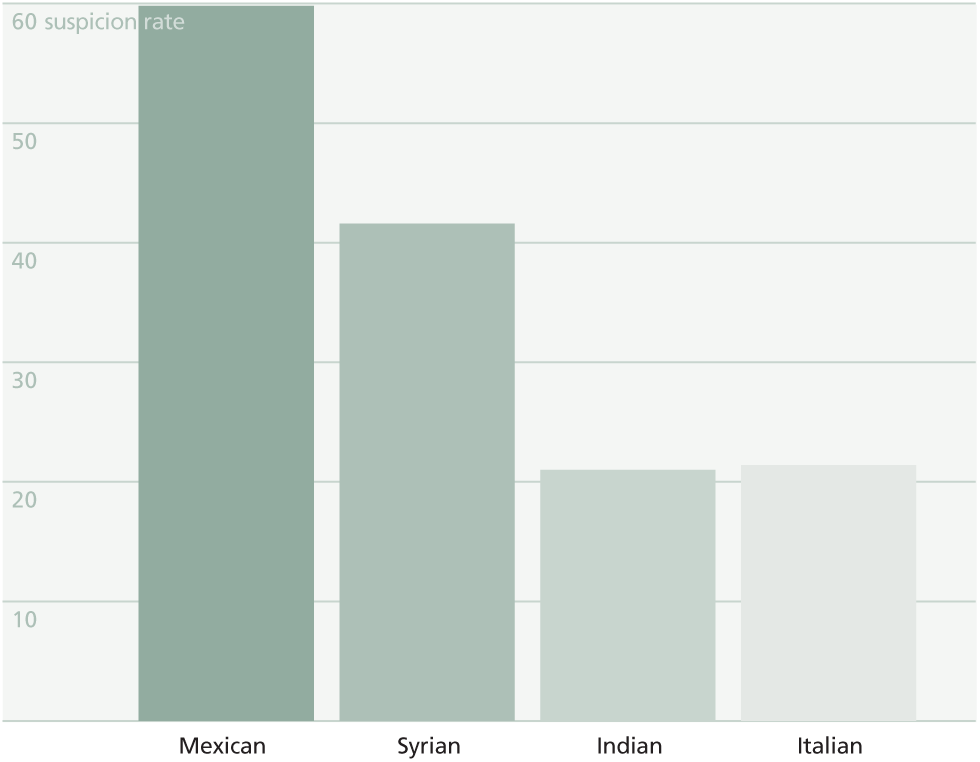
Our experiment was designed to test independent effects, but in real life some of these characteristics are more likely to co-occur among some groups than others. This could exacerbate the differential rates at which groups experience these suspicions. For example, Mexican immigrants are more likely to be lower educated and hold blue-collar jobs. Therefore, their risk of being perceived as “illegal” may be higher, on average, than for other immigrants. To better understand overall risks for specific groups, in the figure below, we plot the overall suspicion rates of four national origin groups based on the groups’ average characteristics across all of the traits in our experiment. Clearly, when we take into consideration how different immigrant traits like education levels and occupation status are correlated with national origin, we see much larger differences in suspicion rates for different groups. In particular, Mexican immigrants with average group values are suspected of illegality almost 60% of the time. In contrast, Indian and Italian immigrants, who tend to be higher educated and hold higher-status jobs, are only suspected of undocumented status about 20% of the time, a shocking 3 times lower than Mexicans.
Interestingly, Syrian immigrants, who typically come to the United States as refugees and receive government benefits, are suspected 42% of the time—twice as often as typical Indian or Italian immigrant profiles. These large differences suggest that members of these four national origin groups face disparate risks of being suspected of illegality and experiencing discrimination or other negative treatment due to these suspicions.
Do Respondents’ Traits Shape Their Perceptions of Illegality?
Can partisanship or class background shape individuals’ beliefs about illegality? To test this idea, we estimated separate models by partisanship and class. Overall, we found that both low-educated and Republican respondents suspect more of the immigrant profiles we presented of illegality. At the same time, we found a high degree of consensus about who the “illegals” are across the board. For example, even college-educated and liberal respondents associated illegality with violent crime.
People rely on powerful stereotypes to classify individuals as “illegal,” regardless of actual documentation status, a condition we refer to as “social illegality.”
White Americans’ suspicions of illegality based on typical national origin group traits
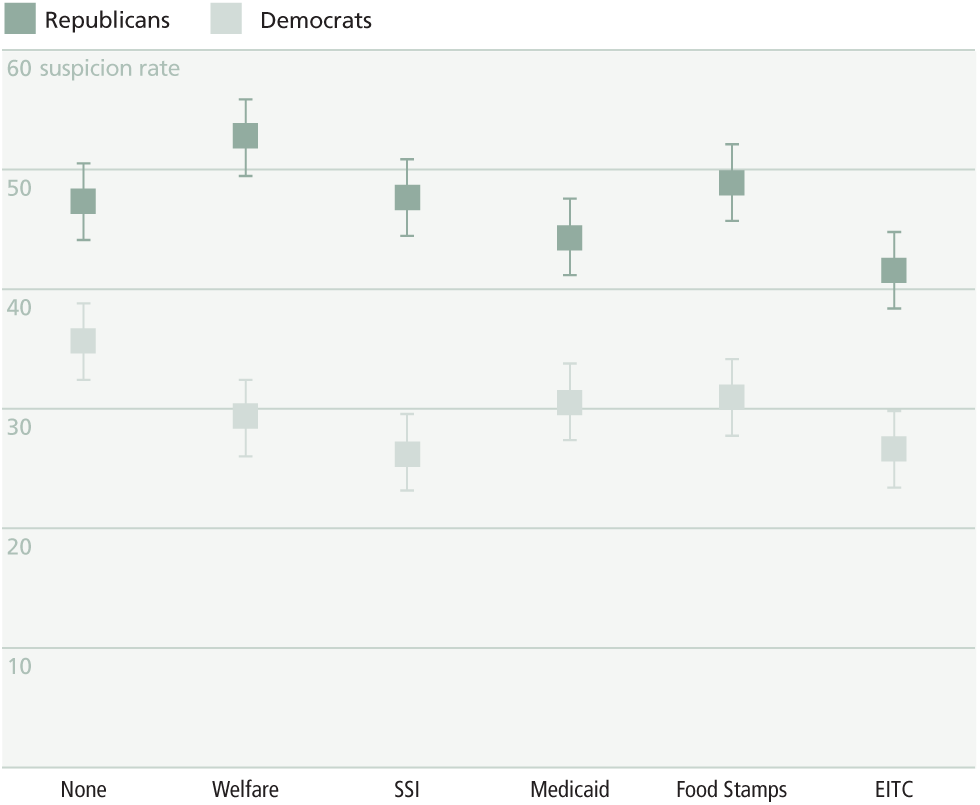
Interestingly, one dimension where Republicans and Democrats disagreed was on government benefits. As shown below, Democrats correctly interpreted receiving welfare as a signal of legal status. But Republicans believed that receiving welfare meant an immigrant was illegal—even though in reality undocumented immigrants are ineligible for federal cash assistance programs. Overall, however, we found few other differences between White Republicans and White Democrats, even though, according to a June 2018 Pew Research Center report, members of these groups tend to have divergent attitudes toward overall immigration policies. These shared stereotypes suggest that beliefs about undocumented immigrants are widespread. Democrats and Republicans alike seem to be absorbing at least some of the political messages coming from Donald Trump and the extreme right.
Reporting Immigrants
In order to further explore the implications of these suspicions, our experiment also asked respondents the yes-or-no question, “If you saw these immigrants… would you consider 10asking local law enforcement to investigate their legal statuses?” Again, respondents separately assessed each immigrant profile. Although this question does not measure an actual behavioral response, it provides preliminary evidence of how non-Hispanic Whites could act on their suspicions of immigrant illegality. In fact, in recent years, there have been increased calls for U.S. residents to report undocumented immigrants, and the government has set up anonymous hotlines for this purpose, even offering financial rewards for tipsters. This further underscores the importance of understanding “social illegality” and its behavioral consequences, because callers may not have access to suspects’ documentation and most, we assume, are not trained as immigration specialists.
All evidence suggests that undocumented immigrants do not commit crimes at higher rates than other groups, yet anti-immigrant politicians and the media often draw a direct connection between the two.
White Americans’ suspicions of illegality based on use of government benefits, by respondent partisanship
White Americans’ suspicions of illegality and willingness to notify law enforcement
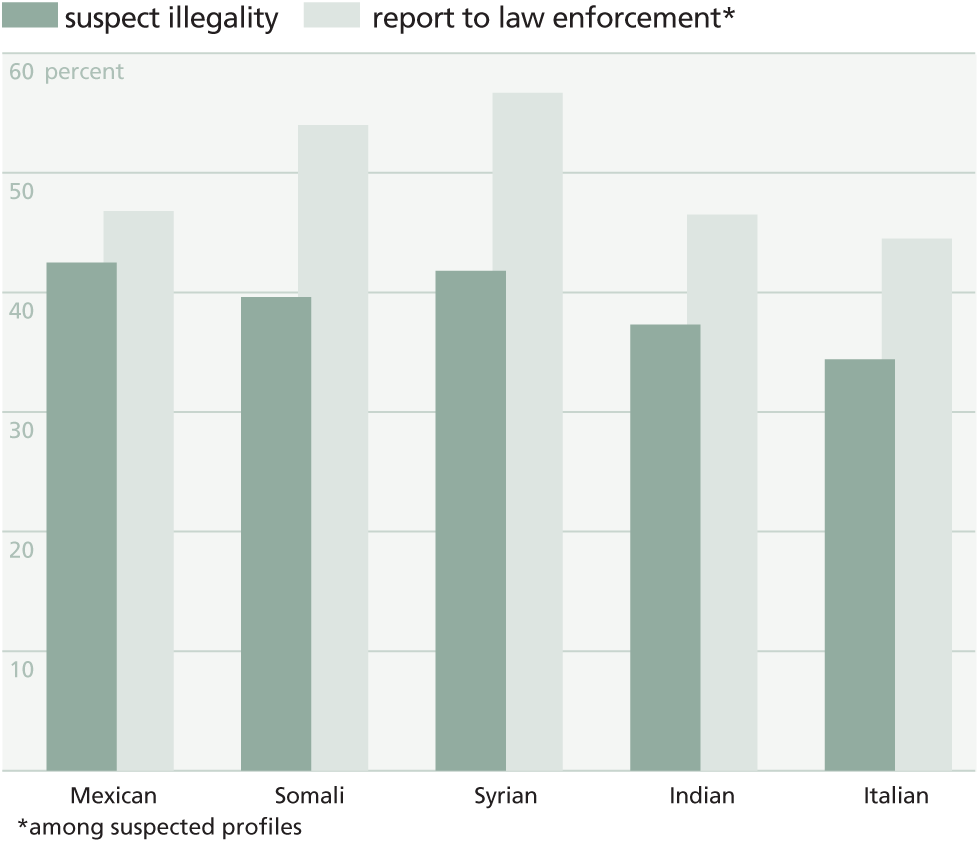
We found largely similar results to our first analysis (although differences were smaller than in our first dependent variable). As expected, having a criminal record increased probabilities that respondents would choose to report immigrants, particularly violent and stereotypical immigrant crimes. We found no statistically significant results for education, government services, and most “time in the United States” categories.
Interestingly, we found that after controlling for whether respondents suspected an immigrant was undocumented, they were disproportionately likely to say they would contact law enforcement only if the immigrant was from Syria or Somalia. These results are demonstrated at left, where we compare the predicted rates of suspicions of illegality and of intent to notify law enforcement (among profiles suspected of illegality). While Somalis and Syrians are less likely than Mexicans to be suspected of being undocumented, net of those suspicions, White Americans are actually more likely to say they would notify law enforcement about these people. We suspect these results may be driven by White Americans’ Islamophobia and fears of terrorism, and while these results are more preliminary, they make the case that researchers need to study perceptions about and treatments of diverse immigrant groups, including those immigrant groups often excluded from such studies.
Why This Matters: Identifying Different Types of “Illegality”
The confluence of illegality as dictated by laws and illegality as attributed by society may create different social categories into which individuals may be unwittingly assigned. In turn, these social categorizations could be highly consequential for them. When both the legal system and society consider an individual to be “legal,” that person enjoys full citizenship. These are individuals who have U.S. citizenship by birth or naturalization and are never confronted by others about their legal status. When individuals do not have legal authorization to be in the United States, but are not typically suspected of being illegally in the country, they are invisibly illegal. Although they may lack legal authorization to reside or work in the United States, they are not commonly suspected of being undocumented. As a result, they can live their lives relatively unconcerned about illegality because most people expect them to be legal and treat them as such. This category includes undocumented European and Canadian immigrants in the United States, as well as high-status but undocumented Asian workers and light-skinned Latin Americans.
When individuals have legal documents but society considers them “illegal,” we label them socially illegal. This category may include substantial numbers of U.S. born individuals of Mexican and Central American heritage, who are primarily suspected because they fulfill an ethnic-based stereotype. Our respondents’ perceptions that Mexicans and Central Americans are likely undocumented are to some extent grounded in reality. Nevertheless, as Mexican immigration flows have slowed down and undocumented migration from Asia and Africa has increased, Mexicans no longer make up the majority of the undocumented population, as demographer Jeffrey Passel found in 2017. Furthermore, sociologist Filiz Garip has found that more recent Mexican immigrants in the United States are more formally educated and more likely to be documented. Nevertheless, due to elite rhetoric, news media coverage, and institutional priorities, social illegality may continue to overwhelmingly affect these groups.
Relationship between social and legal sources of illegality
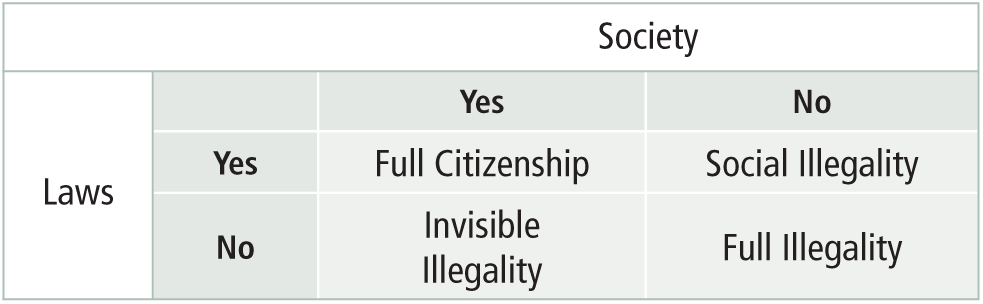
The social illegality category also includes Middle Eastern refugees who, despite their status as legal refugees, fulfill ethno-religious stereotypes. So, too, does it include documented individuals working in informal occupations or who speak little English, and we expect these individuals will potentially face negative consequences in their everyday lives. At the same time, they have the power to counter such claims of illegality by producing actual documentation. This is not the case with the last group, which experiences full illegality. These individuals lack legal documentation and, according to society, fit the stereotype of illegality. They face the full weight of social and legal illegality, and we expect they will face especially severe negative consequences.
Implications for the Study of Ethnic Inequalities
Social illegality may help explain the enduring socioeconomic penalties faced by members of certain nationalities, such as Mexicans and Central Americans, two of the most suspected groups in our study. Being perceived as illegal may shape how landlords, police officers, employers, and teachers interact with individuals of these nationalities and negatively affect the opportunities afforded to them. For example, given that immigration authorities are likely to share the same social stereotypes as the rest of the population, they might target specific groups for closer inspection. This could contribute to the significant nationality-based disparities in police officer stops and deportations reported by sociologist Tanya Golash-Boza, which future researchers could investigate. Perceived illegality may help explain why Latinos receive lower call-back rates from landlords than do non-Hispanic Whites or even Asians, or why they receive worse health care treatment and face more precarious working conditions than other ethnic groups, as prior sociological work has documented.
The prevalent belief that having some kind of criminal record was itself a signal of illegality for Democrats and Republicans alike is troubling. For one, it’s simply inaccurate. And if “undocumented” and “criminal” become linked in the minds of Americans, this could further justify the inhumane treatment of immigrants in our nation, which may be exactly what some proponents of harsher immigration policies want.
Understanding social illegality is crucial. Being subjected to suspicions of illegality, and the ensuing scrutiny and surveillance that follows, can come with serious consequences, including physical and mental health problems, incarceration, and, of course, deportation. According to analyses by the American Immigration Council and reported in the New Yorker, that goes even for citizens and legally present immigrants. Anyone who “fits the profile” could be in danger.
But this is not inevitable. We can educate ourselves about the biases that shape perceived illegality and how they may affect immigration enforcement. We can also hold our elected leaders and government officials accountable to existing laws, which protect individuals from unequal treatment based on race or nationality. And we can focus on what unites us—our shared humanity as residents of the United States of America—rather than relying on inaccurate stereotypes promoted by nativist politicians to divide us.