




Abstract
Brian Powell, Landon Schnabel, and Lauren Apgar on Americans’ attitudes about denial of service.
“He is a private businessman. If he refuses to serve a customer, he should have the right to do so.”
“It all boils down to the same old thing—discrimination. If he doesn’t want to provide this service to all people, he shouldn’t be in the type of business he is in.”
On December 5, 2017, the U.S. Supreme Court heard arguments in Masterpiece Cakeshop v. Colorado Civil Rights Commission. Essentially, the court was to decide whether businesses can refuse to serve same-sex couples on religious grounds. The baker in question asserted that his work is artistry, and an artist cannot be compelled to create: that is, his religious objections to same-sex marriage were reasonable grounds to refuse to make art intended to celebrate a gay couple’s wedding. The Colorado Civil Rights Commission contended that the real issue at hand was a business seeking legal standing to discriminate against customers on the basis of their sexual orientation.
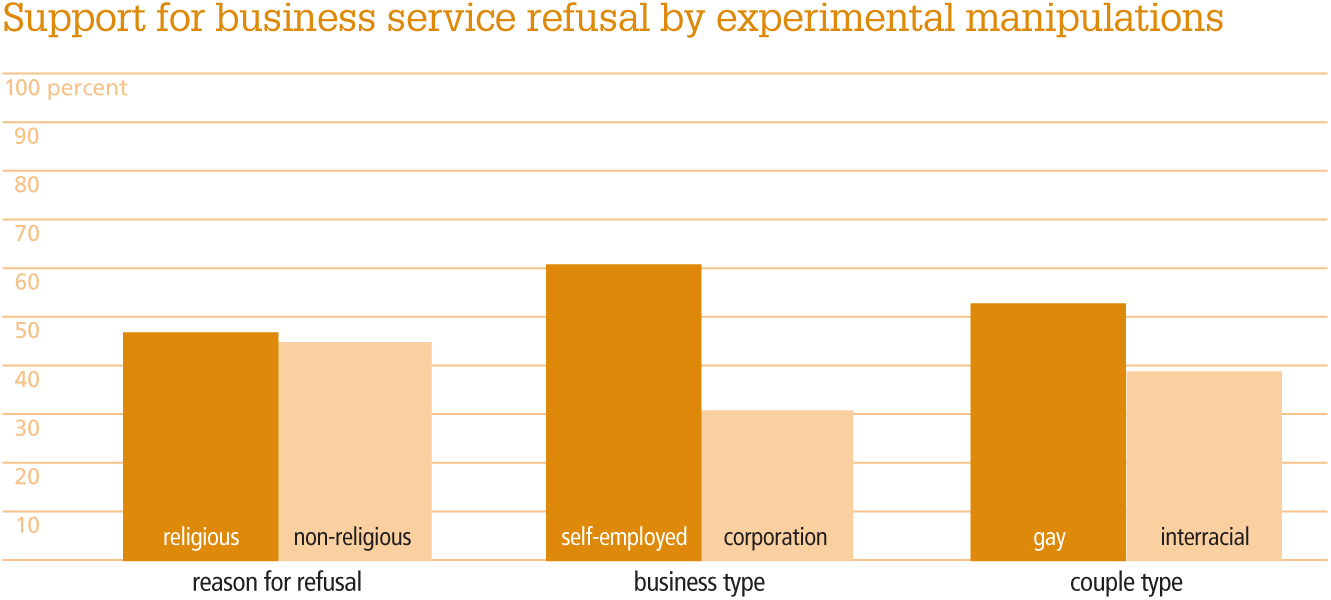
There’s not much good information regarding what the public thinks about whether, when, and why businesses should be allowed to deny service, so we designed an experiment. As reported in our 2017 Science Advances article “Denial of Service to Same-Sex and Interracial Couples,” we presented a nationally representative sample of 2,035 Americans with a vignette, or short story, in which a photographer refused to take a couple’s wedding invitation portraits. We changed three aspects of the story: 1) whether the refusal was for religious or non-religious reasons, 2) whether the business refusing service was a self-employed individual or a corporation, and 3) whether the couple denied service was a same-sex or interracial couple.
After reading the vignette, respondents answered whether they endorsed the photographer’s refusal of service. We then asked why they thought the business should or should not be able to refuse service; respondents gave us quotes like those in the epigraph. In addition, for those who read about a gay couple, we asked their opinions on same-sex marriage, and for those who read about an interracial couple, we asked about interracial marriage views. What they told us was surprising.
When are Americans Okay with Refusal?
We expected Americans would support refusal for religious reasons above non-religious reasons, but we were wrong.
Americans’ beliefs about denial of service were not tied to religious freedom. A nearly identical percentage of Americans endorsed a business denying service for non-religious reasons (45%) as for religious ones (47%). In fact, in the vignettes about the same-sex couple, Americans were slightly less likely to support denial of service for religious reasons.
We expected Americans would support service refusal for religious reasons above non-religious reasons, but we were wrong.
We also learned that Americans believed corporations had different rights than did self-employed individuals. Our respondents were twice as likely to support refusal by an individual photographer (61%) than by a corporation (31%). Thus, even though recent court decisions and legislative actions have equated corporations with persons, the public sees a difference between the two.
Additionally, we saw higher support for the refusal to serve a gay couple than refusal to serve an interracial couple. Still, a sizable proportion of our respondents believed it was acceptable for a business to discriminate against an interracial couple. Over half (53%) agreed that a gay couple can be denied service, while approximately two-fifths (39%) believed that an interracial couple can be denied service.
Does Opposition to Marriage Rights Predict Support for Refusal?
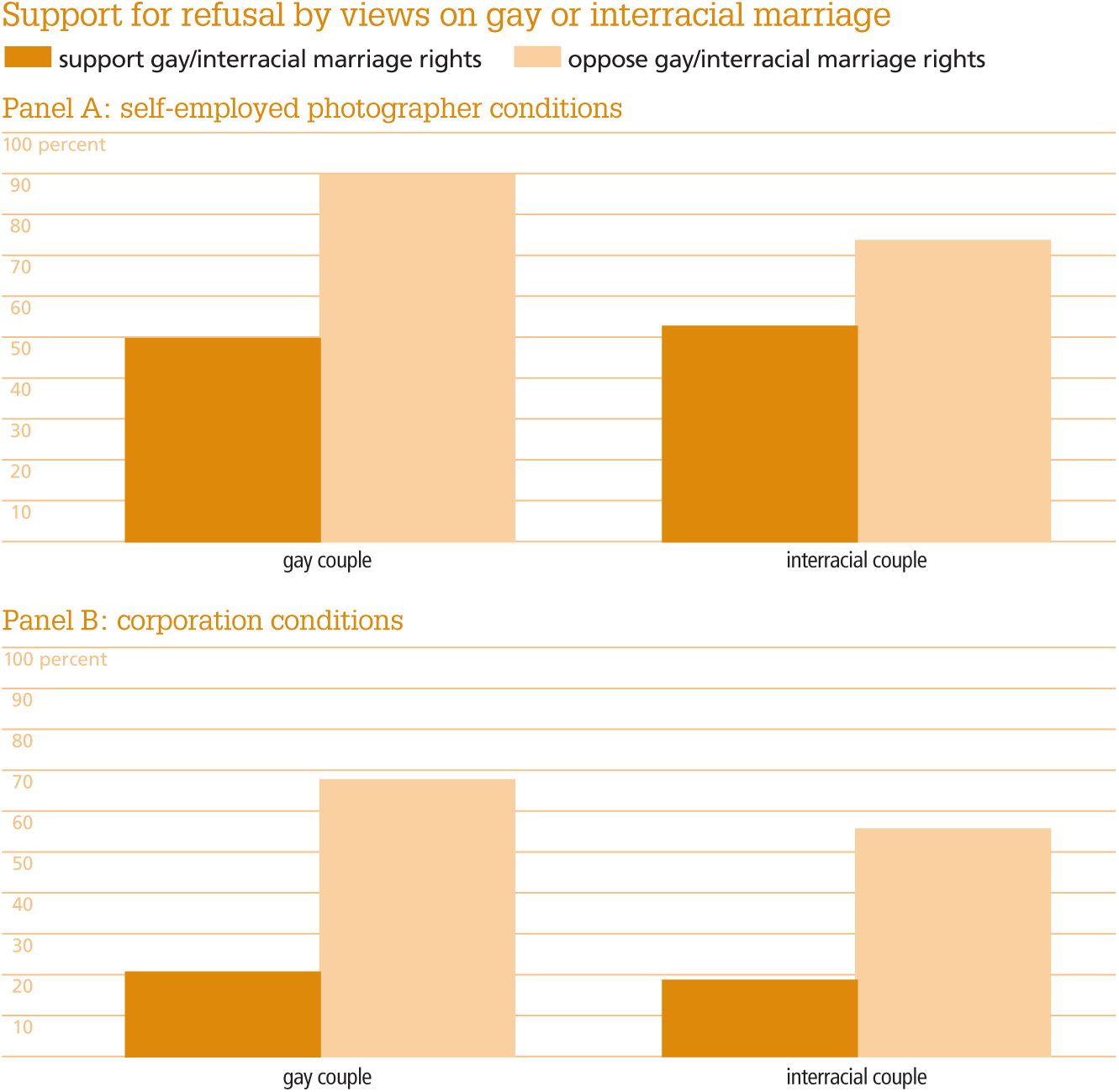
About three in five Americans (61%) in this study supported same-sex marriage, and nine out of ten (90%) supported interracial marriage. Individuals’ personal opinions about same-sex marriage affected their views on the denial of service vignette more than did arguments regarding religious freedom.
The middle figure on p. 74 shows that nine out of every ten same-sex marriage opponents (90%) believed that a self-employed individual should be allowed to refuse service to a same-sex couple. Three out of four opponents of interracial marriage (74%) thought that a self-employed individual should be able to refuse service to interracial couples. And while people may oppose same-sex marriage for religious reasons, they don’t care whether or not the business refuses on religious grounds: they are highly likely to endorse the business’s refusal regardless of stated reasons.
Even among supporters of same-sex marriage and interracial marriage, half believed that it was acceptable for a small business to deny service to same-sex (50%) and interracial couples (53%).
Are Some Groups More Likely to Support Refusal?
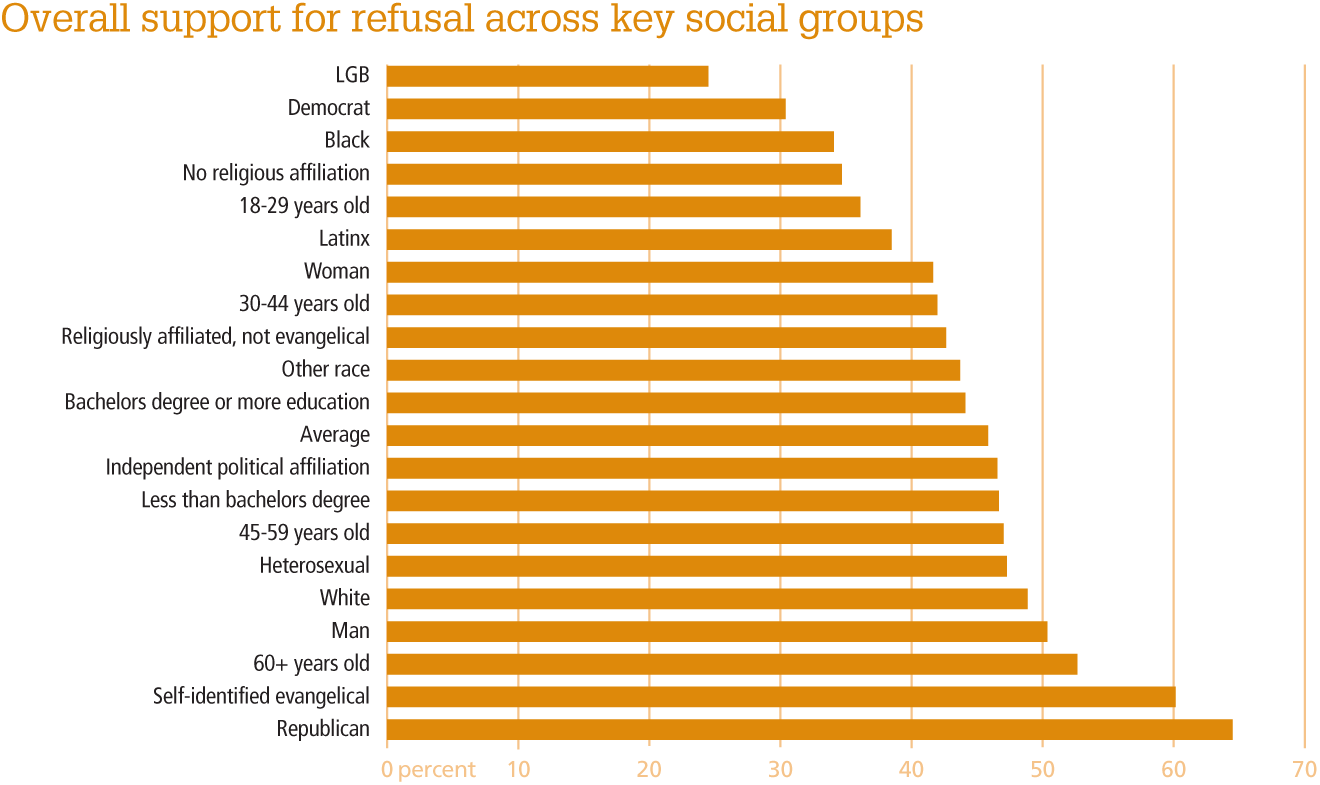
Some groups were more likely to support refusal than others. The figure on this page presents the proportion of different groups that endorsed refusing service to the couple across all experimental conditions (the average support for refusal across conditions was 46%). The groups most likely to endorse refusal were Republicans (65% endorse refusal), self-identified evangelicals (60%), those aged 60 or older (53%), men (50%), and non-Latinx Whites (49%).
Those least likely to support refusal were sexual minorities (25%), Democrats (30%), Blacks (34%), those with no religious affiliation (35%), those under age 30 (36%), and Latinxs (38%). Interestingly, Blacks were much less likely than Whites to believe that businesses can deny services to a same-sex couple, despite their relatively higher level of opposition to same-sex marriage.
Why do Americans Support Denial of Service?
We asked respondents to explain their answers. Those who opposed service refusal consistently said that denial of service to any minority group is discrimination. In the words of one respondent, “They are running a business, there should be no discrimination. Everyone pays with the same money.” Several people who read the same-sex couple vignettes—and thus were unaware of the parallel, interracial couple vignettes—explicitly compared denying services to gay couples with the historical denial of services to African Americans.
Source: Brian Powell, Landon Schnabel, and Lauren Apgar. 2017. “Denial of Service to Same-sex and Interracial couples: Evidence from a National Survey Experiment,” Science Advances 3 eaao5834.
Source: Brian Powell, Landon Schnabel, and Lauren Apgar. 2017. “Denial of Service to Same-sex and Interracial couples: Evidence from a National Survey Experiment,” Science Advances 3 eaao5834.
Americans who supported refusal cited individual rights or libertarianism. They said it was “his right as a private individual to refuse service to anyone he chooses. It is not the government’s business to be involved in individual rights,” or more succinctly, “his business, his option.” Sometimes they admitted that they supported the business refusing service to the couple because of their own opposition to same-sex relationships.
Although Americans were much more likely to support refusal by a self-employed individual than a corporation, the reasons people gave to support refusal were similar in both circumstances. The primary difference between the justifications given in support for self-employed versus corporate refusal was that, in the corporate condition, respondents were even more likely to emphasize that any business should be able to refuse for any reason: “the corporate chain should be able to refuse service to anyone and anything they don’t believe in or agree with!!!!!!!” Discussions of artistic expression and freedom of speech were mostly absent across conditions, despite their importance in legal arguments before the courts.
The half of marriage-rights supporters who endorsed a self-employed photographer’s refusal of service saw little contradiction in their viewpoints. Occasionally, they even connected the freedom to marry with the freedom of a self-employed photographer to deny service. Many assumed that customers will boycott discriminatory businesses in droves and had confidence that the market would sort things out by “put[ting] them out of business.” For example, one sexual minority said, “The photographer is an idiot. Although it is an inconvenience for the couple, ultimately, he is hurting himself. He will lose business in the long term as word gets around about this bad attitude.”
Sexual and racial minorities were among the least likely to support refusal to same-sex and interracial couples. In cases when sexual minorities did assert that a business should be able to refuse service, sexual and racial minorities typically said the couple shouldn’t do business with a bigoted company, that the company would not provide quality service if required to serve them, and that discriminatory businesses would not survive in the market.
Comments about the refusal to interracial couples were nearly interchangeable with those about refusal of service to same-sex couples. Americans generally gave the same types of libertarian concern for business rights or egalitarian concern for minority rights, regardless of whether it was a gay or interracial couple being refused service. In fact, although you might have assumed that the opening quotes of this article were about denial of service to gay couples, the responses were about denial of service to interracial couples.
Source: Brian Powell, Landon Schnabel, and Lauren Apgar. 2017. “Denial of Service to Same-sex and Interracial couples: Evidence from a National Survey Experiment,” Science Advances 3 eaao5834.
Religious Freedom, Markets, and Minority Rights
Many Americans view it as unacceptable and inconsistent with American values of fairness for businesses to deny services. Others view these practices as acceptable and consistent with American values of libertarianism. Still others trust the market to sort things out, with discrimination eventually putting companies out of business.
Even among supporters of same-sex and interracial marriage, half believe that it was acceptable for a small business to deny service to such couples.
From the perspective of the American public, the Masterpiece Cakeshop case and other efforts to “protect religious liberty” are not about religious freedom, freedom of speech, or even artistic expression. Instead, the question is whether businesses can discriminate between different types of customers for any reason.