




Abstract
The large-scale increase in attitudes toward LGBT americans has outpaced change on other social dimensions like race and immigration status.
The year was 1955. Police routinely raided lesbian and gay bars, arresting patrons and publishing their names and addresses in the paper. Sex between two women or two men was illegal, and homosexuality was understood by psychiatrists to be a mental illness. In many places it was illegal for women to dance with women, or men with men. In response to these oppressive conditions, a group of eight women formed the Daughters of Bilitis, the first lesbian activist organization founded in the United States. Phyllis Lyon and Del Martin, a lesbian couple, were two of the founders. Like their gay male counterparts in the Mattachine Society, these brave women took on the fight for civil rights against all odds.
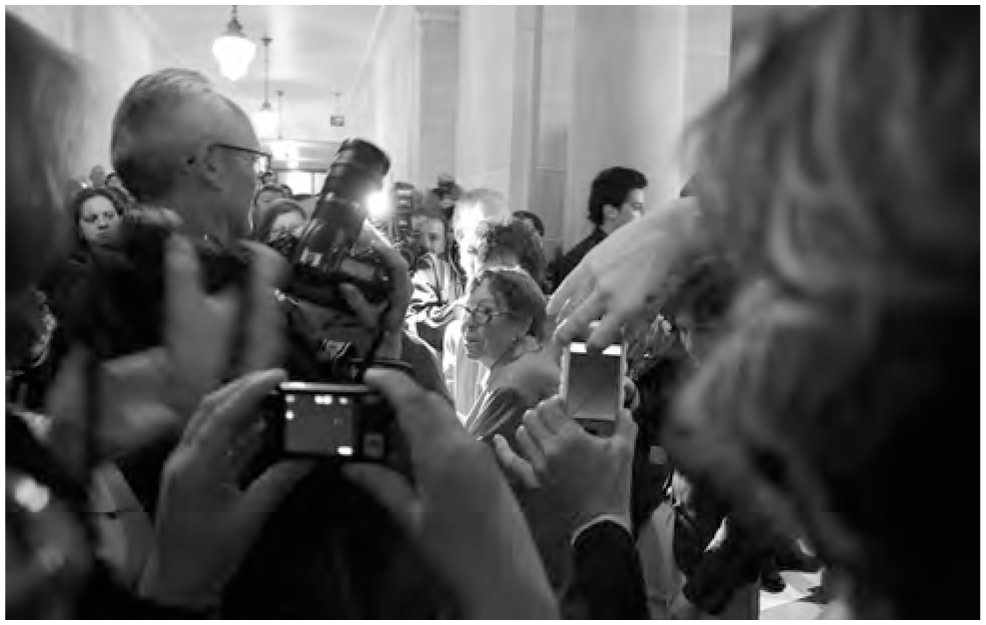
In 2008, Phyllis and Del were married by San Francisco Mayor Gavin Newsom. Celebrating the newly established right of same-sex marriage, they were the first lesbian couple to marry in San Francisco. Together for 56 years, the legal status of their marriage was settled just this year by the U.S. Supreme Court, when it ruled that the right to marry is guaranteed to same-sex couples by the Constitution. In a country that has been reticent to guarantee equal rights to lesbian and gay people, this marks an important step forward in the slow, hard-fought battle for full citizenship. In light of these political changes, it is worth asking how Americans feel about lesbian and gay people, and how these attitudes have changed over time. Below, I provide an overview of the social science data on attitudes toward lesbian and gay people and recount how sociologists understand the social forces behind changing attitudes.
Del Martin and Phyllis Lyon just after their groundbreaking marriage in San Francisco.
Brian Kusler, Flickr CC
In the last sixty years, much more has changed for lesbian, gay, bisexual and transgender people than just same-sex marriage. Laws prohibiting discrimination on the basis of sexual orientation are in place in 21 states; 18 of these also prohibit discrimination against transgender people. In addition, it is against the law to discriminate against lesbian and gay people in numerous cities and counties, as well as among employees and contractors with the federal U.S. government. This year, the U.S. Equal Employment Opportunity Commission ruled that federal employment discrimination laws should be interpreted to apply to lesbian and gay workers. If that ruling holds up in court, this will extend anti-discrimination laws to most workplaces across the country.
These policy shifts are happening rapidly and come from many sources: the courts, bureaucratic agencies, and state legislative bodies. They are the direct result of the long-term efforts of the LGBT movement, which has been fighting for decades for equal treatment, public recognition, and full citizenship for lesbian, gay, bisexual and transgender people. Throughout much of this time, this movement fought an uphill battle in a social setting that made them invisible: government officials who refused to meet with them, newspapers that would not print news of their protests, and a mental health system that diagnosed them as diseased but would not listen to their views.
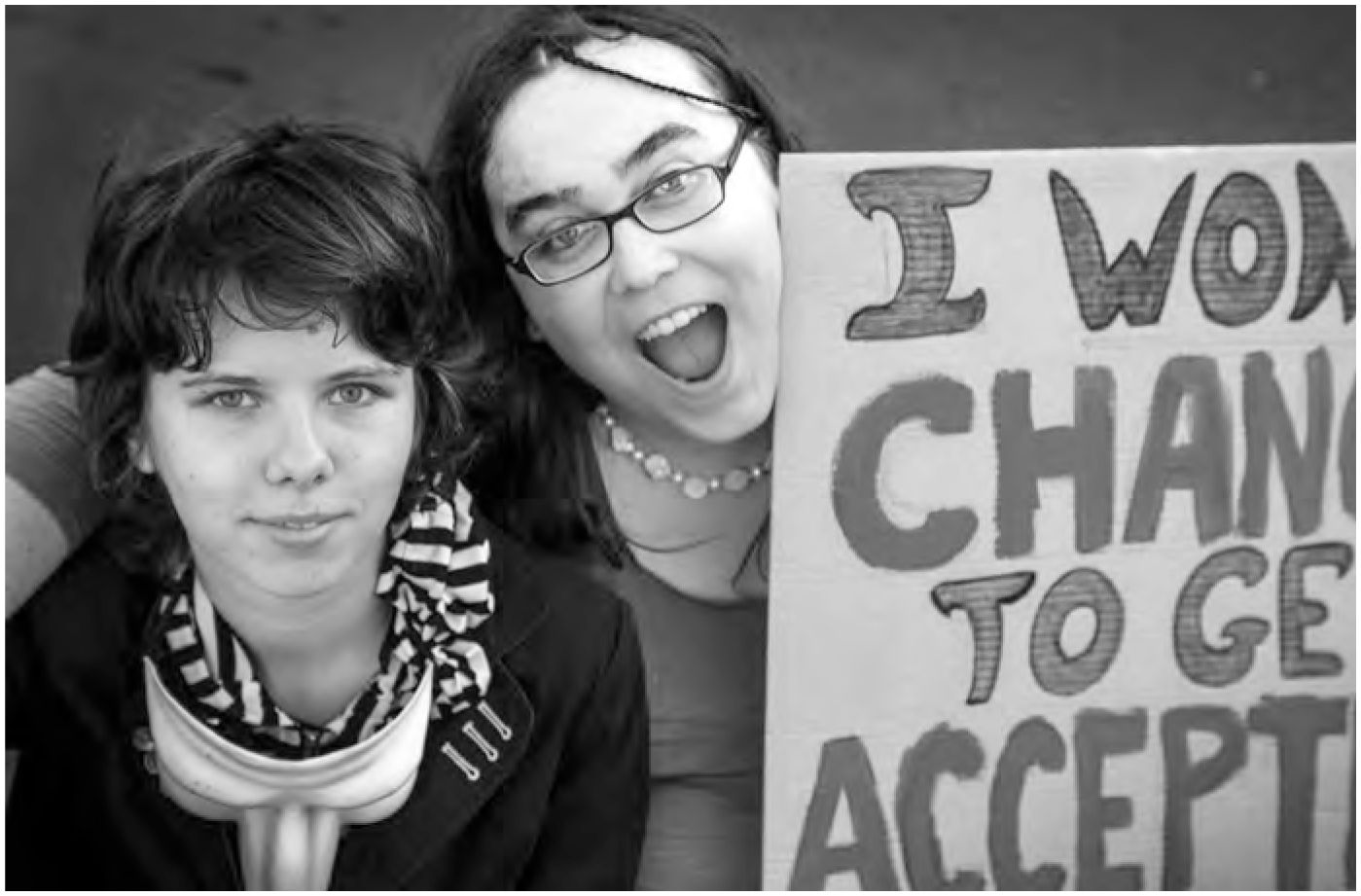
“I won’t change to get accepted.”
Franziska Neumeister, Flickr CC
Over much of this history, little ground was gained. For decades, anti-discrimination bills were proposed and defeated or held up in committees. Battles to decriminalize consensual homosexual sex were met with great opposition. Even when some early ground was gained—the American Psychological Association eliminated homosexuality as a mental illness in 1973, a few cities passed ordinances banning discrimination against lesbian and gay people in the 1970s—opponents formed a countermovement to roll back these small victories. In the 1980s, the HIV crisis decimated the gay community and took the lives of numerous activists.
With the majority of Americans now favoring equal rights, it will increasingly become difficult to pass legislation that marginalizes LGBT people.
Still, the movement fought on, now against a powerful opposing movement that we came to know as the religious right: organizations like the Moral Majority, Concerned Women for America, and the Christian Coalition. Despite their anti-gay activism, the LGBT movement began to realize some gains. Neighborhoods that had started as safe spaces become celebratory hubs of LGBT culture, building communities and strengthening collective identities. Annual pride parades spread across the country into big cities and small towns alike, making LGBT lives visible to wide audiences. Lesbian and gay lives began to appear on television shows, in movies, and in the news. Just over a decade ago, consensual same-sex sexual activity was decriminalized throughout the country. More and more cities and states began to make it illegal to discriminate on the basis of sexual orientation and gender identity. Most recently, same-sex marriage was given equal legal status throughout the United States.
We’ve Got a New Attitude
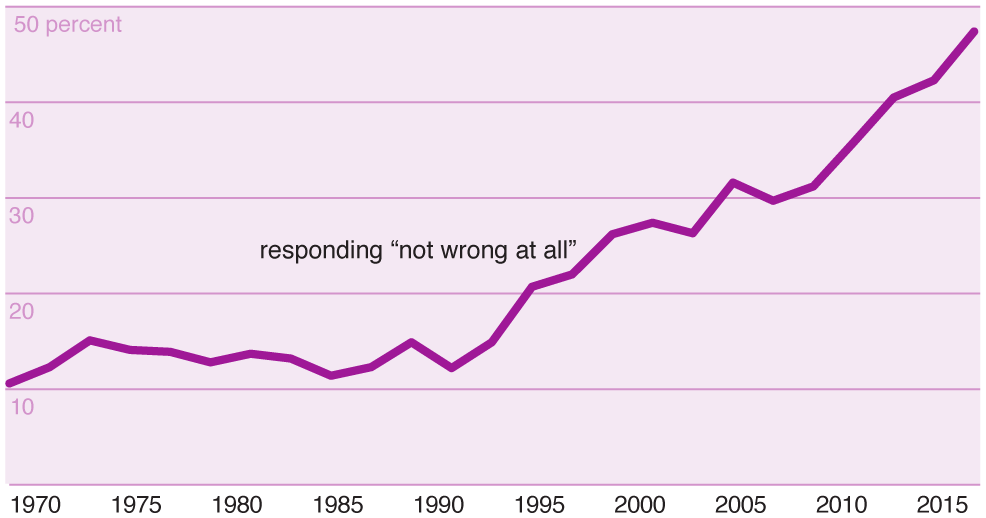
It is not only policies that are changing. Our attitudes toward lesbian and gay people are undergoing rapid change over time as well. The U.S. General Social Survey began asking Americans about their attitudes toward lesbian and gay people in the early 1970s. Throughout the 1970s and 1980s, U.S. attitudes toward homosexuality were consistently negative. A large majority of Americans judged sexual relations between two adults of the same sex very harshly, with about 85% of survey respondents indicating that this was morally wrong, at least sometimes. As recently as 1990, the General Social Survey tells us that fewer than one in ten people said that same-sex sexual relations were “not wrong at all.”
General Social Survey
“What about sexual relations between two adults of the same sex—do you think it is always wrong, almost always wrong, wrong only sometimes, or not wrong at all?”
Source: http://www.electionstudies.org/
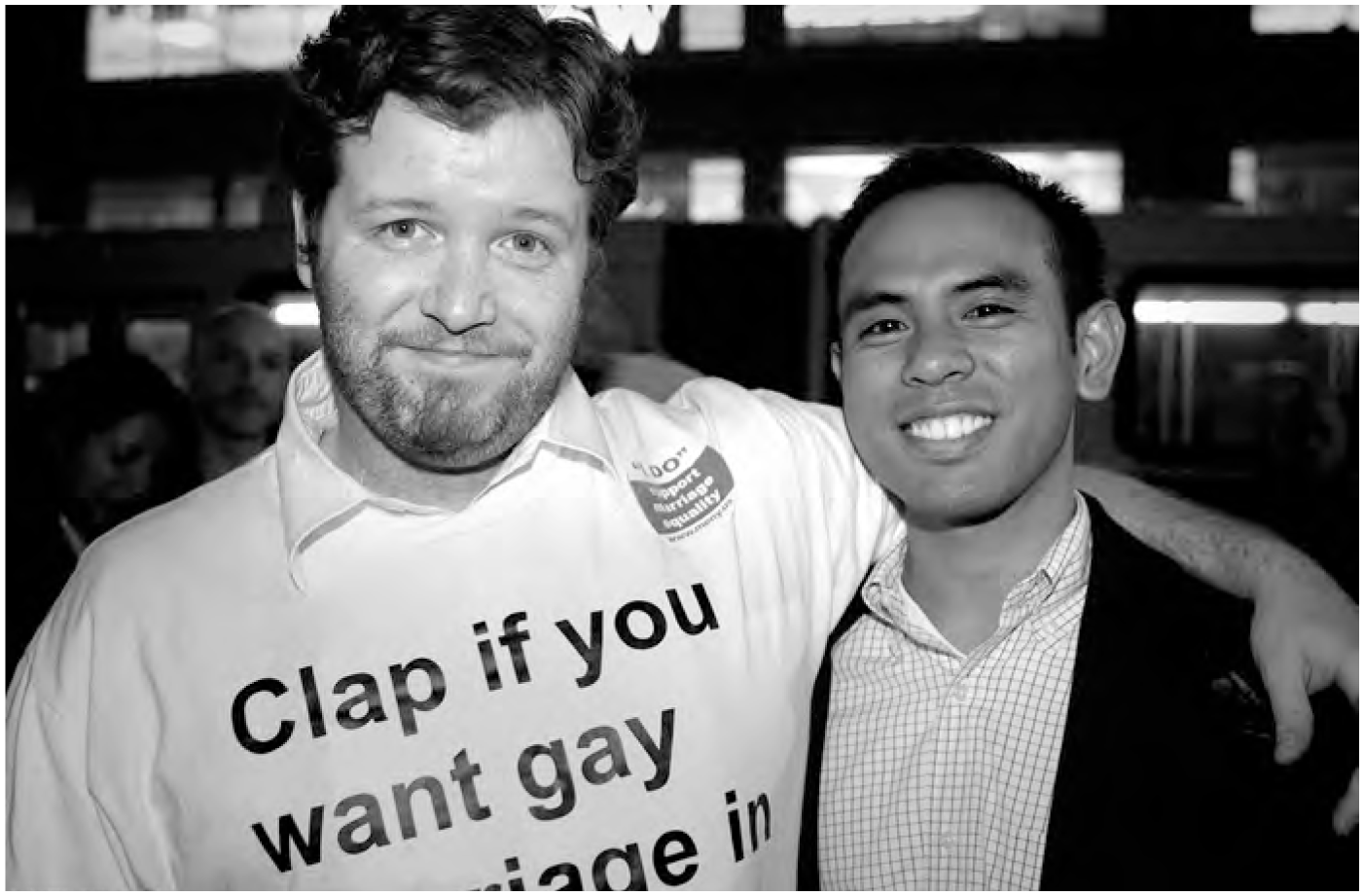
A 2009 “Lighting the Way to Equality” march brought out New Yorkers Brandon and Alexis.
See-ming Lee, Flickr CC
Since 1990, however, U.S. attitudes have shifted dramatically. By 2014, about half of all respondents tell us that same-sex relations are not wrong at all. Using these and other measures, we can see that there has been a large shift in the last twenty-five years toward moral approval of lesbian and gay sexual relations, greater support for lesbian and gay rights, and friendlier feelings toward lesbian and gay people. This large-scale increase in support is an unprecedented change in social attitudes, more sudden and more dramatic than other issues like racial animosity or attitudes toward immigrants.
Gallup: In general, do you think homosexuals should or should not have equal rights in terms of job opportunities?
% responding should or should not, by survey year
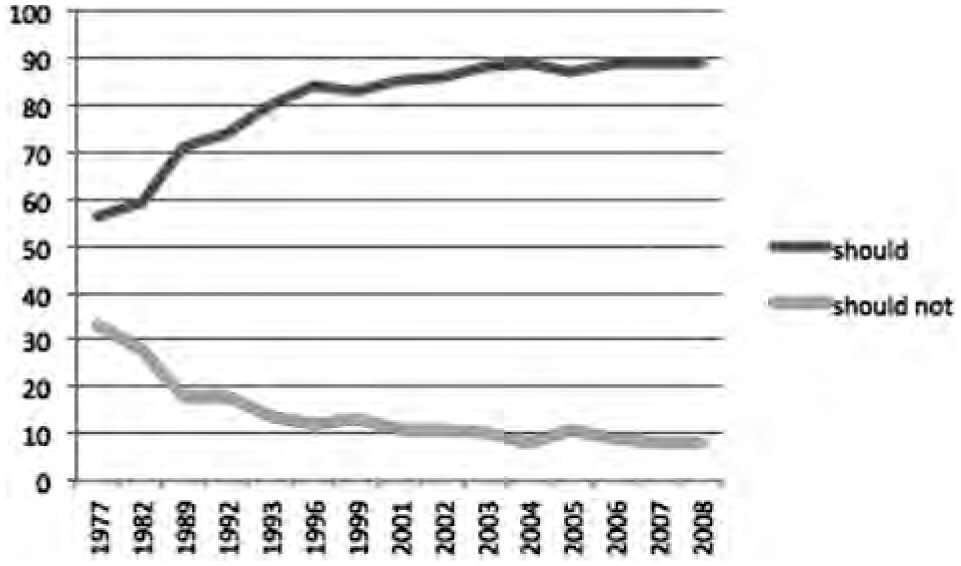
This large-scale increase in support is an unprecedented change in social attitudes, more sudden and more dramatic than we’ve seen on other issues like racial animosity or attitudes toward immigrants.
Let’s take a closer look at the specific lesbian and gay issues about which Americans have been asked their opinions. As you will see, in each case, attitudes are changing rapidly and becoming more positive in the last decade or two. The question that the General Social Survey has been asking the longest is a question about morality: whether same-sex relations are considered wrong or right. Those considering same-sex relations “not wrong at all” were a small minority for twenty years, growing steadily for the next twenty-five years to reach about half of the U.S. population.
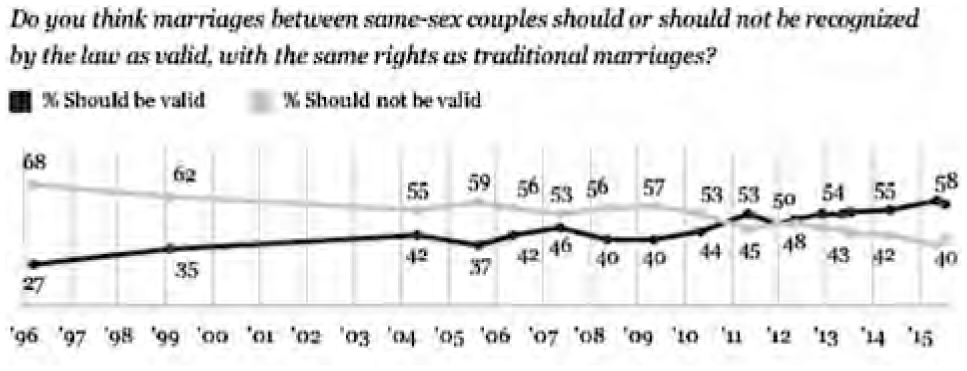
Gallup: Do you think marriages between same-sex couples should or should not be recognized by the law as valid, with the same rights as traditional marriages?
% responding yes or no to same-sex marriage, by year
Note: Trend shown for polls in which same-sex marriage question followed questions on gay/lesbian rights and relations. 1996-2005 wording: “Do you think marriages between homosexuals…”
Source: http://www.gallup.com/poll/1651/Gay-Lesbian-Rights.aspx
Other surveys have asked how Americans feel toward lesbian and gay people as a group, and the trends over time are similar. For example, the American National Election Study asks respondents how they feel about lesbian and gay people on a “feelings thermometer” scale of 1-100, with low scores reflecting colder feelings and high scores being warmer, more friendly feelings. You can see in the chart below that Americans’ feelings toward lesbian and gay people have been steadily warming over the years. 2012 was the first year that the mean response was above 50.
Americans are more positive about lesbian and gay people than about the moral question of homosexuality, more positive still about equal rights for lesbian and gay people.
When we ask for opinions about lesbian and gay rights, the responses are even more positive. We can approve of granting rights to groups even if we consider their actions immoral, and this is the pattern that the surveys have shown. Americans are more positive about lesbian and gay people than about the moral question of homosexuality, more positive still about equal rights for lesbian and gay people. Even on this last question, however, responses have grown more positive over time.
Nowhere is this shift more dramatic than when measuring support for one type of equal right in particular: the right to same-sex marriage. This issue was not among the lesbian and gay movement’s demands until recently, precisely because the public opinion was so strongly against extending marriage to same-sex couples. Gallup polls, which have been asking since 1996, show that support for same-sex marriage has doubled since then. Now, a majority of Americans approve of marriage equality for lesbians and gay men.
As someone who has studied the LGBT movement’s activism for some time, I have been surprised by this major shift in support for same-sex marriage. Since the 1990s, I have observed the powerful organizations of the religious right use the issue of same-sex marriage to fight against lesbian and gay rights. Until very recently, they had been very successful at securing policy changes that would exclude same-sex couples from marriage at the federal level, as well as in many states. Following passage by a Republican congress, President Clinton, who has since disavowed his actions, signed the Defense of Marriage Act into law in 1996, limiting federally recognized marriages to those between one man and one woman—excluding lesbian and gay couples. At this time, only 27% of Americans thought that same-sex marriage should be legal. It seemed like a slam-dunk win for those interested in restricting lesbian and gay rights. Thirty-five states passed laws restricting marriage to straight couples.
A few years later, the tide began to turn. The lesbian and gay movement mobilized in full force to fight for marriage equality. They brought lawsuits to courts all across the country. They pressured elected officials to support their cause and introduced marriage equality legislation in several states. In states where same-sex marriage was not legally recognized, protests included county clerks issuing marriage licenses and officials holding same-sex weddings. In 2004 in San Francisco, Phyllis and Del were at the front of the long line of same-sex couples who participated in wedding ceremonies that were later deemed invalid. Local and national television and print news media gave broad coverage to the spectacle of these protest weddings, drawing the attention of the nation to this issue. Supporters from all across the country sent flowers to the happy couples waiting to be married.
Sociologists who studied these protest weddings argue that they were an innovative social movement tactic that used our culture’s warm feelings toward weddings, love, and family to draw attention to the injustice of excluding same-sex couples from marriage. These weddings sparked a statewide marriage equality movement as they captured the hearts of a broad audience. As courts issued the expected decisions to render the protest weddings invalid, Americans witnessed the state taking away marriages from these same-sex couples. To many, this seemed particularly unfair.
American National Elections Study
Feelings thermometer, mean response, by year
Source: https://gssdataexplorer.norc.org/variables/634/vshow
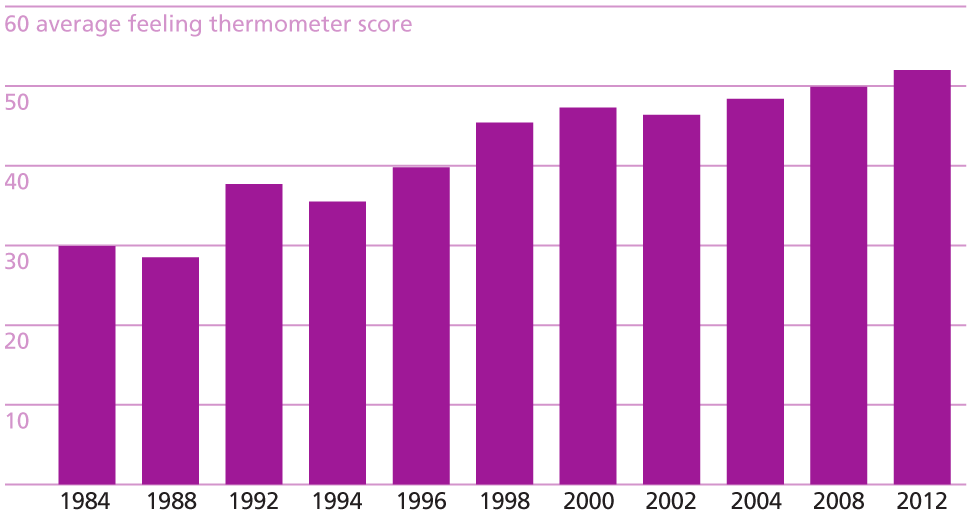
American National Elections Study
Respondents asked to rate their feelings about “gay men and lesbians” in American society.
Feeling thermometer ratings from 50-100 indicate favorable, warm feelings toward the group; ratings of 50 indicate no real opinion; and ratings from 0-50 indicate unfavorable, cool feelings toward the group.
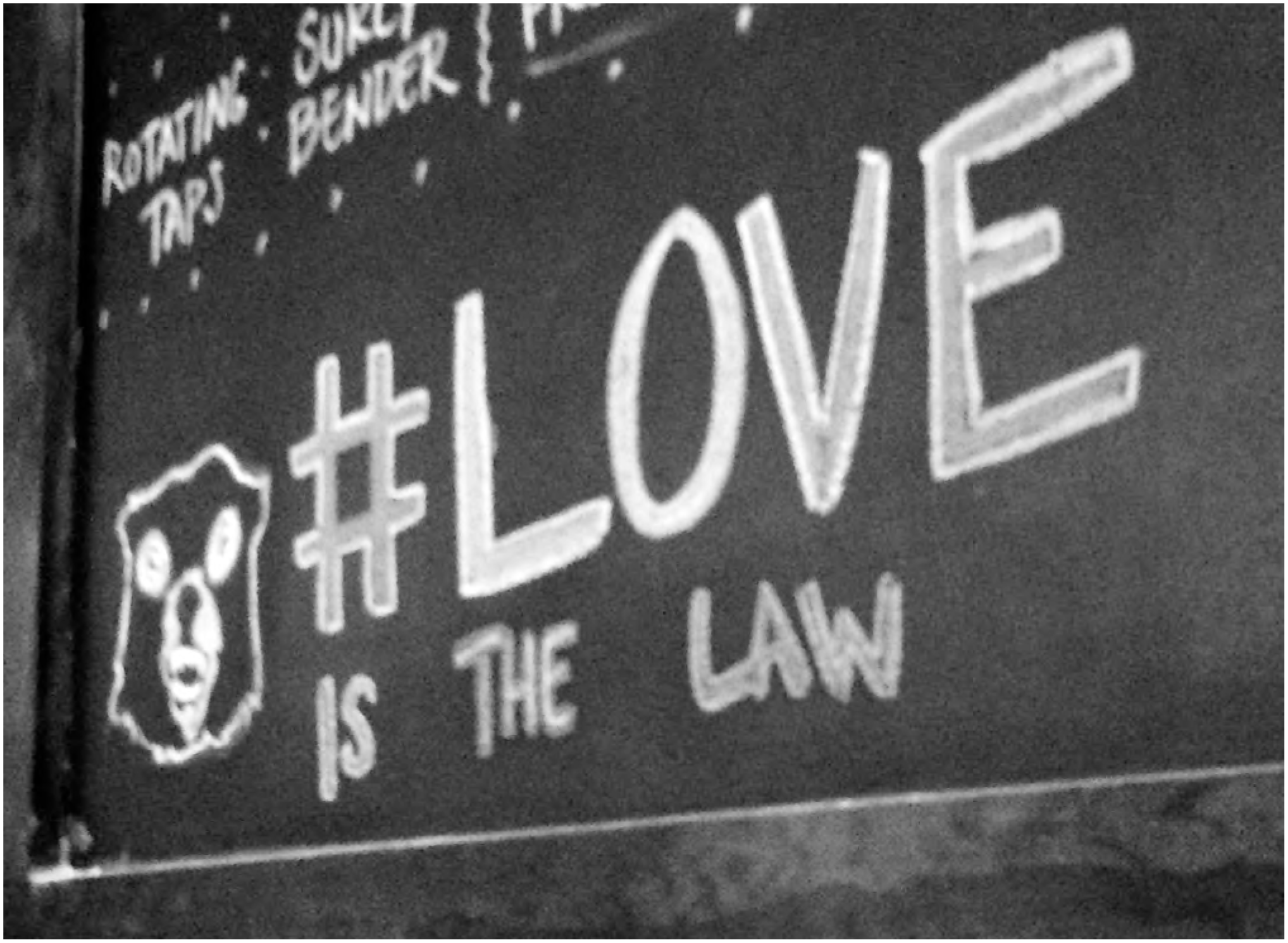
A Minnesota bar celebrates marriage equality’s arrival.
Courtesy Letta Page
Movement success followed quickly on the heels of this activism. Massachusetts legalized same-sex marriage in 2004, and several other states followed suit. Some courts began to rule against the recently passed laws excluding same-sex couples from marriage. All this time, public support for same-sex marriage climbed and climbed. Some key figures in the religious right stopped fighting against marriage equality, and in 2013, dozens of high-level Republican Party insiders submitted an amicus brief to the U.S. Supreme Court in support of same-sex marriage. This year’s Supreme Court decision settled the matter legally, and now more than half of Americans agree that marriage equality should be the law of the land.
Why So Much Change, So Quickly?
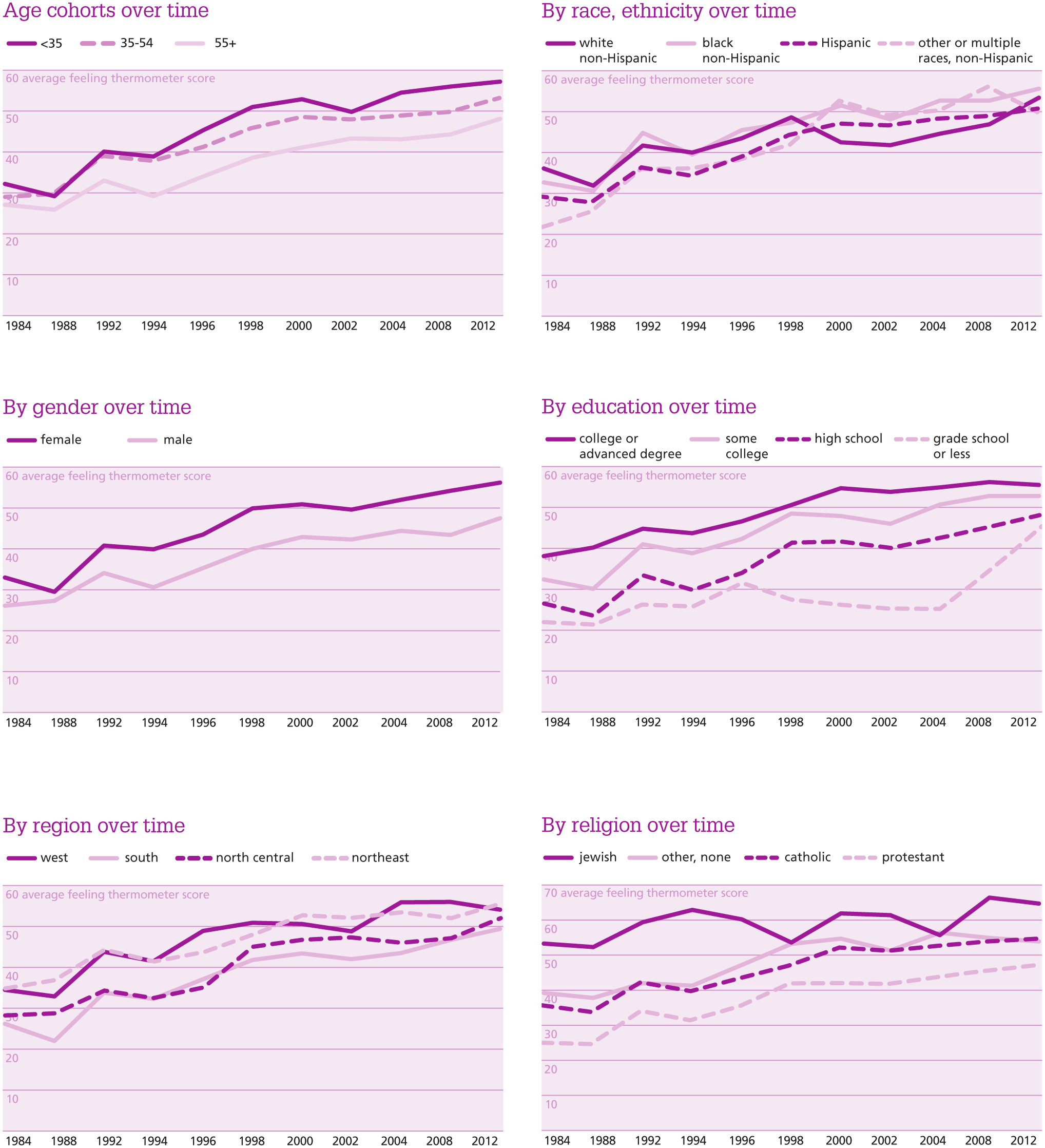
We rarely see such rapid changes in social attitudes. Usually, opinions change at a glacial pace. This is because people mostly form their opinions as young adults and then remain steadfast in them throughout their lifetimes. Most change in attitude comes from the passage of time, as older generations pass away, replaced by younger generations with different attitudes. We see this effect with attitudes toward lesbian and gay people as well; younger people have more positive attitudes than older people. However, on this topic, some people of all ages have changed their minds about lesbian and gay people. The graph below reveals this trend; people under the age of 35 have the most positive attitudes, and those over 55 have the most negative. Yet, all three age groups are growing more positive over time, at about the same rate.
The growing approval of lesbian and gay rights has been surprisingly widespread. Gender, race and education level mark social divisions in Americans’ attitudes toward lesbians and gay people, and yet we see improvements over time among men and women, among people of all races, and among people with all levels of education. Like age groups, these show people in all of these social groups changing their minds.
The fight over lesbian and gay rights has been particularly heated in some parts of the country, and among some religious groups. Attitudes have been more negative in the South than the rest of the country. Jewish people and people with no religion have had more positive attitudes than Catholics and Protestants. Once again, however, we see that people in all parts of the country, belonging to all religious groups, are becoming more positive over time.
These trends show that the United States is undergoing a large cultural shift toward greater acceptance of lesbian and gay people, as well as for equal rights for this group. While more positive portrayals of lesbian and gay people on television, in films and in music may be responsible for some of this change, another important factor is closer to home. One of the strongest predictors of positive attitudes is having personal connections with lesbian and gay people. Those who know lesbian and gay people in their families, at work, or in their neighborhoods, have much more positive attitudes toward them in general than those who do not know any. That LGBT people are in families, schools and churches in every neighborhood, in all regions of the country, among every race and religion, is one of the main reasons why these social changes are so consistent throughout all these diverse groups of people.
Looking into the future, there is reason to believe that attitudes will continue improving. People who live in states with laws that prohibit discrimination against lesbian and gay people have more positive attitudes than people in states where it is legal to discriminate. As schools, government agencies, and workplaces put in place policies against discrimination, their policy changes send messages to all their students, customers, and employees that equality for lesbian and gay people is valued. Policies and attitudes are mutually reinforcing. The personal connections between straight people and LGBT people are also likely to grow as laws protecting lesbian and gay people from discrimination become institutionalized in workplaces across the country, and more people will feel comfortable being out of the closet.
Of course, it is not all good news. A recent study found that people are much more positive toward formal rights than they are toward informal privileges, such as public displays of affection. Americans’ discomfort with same-sex affection reveals that acceptance of lesbian and gay sexuality is incomplete. This study reminds us that, though attitudes are improving quickly, we still see sizable minorities of Americans who hold negative opinions. There are still anti-gay activists working to marginalize LGBT people, such as in the recent repeal of Houston’s anti-discrimination ordinance. Recent legislative battles in North Carolina and elsewhere have focused on keeping transgender people out of public restrooms (see the recent Contexts article by Kristen Schilt and Lauren Westbrook). Some scholars see these developments and argue that it is dark times for LGBT people. However, I disagree. With the majority of Americans now favoring equal rights, it will increasingly become difficult to pass legislation that marginalizes LGBT people.
For decades, the LGBT movement in the United States has worked tirelessly to secure equal rights and to increase social acceptance. From the early days of the Daughters of Bilitis, when activists fought against police raids on gay bars, to the recent fights for same-sex marriage, LGBT activism has produced slow, uneven gains as well as some losses. It is too soon to tell whether the recent policy victories of the LGBT movement will carry over into new areas where inequalities for LGBT people still exist, such as housing discrimination and violence against transgender people. However, the LGBT movement has seen much change since those early days of the Daughters of Bilitis, both in policy and in culture. Americans’ attitudes toward lesbian and gay people are better than ever, and it looks like this will continue to improve into the future.