



Abstract
When a simple trip to the grocery store is anything but, the reality of unequal choices forces us to rethink the American notion that consumption is freedom.
Often, when people talk about grocery shopping, it is as a matter of choice and preferences. They reference the “good” store with the best produce or poke fun at the “bad” store and its patrons. That’s what we found when we talked to White middle-class people who lived in mixed-income neighborhoods. By adopting a sociological perspective, we argue that a focus on “choices” obscures systems of inequality that shape how we shop for groceries in the United States. The rhetoric of choice naturalizes the good and bad qualities of places without interrogating the policies, practices, and systems that made them what they are today.
Making choices is an exercise of power. And while we all have some capacity to choose, we do not have access to the same range of possibilities. In the United States, our choices are shaped by racism, class, and other systems of inequality. Yet the prevailing ideology of consumption as freedom, whereby our ability to shop is an expression of freedom under capitalism, reinforces inequalities by focusing on individual choices as “good” or “bad.” In this essay, we explore the uneven qualities of choice for Black, White, poor, and working-class residents of Riverside, a neighborhood in southern Ohio.
Disinvestment in riverside
Riverside is a predominantly White, mixed-income neighborhood in Cincinnati, where most residents are working-class or poor. In 2010, it was 84.3% White, 11.1% Black, and 1.4% Latinx; its poverty rate was 47.4%; and its median family income was $37,428—$7,000 less than the city-wide median. In addition to single-family houses and some apartments, Riverside is home to Eatondale Apartments, a predominantly Black, section-8 apartment complex on the neighborhood’s border.
One of us, sociologist Sarah Mayorga, completed a study of Riverside in 2014, interviewing 64 residents, including 23 from the Eatondale Apartments. Her interviews are part of a study of two working-class neighborhoods in Cincinnati, of which Riverside is one. The project focused on social relations in the neighborhood and residents’ meaning-making about race, class, and life in their neighborhood. Thus, Sarah asked residents where and with whom they spent their time, how they understood life in their neighborhood, and about their day-to-day interracial interactions. She also asked about grocery shopping decisions.
Living on Cincinnati’s White, working-class “West side,” Riverside participants described feeling forgotten in the context of the larger city. Some said their friends had never even heard of their community; it was, they said, an easy place to “drive past” and miss. This was especially true for Eatondale residents who were new to the West side. Many residents tied Riverside’s invisibility to the absence of a commercial area where they could shop for food, goods, or services. For instance, the only available market was a convenience store inside a local gas station. Longtime resident and White renter Milton took Sarah on a tour of the neighborhood and explained, “There used to be a store right there. Used to be a store there. Little community type. I don’t want to say like a United Dairy Farmers [a regional convenience store chain], but just a community store where you can buy groceries and pop and candy, stuff like that.” While pointing out all the ways Riverside had changed, Milton laughed, “Out of my family, I’m the only one left in Riverside.”
Longtime resident and White homeowner Cait said her son lives in neighboring Delhi township—a higher income, majority White community—and often pesters her about when she will relocate there as well. Cait’s husband Kevin explained that there were various factors leading to white flight, wherein White homeowners moved to the suburbs outside of Cincinnati. These included “the ‘37 flood [that] wiped out a lot of commercial and industrial. So that took a long time [to fix]. Then they did major construction on River Road, which eliminated 50-something houses.” He also said the closing of the neighborhood school led to White homeowners moving away, though the school had closed in 1982, after neighborhood population decline had started.
Under capitalism, consumption is posited as an expression of freedom, but even a simple act like buying groceries reveals the truth: our choices are constrained by class, race, and a host of other inequalities.
Carol E. Davis, U.S. Army Corps of Engineers
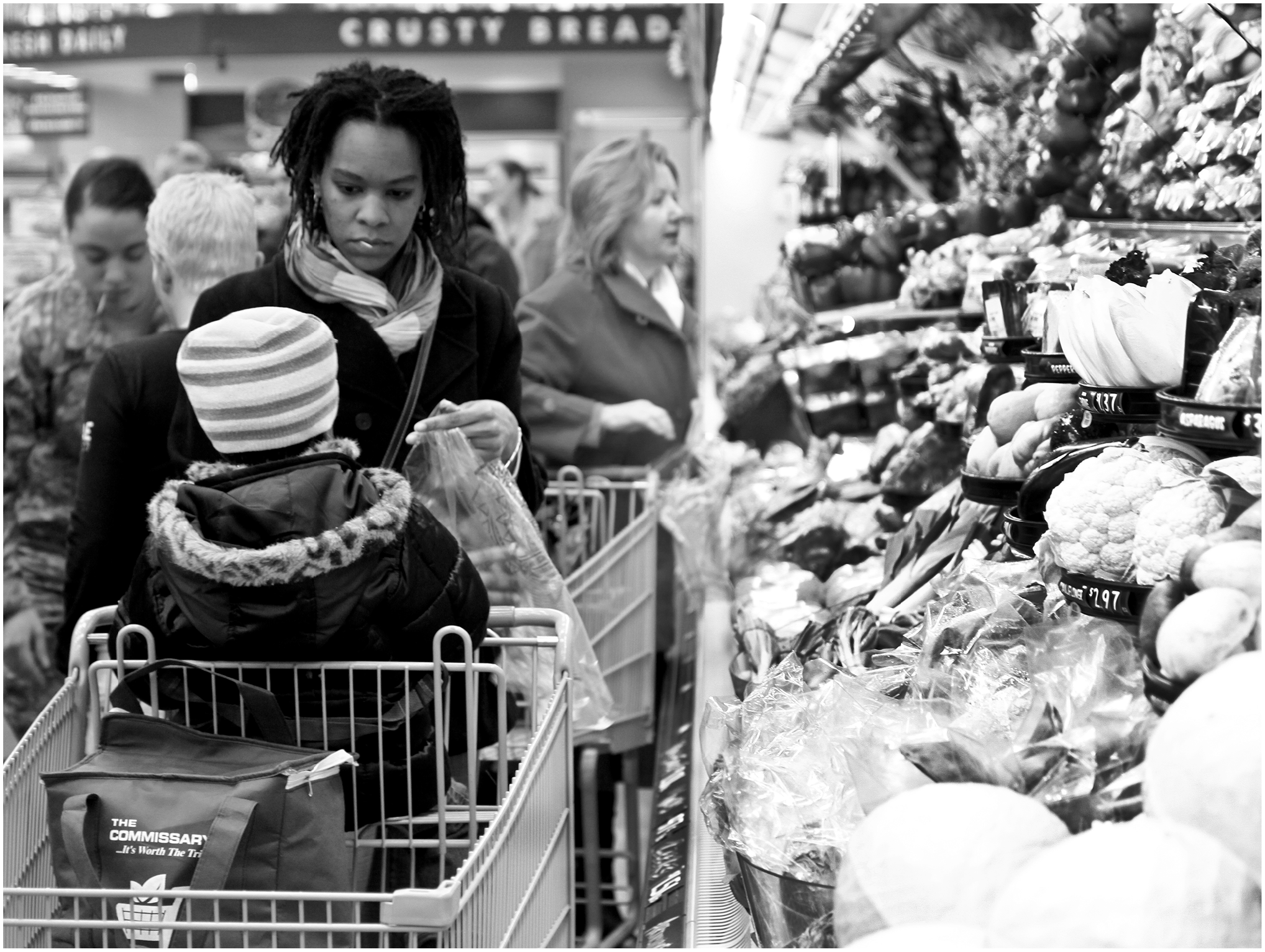
To residents, Riverside felt forgotten, and its lack of amenities reflected abandonment by former residents, the city, and developers via white flight and disinvestment.
Navigating the impossible
With no grocery store, Riverside residents had to leave their neighborhood to procure food. Most working-class homeowners were able to drive to any grocery store they desired. Many went to the Kroger store in the aforementioned Delhi township (94.3% White in 2019). Cait went as far as Lawrenceburg, Indiana, more than 20 miles from Riverside, to shop. She explained, “Don’t want to go to Target in Western Hills because they’ve had so much crime and stuff going on over there. We don’t have so much crime over here. And it’s like the generations, they want more, but they don’t want to work for it. You see that a lot now…. They want things handed to them, and they don’t have to work for it.” The unstated context of Cait’s comments is worth addressing directly. Western Hills Plaza is 15 minutes (6.5 miles) north of Riverside in the Westwood neighborhood.
To residents, Riverside felt forgotten, and its lack of amenities reflected abandonment by former residents, the city, and developers.
According to 2010 Census data, Westwood was 49.7% Black and 47.2% White. In contrast, Lawrenceburg was 95.7% White in 2019. By making references to things like crime, laziness, and the entitlement of younger generations, Cait drew upon well-worn racist dog whistles.
In contrast to working-class homeowners, driving was not an option for most renters, due to the expenses of car ownership. Poor residents generally relied on buses, walking, or rides from friends and neighbors to grocery shop. For example, Cathy and Akilah, both Black renters who lived in the Eatondale Apartments, paid their neighbors for rides if they needed to shop. Their Eatondale neighbors Donald and Tasha, also Black renters, spoke about how difficult it was to simply get up the road to the Delhi grocery store without a car. “I carry two book bags,” Donald said, “and I carry them and go get the groceries unless I pay someone.” Tasha added, “Somebody [with] a condition like me, ‘cause I’m overweight, and I’ve got to walk a half a mile just to get to the nearest bus stop. I mean, I know that I need to lose weight, but that ain’t the way to do it.” The couple also leaned on others for rides, and Tasha added that sometimes Donald caught a bus and then took a cab on the way back. Detailing his ingenuity, Donald continued, “Or, if I got bus tokens, I’ll catch the bus up here or I’ll catch the 15 and then go downtown and catch the 33, and then I’ll walk back down. I do that a lot—it’s motivating to me.” At that, Tasha said, “It’s just—but it’s so crazy. I’m like, you got to get on two buses just to go right up the hill.”
Indeed, the Delhi Kroger was 2.5 miles away, and bus service was limited. The single route that connected Riverside to Delhi only ran on weekdays for two hours at a time, once in the morning and again in the late afternoon. Theoretically, Riverside residents could get to the Delhi Kroger without a car, yet they lamented that the bus service was too infrequent to be useful.
Most Eatondale residents shopped at the Kroger in East Price Hill, a neighborhood northeast of Riverside with a growing Black population. White Riverside residents described it as “unsafe” and “dangerous.” Between 1990 and 2000, East Price Hill experienced a 24% loss of its White population and a 124% increase in its Black population. This Kroger was 1.6 miles from the apartment complex, but there was no direct bus route to it. As a result, many Eatondale residents took buses downtown and then transferred to take another bus to East Price Hill and back again. The excursion was 2 hours round-trip if they timed the bus correctly. Because the service in Riverside is severely limited, missing a bus could mean an hours-long wait for another.
Christopher, a White renter, shopped in Norwood, 12 miles away from Riverside, by taking a cross-town bus. He explained, “The bus don’t run out there [in Delhi] like it does down here on the 50 [bus route] to go to town. It’s a lot easier to go down that way [to Norwood]. I have to catch two buses either way, and I don’t know if I could catch just one there. I think what it is, is that a bus—it goes once up into Delhi in the morning and then once in the evening.” In other words, the bus could get Christopher to the store in Delhi, but he would have to wait all day to take it back home again.
For poor and working-class residents without cars, many hours can be lost waiting on underfunded public transit systems. Under the logic of consumption as freedom, this structural and temporal inequality is normalized and made into an individual-level choice one has to decide how to navigate. It is, however, a policy-level choice. The bus routes that residents discussed are not neutral creations. As Sarah describes in Urban Specters: The Everyday Harms of Racial Capitalism, the city withheld funding for transportation in Riverside at the same time it supported a multi-million-dollar streetcar project to incentivize middle-class professionals to move to Cincinnati’s downtown.
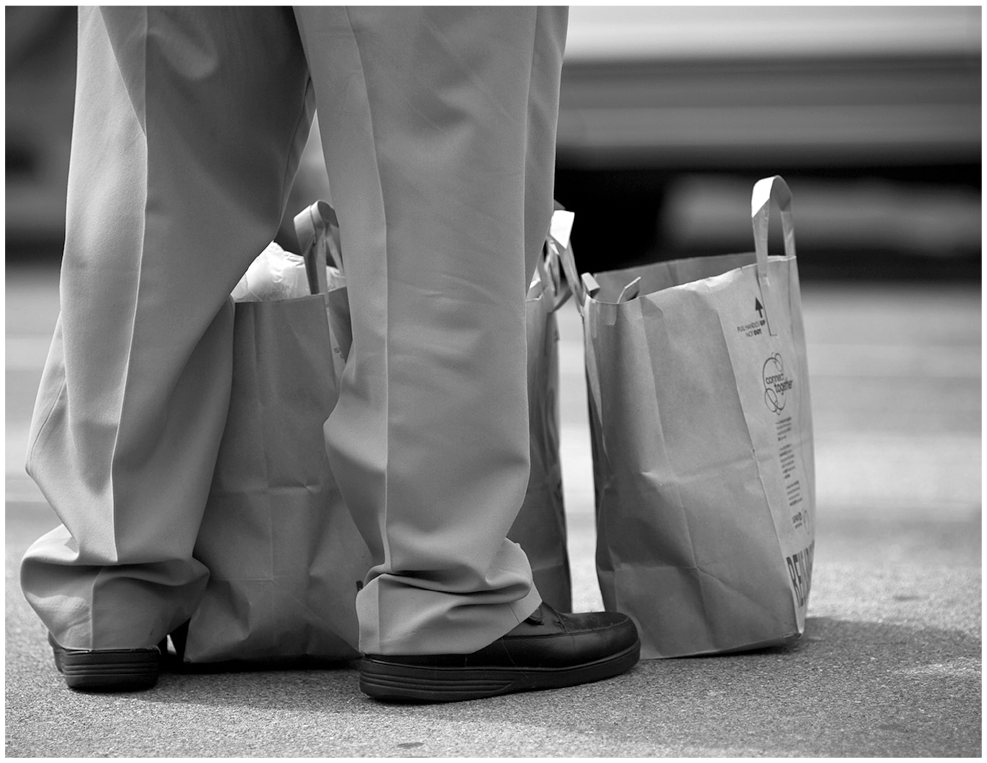
Poor residents in the study described circuitous bus routes, wrangling rides, and compromising their “choices” by shopping at stores with poorer quality goods or racist customer service.
Ryan Carver, Flickr CC
Grocery shopping and anti-blackness
While all poor and some working-class residents struggled with access to public transportation, the experiences of poor Black residents show how the idea of “choice” is a limited way to understand experiences of grocery shopping. Eatondale resident and Black renter Alicia, who had access to a car, stated plainly, “Cincinnati’s still racist… especially in Delhi, they racist as… hell!” She recounted her experience at the Delhi Kroger: “You walk in Kroger’s, they all staring at you and it’s crazy. And I be like, ‘What the fuck are you looking at?” With a small laugh, she continued, “Excuse my language, because I hate that. I’m human just like you. You don’t have to stare at me. If there’s something you want to say, speak. ‘Hello, how are you?’ So, Delhi is very racist.” This type of racialized surveillance has been documented by sociologists in numerous other settings.
In addition to the informal policing that workers and customers imposed at the grocery store, Alicia noted, the Delhi Police subjected her to formal control. Every time she drove into the majority-White township, Alicia said, she was pulled over (including once for a non-existent warrant). “Everybody Black I know, they go up there and get pulled over.” Again, she laughed quietly. “They racist.” What does consumer choice mean in such a context of anti-Black surveillance and harassment?
So, while White Riverside residents could hop in a car and shop at the Delhi Kroger, Alicia and other Black residents did not have similar access. Even without laws banning Black and poor people, social control practices, like systematically pulling certain people over, reinforce race and class boundaries that keep cities like Delhi White, middle-class communities. Every time they targeted her, the Delhi Police communicated to Alicia that she was not welcome in Delhi, even to grocery shop. Her experience highlights anti-Black exclusion as a collection of seemingly routine practices: being treated poorly by other customers and staff while shopping in grocery stores in predominantly White places, being repeatedly pulled over by police, and even finding that such stores lacked culturally relevant products all signaled who was and was not the intended and desired customer.
While the exclusion of poor Black customers could be an example of how anti-Blackness warps capitalist incentives for profit, we argue it is an example of how our system of capitalism is actually dependent on anti-Black racism. Let us remember Cait, who went all the way to Lawrenceburg, Indiana to avoid shopping in a predominantly Black space. Alicia’s experience showcases the limits of rhetoric that advances “choice” as something free and unconstrained.
As previously discussed, most Eatondale residents shopped in Price Hill for a variety of reasons, including transportation and comfortability. There were, however, exceptions. Keisha, a Black renter, did most of her shopping in Delhi. Keisha preferred the selection at the Delhi Kroger, even though she, too, received abysmal treatment as a Black shopper. “Just go to Kroger’s up in Delhi. They make you feel so out of place. Got people watching you, wondering if you gonna steal something.” She recounted a vivid memory of taking her daughter and one of her daughter’s friends to the store on a day when appetizer samples were being given out. “[I]n predominantly Black neighborhoods, they don’t have no appetizing food. They ain’t gonna give you nothing free! So this was new to [my daughter]. She like, ‘Oh! Mom! Look! They got food you can try for free!’” The woman handing out samples only allowed Keisha’s daughter to take a single bite, but the daughter’s White friend was allowed to “eat as much as she wanted.”
“And this is what the lady said to me: ‘If your child is hungry, then you need to take her home and feed her.’ I looked at her, and I start laughing. .. .Do you know how humiliating that is? I don’t know how to explain this to my daughter who’s so innocent and naive to the world.”
Keisha’s description of this humiliating experience reveals the disparities she perceived between store amenities. She also described the disdain with which workers treated poor Black people in a context of anti-Blackness; even a Black child’s enthusiasm was pathologized.
Sarah asked Keisha how these experiences affected her decision-making about where to shop for food. “I ignore it,” she said, “’cause, don’t get me wrong, even though I feel like they are very racist, I still like their Kroger’s better than I do the Price Hill one.” From here, Keisha described the importance of food selection and quality. “I notice their Kroger’s has a better selection, their food is a lot better. See, it seems like in a lot of the predominantly Black neighborhoods, there is a lot of food that’s picked over and bad, so we have to go to the predominantly White neighborhoods to get the good food that don’t make us sick. So, I like shopping up in Delhi because at least you can get a burger that’s not gonna make your stomach hurt.”
Here, Keisha observed key differences in available selection, showing that she exercised her “freedom” to make consumer choices based on her sense of differing product quality. Notably, she perceived a difference in the quality of Kroger stores across class- and race-segregated neighborhoods. This points to a critical area of investigation for scholars as well as food justice advocates—food inequity isn’t only about the location of stores, but the climate and quality of these stores. Importantly, the language of choice obscures these structural injustices and transforms them into individual consumer experiences. If someone experiences racism, many assume they can “choose” to go elsewhere, a directive that ignores how anti-Blackness is foundational to our food systems and cities. In other words, it isn’t just about the stores themselves. It’s about transportation, policing, and city (dis)investment.
Notably, while it’s possible that the cashiers at the Delhi Kroger were rude to everyone, White residents spoke very differently about these same stores. Nick, a Kentucky native who rented in Riverside before buying a home in East Price Hill, chose to shop in Price Hill rather than at the Delhi location. To him, no one was rude—in fact, he found their careful attention smothering. “I really like going to [the Price Hill] Kroger, and no one knows who I am, and no one cares. When I go up to Delhi, I feel the more community thing. I feel like the cashier will smile and maybe they’re like, ‘Aww, you’re such a pretty baby’ or whatever [to my daughter].’” Even as a transplant to the area, Nick’s Whiteness gave him the benefit of a much warmer welcome in Delhi. His choice to shop in Price Hill over Delhi was about enjoying anonymity—a sharp contrast with Keisha and Alicia’s experiences of rudeness, exclusion, and surveillance in the same store.
Keisha was indeed making a choice, but not the free choice many in the United States associate with being a consumer.
Beyond good and bad choices
In Riverside, there were very few neighborhood institutions where residents could make real consumer choices. Still, even within this context, consumption as freedom was a reigning logic. Poor Black residents like Alicia identified how anti-Blackness structured their lives in Riverside; their understanding led some to avoid predominantly White stores like the Kroger in Delhi, while others maneuvered through the racist treatment to procure what they saw as better quality foods. Keisha, for example, navigated anti-Blackness in the form of interpersonal and structural racism and wielded her limited consumer power in choosing the better-resourced grocery store to buy food for herself and her daughter, even though it came at a high psychological cost, including humiliation. She was indeed making a choice, but not the free choice many in the United States associate with being a consumer.
When we use the language of choice, we naturalize and normalize that some stores, products, and shopping experiences are better than others. As such, we assume it is reasonable for Keisha to shop at the “good” Kroger in Delhi, regardless of the toll it takes on her.
Gayle Nicholson, Flickr CC
The language of choice also limits our ability to challenge anti-Blackness, since it misrecognizes what is actually racism as just bad customer service. And it obscures how broader patterns of disinvestment—from city officials, corporations, and White homeowners, shape individuals’ access to consume “freely.” As a result, inequalities of all sorts remain unchallenged.
By identifying anti-Blackness and consumption as freedom as key logics of racial capitalism, we can better understand how individuals navigate this complex, relational system in their everyday decision-making, including where they get their food. By naming these taken-for-granted logics and practices, we can contribute to individual and collective resistance against them.