




Abstract
Lauren A. Rivera reviews Inside Graduate Admissions.
Inside Graduate Admissions: Merit, Admissions, and Faculty Gatekeeping by Julie R. Posselt Harvard University Press 272 pages
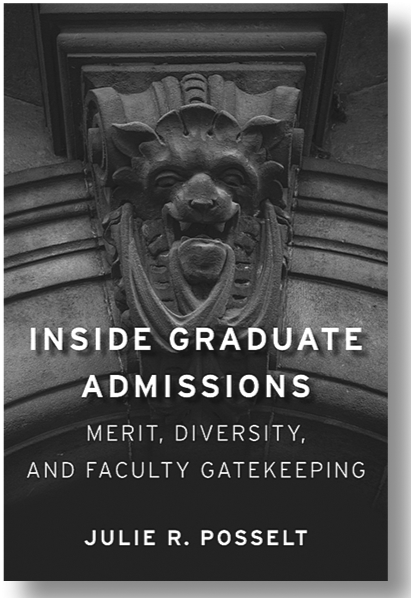
Inside Graduate Admissions is a riveting account of how faculty members select new PhD recruits and, ultimately, the next generation of scholars in their fields. Through careful ethnographic observation of ten admissions committees across nine top-ranked departments at three universities, as well as 86 interviews, Julie Posselt provides an inside look into how committees go about the challenging work of making admissions and rejection decisions.
Posselt, a scholar focusing on institutional inequalities in higher education, takes readers step-by-step through the selection process, unpacking the procedures and criteria used at every stage, including application review, interviews, and post-interview deliberations. Strikingly, she shows how processes of evaluation vary substantially depending on the stage of evaluation and across disciplines and evaluators. Faculty often have good intentions and a genuine desire to build each cohort from the “best” students with the highest potential for academic success regardless of their backgrounds. However, these plans often fall short, particularly when it comes to diversity. Decisions ostensibly based on merit and scholarly potential end up being about much more, including biased definitions of achievement, disciplinary conventions, intragroup dynamics, idiosyncratic preferences, and self-reproduction.
The book begins with an overview of the landscape of graduate admissions, highlighting the changing demographics of both (prospective) graduate students and the profession. Notably, there has been a surge in demand for doctoral education, but the number of spots available in PhD programs has remained relatively stagnant. As a result, admissions have become extremely competitive; today, only about 18% of applicants are admitted to research-focused doctoral programs nationwide, and admission rates at top programs are lower. Some of the committees Posselt observed received hundreds of applicants for only a handful of spots.
Faculty believed the best selection process was one dubbed by Amy Gutmann and Dennis Thompson deliberative democracy: they sought to base admissions and rejections on “open debate among equals in which all members have an equal opportunity to be heard” (20). But in the face of large volumes of applicants and faculty members’ substantial time and attention constraints (given concurrent full-time research and teaching loads), this personalized method proved unrealistic. Instead, committees settled for a system Posselt terms deliberative bureaucracy, in which they substituted holistic review with formalized, rationalized procedures. Committees made a first cut of applicants by delegating and dividing application review among members, emphasizing easily observable, often quantifiable metrics of achievement and distinguishing between applicants through numeric ratings of quality.
Many faculty reported that deliberative bureaucracy seemed a relatively efficient, consistent, and fair compromise, yet Posselt shows how it actually paves the way for inequalities. First, it privileges easily observable qualities such as GRE scores, prior grades, and prestige of university affiliations that systematically disadvantage women, racial minorities, and students from lower socioeconomic backgrounds. Second, it obscures the rationale behind both the choice of specific evaluative criteria and the reasons underlying the assignment of particular scores to particular applicants. Fundamentally subjective judgements of quality were cloaked behind the apparent objectivity of numbers, which were difficult to contest and often concealed biased judgements or misperceptions of common criteria.
The dominance of such easy-to-use—but imperfect—metrics stem from a variety of sources, including interdepartmental competitions for status, risk aversion, perceived associations with intelligence, and convenience. Still, Posselt also cites a fascinating, unexpected driver: the desire to preserve group harmony. While faculty value what they see as fair and accurate evaluation, they also seek to avoid heated conflicts with one another. Given the power and personality dynamics at play in many academic departments, attempts to preserve collegiality and come to consensus relatively quickly often win out over more rigorous evaluations of quality. And doctoral applicants from under-represented groups typically pay the biggest price for this compromise.
After the initial narrowing of applicants, Posselt describes how processes of evaluation shift. When finalizing short lists of applicants to interview, faculty engage in more detailed debate and adopt a broader view of merit (“They opened their eyes to the very minutiae in qualitative components of the application they initially wanted to avoid,” she writes on p. 56). They begin to look for more ephemeral and even moral qualities, such as creativity, curiosity, and research fit. It is only at this point, when students had already met a high threshold of quantifiable achievement on conventional metrics, that diversity enters into faculty definitions of merit (although direct discussions of the diversity, she notes, were still surprisingly infrequent in her research).
At this and later stages of the evaluation process, Posselt observes a crucial disciplinary difference between high intellectual consensus (e.g., economics, philosophy, and physics) and low consensus (e.g., sociology, political science, linguistics) fields. In the former, strong disciplinary logics (which Posselt documents for each field) serve as common interpretive frames that facilitate consensus and decision-making, but also push out students with unconventional profiles. In the latter, disciplinary values still shape evaluation, but the greater degree of disagreement about theoretical and methodological issues—and, fundamentally, what counts as “quality”—allow for greater room for factors such as seniority dynamics in the group, idiosyncratic tastes, and homophily to sway decisions. While these ostensibly non-meritocratic factors have the potential to reproduce existing disciplinary inequalities, they also provide room for faculty who have personally experienced disadvantage or are otherwise passionate about diversity to introduce arguments for giving greater consideration to under-represented applicants.
One of the most interesting chapters of the book (Chapter 6) examines how committees view applications from international students. Posselt describes strong feelings of uncertainty and ambiguity among faculty regarding how to assess these applicants, whom committee members felt were fundamentally different from U.S. students. Of particular note were her observations of faculty interpretations of GRE scores (especially quantitative scores). While many faculty viewed test scores as straightforward metrics of intelligence for U.S. students, they mistrusted them for international applicants, feeling that scores needed “contextualizing” within the cultures of standardized testing (and test prep) in different countries. Committees ended up simultaneously setting higher GRE thresholds for Chinese, Korean, and Indian students and discounting high scores among these students. They did so out of concerns that students had received extensive test coaching, racial and ethnic stereotypes, and fears that international students would “overrun” domestic students in number (some talked about how they could fill entire classes with high-performing East Asian students). For Chinese students, they also expressed concerns about potential testing fraud. Conversely, they lowered the bar (but also discounted) the scores of European students. While they were willing to adjust scoring expectations and weighting for foreign students, faculty were unwilling to do so for U.S. students, especially the racial minorities and lower-SES students research has shown standardized tests such as the GRE are systematically biased against.
In sum, Posselt paints a picture of faculty genuinely interested in identifying the highest caliber students, irrespective of background, but constrained by practical concerns and group dynamics. The process, she writes, becomes “an elaborate, ad hoc comprise rather than an application of specific values and priorities. In that compromise, good intentions and principles often fall prey to pragmatic interests, and faculty frequently default to the safety of self-reproduction” (18).
Inside Graduate Admissions is an important work that supplements existing research on elite undergraduate admissions, such as research by Mitchell Stevens, David Karen, Jerome Karabel, and Joseph Soares, by examining gatekeeping processes in our own backyard. In addition, it contributes to a growing body of scholarship on sources of inequalities in higher education, including the work of Elizabeth Armstrong, Laura Hamilton, Amy Binder, Natasha Warikoo, and Jenny Stuber. Posselt’s comparative design and extraordinarily careful and insightful observations are among the book’s strengths. If one must look for weaknesses, there are times when, given the book’s emphasis on diversity, the book leaves the reader hungry for more detail on the relative frequency of criteria used to evaluate students from majority and minority backgrounds. But the book is an enthralling read, and the arguments are compelling and persuasive.
Relevant well beyond admissions, the book also provides an inside look into evaluative cultures in academia and the reproduction of privilege in higher education more broadly. Its findings have far-reaching implications, not just for understanding how to make doctoral admissions more effective and equitable but also for other gatekeeping functions within academia, such as hiring and promotion decisions. At many universities, the latter are also characterized by the open-debate model that drives many of the weaknesses Posselt observes and that other research shows is an open invitation for gender and racial biases to carry decisions. It is a must-read for faculty, students, and those seeking admission to R1 departments’ doctoral programs, and it will be of great interest to general readers interested in higher education, gatekeeping processes, and inequality.