




Abstract
As Europe’s migration crisis mounts, bureaucratic hurdles and the limitations of humanitarian aid have created a uniquely vulnerable, often unwelcome urban lower class.
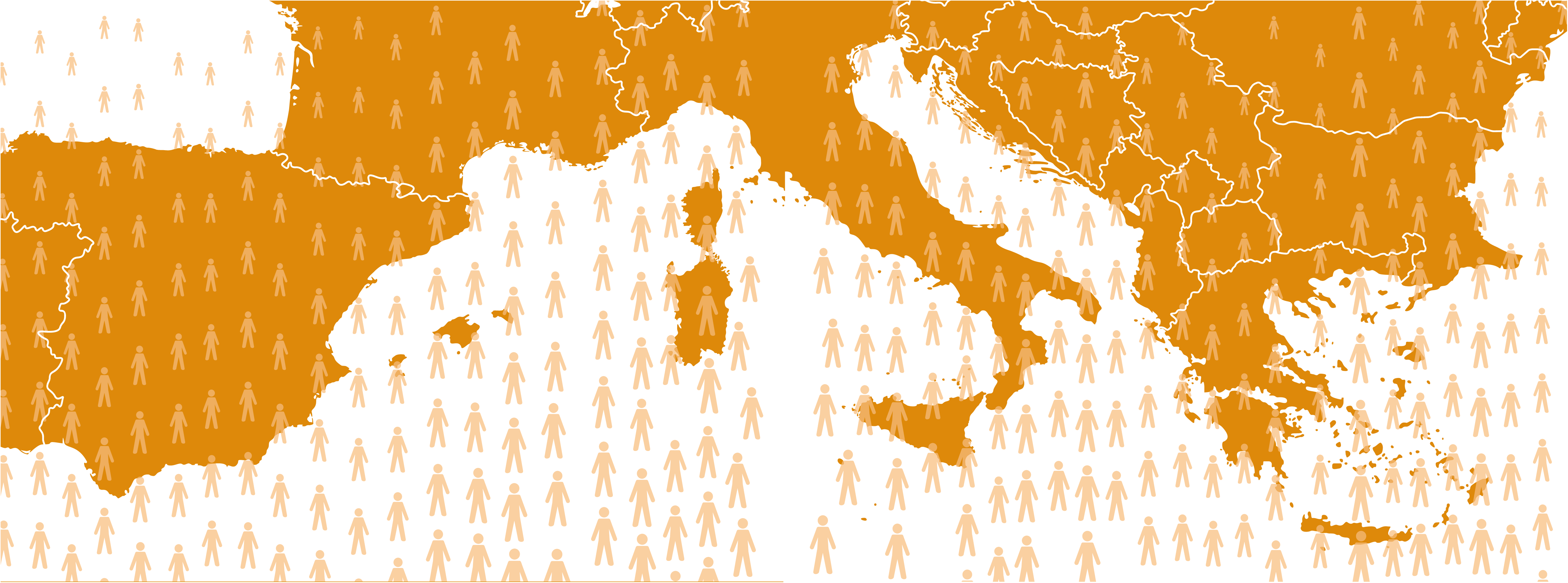
Since 2015, Europe’s migration crisis has garnered global attention. On the nightly news, we see countless images of fishing boats and rubber dinghies filled well past capacity with men, women, and children traveling towards the coastlines of Southern Europe, or of groups of people walking along barbed wire fences at the Hungarian border. These migrants are often described as “in transit,” as their migration is ongoing; they have yet to arrive.
Transit migration is a critical phenomenon not only at these external borders, but within EU nations: “The main issue now is the figure of the transit migrant,” explained Francesca Del Giudice, a volunteer with the organization Baobab Experience in Rome, Italy. The transit migrants Del Giudice and other Baobab volunteers work with have already been met by rescue workers or reached immigration centers. Now they are in Italy—and in limbo. They await an opportunity to move north to another EU country or the processing of their applications for asylum or other humanitarian protection (a process that can take up to two years). Given Italy’s documented shortage of housing for asylum seekers and refugees, along with what Doctors Without Borders has referred to as the “unacceptable” conditions in many reception centers, thousands of migrants become homeless each year.
Although transit migration represents a significant phenomenon shaping the realities of many migrants and the communities in which they, at least temporarily, live, it is a tough issue to study: “transit migrant” is not a recognized legal category. Unlike asylum seeker, refugee, or unaccompanied minor, “transit migrant” does not correspond to a set of laws or rights, though it may overlap with those other categories. In addition, the range of circumstances that fall under “transit” makes transit migrants difficult to quantify. Those in transit might be mid-journey or between journeys. In general, “transit migrants” refers to those irregular migrants who have left their home, traveled without documents or means of legal entry, but have not yet arrived in a place where they will settle. They live in an ongoing state of non-arrival.
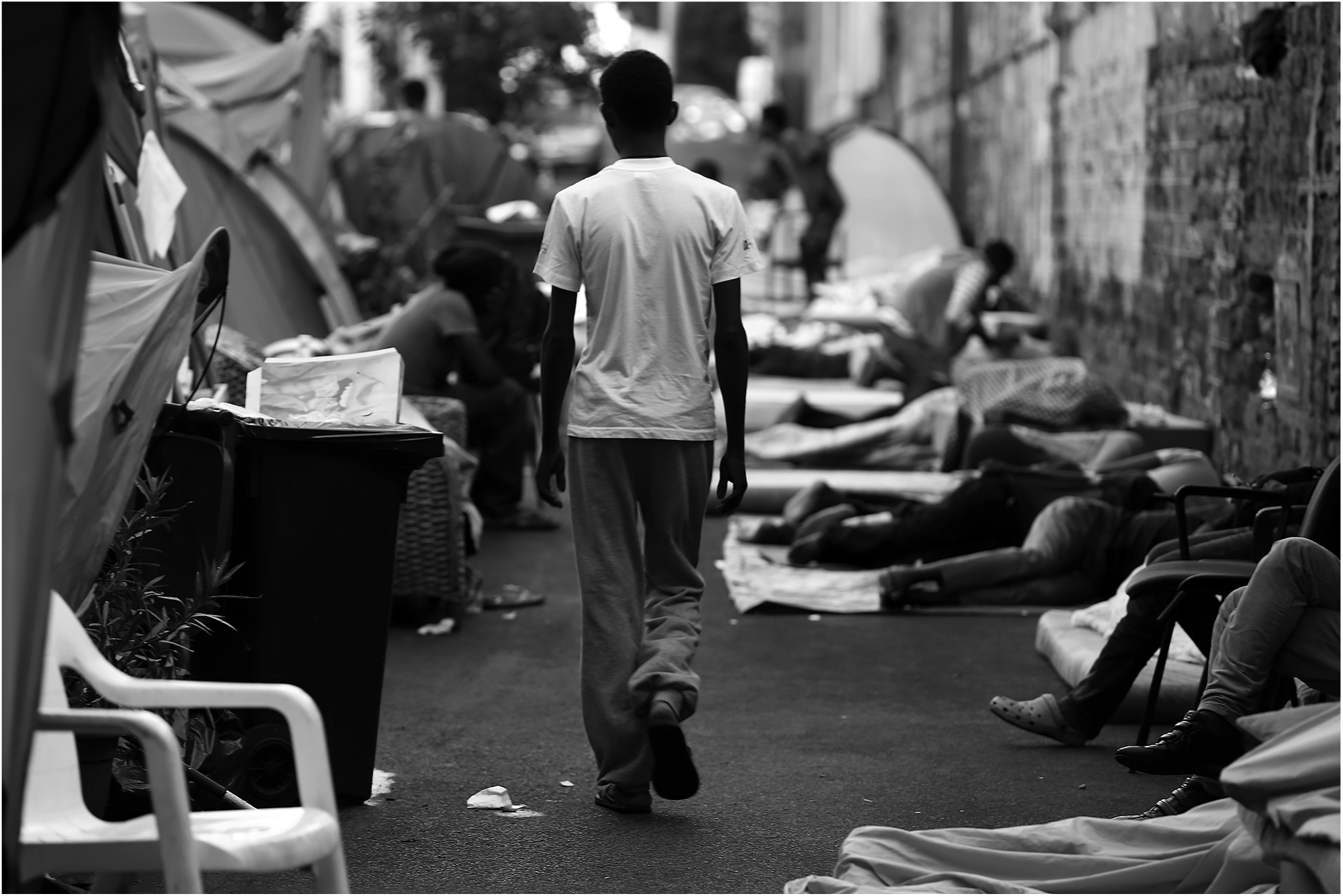
A boy walks through the settlement at Via Cupa.
© Matteo Nardone, matteonardone.com, Used with permission
Since late 2015, I have been following the work of the volunteer collective Baobab Experience, which works with “migranti transitanti” in Rome. Through interviews and observations, and via news coverage and the collective’s strong social media presence, I have traced Baobab’s work and struggles in order to better understand the tensions and circumstances of transit migration in Italy and within the EU. (My work was funded, in part, by OSU’s Global Gateway and Global Mobility programs, and by the Mershon Center for International Security Studies.) Since the cultural center and migrant dormitory Baobab previously ran was closed by city authorities in December 2015, the group has occupied several spaces, managing camps and basic medical, legal, and social services for transit migrants who lack access to shelter in official immigration centers. They served more than 35,000 individuals in 2016 alone.
Baobab’s story illustrates the multilevel dynamics involved in transit migration within the EU. The circumstances of transit are, to a large extent, produced or perpetuated by the same authorities who aim to regulate migrants’ movements and status. In this sense, Baobab and other groups negotiate the relationship between migrants and the authorities who determine the possibilities and circumstances of their mobility. This perspective is crucial for understanding the multilevel factors that create and perpetuate conditions of transit.
As I write, Baobab runs an unofficial camp in an abandoned lot near Rome’s Tiburtina train station. Up to 150 transit migrants, mostly young men, sleep here per night. The migrants’ backgrounds are diverse; many have escaped civil conflict or famine in Somalia and Sudan or the authoritarian regime in Eritrea. Most have arrived via the Mediterranean after a journey of several months or longer, and many hope not to stay in Italy. They are struggling not only for the right to stay in Europe, but to survive.
As a site of struggle and support, the Baobab collective is at the nexus of migration trends, national policies and EU regulations, and city- and neighborhood-level factors that intersect to affect individual and community experiences. Through Baobab, we can see how the limbo of transit develops and changes over time, as well as some of the specific ways in which official structures and regulations are insufficient to meet migrants’ basic needs.
The Crisis of Migration
Transit migration is a key aspect of what we call Europe’s migration crisis today. In the media, the term generally refers to the 2.5 million migrants who applied for asylum in European countries in 2015 and 2016. Yet these movements are neither new, nor detached from European history. Today’s Mediterranean migration can be traced to colonial histories and violence, and reception processes and their failures keep migrants from former colonies on the margins of European society. The prevalence of transit migrants in large cities such as Rome points to the long-term nature of this crisis and its formation at the local level, too.
Cities and regions have had to improvise to acquire and administer aid and services to refugees, asylum seekers, and others. According to data from the United Nations High Commissioner for Refugees (UNHCR), more than 119,000 migrants arrived to Italy via the Mediterranean in 2017. With asylum procedures stalled throughout the country, there is an enormous backlog of applicants, and reception centers are housing migrants who arrived up to two years ago. The challenge of adapting to rapid increases in the number of arrivals, coupled with the lack of financial and political support for preparing structures and hiring and training staff, has meant that many local governments are working just to catch up, let alone undertake any medium- or long-term strategies.
In some cases, NGOs and volunteer groups step in where authorities fail (or lack the ability) to meet migrants’ and communities’ needs. In Rome, Baobab Experience serves meals to 70-150 migrants per day, depending on the time of year (summer sees more arrivals than winter)—just a fraction of the total number of transit migrants in the city at any given time. The collective also has arrangements with lawyers who help migrants prepare their initial asylum or other visa applications, and volunteers assist throughout the usually lengthy process. A group of doctors visits weekly. And despite no longer having its own physical space, Baobab has continued to organize activities such as football tournaments, concerts, and tours of ancient sites, bringing migrants and local communities together in these long moments of uncertainty.
Closures and increased surveillance of national borders have expanded the number of migrants who now fall into the category of “transit” inside EU nation-states. In Italy, transit migrants are irregular migrants, including asylum seekers who, if granted protection, will be given refugee status; migrants who hope to participate in the EU’s Relocation Program, started in 2015 to distribute refugees more evenly among member states; those applying for humanitarian or subsidiary protection; and the so-called economic migrants and others who hope to reach friends and relatives. Because of the Dublin Regulation, which requires migrants to register in the country of arrival to the EU, many migrants end up applying for protection in Italy without wanting to stay there.
Reception centers in Italy are supposed to initiate processes of migrant integration, but they often struggle to do so. According to a 2016 Doctors Without Borders report, of the nearly 154,000 migrants who arrived to Italy seeking protection in 2015, more than 76,000 lived in “extraordinary” reception centers, opened in addition to those originally put in place. Because of the long wait and the centers’ often inadequate resources, some asylum applicants and refugees leave this government-funded housing in search of a better situation. In their March 2016 initial survey of the Italian situation, Doctors Without Borders counted 10,000 migrants living in informal settlements such as the Baobab camp or occupied buildings.
Two mass evictions of informal settlements in Rome in the summer of 2017 also underscore the prevalence of transit migrants and the complicated nature of their limbo. In mid-June, police cleared an abandoned factory building on the city’s eastern periphery, displacing more than 500 transit migrants, some of whom came to Baobab while looking for more stable arrangements. In mid-August, another 800 to 1,000 migrants were evicted from a city-center building they had occupied since 2013; most of the inhabitants were refugees and asylum seekers from Eritrea and Ethiopia, countries with colonial ties to Italy. Told to leave, but without a place to go, they slept in Piazza Indipendenza, the square just outside the building. On August 19, police in riot gear used hoses to disperse the group. Authorities took up to 150 refugees to immigration centers for shelter. Hundreds of others were left on the street. There simply aren’t adequate or acceptable shelter options for refugees and asylum seekers who intend to stay even temporarily in the city of Rome.
From Cultural Center to Migrant Camp
Rome has been a migrant destination since Italy’s transformation in the 1980s from a country of emigration to one of immigration. The capital city has also been a hub for the struggles associated with the country’s increasing diversity. Baobab began more than ten years ago as a “centro culturale,” a cultural center for Rome’s immigrant communities, particularly those with heritage in Sub-Saharan Africa. Run primarily by first- and second-generation migrants and supported by volunteers, Baobab hosted translation services, musical events, and a restaurant. In the last few years, with increased arrivals of asylum seekers and refugees, the organization refocused on its growing dormitory, taking in transit migrants whom police had evicted from an informal settlement on city outskirts.
When city authorities closed that structure in December 2015, the group renamed itself Baobab Experience and occupied the street outside—ironically named Via Cupa, or “gloomy street.” There, for more than nine months, a core group of about 40 volunteers maintained a camp including tents, areas for meals and for counseling, and seven chemical toilets. “Looking back, Via Cupa seems like a paradise,” one volunteer told me.
One of the main issues transit migrants and those trying to help them face is that local authorities cannot sanction the occupation of public spaces or buildings, and yet they have no alternative shelter to offer. As a result, eviction and displacement are regular occurrences for Baobab. When I visited in December 2016, approximately 20 migrants, half of them minors, were gathered just outside Rome’s Tiburtina train station, where the group moved after Via Cupa. They had just finished lunch in an area partially hidden by a low wall and marked by a small Christmas tree. One man mopped the pavement; another put away supplies and covered a crate of plums. A volunteer originally from Eritrea reminded me that at night “it is very cold here.”
The transformation of Baobab from a cultural center for Rome’s resident communities with African heritage to a collective offering assistance to newly arrived transit migrants has paralleled the city’s transformation through transit migration. This Baobab Experience camp has since been moved between areas of the station. At various points, police have rounded up migrants and seized their belongings, including tents and materials donated by locals. Last spring, a nearby hotel was designated as a future dormitory for migrants; anti-migrant groups hung banners from its windows. “Roma ai romani,” Leave Rome to the Romans. Renovations stalled.
In the meantime, migrants move. Some head north; others are turned away at the French border and return. Some attempt to re-enter reception centers. The few who can find work improvise to share rented rooms. Tightened national borders have meant that transit migrants stay in Italy longer; those who, two years ago, would have stayed two or three days with Baobab, now stay two or three months—or more. Virtually everyone is looking for a chance to move on or find a more stable situation.
Despite the lack of official recognition for transit migration, the locally based organizations working with transit migrants are in fact transnational networks of activists and experts. In addition to its core group, Baobab’s community of volunteers includes dozens of periodic volunteers from Rome and visitors from elsewhere. Andrea Costa, a professional stained glass artist, has led the group from the beginning and now also represents Baobab before the UN and in cities such as Barcelona, where local authorities are, he told me, “actually interested to hear about what we’re doing.” The collective also includes teachers, students, performers, and employees at the UN’s Food and Agriculture Organization (FAO). Organizations including Amnesty International, Doctors Without Borders, and the Italian group Medici per i Diritti Umani (Doctors for Human Rights) have publicly supported Baobab. The ability of a group of volunteers to coordinate meals, medical and legal services, showers, sleeping accommodations, and cultural activities for several thousand people per month requires a combination of local knowledge, global awareness, social media skills, and resilience. All of these factors have incredibly high stakes; the survival and well-being of transit migrants depend on them.
The trauma experienced before migration is often joined by the physical and psychological consequences of homelessness and repeated displacement.
Given its origins and its reliance on collaborative improvisation, Baobab is not only a group providing shelter, but a collective creating community by acknowledging and drawing on migrants’ own agency. At its weekly assembly, volunteers and migrants share information and make decisions together. Costa addresses the group in English and Italian, pausing as migrants who volunteer as interpreters call out translations in French and Tigrinya. “We have some information to give you, and then we want to hear from you—you tell us what you think,” he called out to open a meeting at which the key decision was whether to put up more tents.
Whose Security?
States have justified the localized displacement of migrants, in raids on informal camps and occupied buildings, by framing migration primarily as a security issue. After the terrorist attacks in Paris on Nov. 13, 2015, Italian authorities cracked down on organizations assisting transit migrants. When Rome’s police commissioner ordered Baobab to close two weeks later, the 30 migrants there at the time were effectively rendered homeless.
The closure, surveillance, and repeated displacement of migrants within Europe (and within European cities) underscore that the limbo imposed on migrants is both part of a systemic problem and evidence of the site-specific nature of policy enforcement. At the Italian-French border, the mayor of Ventimiglia expelled activists from the city in hopes of discouraging informal settlements. In Athens, after the mayor evicted migrants who had been sleeping in a main square, local activists helped approximately 400 refugees and asylum seekers occupy the vacant City Plaza Hotel.
For migrants living outside institutional structures, the violence or trauma experienced before arriving in Europe is joined by the physical and psychological consequences of homelessness and repeated displacement within Europe’s borders. After the dismantling of Baobab’s original Via Cupa camp, migrants fended for themselves in the streets for about a week. “We lost them,” Del Giudice said. “The police picked them up if they were together in groups of 4-5 or more. For us, groups of that size were a kind of security—we knew that if they were together, they wouldn’t likely be harmed by xenophobic groups, by fascist groups, by groups that are part of the extreme right here.” As racialized outsiders, the migrants were now not only rendered homeless, but also left exposed.
Rome does not want a “Jungle,” the large camp that stood outside Calais, France. But the city lacks an alternative plan for migrants in transit. In its short-term management of the situation, Rome seems to have prioritized unsettlement, by dismantling encampments and carrying out regular document inspections. When Baobab still occupied Via Cupa, police responded to locals’ complaints by setting up temporary checkpoints at which passersby had to prove legal, local residency. The group’s other encampments have included the churchyard of San Lorenzo Fuori Le Mura, where migrants slept for a week at the edge of the city’s largest cemetery. Often, Baobab’s volunteers set up informal settlements in areas police have indicated as options; later, the same police will evict them.
When I visited Baobab in June 2017, they occupied an asphalt lot out of sight of the Tiburtina station. Despite the need for shade, only a few tents were set up. Police had seized the others a week prior. Volunteers provided three meals a day and continued to arrange legal and medical visits, as well as cultural activities.
Migrants told me that their asylum applications were complicated by their lack of stable shelter. One man, from the Ivory Coast, had been upset by the conditions in a reception center in Catania, Sicily, and opted to sleep instead under a bridge. Eventually he had traveled to Rome and, unable to gain access to reception centers there, found his way to Baobab. His asylum application was being reviewed throughout this period, but the latest Baobab eviction had upended this process: “When they took the tent, they took everything, also my documents,” he said, noting that he was not sure he’d be able to retrieve the documents, and certainly not in time for his hearing appointment.
At the municipal level, tensions are high. The city has periodically delayed or ceased processing of asylum applications. Progress on securing accommodations for the displaced slowed after the election of populist mayor Virginia Raggi in July 2016; UNHCR cited her inaction on this matter as an injustice. Newly arrived migrants are effectively kept in transit.
“We are not Dangerous, We are in Danger”
Caught between places and between systems, transit migrants demonstrate that the risks of migration do not end with the crossing of a border. In fact, transit migrants’ limbo draws attention to the ways that labels assigned and regulated by nations cannot capture the identity or movement of all people within their borders.
In her work with Baobab, Del Giudice has noted a shift in the transit migrants’ sense of agency. After Baobab’s eviction from Via Cupa, a group approached volunteers to collaborate on organizing a demonstration, saying, as Del Giudice explained, “We want to put ourselves front and center.” Since then, migrants staying with Baobab have increasingly participated in demonstrations for refugee rights. Through these actions, “they [have] declared that they are human beings,” Del Giudice said, “and for this reason we need respect, services, we need your help.”
For many awaiting formal protection, staying out of sight now seems riskier than speaking out publicly about their circumstances. One of the signs they carry at demonstrations reads, “We are not dangerous, we are in danger.” The danger they cite is not, at this point, that of international border crossing, but of being a migrant in Rome.
As migrants staying with Baobab have become more engaged in demonstrating and lobbying for aid, volunteers have increasingly traveled to support groups facing similar struggles in other Italian cities. Baobab has documented conditions in Ventimiglia, at the French border, and Bologna, the site of another mass eviction. They work both to meet the immediate needs of the transit migrants staying at their camp, and to think longer term, about establishing collaborative networks of assistance to counter what they have documented as the lack of housing and lack of response from government officials.
The realities of transit migrants in Rome and elsewhere point to the multilevel factors involved in experiences of displacement and the ways in which the migration crisis continues to unfold within the EU, including through the marginalization of migrants who have already entered Europe. Baobab and its network of activists and advocates has the potential to supplement aid at local levels and create more stable situations. Yet the limbo of transit is also, in many ways, the limbo of these collectives: their stability depends on the recognition and permission of local authorities. These precarious positions deserve further attention, in particular as they are perpetuated by the ways in which local authorities variously “manage” newly arrived irregular migrants. As groups such as Baobab take shape within and adapt to this uncertainty, they speak to the prevalence of transit migration in Europe and the degree of precarity faced by thousands of asylum seekers and refugees.