




Abstract
Most of the world’s 25.4 million refugees have been displaced for five or more years. A sharp curtailment in refugee arrivals to the United States, then, isn’t just a national decision, but a global disruption.
Zhang Yu, Flickr CC
The international refugee assistance regime is a complex system of cooperation, support, and coercion. The United Nations’ Refugee Agency (UNHCR), governments around the world, and humanitarian assistance organizations work together to aid refugees while upholding the interests of states. Most of the world’s 25.4 million refugees live in developing countries that neighbor the states from which they fled. Countries like Jordan, Turkey, and Uganda each host over one million refugees on their territory, while donor states in the Global North largely finance refugees’ housing, food, health care, and education from a distance.
Some countries in the Global North also participate in a process called resettlement in which states work with the United Nations to select and vet refugees for permanent relocation to their countries. Even though less than 1% of the world’s refugees are resettled to the Global North, we argue that a disruption to this system of cooperation and burden sharing can have far reaching consequences for states, the communities that host refugees, and refugees awaiting an alternative to displacement. (This paper benefitted greatly from the feedback of Gail Kligman, Chiara Galli, Inga Kiderra, David FitzGerald, and Roger Waldinger.)
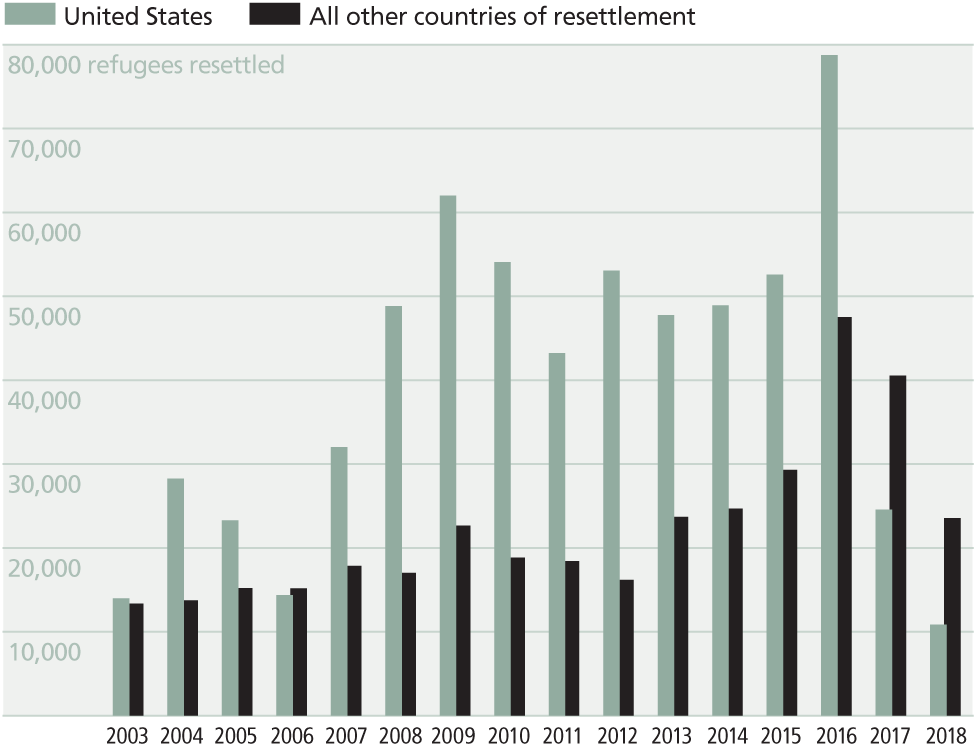
The United States has historically been the leader of permanent resettlement, typically accepting more refugees than all other resettlement countries combined, including Canada, Australia, Sweden, and Norway. Under the Trump Administration, the United States has lost this designation (p. 20, left). Forced displacement continues unabated, but the number of refugees allowed to enter the United States for resettlement has drastically decreased. What happens when the United States abruptly decides to accept fewer refugees?
President Trump’s January 2017 Executive Order, referred to as both “the travel ban” and “the Muslim ban,” curtailed refugee resettlement, causing local and global ripple effects disrupting the international refugee assistance regime. The Executive Order temporarily banned travelers from seven Muslim-majority countries: Iran, Iraq, Libya, Somalia, Sudan, Syria, and Yemen. Each is a significant refugee-producing state. The Executive Order also slashed the total number of projected refugee arrivals for 2017 from 110,000 to 50,000 people, suspended all resettlement for 90 days, and indefinitely halted the resettlement of Syrian refugees. Subsequently, in 2018, the number of resettled refugees decreased to 22,491 people, just 20% of President Obama’s 2017 resettlement goals.
This change in refugee policy has sparked a cascade of consequences across the United States and around the globe. Before the Supreme Court upheld the Executive Order in June 2018, many of these ripple effects had already gained momentum. Fewer refugees are being afforded the security that comes with permanent resettlement and a pathway to citizenship, the local resettlement infrastructure to support refugees in the United States is being systematically undermined, and the responsibility of refugee hosting in the Global South has become more demanding. Fallout from the Executive Order and decisions made since demonstrate the extent to which the United States is part of a larger system of accountability.
A Country of Refugee Resettlement
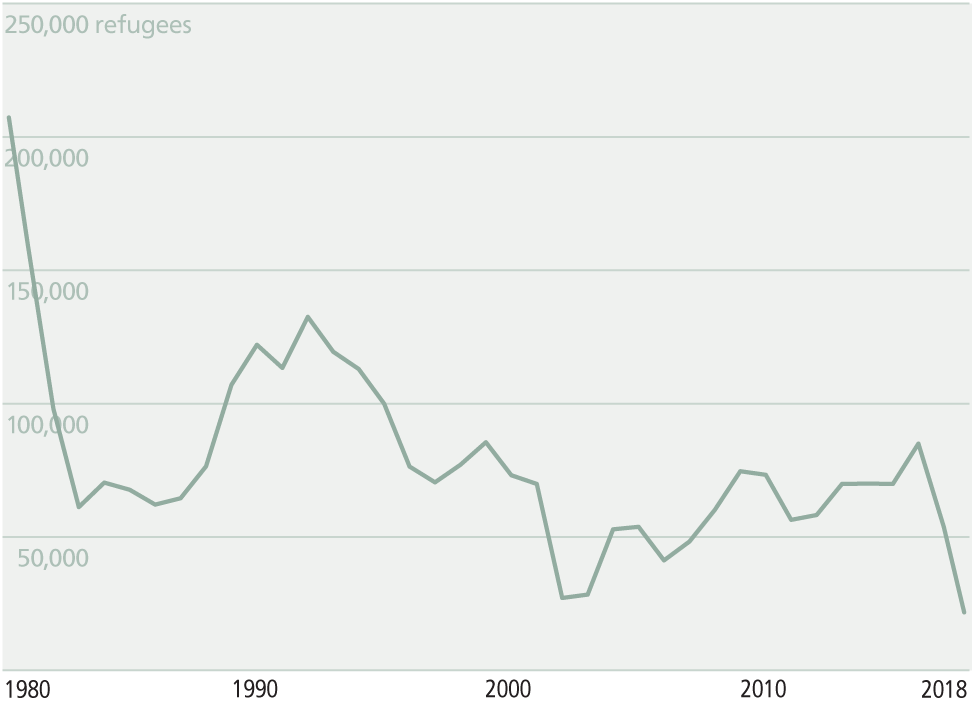
The capacity of the United States has provided a critical lifeline and a pathway to citizenship for refugees over the past several decades. More than three million refugees have been resettled to the United States since the passage of the Refugee Act of 1980; many have become naturalized citizens. Refugee resettlement peaked at over 200,000 people in 1980 under the Carter Administration, when most refugees were fleeing Vietnam, Laos, Cambodia, and the Soviet Union. The resettlement program has also experienced setbacks. In the aftermath of the terrorist attacks of September 11, 2001, the United States temporarily halted refugee resettlement. Consequently, only 27,131 and 28,403 refugees were resettled in 2002 and 2003, respectively. The resettlement program recovered slowly, only surpassing 50,000 refugee arrivals in 2004 (above, right). However, even the response following September 11, 2001 was not as drastic as the Executive Order. The Trump Administration is currently overseeing the lowest number of refugee arrivals in the history of the U.S. Resettlement Program.
Resettlement departures based on UNHCR referrals, 2003-Aug. 2018
Source: UNHCR Resettlement Data Finder
Note: This graph only includes those refugees who were resettled through UNHCR referrals, not those who apply for resettlement directly to the resettlement country through special programs, which accounts for the discrepancy between the U.S. totals in the first and second figures. Moreover, asylum seekers are also not included in these figures. Unlike resettled refugees, asylum seekers ask for protection after arriving to a country.
Notably, the political backlash against the U.S. Resettlement Program is disproportionate to the actual number of refugees: Refugees who arrived since 1980 comprise approximately 9% of the U.S. population. In 2016, refugees accounted for 10.2% of new legal permanent residents.
The political backlash against the U.S. Resettlement Program is disproportionate to the actual number of refugees.
The U.S. Resettlement Program relies on a public-private partnership between the Department of State’s Bureau of Population, Refugees, and Migration; the Department of Health and Human Services’ Office of Refugee Resettlement; and nine national resettlement agencies, with local affiliate offices across the United States. Each year the President, in consultation with Congress, sets the agenda for the coming year’s resettlement program. President Obama’s fiscal year 2017 proposal called for an increase in the annual ceiling of refugee arrivals. His petition was in line with pledges from other Western leaders, all of whom promised to accept more refugees when hundreds of thousands of people arrived on the shores of European countries seeking asylum in 2015 and 2016. Congress subsequently approved an increase from 85,000 refugees for 2016 to 110,000 refugees for 2017. Monthly refugee admissions gradually followed suit.
Refugees resettled in the U.S. since the Refugee Act of 1980, Fiscal Year 1980-2018
Source: Worldwide Refugee Admissions Processing System
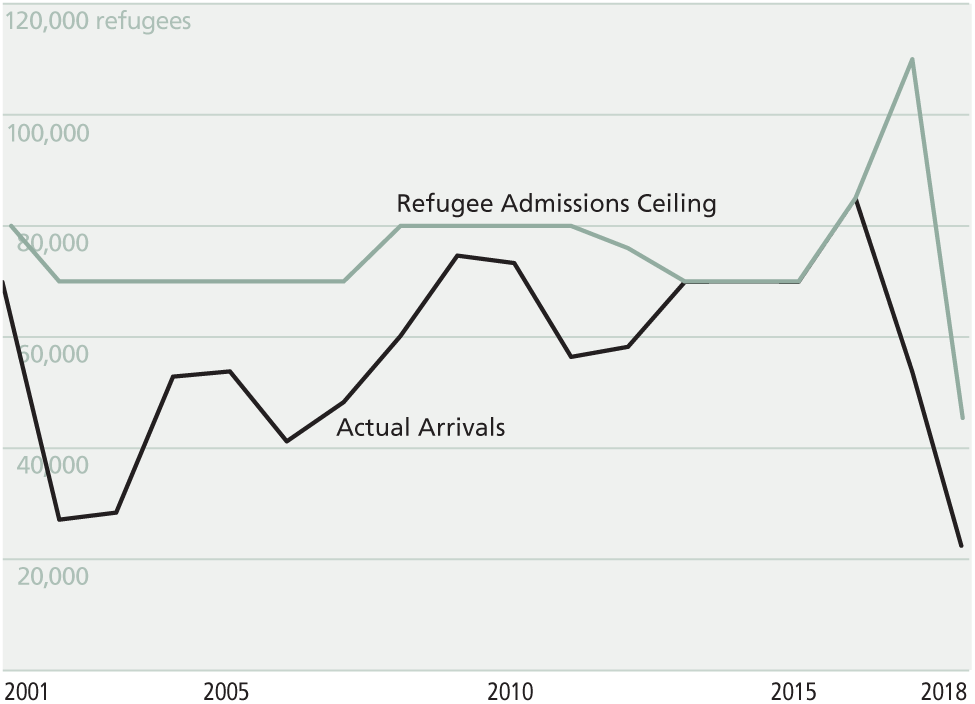
Once the Obama Administration set the annual ceiling, the gears of the resettlement program began turning, both in the United States and abroad, to process and receive 110,000 refugees over the course of the year. The UNHCR referred refugee cases, resettlement agencies expanded their capacity based on projected budgets, and refugees underwent background checks and medical examinations. Then, only four months later, President Trump signed his Executive Order. It was a shock to the international refugee assistance regime. The graph on p. 21 (left) illustrates the extent to which refugee arrivals plummeted after President Trump took office. Some of the ripple effects were quickly felt by resettlement agencies and the refugees whose resettlement was imminent, while the true scope of the impact may not be known for years to come.
Domestic Effects of Decreased Resettlement
Refugees are an integral part of the American story. Refugee histories and dreams of escaping persecution in search of religious freedom are central to American mythology and the power of the “American Dream.” By the same token, America’s global standing was built on the backs of forced migrants. Native Americans were forcibly removed from their homelands to make way for the project of manifest destiny, and African slaves were forcibly brought to the United States to build America’s wealth. Resettled refugees have contributed to the country for decades, including Vietnamese communities in Southern California; the diverse refugee community in Clarkston, Georgia; and the Somali community in Minneapolis, Minnesota where Ilhan Omar became the first resettled Somali American elected to Congress in 2018. A 2017 study conducted by the U.S. Department of Health and Human Services finds that refugees across the country contributed $63 billion more to the economy than they cost the government over a ten-year period.
Annual refugee admissions ceiling vs. actual arrivals, Fiscal Year 2001-2018
Source: Worldwide Refugee Admissions Processing System
Select refugees who meet the 1951 Refugee Convention definition of a “well-founded fear of being persecuted for reasons of race, religion, nationality, membership of a particular social group or political opinion” and who pass an extensive vetting process are invited to continue their lives in the United States. The international refugee assistance regime, international laws, and human rights norms recognize that refugees have fled persecution and may continue to experience trauma. The United States resettles some of the most vulnerable refugees. They have not only lived through the ravages of war, violence, and torture, but may also face cultural, linguistic, and economic challenges early in their incorporation. Local resettlement agencies are tasked with assisting newly arrived refugees and supporting them along their journey to becoming Americans.
Prior to the Executive Order, domestic resettlement was carried out by approximately 350 local resettlement agencies throughout the United States. Contemporary resettlement agencies originated from groups of volunteers in religious and community organizations who came to the aid of arriving refugees after World War II and during the Cold War. With the Refugee Act of 1980, resettlement agencies became a formal part of the U.S. Resettlement Program, carrying out the daily, on-the-ground work of resettlement. Presently, nine national agencies determine the distribution of arriving refugees based on the capacity of their local affiliate offices. Resettlement agencies are funded by the federal government on a per capita basis, receiving a fixed fee for their services as each new refugee arrives. Resettlement agencies rely on these per capita grants to support their operating expenses, maintain a well-trained staff, help prepare refugees for employment, and ensure appropriate medical care upon arrival.
Monthly refugee arrivals to the U.S., Fiscal Years 2017 and 2018
Source: Worldwide Refugee Admissions Processing System
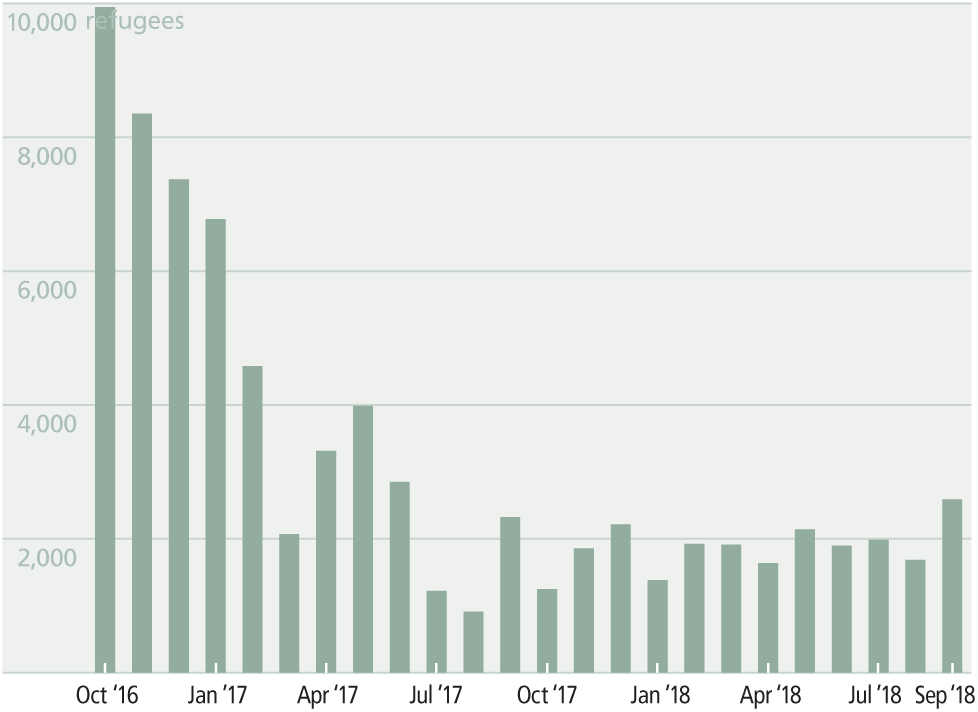
The Executive Order’s more than 50% reduction in 2017 refugee arrivals had drastic consequences for resettlement agencies, many of which suddenly saw their projected annual budgets slashed. Forcing already underfunded resettlement agencies to operate on a fraction of their budget is unrealistic and detrimental to refugees and American communities. The graph above (right) illustrates the monthly arrival rate from the beginning of fiscal year 2017 through the end of fiscal year 2018. By March 2017, resettlement had dropped to 20% of the arrival rate at the beginning of the fiscal year. At the local level, these reductions are even more extreme: arrivals slowed to a trickle, with some months seeing zero new arrivals. When refugees stop arriving, so does revenue, making it difficult for resettlement agencies to keep their doors open. This is especially consequential for the refugees already in the United States who continue to rely on these agencies.
Resettlement agencies have had to downsize, cutting staff and reducing professional capacity in the very communities tasked with helping refugees once they arrive. This reality of job loss is especially salient given President Trump’s nationalist rhetoric about protecting American workers. Refugee resettlement supports a specialized employment sector in receiving communities. Due to reduced arrivals, skilled and experienced caseworkers, social service providers, and expert staff have been laid off, creating a void in communities across the country.
A 2017 survey of the nine national resettlement agencies found that at least 300 jobs were cut in the months following the announcement of the Executive Order. Within weeks of President Trump’s first Executive Order, one national agency closed five local offices in Maryland, Idaho, Ohio, Florida, and Tennessee, laying off 140 employees in the process. Hawaii, Louisiana, and West Virginia are at risk of losing their resettlement programs entirely. This trend is expected to continue, as the Department of State informed the nine national agencies that any local office slated to receive less than 100 refugee arrivals annually would be shut down. It bears repeating that cuts to resettlement agencies reduce the future organizational capacity of refugee resettlement if and when policies become more favorable under subsequent administrations.
Other peripheral industries have experienced adverse consequences as well. For example, a furniture company that sold affordable basics to arriving refugees in Southern California has seen their business shrink. In cities where employers rely on resettlement agencies to refer refugees for employment, requests to fill vacancies are coming up short.
The abrupt decrease in the number of resettlement spots also affects the refugees who have already immigrated to the United States and the communities in which they live. Despite only being officially responsible for a refugee’s first 90 days in the United States, resettlement agency caseworkers continue to serve in a de facto capacity as an invaluable resource to refugees long after their formal services end. Months later, caseworkers are still helping former clients decipher their mail, fill out forms, secure better housing, and advance in their careers. As staff are laid off and offices close, refugees are left without this crucial support system. Their needs will fall instead to underprepared schools, service providers, and local governments. When policies target federal programs for refugees, states and local communities must prepare to assume greater involvement in the resettlement process.
International Effects of Decreased Resettlement
President Trump’s Executive Order has created a domino effect that is reverberating backward along the chain of resettlement. Secondary effects are especially consequential when understood within the context of the global division of labor between states of resettlement and major refugee host states. The pathway to resettlement is long and complicated. There are several junctures at which the Executive Order has negatively affected refugees in the resettlement process, resettlement institutions abroad, and host countries in the Global South.
Around the world, the refugee experience is characterized by waiting: waiting for the war to end, waiting for aid, waiting for resettlement, and waiting to hear from or join loved ones. This state of limbo is an intrinsic byproduct of the international refugee assistance regime, the consequences of which are exacerbated when countries like the United States abruptly curtail their resettlement program. A lower resettlement cap has resulted in a delay, or even complete denial, of resettlement for many refugees who were once all but guaranteed entry to the United States. Fewer resettlement spots create longer waiting periods, which, in turn, make planning and local integration more challenging. The Executive Order complicated standard bureaucratic regulations. For some refugees, required screenings expired during the prolonged process, derailing their resettlement application after years of waiting and putting them in precarious situations. Notably, many refugees go into great debt prior to their departure, watching their savings dwindle as they avoid unauthorized employment and bet on the hope of resettlement.
Refugees resettled from Somalia, Syria, and Iran
Source: Worldwide Refugee Admissions Processing System
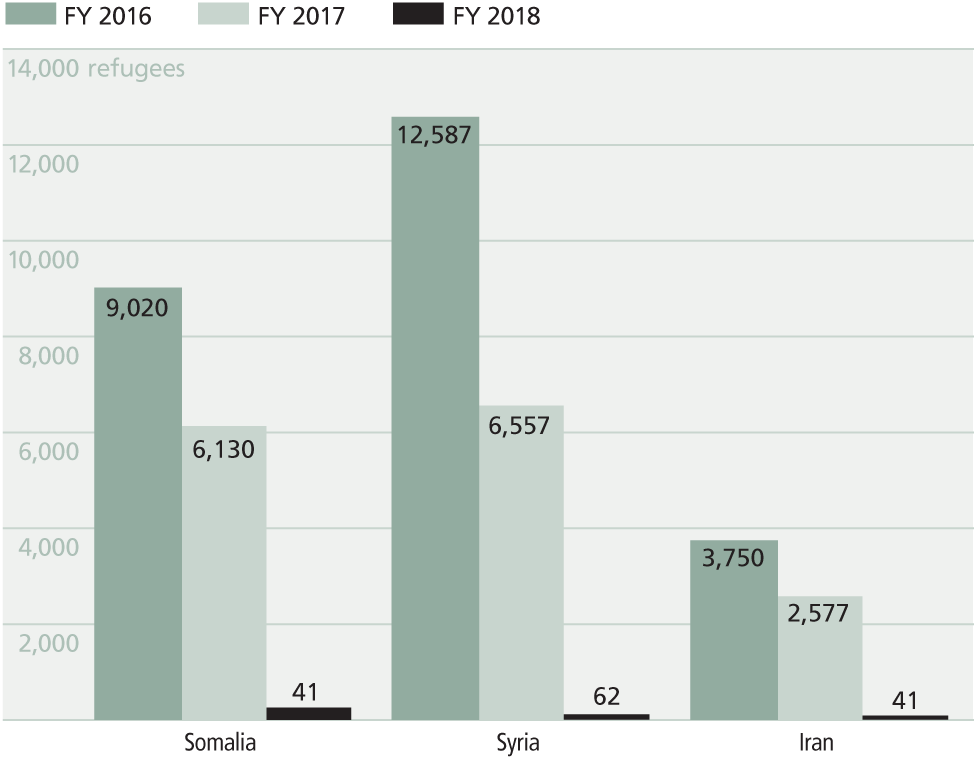
Thousands of Somali refugees have been living in camps in Kenya for decades, with many having submitted their applications for resettlement over ten years ago. According to This American Life, shortly before the first Executive Order was signed, a group of Somali refugees had received news of their approval for resettlement and impending departure for the United States, and they began taking steps to prepare for resettlement. They sold their belongings and took loans to secure their futures in the United States. The promise of work in the United States served as their collateral. These refugees had made it to the final stage of an incredibly arduous process only to have their immanent departure blocked when President Trump signed the first Executive Order. They had given up their shelters and jobs in the refugee camp and were left with broken promises. Shortly after these refugees heard the news that they would no longer be leaving for the United States as planned, concerned staff at the transit center where they were housed felt the need to add extra security for a suicide watch. For these particular refugees, the March 2017 injunction by a federal judge in Washington eventually allowed them to resettle in the United States.
In other cases, resettlement was completely halted in response to uncertainties about the future of the U.S. Resettlement Program. The Austrian government cancelled the transit visas issued to religious minorities who were preparing to flee Iran. These Iranians were about to travel to Vienna to undergo the U.S. resettlement application process in search of religious freedom and more secure futures for their children. This doorway to resettlement and freedom from religious oppression established by the 2004 Lautenberg-Specter Amendment may now be shut.
The Executive Order also had negative consequences for members of the host community in major refugee host countries. Employment opportunities for citizens in these Global South countries is another form of burden sharing among states. In Jordan, for example, the decrease in resettlement to the United States led to job loss among the Jordanians who work in Refugee Status Determination (RSD). Jordan was the top country for UNHCR resettlement operations in 2015 and 2016 and served as a primary country of refugee processing for the United States. Job loss among Jordanian citizens has been cited as an important factor in increased tensions between refugees and their host communities. Similarly, the U.S. Resettlement Support Center offices in Kenya, South Africa, and Tanzania laid off more than 500 employees in the wake of the Executive Order, which weakens their ability to assist refugees in the future.
The subsequent iterations of the Executive Order have all but blocked resettlement for refugees who originate from the Muslim-majority countries included in the version upheld by the Supreme Court in June 2018. Syria and Somalia are among the top refugee sending countries in the world, yet arrivals from these countries, as well as Iran, have dropped drastically (see p. 22). For refugees who had already been resettled, the Executive Order has halted the applications of loved ones, keeping families apart and adding new anxieties to the already difficult process of resettlement. At best, refugees will have to wait longer for fewer slots in this more precarious program. Without access to authorized employment in host countries, high rent and daily living expenses become increasingly daunting for refugees with each passing week. These delays can also be exceedingly consequential for children who are unable to attend school and for those in need of regular medical care.
Looking Ahead
The future of the U.S. Resettlement Program looks bleak in the wake of President Trump’s January 2017 Executive Order, which significantly reduced the number of refugees allowed to enter the United States. In September 2018, President Trump set the annual refugee admissions ceiling for fiscal year 2019 at 30,000 refugees, a historic low. Given the gross disparity between the resettlement cap and actual refugee arrivals in 2018, the United States is likely to resettle far fewer than 30,000 refugees. If the U.S. continues to resettle the same proportion of the annual ceiling in 2019 as it did in 2018, under 15,000 refugees will be granted resettlement. The precipitous decrease threatens the international system of refugee assistance, disregarding the decades-old legacy of U.S. resettlement. Though some may argue that the number of resettled refugees is relatively small and therefore has an insignificant impact on alleviating forced migration, the U.S. Resettlement Program is a partner in a broader system of global refugee management. By diminishing the U.S. Resettlement Program, the Trump Administration consigns refugees and their host communities around the world to bearing yet another burden.
Though most refugees remain in refugee camps and urban areas in developing countries, the opportunities that arise from resettlement can be life changing for each refugee and his or her family. Most of the world’s 25.4 million refugees have been displaced for five or more years, periods of displacement characterized as “protracted situations.” Some refugees are displaced for decades, making refugeehood an inherited status, as generations live without the legal protections of citizenship. Though resettlement has only ever been an option for a small fraction of the world’s refugees, it nevertheless provides some with an alternative to protracted displacement. Resettlement allows refugees to access civil, social, and economic rights, breaking the cycle of refugeehood by offering a pathway to citizenship. The Trump Administration is withholding this possibility from thousands of refugees by pulling resettlement even further out of reach.