



Abstract
Amin Ghaziani and Ryan Stillwagon on temporary spaces of queer community-building.
The world is post-gay, some people say. The American statistician Nate Silver is a prime example. Silver rose to fame for predicting the outcome of the 2008 U.S. presidential election with stunning precision. In 2009, Time magazine named him as among the world’s 100 most influential people, and Out magazine selected him as their person of the year in 2012. During his interview with the editor of Out, Silver rocked the boat when he defined himself as “sexually gay but ethnically straight.” Cynthia Nixon, a star on “Sex and the City,” created a similar kerfuffle that same year when she said that being gay was a “choice.” And then there are big-ticket Hollywood actors like Tom Hardy who speak casually about their sexual exploits with other men, while self-identified straight women routinely kiss other women. A realtor in Fort Lauderdale summed up the new state of sexual nonchalance: “No one gives a good goddamn if you’re gay or straight.”
Courtesy Pop-Up! QDP
Pop-ups provide a peek inside a thriving world beyond the gayborhood and its bars. They are an innovative expression of contemporary urban sex cultures that showcase the exquisite diversity of queer lives.
All this fluidity might explain the panic that some of us feel about the alleged death of queer communal life in cities across North America. “There Goes the Gayborhood,” the Globe & Mail and New York Times declared in 2007 and 2017. The Los Angeles Times lamented in 2015 that gayborhoods are “a victim of the gay rights movement’s success.” Around the same time, the Financial Times predicted that “gay areas in cities may disappear” altogether.
Headlines like these have some truth to them. Demographers like Amy Spring show that more straight people are moving into gayborhoods while gay people are spreading throughout cities and even branching out to the suburbs and rural areas. One effect of these migrations, we are told, might be the demise of gay bars. In 2007, Entrepreneur magazine put gay bars on its list of “businesses facing extinction,” and a decade later, the Economist was still describing them as “under threat.” Meanwhile, a blogger for the Huffington Post saw the emaciation of gay bars as symptomatic of a bigger cultural problem: “the gay community is dying.”
While gay bars might be dropping like flies, a new innovation in queer nightlife is thriving: the phenomenon of temporary hang-out spaces—or pop-ups. Spontaneous and ephemeral, these gatherings are often dance parties, but they can also include pop-up museum exhibits, theatrical performances, drag balls, cruising spaces, dinners, thrift-shops, poetry slams, and kick ball games. The specific venue matters less than the communal effervescence. Conversations in Vancouver, where we live, have opened our eyes to lesbian social justice warriors congregating at “Denim Vest,” gender fluid virtuosos flocking with irony to “Man Up,” trans folk gathering at fire spinning parties, and indigenous individuals celebrating at the annual “2Spirit Rebellion” and weekly “powwow dances.” Characterized by outrageous names, costumes, and a bacchanalian spirit, each space is brimming with possibilities. “I am still beholden to the idea of a queer Mecca,” one organizer told us. “Like queer heaven.”
Queer pop-ups take several forms. “Canvas-style parties” are held weekly, monthly, or quarterly. They bounce from place to place as part of a strategy to curb costs and include people who are scattered across the city. Canvas parties attract a close network of patrons who enjoy the experience of social familiarity. “Community-need parties” have emerged in response to the perceived Whiteness of the gayborhood and its bars. These are frequently people of color-only events—with sassy and empowering names like QTPOColypse. They provide forums for investments in queerness that do not require residence in expensive, gentrifying gayborhoods—or “vicarious citizenship,” as urban sociologist Theo Greene calls these extralocal forms of territoriality. Finally, there are “guerilla-styled events” in which partygoers coopt an existing bar and transform its tone, vibe, and composition with a queer density of bodies and styles of interaction. Demographers may be right about residential diffusion, but our research suggests that pundits are wrong in their interpretation of its institutional effects. Gay and lesbian bars are not the only hub for communities to form and flourish.
A Man Up Vancouver event in 2017.
Lindsay Elliot, used with permission. lindsayelliot.com
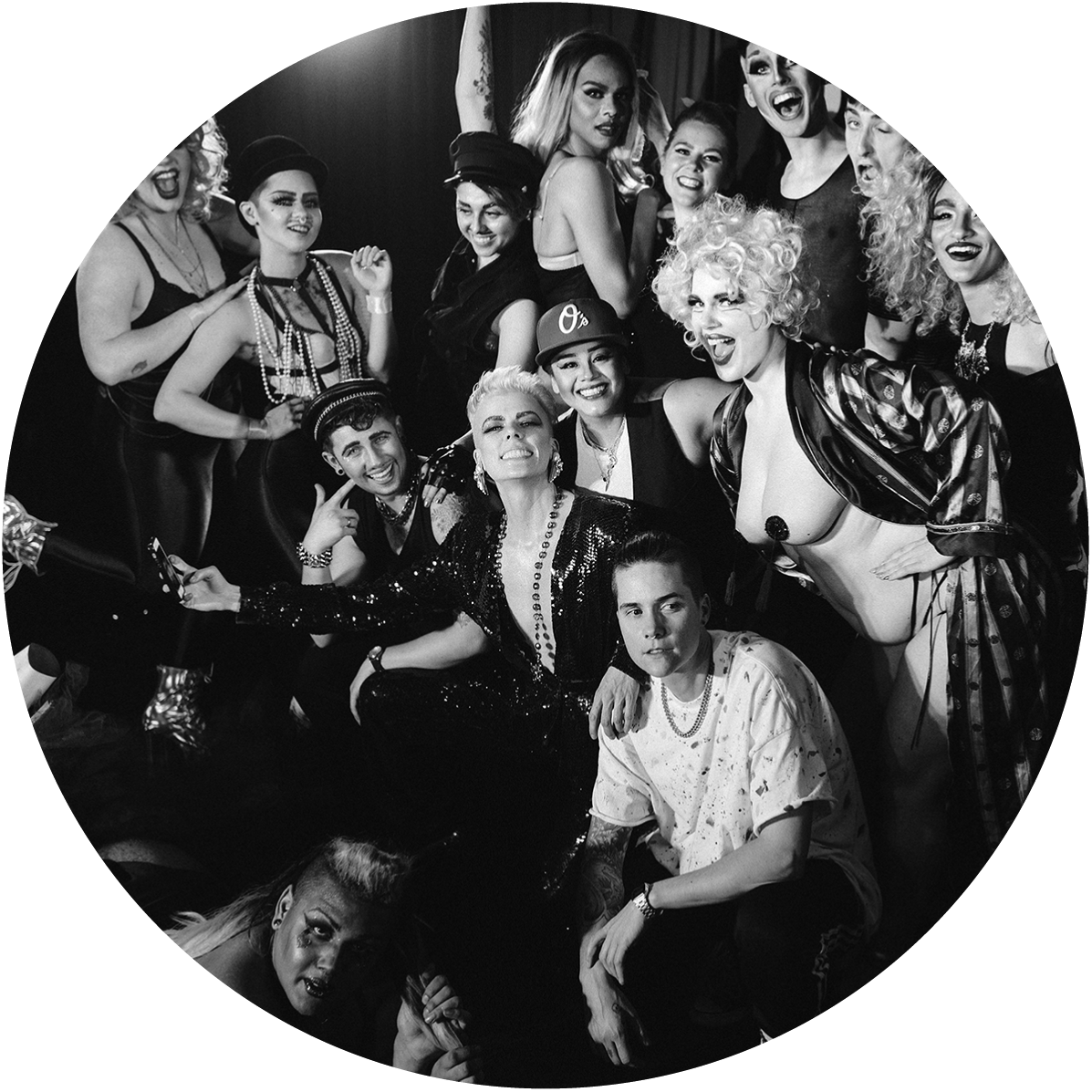
Organizers of queer pop-ups are invested in a number of political projects, including safety, self-expression, and inclusion. One said to us, “I’m an organizer for queer events, such as Denim Vest, which is a dance party that is centered around community-determined access and collaboratively trying to figure out what safer spaces can look like.” Shanice, who organizes QTPOColypse, focused on the visibility of people of color. “I think about queerness as a kind of radical self-expression and an encompassing of difference. That separation [into a party space] can be really awesome.” And then there’s Nia: “When I’m with everyone, I feel like I’m just a one of a many: there’s a couple of south Asian gay boys, and then there’s also the queers, and there’s also the transfolks. When I have to choose—who wrote that poem? [Pat Parker]—I want to be able to talk to everyone in one space, because otherwise I always leave a part of myself behind at the door when I walk in.” Lilliam echoed the importance of connecting queers with each other: “We are reaching out to people that need the space. We are reaching out to people who don’t really feel like they belong in other places. The only real distinction [between pop-ups and gay bars in the gayborhood] is that we’re not actively seeking out people who already have a lot available to them.” Pop-ups offer a space for people who feel uninvited to the party in the gayborhood, where bars cater to a narrow segment of wealthy, White, male, and cis-gender patrons who flaunt a consumerist aesthetic.
Attendees echo what we heard from organizers. “Pop-up events have the opportunity to include folks who are not cis-gay men,” Wei, a 30-year-old Taiwanese gender queer individual told us. “That would be for me the differentiator [from gar bars]. The event is really about the diversity of the community.” Aeron, another reveler, added, “Of the times that I’ve danced with folks, sometimes they have been in straight spaces where I am female presenting at the time, and someone female is drawn to me, and that set-up is not a safe one for me, right? But within queer spaces, you can let down your hair. Go and explore, figure yourself out. This is a space to do it. No questions asked.” We also spoke with Xinyi, who described how she felt when she attended her first pop-up party: “I think one of the most memorable moments, when I first went, was just seeing queer women together, just seeing the different kinds of queer couples that were there, seeing cute queer people of color together instead of just seeing like the regular White women making out. It was just so nice to see them just being intimate with each other in this safe space.”
Pop-ups provide a peek inside a thriving world beyond the gayborhood and its bars. Although demographic and institutional upheavals certainly surround those spaces, we must resist making sweeping, not to mention alarmist, conclusions about their death and demise. Most of the attendees that we talked to disputed claims about a dwindling need for separate social spaces. “What gay people are you talking to?” one of our interviewees wondered when we showed him a news headline. “That actually doesn’t make sense to me, because as a queer person, I’m always going to be searching for queer-specific events.” He then drew a comparison with his race: “For me, as a Black person, I would never be like, ‘There’s too many black-centered things in the city. Because there literally are not.” The same logic applied to queer gatherings. “Even if there are specifically gay bars in the city, I’m never—in my mind, it doesn’t make sense to be like, ‘We’ve reached our limit.’ There should always be so many more. Always.”
Pop-ups are ephemeral, lacking specific geographic anchors, but they still shape an enduring sense of self and community. They are an innovative expression of contemporary urban sex cultures that showcase the exquisite diversity of queer lives, especially those individuals who feel excluded and marginalized by the gayborhood and its bars. Pop-ups display the power of spontaneity, organizational flexibility, and empowerment in placemaking efforts. Some people, it seems, still give a good goddamn about their sexuality.