



Abstract
c. winter han on using white as a proxy for normal in gay media.
Once cloaked in non-descript brown wrappers and confined to back-alley magazine stores, gay media is now ubiquitous. Yet, in contemporary gay media, as in mainstream media, gay people of color don’t often exist outside of fantasy cruises to Jamaica, Puerto Rico, or the “Orient.” Even when they are present, they exist only as flamboyant sidekicks to “straight-acting” gay White men, who have come to represent the “gay community.” Sometime between Stonewall and Will & Grace, those who exercise sway over gay media seemed to have decided that the best way to be accepted by straight America was to mimic upper middle-class Whiteness.
Pushing for normality by doubling down on Whiteness necessarily implies further marginalizing non-White people.
Gay media targets straight audiences in much the same way that gay bars now seem to exist for the fun of straight women. Consider the mid-2000s show, Queer Eye For the Straight Guy, and the more recent Academy Nominated film, The Kids are Alright, which features a lesbian couple in a stereotypical husband and wife role arrangement: there is doctor and breadwinner Nic and a stay-at-home wife Jules. Widely celebrated images of gay men, like the revived character Will Truman present gay White men as entirely “normal” so that straight audiences can “relate” to them.
It wasn’t surprising that, in March of 2016, the hashtag #GayMediaSoWhite began trending on Twitter. Where, the protest asked, were all the gay people of color? Magazine articles lamenting the lack of “diversity” in gay media began asking a more instrumental question, but “How can gay media be more inclusive?” editorials made it seem as if the exclusion of non-White people had been an oversight. Include diverse faces, and the problem would be solved.
But something else is going on. It isn’t just that gay people of color are not represented on TV or don’t make it to the covers of gay magazines; rather, they are less likely than even straight, White, cis-gender men to be on the cover of a “gay” magazine. Writing for Fusion Magazine, journalist John Walker found that only 35% of the covers he surveyed featured a gay White person (mostly men), and straight White men adorned 45% of the covers. So it’s not just that gay magazine covers feature White men, but that they only feature a certain kind of White men: straight, or at least “straight-acting.” This typical cover model is neatly groomed, gym-toned, and reminiscent of the American “boy next door.” And these images are not confined to glossy pages: Gay protagonists on television and in movies are also uniformly White, with people of color often in supporting roles deliberately meant to normalize Whiteness.
A good example is the 2015 film Stonewall, directed by Roland Emmerich. Emmerich’s films have grossed over $3 billion, and he is widely considered to be the most successful, openly gay film director in history. His admittedly fictional account of the gay liberation movement was set around the 1969 Stonewall riots, “where pride began,” and the release of the first theatrical trailer led to widespread condemnation. Gay people of color rightly charged that Emmerich appeared to be whitewashing the historic event. As journalist Richard Lawson wrote in Vanity Fair, the whole film depicted Stonewall through a “white, bizarrely heteronormative lens” that erased people of color or treated them as comic sidekicks to a fictional White protagonist, Danny (who we see disembark a bus from Indiana in the West Village, only to be mistaken for straight at a local diner).
Responding to criticism, Emmerich told The Guardian that “Stonewall was a white event, let’s be honest.” He went so far as to attribute his inclusion of people of color in supporting roles and bit parts as “political correctness,” rather than any attempt at historic accuracy, and to explain that Danny, is “very straight-acting. He gets mistreated because of that. [Straight audiences] can feel for him.” In Emmerich’s mind, the gay White man easily mistaken for straight is the more real and relatable victim of prejudice, not the gender fluid people of color rendered in his film as modern-day minstrels.
A sample of Out magazine covers via Google image search.
Screenshot, google.com
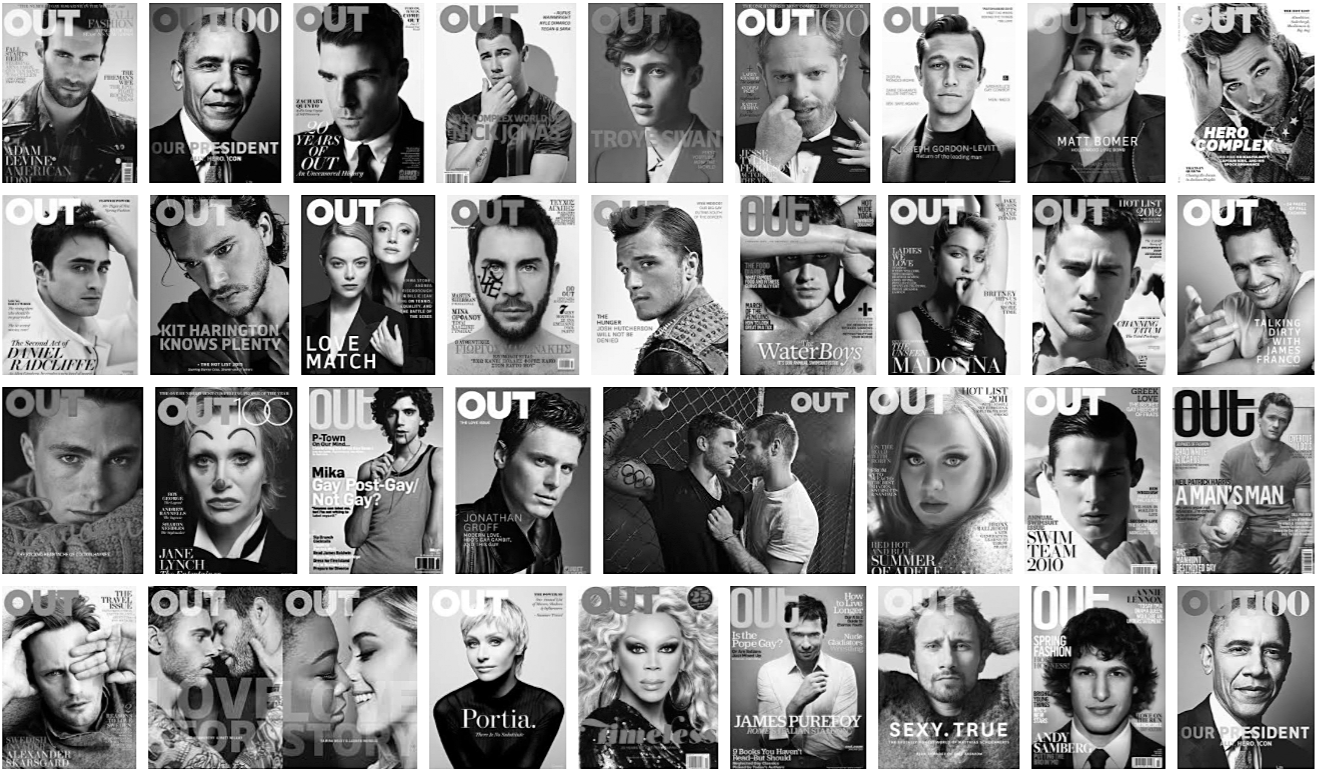
This Whitening and heteronormalizing of the “gay image” makes a certain sense. As queer theorist Ian Barnard noted in Queer Race, literary and historic projects that attempt to define and create a mythological and unified gay past will simply reaffirm and re-enforce Whiteness, given their genesis in largely White organizations and educational settings. In other words, as gay White men dominate powerful positions within “gay media”—see Lucas Grindley at The Advocate, Aaron Hicklin at Out magazine, Chris McCarthy at Logo TV, and Andy Cohen at Bravo—they become the face of gay America and they present “gay history” as their history. In this context, erasing gay people of color from the memory of Stonewall seems all too inevitable.
Race was also missing from media coverage of the June 2016 Pulse nightclub shooting in Orlando. Progressive media watchdog, Media Matters, examined the news coverage following the shooting and found that, despite the fact that the vast majority of victims were gay Latinx, only 20 of the 254 commentators featured on MSNBC, CNN and Fox Newswere Latinx and just 45 were LGBTQ. Even in unfolding events, gay people of color are shunted to the periphery of “gay history.” The absence of Latinx voices in speaking about the Pulse nightclub shooting shifted the dialogue from race to sexuality, as gay White men (with the privilege to be “unraced”) came to speak for the entire community. Media ignored the uncomfortable truth that nightclubs such as the Pulse exist specifically because gay White men do not, in fact, speak for all gay people. After Pulse, gay White men were able to claim victimhood and demand justice, even as they helped erase gay Brown men in claiming the Pulse nightclub tragedy was a “gay” tragedy.
An argument can be made that the “heteronormalizing” of gay America and the normalizing of gay relationships more generally have been crucial in the fight for marriage equality. Now at over 60%, the dramatic shift in public support for gay marriage has happened faster than transformation on almost any other social issue in history. Statistician Nate Silver has marveled: “Change doesn’t usually come this fast.” Yet, as sociologist Suzanna Walters argues in her book, The Tolerance Trap, the fight for marriage equality represents the quintessential striving for normalcy by specifically gay White men. In fact, the fight for gay marriage has relied in part on portraying gay men and lesbian women as being “just like” straight people in every way but one. Pushing the “normality” of homosexuality in a country steeped in racism and heterosexism means promoting the Whiteness of the “gay community” in an attempt to veil the absence of its heterosexuality. If you can’t be straight, at least you can be White. The problem is that pushing for normality by doubling down on Whiteness necessarily implies further marginalizing non-White people.
As decades of social psychological literature have demonstrated, constructing one group as “normal” depends on the ability to define another group as “deviant.” In striving for normality, not all gays can be seen as “just like” straight people. For example, Black men are on the “down low” and are a threat to Black women, while White men who need to escape to Brokeback Mountain to express their true love for one another deserve our sympathy.
How gay media represents race is about more than the underrepresentation of people of color. It is equally important to consider how media represent gay men of color. As Twitter user Viktor Kerney observed, gay men of color are constantly pathologized as sexual deviants. Thus, gay White men become “normal” and straight audiences understand what a “bad gay” looks like.
In his influential essay, “The Matter of Whiteness,” media theorist Richard Dyer argues that racial imagery is central to the way societies decide who has value and who does not. Cis-gender, straight or “straight-acting” White men nab magazine covers and dominate television and movies. Even lesbian couples are White and take up conventional heterosexual family roles. Media trade on White privilege and cis-gender privilege to make “gay” palatable to straight audiences. And so ultimately, the problem with gay media being so White isn’t that it is so White, but that it equates Whiteness with normality. I guess that makes the rest of us abnormal.