



Abstract
Andrew M. Lindner reviews Tim Wu’s The Attention Merchants.
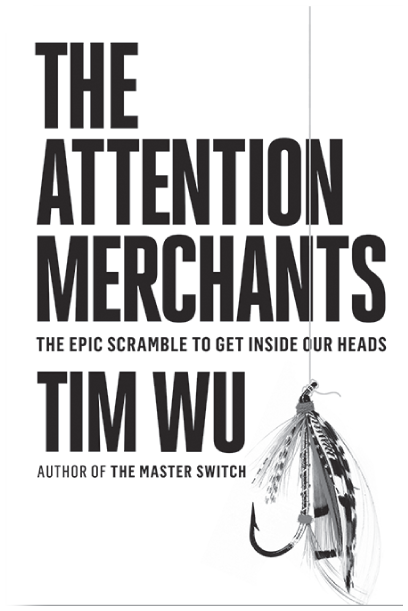
The Attention Merchants: The Epic Scramble to Get Inside Our Heads By Tim Wu Alfred A. Knopf, 2016 403 pages
In 1957, journalist Vance Packard’s The Hidden Persuaders became an overnight hit, selling more than a million copies with its disturbing story of how advertisers were using subliminal psychological techniques to sell the American public on the full gamut of consumer goods. “The result,” wrote Packard, “is that many of us are being influenced and manipulated, far more than we realize, in the patterns of our everyday lives.”
If those engaged in the capture of our collective attention were harnessing it for the purposes of altruism, justice, democracy, or kindness, there might not be an entire genre of books devoted to balking at their relentlessness.
The Hidden Persuaders was an influential, early entry in a genre that sticks with us today. Such books, which include Sherry Turkle’s 2011 Alone Together and Adam Alter’s new Irresistible, purport to pull back the curtain on the ways media are manipulating our desires and undermining our free will as companies attempt to turn us into ever-better consumers. If Packard’s story was about the emergent television commercials that lure us into buying cars and beauty creams, Turkle and Alter warn of the addictive and disruptive power of the wee Skinner boxes we call smartphones.
Into this genre comes Tim Wu, the Columbia Law professor best known for coining the term “net neutrality.” In his new book, The Attention Merchants, Wu raises alarm about media afflictions of the Internet era. He takes the reader on a guided tour of the history of “attention capture,” or “the harvesting of attention on a mass scale and directing it for commercial effect.” The Attention Merchants opens with the penny papers of 1830s New York City and the vivid posters that redecorated the Parisian cityscape in the 1860s, then walks us through the historical development of attention capture techniques from the patent medicine industry in the early days of radio up through Netflix and the birth of binge-watching.
Wu is an accomplished storyteller, filling his book with colorful characters and delightful bits of media trivia (did you know that, in 1980, Americans inserted 11.2 billion quarters into arcade games?). For this reason, historians may chafe at his “just so” telling of historical events, such as when he paints the early days of television as a war between the visions of two men, CBS’s Bill Paley and NBC’s David Sarnoff. Likewise, Wu’s brief and caricatured references to Adorno, Marcuse, and Foucault are sure to rankle cantankerous social theorists.
Nonetheless, by going big and telling a sweeping story about history, Wu does two important things. First, he gives a dose of perspective on our faddish media panics. Yes, we are currently worried about smartphones—just as we were worried about arcade games, advertising, television, radio, and flashy posters before that.
Indeed, Wu argues that The Hidden Persuaders moment (the mid-1950s)—not now—deserves credit as the period of “peak attention,” or the historical time “when more regular attention was paid to the same set of messages at the same time.” When Elvis debuted on the Ed Sullivan Show in 1956, roughly half the country was watching.
Today, no monopoly merchant directs a single message to so many of us. A little more than half of Americans have Facebook, but our Facebook feeds serve us a diet prepared to our tastes. If nothing else, that means a greater diversity of messages and less control for any given merchant.
Even as the historical scope of Wu’s book counteracts some degree of alarmism, his historical telling turns our focus on the troubling trajectory toward greater total attention capture for commercial means. As a whole, we are no longer seeing the same commercials for Breck shampoo. Instead, we are all subjected to hundreds of demands on our attention before we leave the house in the morning.
Given this level of attention capture, many, including Turkle, Alter, and Wu, have worried about what smartphones mean for our ability to be fully present in social situations, to find space for quietude and reflection, and to hold focus on important work.
Media sociologist Nathan Jurgenson, writing in The New Inquiry, has argued that such concerns are typical of “digital dualism,” the view that time spent online and offline are distinct and zero-sum, rather than blended and potentially complementary. As he writes, “Facebook is real life.” Likewise, even Alter—who likens technology use to addiction—has to admit that an infinitesimal number of media users actually meet the clinical definition of addiction.
While Wu shares concerns about the extent of attention capture with the likes of Turkle and Alter, he is no extremist. Throughout the history told by The Attention Merchants, we see that advertising revolts are frequent and can succeed in rolling back attention-grabs that go too far. And, today, signs abound that people are revolting against the extraordinary degree of attention capture. Talk of digital sabbaticals, cord-cutting, and humble-brags about “taking a break from social media” reveal that we are already resisting the tyranny of app notifications.
As Jurgenson and Wu both make clear, we do have free will. We can opt-out. Heck, we can get flip-phones. The reason we usually don’t is that media offers us things we like. Video games offer us leisure and a chance to interact with far-flung friends. The Internet provides opportunities for information, learning, and mobilization. My smartphone lets me FaceTime with my nieces and nephews. So, who cares?
The powerful contribution of The Attention Merchants is that by lining up the history of “attention capture,” we see that part of the story is companies responding to consumer desire for cool stuff. But the more significant story is a set of overlapping industries using scientific measures to invade ever-more parts of everyday life for commercial purposes. As Wu asks in his conclusion, “Do we draw any lines between the private and the commercial? If so, what times and spaces should we consider too valuable, too personal, or sacrosanct for the usual onslaught?”
If those engaged in the capture of our collective attention were harnessing it for the purposes of altruism, justice, democracy, or kindness, there might not be an entire genre of books devoted to balking at their relentlessness. But, in fact, as The Hidden Persuaders once warned, our attention is primarily being pumped for commercial purposes.
Ultimately, it’s not online or offline that matters. The divide that matters is private vs. commercial space. The Attention Merchants helps us retain some perspective in our panic over the digital, while reminding us of the ever-growing incursion of capitalism into our lives.