



Abstract
Reviewing The Entrepreneurial State and The Power of Market Fundamentalism.
The Entrepreneurial State: Debunking Public vs. Private Sector Myths Mariana Mazzucato Anthem Press 2014 237 pages

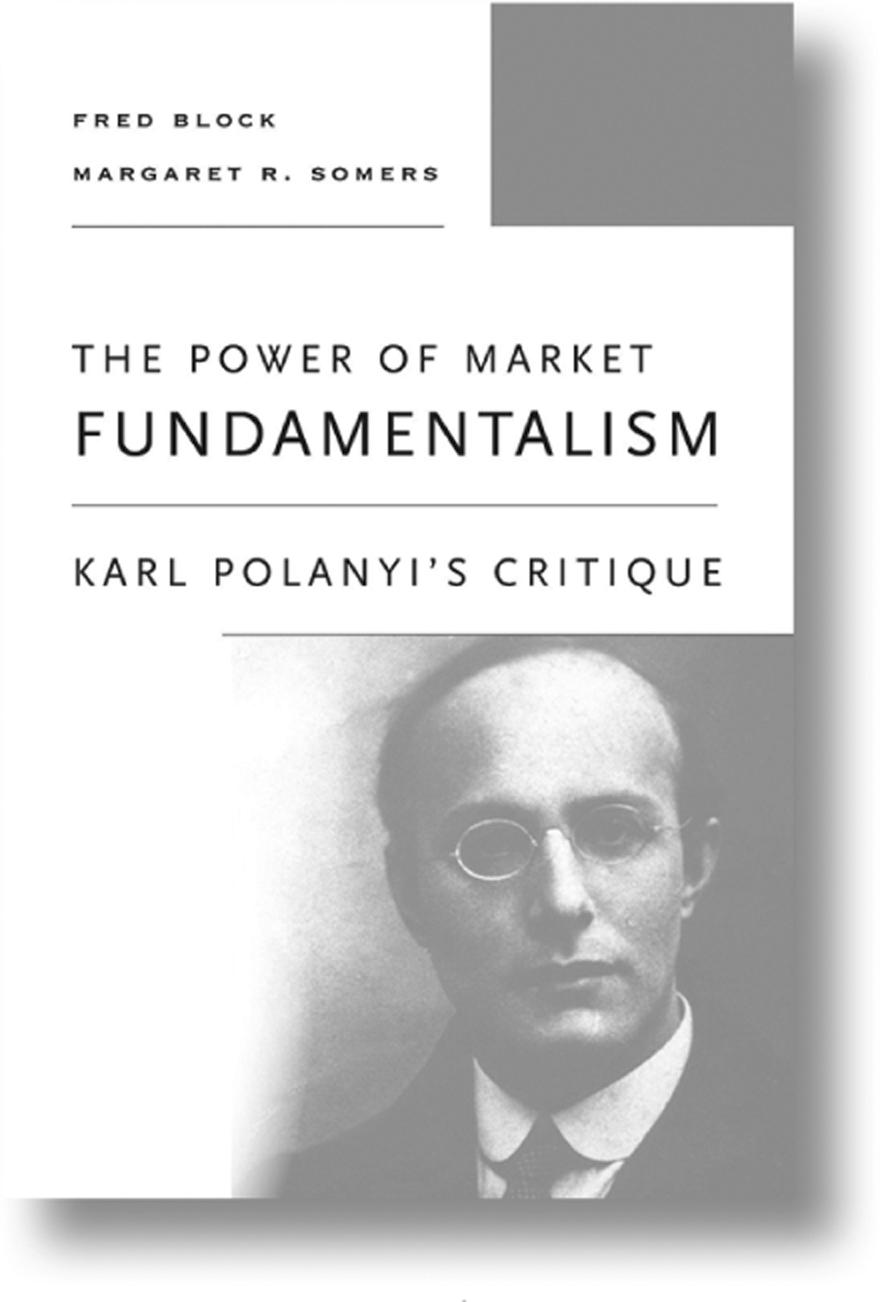
The Power of Market Fundamentalism: Karl Polanyi’s Critique Fred Block and Margaret R. Somers Harvard University Press, 2014 296 pages
What is the appropriate role of the state in the innovation economy? According to an enduring myth, the state is a mere parasite and the capitalist economy would be much better off without it. Milton Friedman captured this sentiment in Capitalism and Freedom when he wrote that the “greatest advances of civilization, whether in architecture or painting, in science or literature, in industry or agriculture, have never come from centralized government.” And grand visions and innovations, Walter Isaacson writes in The Innovators, come from “pioneers, hackers, inventors, and entrepreneurs,” not from the lumbering actions of the bureaucratic state.
Dominant as this narrative might be, Mariana Mazzucato vehemently disagrees. In The Entrepreneurial State, she argues that the state plays a pivotal role in shaping the modern economy: It has helped industrialize entire economies (such as Singapore), and it supports the private sector in a myriad of ways, from publicly funded research activities, small business start-up grants, and tax credits, to relocation packages. But the modern state does not only nudge the economy, in Mazzucato’s view, it actually pushes it forward through bold and innovative measures. The modern state is an entrepreneurial state.
Mazzucato makes her argument through a series of case studies, one of which is Apple Computers. In producing many of its innovative designs, Apple drew on technologies that had been developed by the U.S. state, especially through its military arm. This includes such technologies as the Internet, multi-touch screen, liquid crystal display, GPS, as well as the new Siri voice-activated personal assistant. But it is not just the Department of Defense and its research organizations that have produced some of the most important technologies that are around today. Apple has also benefited from the very visible hand of government by receiving early stage investment funds from the Small Business Investment Company program.
Mazzucato’s argument adds up to a theory of how the entrepreneurial state operates and how major innovations come about. In order to produce technologies that can profoundly change the economy and drive it forward (such as the Internet, the green industrial revolution, or clean technology) you need an actor willing to deal with situations where you simply do not know the outcome (“Knightian uncertainty”). This actor has to have a long-term perspective and be willing to take on high-risk investments. Far from parasitic, the modern state is the only actor to take on this essential challenge. Venture capital, in contrast, wants to deal with situations that are much easier to control, and where it is possible to calculate the chance of success (risk). Venture capitalists are typically timid when it comes to taking on daring projects: their investments are driven by short-term profit motivations, not by the desire to fund truly game-changing innovations. They let the state take care of high-risk investments, entering the game only when they see clear returns and market opportunities.
One major problem with this way of doing things is that while the state invests vast amounts of taxpayer money into basic research and development, private industry reaps the profits. Modern firms like Apple have benefitted enormously from state-funded research and yet they pretend they have no obligations to society. Tax avoidance schemes, offshore accounts, sea steading, tax havens, and tax inversions are just some of the many strategies to avoid paying their full share of taxes in the United States.
Mazzucato argues for a multi-pronged remedy that includes coordinated decentralization, cooperative sharing of expertise, reciprocal public-private partnership, and (above all else) gain sharing. To put it more bluntly, she calls for a good dose of economic transparency. It is time that we come to terms with the utter foolishness of the Ayn Rand/Adam Smith fundamentalist approach to the economy. This is because the narrative that the state is a pariah and the private sector is the savior of the modern economy is not only empirically flawed but also economically unsound.
In their brilliant new work, The Power of Market Fundamentalism, Fred Block and Margaret Somers also emphasize the importance of bringing both politics and the government back into the heart of economic analysis. They do this through a fine-tuned and sophisticated analysis of the ideas of the new “it” theorist, Karl Polányi. The book takes us through the long journey of Polányi’s life, starting in Budapest and ending in Pickering, Ontario, with stops in Austria, England, and the United States. It provides a sure-to-please summary of Polányi’s most well known work, The Great Transformation, and rehearses his key idea that there is no such thing as a self-regulating market. Laissez faire is a stark utopia.
Through a superb reinterpretation of the so-called Speenhamland System of Poor Relief (1795), the authors link up Polanyi’s critique of the utopian market project to its current version, which they call market fundamentalism. Politicians and political economists succeeded in recasting Speenhamland, which actually helped the poor in many ways, into its very opposite. It was now said that Speenhamland made life harder for the poor and therefore must be abolished. Block and Somers show the parallels between this argument and the justifications for ending welfare in the U.S. more than a century later, especially with regard to Aid to Families with Dependent Children (1996). In this view, welfare legislation makes things worse for the people it supposedly tries to help. Following Albert O. Hirschman, the authors refer to this as “the perversity thesis.”
The central theme of The Power of Market Fundamentalism is that ideas matter in politics and can deeply change the way major institutions work. For these reasons, they suggest, social scientists need to pay more attention to ideas—especially to how they are embedded in social and political structures. First and foremost, however, we need to debunk market fundamentalism and replace it with a new public philosophy that is be centered on society, not ego-centric needs of the market economy. The last words of their book channel Polányi’s ghost,
“We are social beings; we derive our meaning from our connections to other people, and we need to understand that genuine freedom comes from constructing human institutions that protect the rights of each and every one of us.” (p. 240)
Mariana Mazzucato could not agree more.