



Abstract
Richard Lachmann reviews J.D. Vance’s Hillbilly Elegy.
Hillbilly Elegy: A Memoir of a Family and Culture in Crisis Vance, J.D. New York: Harper, 2016
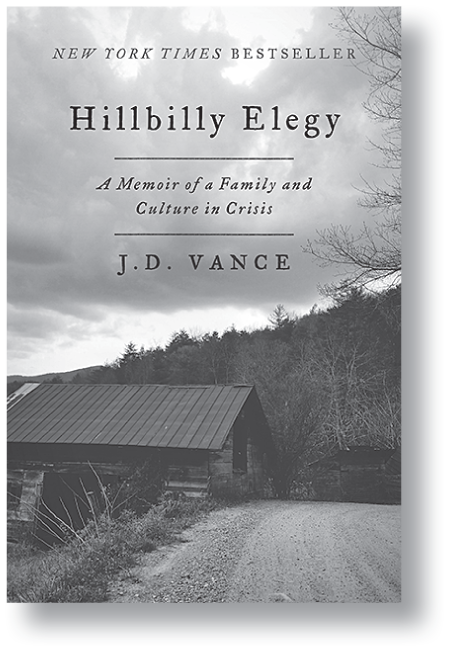
Even before Donald Trump won the Electoral College vote to become President of the United States, J. D. Vance’s Hillbilly Elegy was receiving widespread critical attention and vaulted onto bestseller lists. This is not altogether surprising; the story Vance tells is both timely and significant. Hillbilly Elegy is presented as an account of why Scots-Irish men in Appalachia “suffer from a particular crisis of masculinity in which some of the very traits that our culture inculcates makes it difficult to succeed in a changing world” (pp. 4-5). Vance says little about the shift in the political support from the Democratic Party to the Republicans among the Appalachian voters. Nonetheless, his book is chock full of insight into why the Tea Party (and Trump) appeal, even when those voters are harmed by the economic policies that the Republicans have worked to implement.
Bounded cultures do not offer blueprints for viable leftist politics. If anything, we learn that those cultures are designed to repel outside influences.
Hillbilly Elegy is framed as a memoir, but its tone is similar to that of British anthropologists writing in the first half of the twentieth century, as well as that of the American urban ethnographers of the past hundred years. Both sought to present native or ghetto life as inscrutable or irrational, but promised to interpret these “exotic others” for their highly educated readers. Vance, too, wants to explain his exotic people to outsiders. In writing a memoir, he has produced something that is more direct and immediate, but also more idiosyncratic than most academic attempts.
In telling his story, Vance shows the harm that growing up in a Hillbilly family can do to children. He recounts the violence that is directed at them, the alcoholism and the drug abuse, the lack of nutritious food, and (perhaps most disturbingly) the absolute lack of concern for children’s success in school.
Vance’s Appalachia is anomic. He quotes a teacher at his old high school saying, “They want us to be shepherds to these kids. But no one wants to talk about the fact that many of them are raised by wolves” (p. 127). Residents claim they go to church regularly, but most do not. Vance sees this as a pity because churches often provide both a sense of community and real social supports for the unemployed, broken families, addicts, and teen mothers.
Appalachian men are lazy and resentful in Vance’s experience. His stories mirror those told by conservatives about ghetto residents: A young man with a pregnant girlfriend found a job, with health insurance, at a tile warehouse. But he took numerous hour-long bathroom breaks and, when he was fired, he blamed his boss. Vance concludes, “There is a lack of agency here—a feeling you have little control over your life and a willingness to blame everyone but yourself” (p. 8). These men with a poor work ethic “talk about the value of hard work but tell [themselves] that the reason [they’re] not working is some perceived unfairness: Obama shut down the coal mines, or all the jobs went to the Chinese” (p. 147).
Vance sees the Appalachia of his childhood as “a world of truly irrational behavior” (p. 146), of people who buy unneeded consumer goods with high interest loans instead of saving for their children’s college or their own retirement. He believes he owes his own escape to his grandmother, who valued education and encouraged his success in school. But even that wasn’t enough to get him on a path to college. Vance enlisted in the Marines, where he learned discipline and received valuable advice on how to save much of his salary. His veterans’ benefits allowed him to go to Ohio State University and then Yale Law School.
Why do Hillbillies act in such self-destructive ways? Vance argues that Appalachian Scots-Irish culture is unchanged, still combining “many good traits—an intense sense of loyalty, a fierce dedication to family and country [with] many bad ones. We do not like outsiders or people who are different from us… We’re more socially isolated than ever, and we pass that isolation down to our children” (pp. 3, 4). This isolation fosters distrust of national institutions. Distrust leads Appalachians to embrace conspiracy theories, including the one about President Obama being a Muslim. Hillbillies’ downward mobility also breeds resentment: Michelle Obama “tells us that we shouldn’t be feeding our children certain foods, and we hate her for it—not because we think she’s wrong but because we know she is right” (p. 191). For Vance, this is not racism but resentment toward those who prosper as well as toward welfare recipients whom Hillbillies believe game the system and mock the struggles they face despite their hard work. Of course, as Vance readily acknowledges, the Hillbillies’ self-image as hard workers is often false, and, as he fails to recognize, the betters who draw Hillbilly hatred are the Black Obamas, not the White Romneys or Trumps, just as the lazy poor they resent are Black and not White.
Vance suggests that Appalachian culture once was functional, but he doesn’t explain how group solidarity and a propensity to violence helped Scots-Irish farmers and miners. We read nothing about Hillbillies’ violent struggles with mine owners and the state and local governments the owners commanded. Of course, those coal jobs, which we are likely to hear about again now that Donald Trump is in office, have disappeared forever. Yet the culture that enabled workers to survive in that world remains. Only now it is counterproductive in building the skills and attitudes needed for success in the post-industrial and neoliberal society in which Vance has learned to excel and prosper.
Vance’s story, of a culture that reproduces itself even as the world in which it arose and thrived has disappeared, has been told before—namely, by Paul Willis in Learning to Labor (1977). Willis did fieldwork in a working-class British high school. He found two sorts of students: the ”ear’oles,“ diligent students who passively absorbed what teachers told them, and the “lads,” male students who continually challenged teachers and were determined not to learn and instead sought to “have a laff,” cutup in class, and display contempt for academic success and preparing for employment. Not surprisingly, the ear’oles did well enough in school to quality for university or for training programs that led to stable, white collar jobs.
Despite demographic decline, the British working-class and White rural Americans can still swing elections, voting Britain out of the European Union and Trump into the White House.
The lads, like Vance’s Hillbillies of the twenty-first century, engaged in behavior that sabotaged their futures. Willis has an explanation for the lads’ self-destructive attitudes toward school: He finds that the lads learned their contempt for school authority from their thoroughly blue collar fathers who held factory jobs. In the fathers’ case, contempt for teachers had translated into a sustained opposition to bosses that allowed them to win a measure of autonomy at work. By the time the lads were in school, factory jobs had disappeared and the attitudes they learned from their fathers no longer served any purpose. Lacking both jobs and bosses, the lads turned their anger on non-White Britons, as well as women.
Willis was prophetic, writing before Margaret Thatcher took office and pioneered the neoliberalism that deindustrialized and de-unionized Britain, the U.S., and much of the developed world. By contrast, Vance is writing well after that process completes. Yet the different cultures both authors describe endure and continue to spawn attitudes and behaviors that are destructive of civil society and progressive politics, as well as of their holders’ individual possibilities for stable careers and family lives.
The social worlds that reproduce racist and misogynist cultures among the sons of the White, British working-class and Appalachian coal miners have a resilience and salience that are not erased by the helpful advice of teachers, political leaders, or cultural tastemakers. Despite demographic decline, the British working-class and White rural Americans can still swing elections, voting Britain out of the European Union and Trump into the White House.
Neither Willis nor Vance offers any suggestions on how outsiders can affect these insular cultures. If anything, we learn that those cultures are designed to repel outside influences. As a result, books that explain bounded cultures do not offer blueprints for viable leftist politics. Yet we must remember that the communities Willis and Vance write about are stalwart in their support for existing universal programs like British National Health and U.S. Social Security. Hopes for building progressive majorities or for combating racism and misogyny in the U.S. or Britain are more likely to succeed if they are built upon political programs that identify the structural sources of misery in industrial or rural communities and offer new universal programs that cannot be identified as designed “for” specific social groups.