



Abstract
During eight years of a U.S.-led occupation, Iraqi attitudes have shifted away from sectarianism and toward a national identity. Coupled with increased support for the separation of politics and religion, this shift may pave the road for a functioning national government.
Keywords
Consider some recent incidents of unrest in the Middle East:
On December 17, 2010, a street vendor in Sidi Bouzid, Tunisia, set himself on fire in protest of the confiscation of his wares and mistreatment by the municipal agents. The tragic incident triggered nationwide protests that led to the ouster of President Ben Ali. Just one month later, on January 25, 2011, a computer savvy Egyptian reached out to fellow youth on Facebook to organize a protest rally against police brutality, lack of freedom, and corruption in high places. And the next month, on February 15, 2011, thousands of Libyans protested the government arrest of human rights attorney Fathi Terbii in Benghazi. In these months, anti-government protests also erupted in Yemen, Bahrain, Jordan, Morocco, and Syria.
In each of these cases, dissatisfied individuals organized into collective action, mobilized resources, planned rallies, designed visual rhetoric, produced and chanted slogans in harmony, and overcame fear of repression, resulting in massive upheavals. These movements are much-welcomed developments for enthusiasts of democracy, as they represent a dramatic departure from the past extremism of radical ideologies (like pan Arab nationalism and Islamic fundamentalism) which, until very recently, dominated the Arab world.
Yet the rise of political pragmatism and people’s demand for freedom and social justice surprised observers throughout the world. How did we miss the signs of the end of extremism and the dawn of the age of realpolitik? At least two factors are responsible for our distraction. First, media coverage has fixated almost exclusively on sensational acts of terrorism committed by an extremist few, while failing to detect the undercurrent influence of the moderate majority. Second, there has been a dearth of empirical data showing what was really happening in the region.
Iraqis who report identity as Iraqi above Muslim, Arab, or Kurd
Source: mevs.org
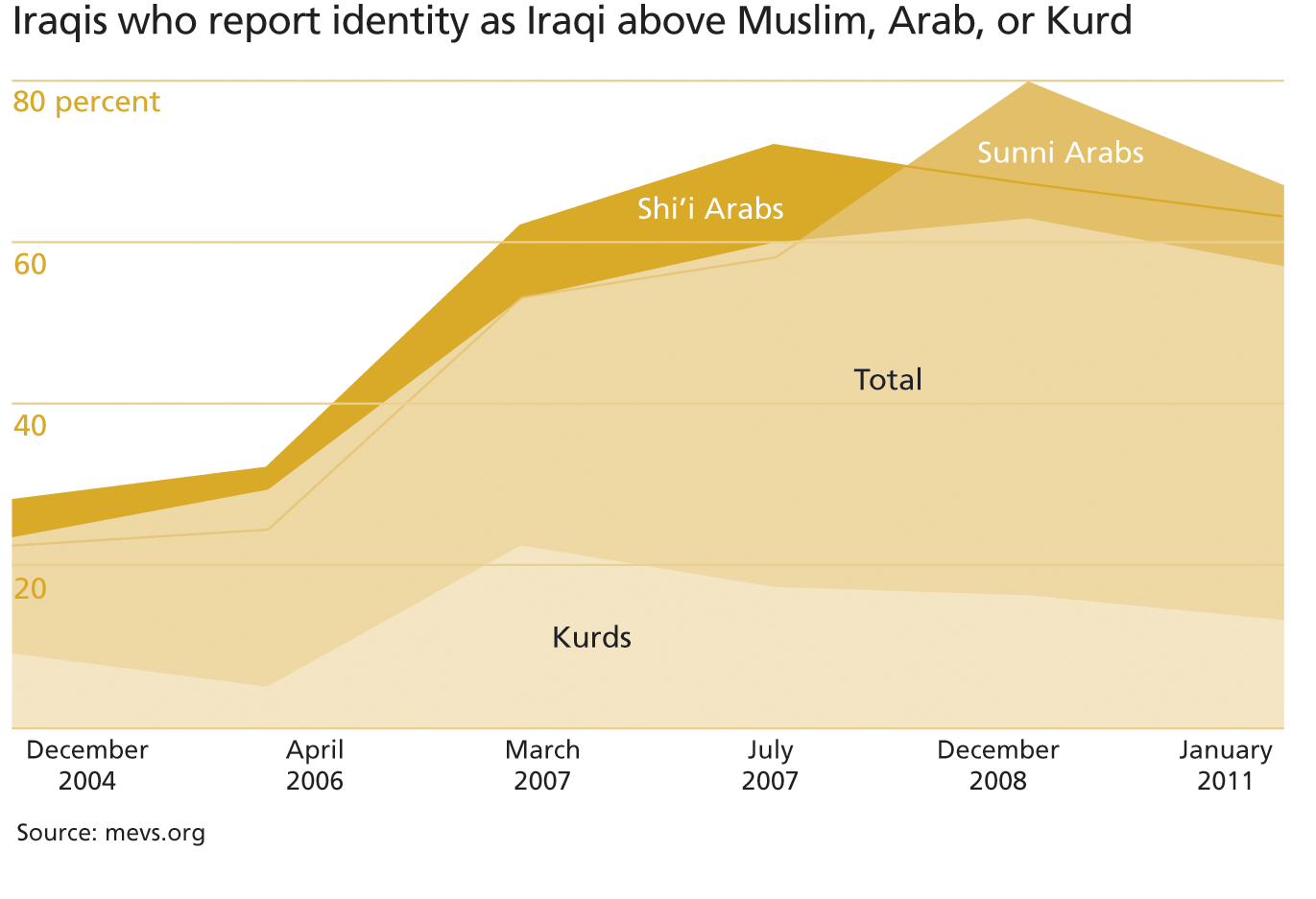
New survey data from Iraq, funded by the National Science Foundation and the Office of Naval Research, reveals a sweeping shift in attitudes over the past seven years. Evidence from seven nationally representative surveys conducted between 2004 and 2011 by the Iraq-based Independent Institute for Administration and Civil Society Studies reveal a significant increase in the proportion of Iraqis who adhere to Iraqi nationalism and favor secular politics over an Islamic government. Responses to two survey questions illustrate this change. The first asks whether Iraqis considered themselves “above all Iraqis, Muslims, Arabs, or Kurds,” and the second whether they strongly agree, agree, disagree, or strongly disagree that “Iraq would be a better place if religion and politics are separated.”
The type of collective identity people adhere to has implications for national integration. Adherence to an Arab identity by Iraqi Arabs may foster Arab nationalism, yet alienate Iraqi Kurds (an ethnic group located in northern Iraq). Identification with Islam, by contrast, may unify Iraqis on a religious framework. In practice, however, given the persistence of Shi’i-Sunni sectarianism, this framework may contribute to ethnic division and conflict rather than to national unity. Widespread adherence to an Iraqi identity, on the other hand, may help the nation to transcend ethnic and sectarian divisions under a unifying Iraqi nationalism.
Likewise, attitudes toward the separation of religion and politics indicate the degree to which the idea of an Islamic government and, ultimately, religious extremism, resonates among the public. A society where the majority supports secular politics tends to be much less tolerant of religious extremism than one in which political Islam is the dominant discourse.
Changes among Iraqis on these attitudinal measures have been remarkable. The percentage of Iraqis who self-identify as “Iraqis above all” increased steadily from 23 percent in 2004 to 63 percent in 2008, and then dropped slightly to 57 percent in 2011 (see above). The data also indicate that the Kurds adhered primarily to a Kurdish identity until the most recent survey, when adherence to Islam took precedence, most likely reflecting dissatisfaction with secular Kurdish political parties.
Iraqis who think religion and politics should be separate
Source: mevs.org
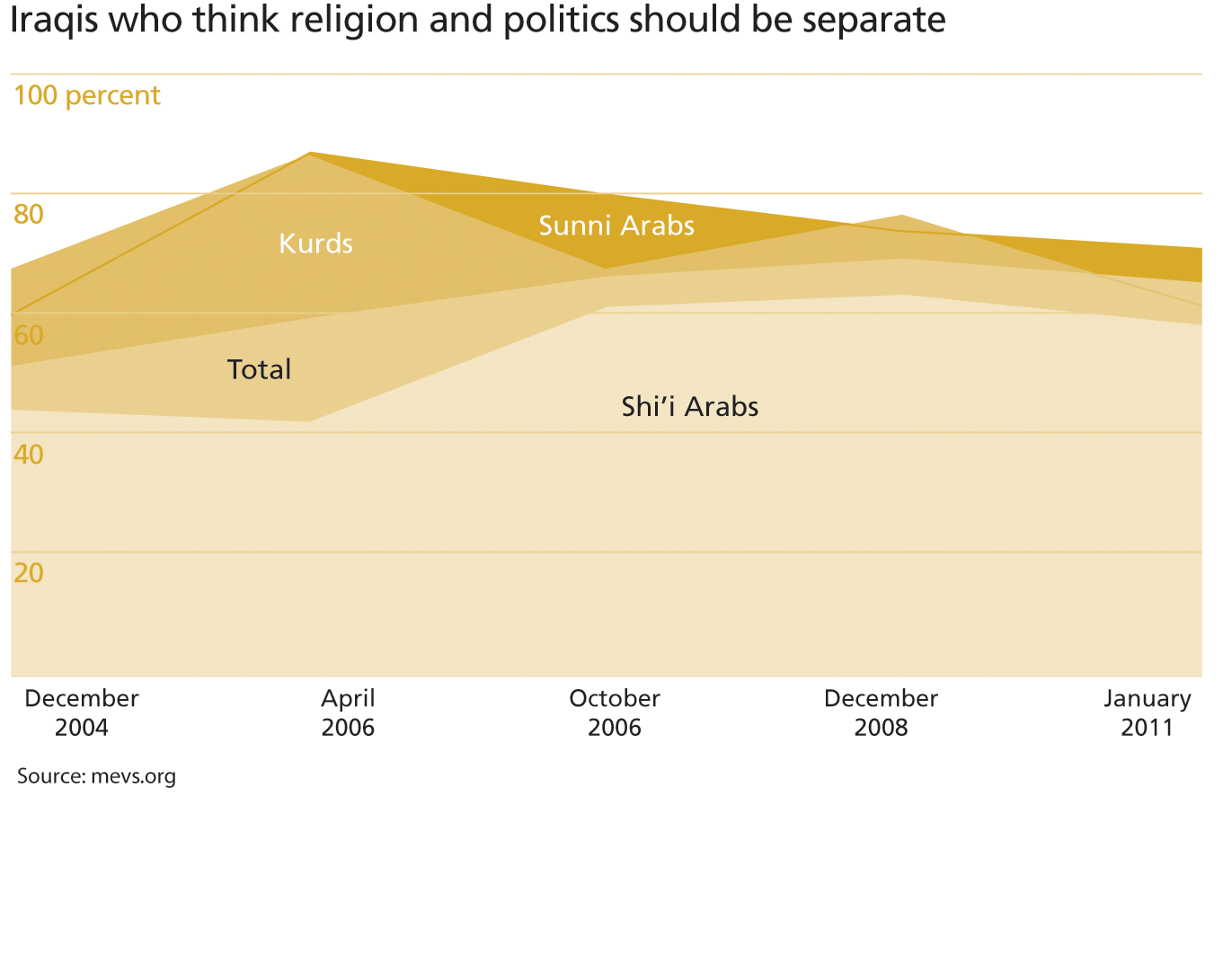
Similarly, favorable attitudes toward secular politics increased dramatically during this period. In 2004, only 50 percent of Iraqis agreed or strongly agreed that Iraq would be a better place if religion and politics were separated, but this percentage rose to almost 70 percent by 2011. The opinions of members of diverse ethnic and religious groups have converged since 2006, following a relatively large divergence between the Shi’i, on one hand, and Sunnis and Kurds, on the other, in the 2004-2006 period (see above).
Ironically, this anti-sectarian trend appears to be a positive outcome of the same set of factors that engendered sectarian violence and religious extremism in the first place: the U.S.-led occupation of the country and the subsequent shift in power from the Sunnis to the Shi’is. Foreign occupation enhanced national Iraqi identity, while the rise of Shi’i political parties and religious extremism contributed to the widespread desire for secular politics among Iraqis. This pattern parallels the historical cases of Algeria and Egypt, where French and British occupation, respectively, stirred nationalism. Similarly, in Iran today, the fundamentalism of the current Islamic regime has made liberal values attractive to a significant section of Iranians.
It is not possible to discern from repeated cross-sectional surveys whether attitudinal change has forged behavioral change or vice-versa; panel data are necessary in order to draw such conclusions. Nonetheless, results from the January 2009 provincial elections and March 2010 national elections suggest that liberalizing attitudinal changes might have shaped Iraqi political behavior.
One thing has become clear, though: pragmatism contributed to the 2009 success of Prime Minister Nuri al-Maliki’s State of Law Coalition. This coalition is substantially more moderate than his previous Islamic Dawa party, an extremist, pro-Iranian movement that had fought Saddam Hussein since the 1960s. The secular party connected to former Prime Minister Ayad al-Allawi, a pro-American Shi’i politician, also saw unexpected success in the 2009 elections, winning 26 seats. Conversely, the poor performance of the Islamic Supreme Council of Iraq, a Shi’i political party, was attributed to its ties to Iran’s Islamic regime and support for decentralization—a policy that runs contrary to Iraqi nationalism. Likewise, the decline of the anti-American Sadr faction was linked to its extremism. The results of the March 2010 elections were even more telling, as the slate led by al-Maliki trailed one led by pro-American Allawi, by 89 seats to 91. Allawi’s Iraqiya list also won the most popular votes.
Iraqis have endured a horrific experience following the invasion of their country by U.S. troops in 2003. Studies estimate between one hundred thousand and more than a half-million dead, many more wounded, and millions dislocated. It is not, however, correct to conclude that the American project of building a stable democracy in Iraq has failed. Survey results show that Iraqis have arrived at the necessary attitudinal and cognitive requirements for building a functioning national government. For Iraq to successfully complete its transition to a democratic order, territorial nationalism and secular politics must now be institutionalized. In addition to political stability and movements toward economic prosperity, this institutionalization would entail a collective recognition of the framing of politics in terms of the norms derived from the principles of patriotic affiliation and a secular non-sectarian outlook. The current popular uprisings against entrenched despotic rulers in the Middle East may reinforce Iraqis’ resolve to achieve this objective.