




Abstract
According to social theorists of time, the way societies structure and value different aspects of time plays an important role in people’s perception and evaluation of economic, political, and cultural change. I explore if two dimensions of social time—social acceleration and long-term orientation—have an effect on the public evaluation of the speed of European integration. Combining Eurobarometer data for 27 societies with measures for social acceleration and time horizons, the results show distinct patterns for the perception and preferences of European integration. Whereas I find no connection between dimensions of social time and the perceived speed of integration, more social acceleration and cultural long-term orientation lead to a desire for a slower speed of European integration. Even when controlled for other economic and political macro-factors, temporal structures can play a key role in the evaluation of political change in European societies.
Introduction
European integration is a lot more than a political administrative process. Rather, European integration is a transformation of societies that has economic, political, and cultural consequences (Hooghe and Marks, 2009). The fact that this process is perceived by the public and has real-life consequences for the everyday life of most European citizens seems almost commonplace. What is new, however, is the growing politicization of European integration in the past decade: citizens do not only perceive European integration, they develop explicit opinions toward the European project (Hurrelmann et al., 2015; Schmidt, 2019). After the Brexit referendum in 2016, the vision of Jean Monnet to build a union of men rather than of states seems in danger. Although no country followed on this radical disintegration track so far, the future of the European integration is still open to all directions: disintegration, stasis, and deeper integration.
I base my argument on the observation that European integration is both process and product, hence both dimensions are perceived and evaluated by European citizens. On the one hand, the process of integrating national polities and societies into a supranational framework has a certain direction and speed. On the other hand, the product of integration manifests in European law, institutions, policymaking, and the emergence of a European identity (Malang, 2017). Almost all studies on public opinion toward European integration focus on the products of European integration, that is, attitudes toward European institutions or the European Union (EU) more in general (Hobolt and De Vries, 2016). However, the process of integration, especially its speed, is a contested and politicized issue for European decision-makers and publics as well. For instance, in 2017, the European Commission released a “White Paper on the Future of Europe” that is commonly interpreted as a document of a “multi-speed Europe,” meaning that different countries choose different integration speeds for their future integration.
To explain attitudes toward the temporal aspect of integration, I utilize previous works on the social aspect of time (Adam, 2013; Gokmenoglu, 2022). Sociologists analyzing the temporal dimensions of social life, especially proponents claiming that life is accelerating, often point toward the missing link between the temporality of the social and the political realm (Rosa, 2013). Anecdotal evidence suggests that the way societies structure time has effects on the political realm: parliaments complaining that they are overstrained by the rate of social change and the required legislative action; executive decision-makers trying to “buy some time” for decisions during the recent crises; and political theorists discussing “liquid democracy” as a solution for time pressure in the democratic process (Blum and Zuber, 2016). The goal of this article is a theoretical and empirical exploration of the potential connection between social and political time. Theoretically, I utilize sociological concepts of time and link them to the perception and evaluation of political change. Empirically, I concentrate on a small but integral part of this connection, namely the question if social acceleration and cultural time orientation can explain the perception of and preferences on the speed of European integration.
The academic literature about public opinion on European integration has so far (almost completely) neglected the temporal dimension of European integration in theory and empirical analysis. In my view, the sociology of time provides a special point of access to the necessary connection between societal macro-level developments, individual experiences, and political preferences. I argue that a social lens is especially attentive to how interpretations and understandings of integration speed matter. The point is to investigate how perceptions and arrangements of time and change at a national societal level are key heuristics for evaluating the appropriateness of the political integration speed at the European level (Hom, 2018). This is a large topic with many strands, and my focus is deliberately selective. I argue that two temporal dimensions should have an effect on the way citizens perceive and desire political change: First, the level of social acceleration, that is, the speed of life in general (Rosa, 2003, 2005, 2013). Second, the socio-cultural orientation toward the future, that is, the degree to which a society rewards and emphasizes future-oriented behaviors such as planning, which appears as a stable cross-cultural notion of national culture (House et al., 2004). I try to contribute to the wider literature in the field of sociology of time by utilizing these two dimensions for the analysis of public opinion on political change.
My empirical analysis is based on an expanded Eurobarometer (EB) dataset from 2017 that I enrich with measures of temporal structures like the speed of transportation or the cultural long-term orientation of a society. I analyze the perceived and desired speed of European integration for 24,000 individuals from 27 European societies. My findings consistently show that temporal structures are not linked to the perceived speed of integration: citizens in more accelerated societies do not differ in their perception of the velocity of integration. However, social acceleration and future orientation show a stable connection to the level of speed at which citizens desire European integration to happen. Citizens living in more accelerated structures have a stronger long-term orientation to desire a slower speed of European integration. The findings serve as a new impulse for more fundamental debates and concerns with respect to the relationship between the speed of societal and political processes. These sociological and political debates might lead us toward more actively thinking about the temporal politics of integrating national societies into a globalized world
European integration as a process
European integration is a process that happens across space and time. This very basic notion is often left aside when analyzed in political science and sociology. As Bidart et al. (2013) put it very generally: Most social phenomena are processes, and like all processes they “take time.” They are part of the flow of history; they evolve and, in doing so, produce changes themselves. However, the dynamic aspects of such phenomena are not always taken seriously in the social sciences. Time is often seen as a variable to be added to the others but without incorporating what it changes into what is observed. (p. 743)
I take the processual aspect of European integration seriously and ask how preferences for change, especially the rate of change, that is, the speed of integration, could be explained if we include theories of social time.
Compared to stable national political systems, the EU is still a “polity in the making” (Hooghe and Marks, 1999) which is linear, future oriented and not cyclical in its temporal nature (Goetz and Mayer-Sahling, 2009). The speed of European integration is perceived by its citizens. The European Commission seems to be aware of the EU’s temporal nature and the potential dangers of citizens perceiving the integration process as either too fast or too slow. Therefore, the prime survey tool of the Commission—the Eurobarometer—asks about the perceived and desired speed of European integration since 1986. Figure 1 plots the EU 15 average of perceived speed of integration for the last 30 years as a solid line. Especially the years after the collapse of the Soviet Union and after the Treaty of Maastricht are perceived as acceleration of integration, whereas a phase of perceived deceleration can be seen in the decade of crises after 2008.
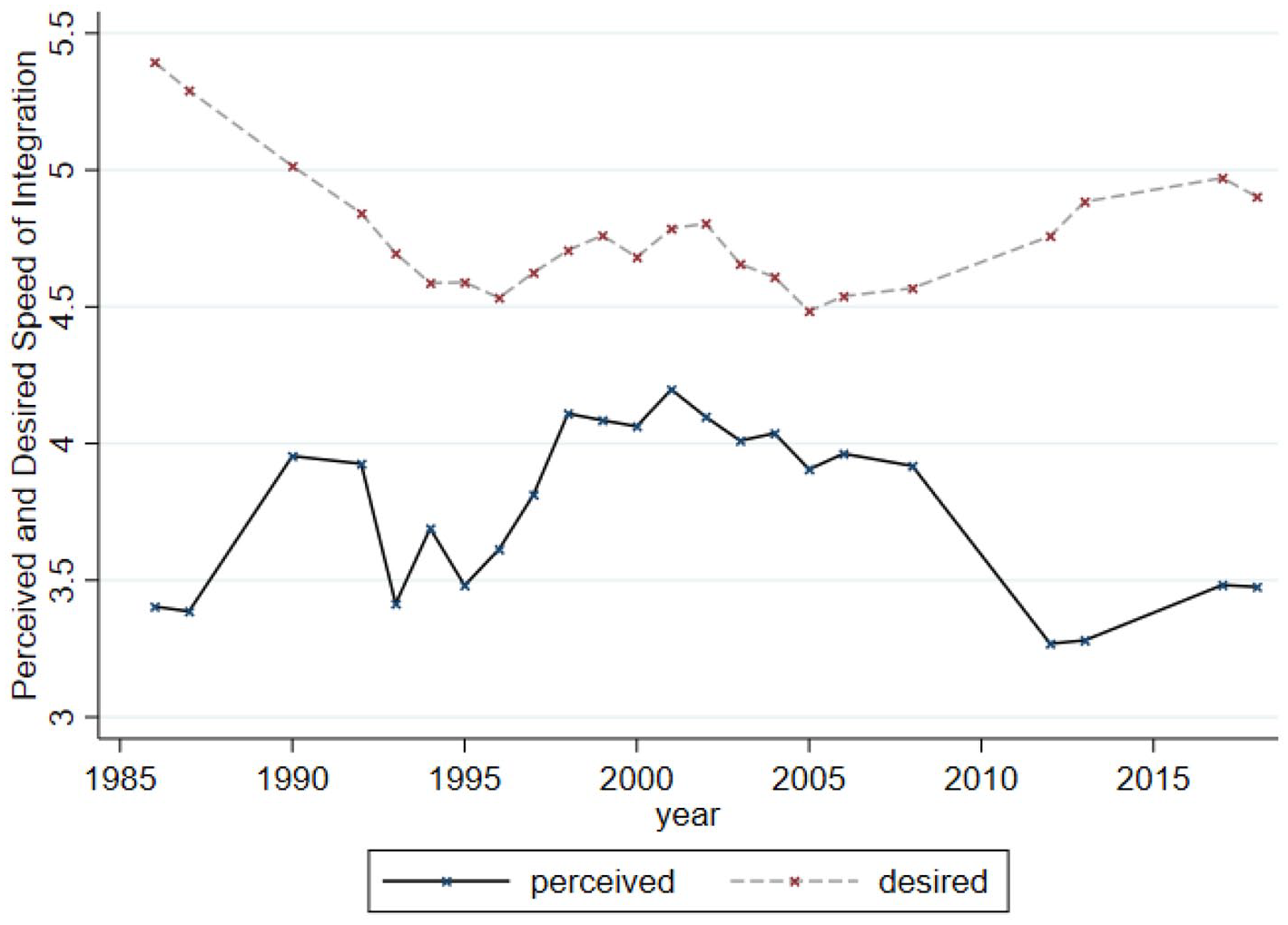
Perceived and desired speed of European integration (mean EU 15). Data: Eurobarometer, own visualization.
In addition to the perceived speed, individuals and whole societies develop a preference for an appropriate speed of European integration. This desired speed of integration is also part of the EB and is visualized by the dashed line in Figure 1. In all phases of the observed period, citizens desire European integration to be faster than they actually perceived it to be in reality. This descriptive temporal finding challenges the general assumption that seems prevalent nowadays which is that the public has a very critical stance on the EU project (Goldberg et al., 2021). There might be a decline in trust in EU institutions or general support (products of integration) (Arpino and Obydenkova, 2020). But on the procedural level, the average EU mood always favors faster integration in comparison to the perceived speed. This does not challenge the notion that Euroskepticism is a persistent phenomenon (Usherwood and Startin, 2013); however, Figure 1 does challenges the excessive emphasis on the negative sentiments toward the EU, especially after Brexit in 2016 (De Vries, 2018; Foos and Bischof, 2022; Treib, 2021). The United Kingdom was only one of (then) 28 member states. Conversely, most citizens across most EU states desire more and faster integration.
Sociology of time and process: theorizing the evaluation of political change
If the speed of European integration varies in its perception and evaluation between countries and individuals, we want to know which sociological theories of time and process can be linked to this phenomenon (Abbott, 2016; Sewell, 2005). The sociological perspective adds an important aspect to the cost-benefit and identity approaches from political science that help to explain why citizens support European integration. Beyond the explanations why citizens support the EU, we want to know how fast they desire the integration speed to be.
If everything in the EU is continuously in the process of making and remaking, which political and societal reference points exist for the evaluation of the process? My argument builds on the idea of benchmarking and the congruence model, developed for the explanation of EU support (De Vries, 2018; Kritzinger, 2003). The general assumption is that citizens have extremely low levels of information and knowledge about European politics and the events of European integration (Muñoz et al., 2011). But if citizens are largely ignorant about European integration, how is it possible that they perceive, compare, and evaluate its velocity? Congruence theory expects that citizens do not develop independent judgments about European integration, but rather base their evaluations on domestic reference frames with which they are familiar. For judging the EU, citizens use national political proxies like trust in national political institutions or satisfaction with the government (Torcal and Christmann, 2019). For the interpretation of integration speed, I suggest that citizens use national temporal frames. I thus search for sociological categories or temporal proxies that allow us to capture how time and change are perceived and evaluated in societies. Two sociological approaches appear most promising for my endeavor: works about social acceleration and research about the cultural dimension of time use. I will describe and theorize literature about these temporal structures and their potential links to the process of European integration in the following.
I take social acceleration as starting point about how the perception and evaluation of the pace of building Europe varies between European societies. The “acceleration thesis” has been selected because it is the subject of a growing body of academic literature that is raising important (yet still largely unexplored) questions about acceleration and its implications for the future of democratic politics, governance, and international relations (Fawcett, 2018). Explaining political speed can hardly be meaningful without the incorporation of social acceleration as the most prominent diagnosis of contemporary social theory (Rosa and Scheuerman, 2009). “Any attempt to make sense of the human condition at the start of the new century must begin with an analysis of the social experience of speed” (Scheuerman, 2004, xiii). The core idea is that there exist two types of social systems with distinct rhythms of change: Politics on the one hand and economy and culture on the other hand (Wolin, 1997). Political change appears slower or out of sync with the other two systems because the temporalities of economy and popular culture are dictated by innovation and change.
I build my argument on the concrete level of societal acceleration which is linked to the societal construction of time (Gell, 1996; Zerubavel, 2003), and the organization of time (Goodin et al., 2008; Sorokin and Berger, 1939). I try to disentangle two concrete drivers for acceleration that promise to deliver quantifiable measures: First, socioeconomic changes that accrue most notably from the increased level of globalization (Schöneck, 2018). This dimension can be observed by the speeding up of intentional, goal-directed processes of transport and production. Second, socio-informational changes that are mostly driven by the progress in information and communication technologies (Castells, 2011). These information technologies transform the pace of life which refers to the speed and compression of actions and experiences in everyday life (Rosa, 2013). It has a subjective side, that is, how people feel toward time, and an objective one, that is, what people do with their time (Agger, 2004). Acceleration within this realm means that people do more things in less time and that time is valued more, for example, people have a higher frequency of events and desire more leisure time.
Congruence theory, in turn, assumes that the level of social acceleration influences the perception and evaluation of European integration speed. The level of acceleration, that is, the speedup of life which leads to a perception of busyness (Hassan, 2009), and a “time squeeze” (Southerton, 2003) serve as the standard rhythm under which political processes are perceived and evaluated. If the national level of acceleration serves as the benchmark for the perception of the speed of European integration, more social acceleration is associated with a slower perception of the integration process. Citizens who are used to a higher rate of social acceleration should thus perceive European integration to be slower than citizens living in less accelerated societies, simply because the national benchmark is higher.
Beyond the different perceptions of integration velocity, the level of social acceleration could also affect the evaluation of integration speed. A unique feature of democracy is its comparative slowness. Collective will-formation, deliberation, democratic decision-making, and implementation take time (Fawcett, 2018). How should the political sphere cope with social acceleration? Some scholars argue that fast politics is dysfunctional and a threat to the democratic process (Wolin, 1997). For others, turbulent governing environments and fast political changes, such as European integration, are a particular feature of contemporary politics (Ansell and Trondal, 2018). I depart from the normative question and ask if citizens want democratic politics to adjust to the accelerated standard of society or if they see the political realm as a stabilizer for the accelerated social interaction and thus want European integration to happen more slowly?
On the one hand, Rosa (2005) argues that the general conception of democratic politics in accelerated societies appears to be plausible only within certain speed-barriers of social change. “Beyond a certain temporal threshold, the dynamic forces of society are too strong for democratic political self-determination” (Rosa 2005, 450). Since democratic values, or democratic political self-determination, are important societal values that are threatened by social acceleration, we can assume that citizens in more accelerated countries desire the pace of the political life, and European integration in particular, to be slower than citizens of countries with a less accelerated structure. On the political level, Scheuerman (2004) formulates an argument that points in the same direction: he states that a more accelerated society conflicts with the demand for prospective and stable legislative rule. The necessarily slow-going texture of broad-based, legitimate, deliberative decision-making is negated in a more accelerated environment that forces politics to react fast.
Conversely, benchmarking and congruence theories predict that citizens from more accelerated societies should desire more integration speed. The reason is that these citizens are familiar with acceleration and accordingly evaluate a faster integration speed as appropriate. High levels of acceleration or deceleration are expected to be desired coherently across all levels of society, from national to European. In line with the benchmarking logic, Sutherland argues that contemporary societies interpret speed as an end in itself. “There is no equilibrium to be reached—no perfect speed—and as such, social processes are increasingly driven not by rational ends, but by an indeterminate demand for acceleration that—both defines and restricts the decisional possibilities of actors” (Sutherland, 2014: 49). Hassan (2009) also bases his argument about the weakened legitimacy of democratic systems on the temporal prerogative of the accelerated economy (p. 11). He states that democratic institutions cannot function in contemporary high-speed economies, because they have different time horizons and are comparatively slow. We can also observe this weakened legitimacy in the current Covid crisis, where democratic states reacted slower on average than autocratic states and were criticized for this temporal prerogative of the democratic decision-making process. From this point of view, the level of desired political speed should increase with the level of societal acceleration. Accordingly, I formulate H1 about the perception and evaluation of the integration speed.
H1a. More social acceleration leads to a slower perceived speed of European integration.
H1b. More social acceleration leads to a faster desired speed of European integration.
The cultural dimension of time is the second aspect that promises a sociological explanation for the perception and evaluation of the European integration process. The argument is rooted in scholarly work about the social construction of time (Gell, 1996; Zerubavel, 2003) often with an anthropological or cultural focus and space–time geography about individual coordination and organizational scheduling (Levine, 1997). Here, the social aspect of time materializes in specific values and practices of time use and time horizons, which influence how individuals and groups interpret their reality and form “appropriate” sentiments and solutions for a given phenomenon (Ross, 2009). These transmitted patterns and values of how time is perceived, structured, and organized in different societies encompass what people experience as a distinctive temporal way of life. It is especially important for the political question if contemporary politics merely reacts to crises, economic trends, and cultural shifts or if a future steering of the society with long planning horizons (greater than the legislative period) is possible.
The cultural dimension of time that I use here is that of long-/short-term orientation or future orientation (Hofstede, 2001; House et al., 2004). Future orientation is defined as “the degree to which a collectivity encourages and rewards future-oriented behaviors such as planning and delaying gratification” (House et al. 2004: 282). Empirical findings in Trompenaars and Hampden-Turner (1998) on the basis of 42 countries show that long-term orientation includes the recognition of how one’s own tradition and history define opportunities and capabilities for the future, opposite to a short-term orientation which emphasizes only immediate concerns in the present moment (p. 123ff).
How are the cross-cultural dimension and basic value orientation of different time horizons related to perceptions of the process of European integration? Generally, the time perspective is a process of differentiating personal and societal experiences into temporal frames (Fraisse, 1984). These temporal frames help to encode perceived experiences like the European integration process (Zimbardo et al., 1997). Adapted to political change, short-term or present oriented cultures should be more aware of the immediate state of European integration since they are oriented toward fast gains (Chwialkowska et al., 2020). Deduced from that, I argue that short-term or present orientation should correlate with a slower perception of the integration process. Analogously to the benchmarking of social acceleration, I hypothesize that more orientation toward the present leads to higher perception of social change more in general, and thus to a slower perception of the European integration process in particular.
When it comes to the evaluation of the integration process, what are the arguments for different levels of long-term orientation resulting in a different coherent desire for the pace of European integration? Studies on national temporal cultures link the motivational force for future goals to its investment manifestations in terms of intensity (depth) and perseverance (duration) of behaviors (Peetsma, 1993 as cited in Ashkanasy et al., 2004). Long-term orientation translates into a high depth and duration of future-related actions. This suggests that long-term oriented societies show a low appreciation of fast change since their planning goals reach far into the future and they are willing and able to pursue their goals for a longer time. Put differently, people with a long planning horizon see no need for fast change since they think that they can reach their goals on a constant and slow change rate. Including the general benchmarking process in effects of long-term orientation makes it possible to predict the desired speed of European integration. Arguments and evidence point in the direction that societies with a stronger long-term orientation dislike fast change. Conversely, societies with a short-term orientation value fast change. If the same holds for European integration, I expect that long-term orientation leads to a desire for slow European integration.
H2a. More long-term orientation in a society leads to a faster perceived speed of European integration.
H2b. More long-term orientation in a society leads to a slower desired speed of European integration.
Empirical strategy
Data
I compiled the dataset from several distinct empirical sources. On an individual level, I use the second wave of the EB from 2017. 1 I enriched this data with several country measures for my main independent variables and some control variables which are described in the following. In sum, my analysis is based on 24,000 respondents from 27 EU countries.
Dependent variables
The two dependent variables, the perceived and desired speed of integration, are measured with the respective EB-item: the Eurodynamometer. The answer categories range from 1 to 7, indicating the extremes “standstill” (1) to “running as fast as possible” (7). The first half of the EB-question is about the perceived speed of European integration:
In your opinion, what is the current speed of building Europe? Please look at these figures. (SHOW CARD) No.1 is standing still; No.7 is running as fast as possible. Choose the one which best corresponds with your opinion of the current speed of building Europe?
The second part asks about the desired speed:
And which corresponds best to the speed you like?
Method: hierarchical random-intercept model
My research interest lies in the relationship between societal temporal factors and individual’s evaluation of the speed of integration. The effects will be estimated using a multi-level approach, simultaneously testing the influence of macro- and micro-level predictors. Fitting the empty model for the two dependent variables yields some first basic insights. The estimates for the grand mean and for the variance components are statistically significant. The average perceived speed across countries and citizens is 3.55, the desired one being 5.07. The variance component corresponding to the random intercept is 0.04 (perceived) and 0.15 (desired). Because these estimates are substantially larger than their standard errors (0.01 and 0.04), there appears to be significant variation in country means. The two variance components can be used to partition the variance across levels, leading to roughly 2.5% and 8.5% of the overall variance attributed to the country level. In line with Steenbergen and Jones (2002), I see good reasons to take this share of variance as important and opt for a hierarchical multilevel model.
The general strategy to construct a model that fits the data is to work upward from level one to level two and to test this with a random-intercept model. Since the dependent variables have possible values from 1 to 7, I treat them as continuous, calling for an ordinary least squares analysis.
Core explanatory variables
The sociology of time variables is operationalized on the country level. I need measures for two core dimensions: social acceleration and long-term orientation. Supplemental Appendix 1 gives more details to all macro-variables
For social acceleration, I concentrated on two dimensions in the theoretical section: technological acceleration and the acceleration of the exchange of communication and information. To grasp technological acceleration, I decided to take the Worldbank’s logistic performance index that captures the efficiency of a country’s transport structure related to trade. This index has a clear temporal component, since its overall score reflects perceptions of a country’s logistics based on efficiency of the customs clearance process, quality of trade- and transport-related infrastructure, quality of logistics services, and frequency with which shipments reach the consignee within the scheduled time. In my view, this is the best measure for how infrastructure and technology accelerate the social life.
The second dimension of acceleration was defined as socio-informational acceleration that is notably driven by the progress in information and communication technologies. To measure the acceleration of communication and information exchange, an encompassing measure is provided by the “informational globalization” indicator of the KOF Index of Globalization, which systemizes among data about international voice traffic and Internet bandwidth (Gygli et al., 2019). In my view, this index is the best measure for grasping the structural information acceleration of a given country.
It is an open discussion if the present social structure can be “accelerated” on the basis of technology and social interaction or if the changes of these components themselves should be considered as acceleration. My interpretation is that Rosa’s (2013) definition emphasizes the structure itself, not its change. Hence, indicators like the logistic performance index can capture acceleration. However, to account for the changes in the structure, I also included the change in the logistic performance index and the KOF informational globalization index over the past 10 years. Positive values of the change variables indicate that the structures became faster, independent of the overall acceleration level that the structural variables are capturing.
The most advanced data about different cultural time horizons were developed by the GLOBE study (House et al., 2004). The basic question for their categorization of future orientation (i.e. long-term orientation) is one that deals with the trade-off between momentary gains and future investments. Here, the long-term value is the extent to which members of a society or organization believe that their current actions will influence their future, focus on investment in their future, believe that they will have a future that matters, believe in planning for developing their future, and look far into the future for assessing the effects of their current action. (Ashkanasy et al., 2004: 285)
I take the values of the concrete future orientation practices (Ashkanasy et al., 2004: 304). 2 The measure is used in a wide range of sociological and organizational studies, and is a premium way to characterize the temporal culture of a society (Chwialkowska et al., 2020). All country characteristics can be found as descriptive overview in Table 1. For the analysis, I standardized the variables as z-scores to be able to compare the effect sizes.
Descriptive overview of dependent variable and main macro-indicators.
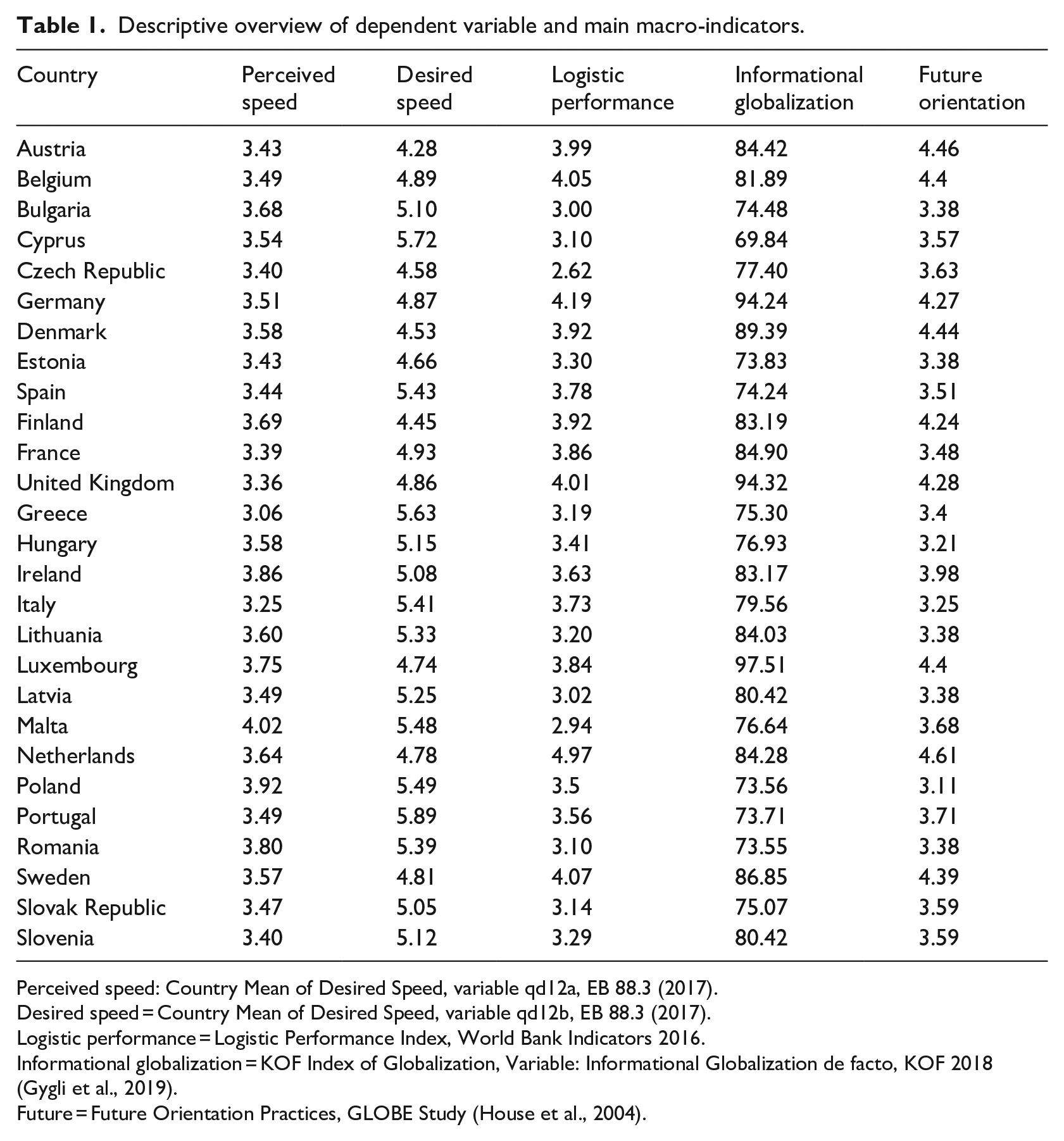
Perceived speed: Country Mean of Desired Speed, variable qd12a, EB 88.3 (2017).
Desired speed = Country Mean of Desired Speed, variable qd12b, EB 88.3 (2017).
Logistic performance = Logistic Performance Index, World Bank Indicators 2016.
Informational globalization = KOF Index of Globalization, Variable: Informational Globalization de facto, KOF 2018 (Gygli et al., 2019).
Future = Future Orientation Practices, GLOBE Study (House et al., 2004).
Table 1 shows that countries show variation on the level of acceleration and cultural time practices, but also that the dimensions are overlapping. The three measures correlate quite highly around 0.75 (see correlation matrix in Supplemental Appendix 4). We can also identify distinct regional cluster. The north–south divide, also a prevalent dimension in EU politics (Kaeding and Selck, 2005; Malang and Leifeld, 2021; Mattila, 2009), is more nuanced as the east–west divide. Especially the cluster of the GLOBE project called “Latin Europe” countries matches with the social acceleration date and can also be found in newest public opinion studies on European integration (Leuffen et al., 2022). Overall, we can see reasonable variation within Europe countries on dimensions of comparative sociology that are now tested as explanations for political phenomenon.
Individual-level control variables
I present a full individual-level model of economic, political, and cultural attributes that were found to have a significant and stable effect on attitudes toward the EU (Hobolt and De Vries, 2016) and especially Euroskepticism (Kuhn et al., 2016) in previous studies. I generally control for the factors that previously showed a stable effect on the support of European integration and are part of the EB data. 3
First, a better economic situation should be related to the desired speed of integration (Gabel, 1998; Verhaegen et al., 2014). Economic well-being is operationalized with an indicator asking about the expectations for the economic situation in the next 12 months. Second, citizens assess the “costs of integration” (Sanchez-Cuenca, 2000), that is, whether it pays off to support integration with respect to the performance of the national institutions. To measure this trade-off, the question about trust in the national parliament as compared to the European Parliament is taken from the EB. Third, national identity is normally negatively correlated with EU support (Lubbers and Scheepers, 2005). A measure for civic identity is the EB-item that asks if a person sees himself as being a national or a European citizen. Those with exclusive national identity are respondents that feel attached to their nation but not the EU.
I include several individual characteristics from the sociology of time literature that should influence the individually desired speed. Two attributes always mentioned in the social acceleration discussion are age and the rural–urban divide (Rosa, 2013). I expect that older people and residents of villages and small towns perceive European integration to happen faster and should desire it slower as compared to their more accelerated counterparts, adolescents living in metropolitan areas (Clark and Rohrschneider, 2021). A classic variable in the integration discussion, however, relatively unique in the temporal one, is the political ideology of individuals (Svensson, 2002). Conservatives defend the European free market and urge acceleration whereas socialists stand for the preservation of the welfare state and preach for deceleration of integration. A last concrete materialization of individual time practices is the duration of the interview. In line with time use studies (the concrete application of the acceleration dimension), I see time as a resource. I therefore expect people that spend more time on answering polls to have a different perception and evaluation of political speed. The temporal expectations are measured by the respondents’ age, their left–right placement, the size of the community they live in, and the concrete duration of the whole interview. I additionally control for gender, knowledge about the EU, and the enlargement round (on the country level). The descriptive statistics for all variables can be found in Supplemental Appendix 3.
Results
The results for the perceived and desired speed are presented in Tables 2 and 3, respectively. I present five models in each table with one temporal macro-indicator at a time. 4
Multilevel results for dependent variable perceived speed.
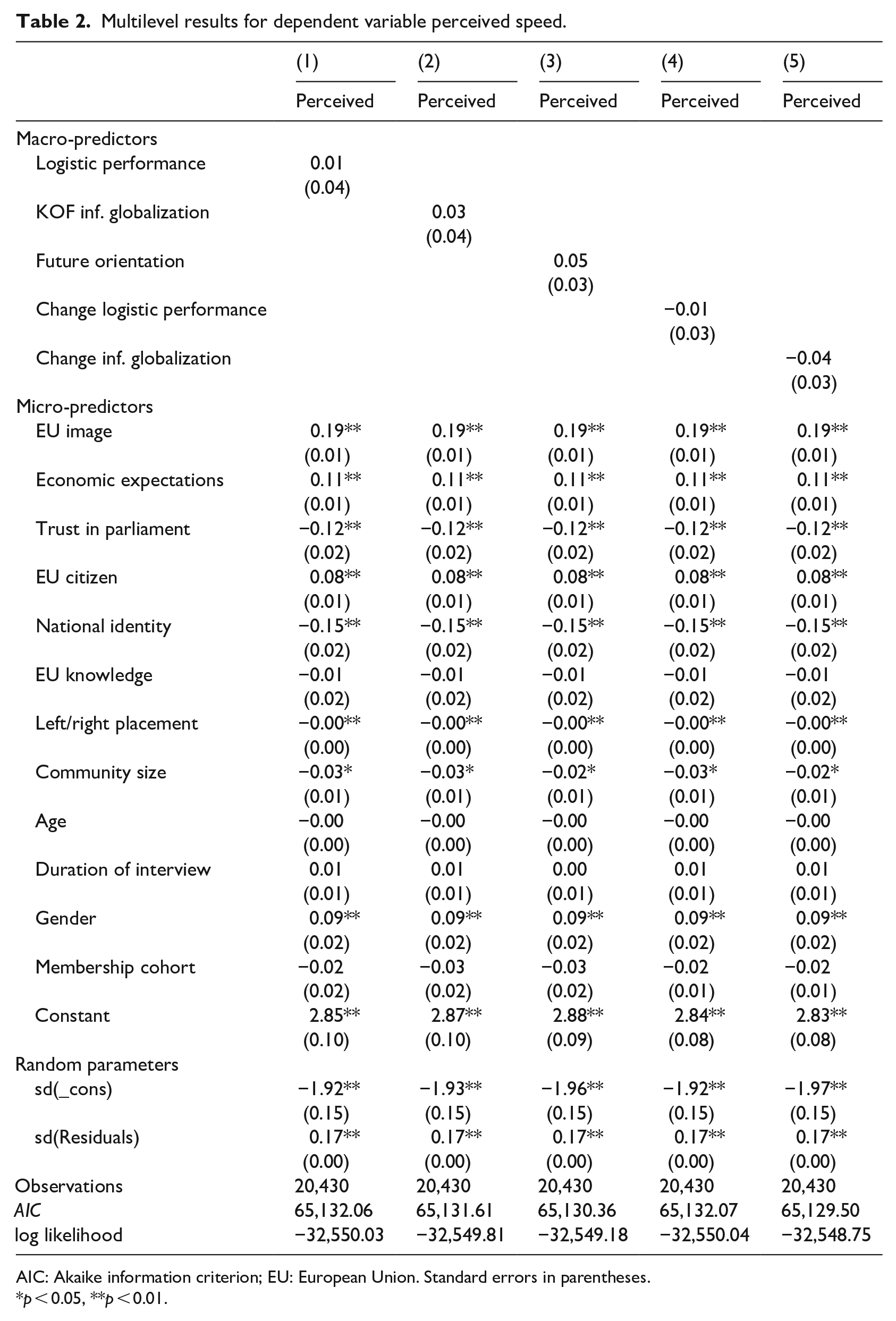
AIC: Akaike information criterion; EU: European Union. Standard errors in parentheses.
p < 0.05, **p < 0.01.
Multilevel results for dependent variable desired speed.
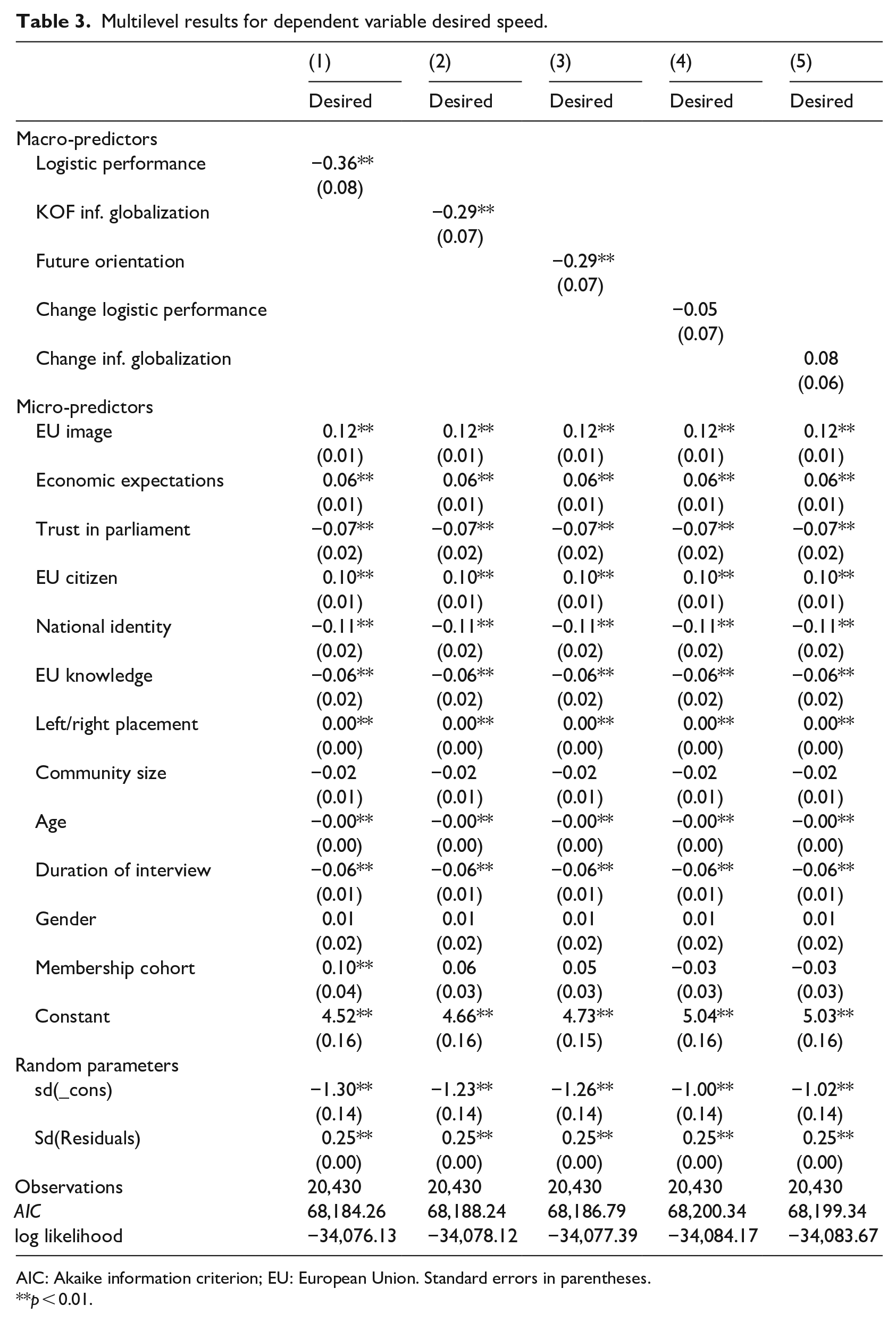
AIC: Akaike information criterion; EU: European Union. Standard errors in parentheses.
**p < 0.01.
I theorized that the level of social acceleration and the concrete cultural value of future orientation stands in relationship to the perceived speed of political change. More concretely, I hypothesized under the assumption of temporal benchmarking, that more acceleration and more short-term orientation should lead to a slower perception of the European integration process. However, Table 2 with Models 1 and 2 (for measures of social acceleration), Model 3 (for long-term orientation), and Models 4 and 5 for the change rate of acceleration do not deliver any evidence for such an effect. All macro-predictors are insignificant. The idea that the pace of life and the social value of time horizons are a benchmark for people to interpret the speed of political processes does not receive empirical support through my study.
These non-findings leave room for interpretation and future research. It could be the case that the perceived speed of integration is to invariant between countries to gain meaningful statistical results. And indeed, if we look at the realized country means in Table 1, we see that the variation is smaller for the perceived than for the desired speed. However, it could also be the case that the level of social acceleration and time practices simply do not influence the way how citizens perceive political processes.
Beyond the temporal structures on the societal level, we can see that individual-level factors do have an effect on people’s perception of the integration speed. A positive view of the EU and the economic situation leads to a faster perceived speed than a negative one. In addition, the next three measures, which try to capture if citizens are more satisfied and emotionally attached to the nation state or the EU, show a coherent picture: more emphasis on the nation state (in terms of identity or positive evaluation of national institutions) leads to a slower perceived speed of integration. This finding is rather puzzling, since one could have argued that citizens with an exclusive national identity would see the EU as a threat to their national sovereignty and, hence, perceive the process of integration as rather fast. However, my results show the opposite effect. These findings are independent from the level of knowledge the respondents have about the EU, as this variable stays insignificant. Notably, all the individual-level indicators that approximate several aspects of the sociology of time literature—like the rural–urban divide or the age of respondents—show no or only weak significant relationship to the perceived speed of integration.
Table 3 contains the results for the second dependent variable, the desired speed of integration. I argued with a congruence or benchmarking theory that citizens from more accelerated countries with societies that put little emphasize on long-term orientation should desire a higher speed of integration. We can see, at first glance, that in contrast to the perception of the integration process, the temporal macro-predictors are significantly correlated with the evaluation of the process.
If we focus on the level of acceleration, we can see that faster transportation structures (Model 1) and faster communication in a society (Model 2) lead to a slower desired speed of integration. This finding is in contrast to our benchmarking assumption. Citizens in more accelerated countries do not desire European integration to be speeding up in a similar way. Rather, more societal acceleration leads to a preference for slower European integration. This has important implications for the sociological discussion. My analysis suggests that it is not benchmarking as used in political science which predicts the desired speed of European integration correctly but rather fine-grained sociological theories which see a general limit of social acceleration and a negative spillover on the evaluation of political processes (Rosa, 2005; Scheuerman, 2004). My results support the claim of the acceleration theorists who assume that citizens can be overstrained by acceleration and, thus, desire a stable political development (Rosa, 2005).
Model 3 shows that long-term or future orientation (as opposed to short-term orientation) leads to a preference for slower European integration. This is in line with my benchmarking prediction. It also supports and adds to the findings of Trompenaars and Hampden-Turner (1998) and House et al. (2004). Contrary to Hofstede (2001), we see that societies with higher emphasis on future rewards desire European integration to happen slower. As a generalization, long-term oriented societies show a low desire for fast political change since their planning goals reach far into the future and they are willing and able to pursue their goals on a longer time scale.
The operationalization of acceleration as the changes in the temporal structures in Models 4 and 5 do not lead to significant relationships. The use of the acceleration as static macrostructure like Rosa (2013) suggests seems to be more related to preferences for political change.
I have standardized the macro-variables and can thus compare the effect sizes between social acceleration and long-term orientation. For all three macro-variables, a change in one standard deviation results in a change in the dependent variable from approximately 0.3. Since my dependent variable is scaled from 1 to 7, this is a substantial effect size. If I z-standardize also selected independent variables on the micro-level, the impact of the main effects become graspable (see Supplemental Appendix 5). A change in one standard deviation in general EU support only results in a change of 0.1 in the desired speed. The effect is even less pronounced for other standard predictors like national identity (0.05) and EU knowledge (0.03). The temporal macro-predictors really have the biggest impact on the desired speed.
Almost all individual-level predictors show significant results in the assumed direction for the desired speed of integration. Beyond the variation on the macro-level indicators, citizens with positive opinions about the EU and the general economic situation desire the integration process to be faster than their more pessimistic peers. A better evaluation of the national level (in terms of parliamentary trust, democratic satisfaction, and national identity) is correlated with a desire for slower integration, something general wisdom would have suggested. Interestingly, citizens who are better informed about the EU also desire integration to advance slower. The sociology of time micro-level variables appear also in a meaningful fashion. Older people and people who spend more time on the interview desire integration to advance slower.
Can we trust the results in terms of robustness? I tested several alternative explanations to see if the temporal macro-indicators are really the driving force of the connection. First, a general problem in research about political opinions is that on both sides of the equation are attitudes. These “attitudes on attitudes” regressions could influence the real effect of our temporal macrostructures on the desired speed of integration. Tables A.6.1 (for perceived speed) and A.6.2 (for desired speed) present the same models without any attitudinal variables. I only include the macro-variables and the socio-demographic controls. The results of social acceleration and long-term orientation stay exactly the same. There seems to be no critical influence of the attitudinal variables on my core findings.
Second, one could argue that the proposed temporal explanatory factors do not measure temporality but are rather vague proxies for the wealth, the general economic development of a country, or other socioeconomic developments (Basile and Olmastroni, 2020; De Wilde, 2012; Eichenberg and Dalton, 2007). Then I would simply show that citizens in, say, richer member states desire integration to happen slower. I try to refute this objection by introducing four measures that could serve as alternative explanations: gross domestic product (GDP), EU budget transfers, the level of Euroskepticism on a country level, and the exposure to migration. I assume that higher GDP, being a net payer to the EU budget, a higher share of a Euroskeptic population, and receiving more migrants causes a slower desired speed of integration. However, as Tables A6.3–A6.6 of the Supplemental Appendix show, none of these macro-predictors is related with desired speed of its citizens. Furthermore, the original results for the temporal macrostructures stay significant. The temporal macrostructures really capture something else than the general economic development or political mood of a country.
One could additionally criticize that my findings simply show a correlation between temporal structures and general EU support and not the dynamic integration preferences. Hence, I crosscheck my models and substitute the desired speed of integration with the non-temporal standard trend variable EU evaluation as new dependent variable in Supplemental Appendix A6.7. Here, in contrast to my previous findings, all temporal macro-indicators are insignificant. The level of social acceleration and long-term orientation is not related to the general evaluation of the EU, whereas the micro-level indicators to explain standard EU evaluation still work. I conclude from this that it is not simply some underlying general economic development sequence that explains the connection between an underlying economic or political macro-factor and the public opinion on the EU in general. Rather, the level of acceleration in a country really influences the desired speed through a temporal mechanism. Citizens living in more accelerated structures and with a long-term orientation desire a level of stability and deceleration for the political integration process, resulting in a lower level of desired speed as compared to countries with lower general social acceleration and a short-term oriented culture.
Conclusion
This article started with two observations: First, the speed and direction of the process of European integration are recognized by European citizens and became contested over the past decade. Second, there are variations in how societies organize, perceive, and evaluate time and social change. I investigated if these two dimensions of societal and political change stand in relation to each other. In particular, I explored if the way societies organize the social aspects of time on a national level has consequences for how citizens perceive and desire political change on an international level.
I started with a social lens of time that is attentive to how interpretations and understandings of time and change matters in a society. The point was to investigate how perceptions and arrangements of time and timing are a key heuristic for thinking and evaluating the world. I focused on social acceleration and the cultural dimension of long-term orientation as two main dimensions of how temporality is organized in a society. I then developed a benchmarking theory for the perception and evaluation of political change. I argued that the national level of temporality is used as a proxy for the evaluation of international political change.
I applied the benchmarking model of temporality to one specific case of political change: European integration. I took social acceleration and its cultural time practices serious and ascribed these dimensions analytical leverage when it comes to the explanation of public perceptions and evaluations of the speed of European integration. I argued that more technological and social acceleration as well as short-term time horizons should be related to a slower perceived and faster desired speed of European integration.
To test these claims, I combined individual-level data from the EB with macro-level data about social acceleration of European societies and the concrete time practices of their citizens. My dependent variable was the perceived and desired speed of European integration. The main result was that—whereas the societal temporal factors show no relationship with the perceived speed of integration—citizens in more accelerated societies desire a slower integration speed than their peers in other countries. Cultural time practices underlined the direction of the findings. Living in societies with future long-term orientation decreases the level of desired speed of integration.
The findings enrich the debates about social acceleration and the sociology of time. First, most scholars who have examined the relationship between social acceleration and liberal democracy formulated concerns about a speeding up of politics (Scheuerman, 2004; Schmitt, 2009). Their uneasiness stems from the fact that it takes time to fulfill the liberal democratic ideals of deliberation, consultation, and negotiation. Having to respond to an increasingly high-speed society increases the pressures and demands for a political system to change with a speed beyond the possibilities of democratic control (Fawcett, 2018). My results delivered a nuanced understanding of the political effects of social acceleration. On the contrary, acceleration theorists seem to exaggerate the political implications of more acceleration. The descriptive results showed that the speed of integration is perceived slower than it is desired. Hence, citizens are at the moment not overstrained by the rate of political change, as some sociologists assume (Rosa, 2005). On the contrary, my results also suggest that citizens from societies with more acceleration desire slower political change. This finding supports Rosa’s assumption and contradicts the idea of proponents that see no speed limits for the desirability of political change (Hassan, 2009; Sutherland, 2014).
Second, I showed why a processual sociology is needed to understand public evaluations of change (Bidart et al., 2013). My analysis obtained that the speed of integration is distinct from the standard evaluation of EU support. The evaluation of the process of political change is (partly) independent from the evaluation of the outcomes of change. Whereas the temporal indicators are able to explain variation in the desired speed, they are insignificant for the explanation of EU support. Thus, the dynamic dimension of European integration is a distinct phenomenon that has to be analyzed accordingly. More generally, I take my findings as evidence that paying close attention to speed and temporality is a unique dimension in the explanation of political preferences and has to start with a broader reasoning of time and speed as sociological categories that enrich political analysis (Amoureux, 2020; Fawcett, 2018). This article has pursued a first empirical–analytical step to initiate this temporal dialogue between sociology and political science.
Supplemental Material
sj-docx-1-cos-10.1177_00207152221108641 – Supplemental material for Can the social dimension of time contribute to explain the public evaluation of political change? The case of European integration
Supplemental material, sj-docx-1-cos-10.1177_00207152221108641 for Can the social dimension of time contribute to explain the public evaluation of political change? The case of European integration by Thomas Malang in International Journal of Comparative Sociology
Footnotes
Acknowledgements
This work originated in the doctoral program “Cultures of Time” of the Center of Excellence “The Social Foundations of Integration” at the University Konstanz. I thank my peers from the program – most notably Leon Wansleben, Julian Bauer, Hanna Göbel, Franz Fillafer, Gwendolyn Whittaker, and Christian Meier – for commenting on earlier versions. The manuscript also benefitted from comments by Jürgen Osterhammel, Volker Schneider, and Wolfgang Seibel. I am especially grateful for the constructive feedback of the reviewers and the support by the IJCS editors throughout the peer review process.
Funding
The author(s) disclosed receipt of the following financial support for the research, authorship, and/or publication of this article: Thomas Malang acknowledges funding by the German Research Foundation DFG through the Emmy Noether programme, Grant No. 447624982.

Supplemental material
Supplemental material for this article is available online.
Notes
References
Supplementary Material
Please find the following supplemental material available below.
For Open Access articles published under a Creative Commons License, all supplemental material carries the same license as the article it is associated with.
For non-Open Access articles published, all supplemental material carries a non-exclusive license, and permission requests for re-use of supplemental material or any part of supplemental material shall be sent directly to the copyright owner as specified in the copyright notice associated with the article.
