



Abstract
Rosie the Riveter wasn’t always a feminist icon. Her roots lie in inspiring Westinghouse workers toward the war effort, and it wasn’t until the 1950s and ‘60s that women’s rights movements reframed the way we see Rosie.
“We Can Do It!” For many Contexts readers, these words will bring to mind the World War II-era poster of a female factory worker in a red bandana and a blue work shirt, her sleeves rolled up and her fist held high. This image has been widely associated with “Rosie the Riveter,” a fictional persona that represented (and encouraged) American women who joined the war effort by temporarily entering the paid workforce. Accordingly, it’s become a feminist icon, a symbol of women’s empowerment and solidarity.
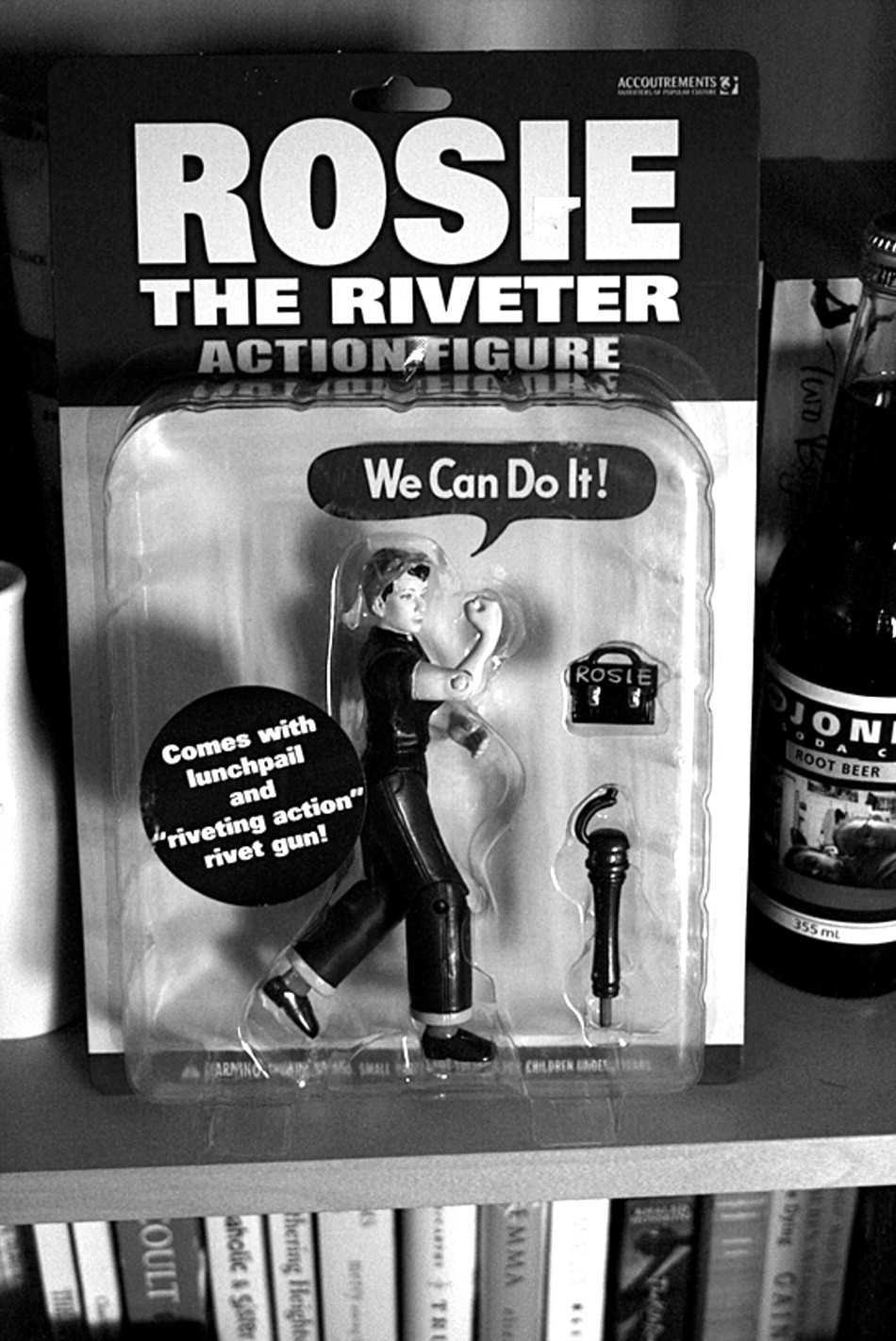
The poster is so recognizable today that it’s often parodied or appropriated for everything from campaigns to improve women’s lives to marketing for cleaning products. You can even buy a “Rosie the Riveter” action figure, complete with “We Can Do It!” emblazoned on the packaging. One retailer, giftapolis.com, enthuses, “Rosie the Riveter is no ordinary gal! Her image was used to promote the Women Ordinance Workers (WOWs) during World War II. Her confident declaration… inspired millions of women to drop their brooms and pick up rivet guns and wrenches.”
However, in their 2006 Rhetoric & Public Affairs article, “Visual Rhetoric Representing Rosie the Riveter: Myth and Misconception in J. Howard Miller’s ‘We Can Do It!’ Poster,” communications scholars James Kimble and Lester Olson argue that the image was never used in any such way. The idea that the poster was an inspirational call to other women is the result of reading history through the lens of our current assumptions about gender and politics. In fact, the real story of the poster is about labor relations, not gender.
The original Westinghouse poster.
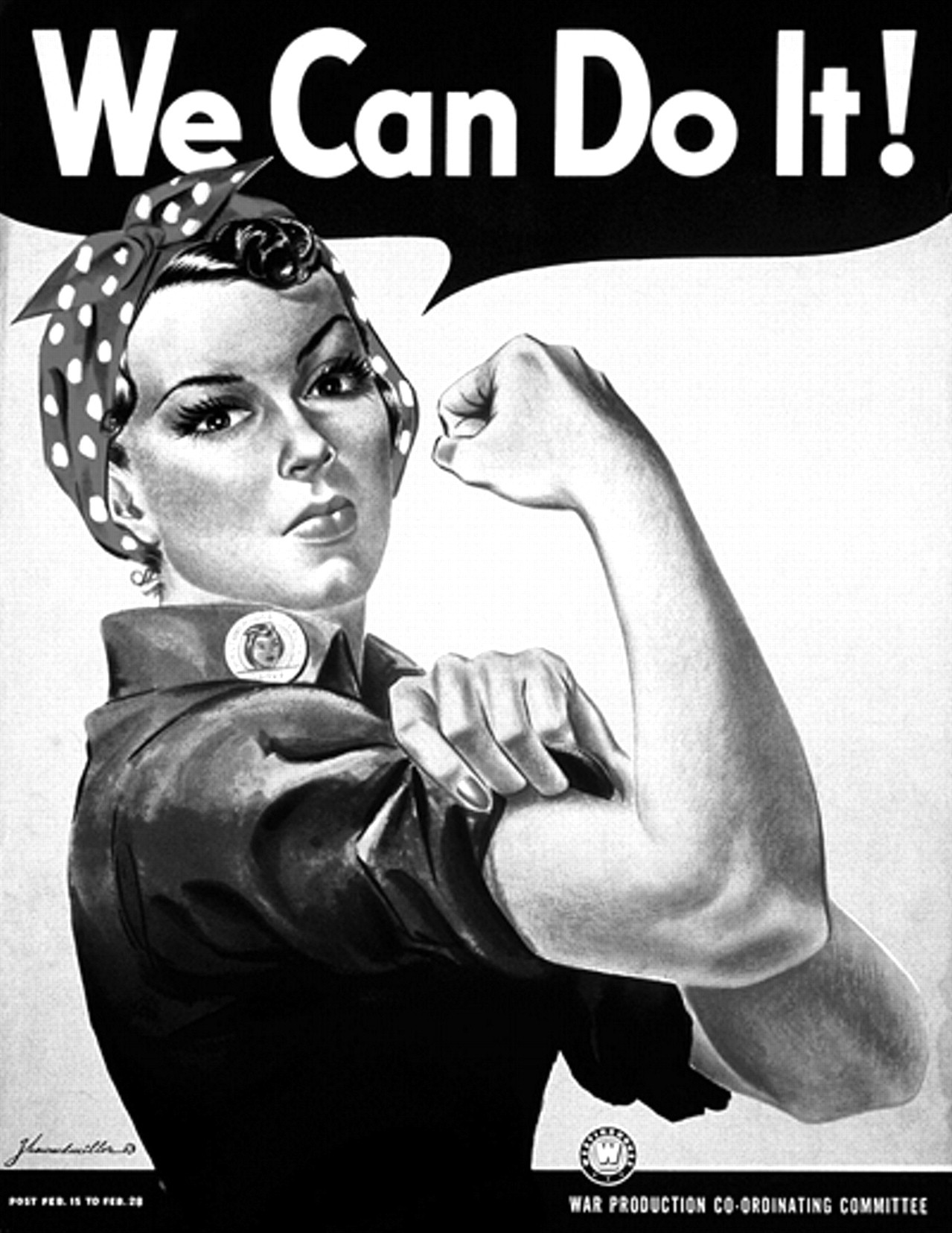
First, though we often think of the “Rosie the Riveter” poster as the product of a government enthusiastic about incorporating women into the war effort, it was actually an internal corporate design, not meant for the general public. Created by J. Howard Miller for the Westinghouse Electric and Manufacturing Company, it was intended only for Westinghouse employees.
A closer look at the poster itself testifies to this: you can see the Westinghouse logo is clearly visible just under the woman’s arm and the badge on her shirt collar is the badge employees wore on the plant floor, including an employee number. The War Production Co-ordinating Committee, listed along the bottom of the poster, wasn’t a government agency; it was a Westinghouse committee, similar to those created by many corporations during the war to monitor production and address any issues that might interfere with the war effort. Westinghouse routinely commissioned posters like these to hang in its plants for specific periods of time; the “We Can Do It!” poster even includes the instructions, “Post Feb. 15 to Feb. 28? [1943]” in small font. Accordingly, there’s no evidence that it was ever made available to the general public at the time. “Rosie,” then, isn’t calling out to women to join her in working at the plant, as our national mythology suggests; she’s speaking to workers already employed there.
Second, despite its current association with Rosie the Riveter, the poster doesn’t identify her as Rosie, and it’s not clear that she would have been immediately recognizable to viewers as a Rosie. (The Rosie character’s origins are similarly difficult to pin down; the phrase “Rosie the Riveter” was first mentioned in a 1942 big band song, and there have been many suggestions for the song’s inspiration, including Rose Will Monroe, a real-life riveter who later became a pilot.) Westinghouse, an electric company, didn’t employ riveters, and the woman in the poster isn’t shown with any tools that would indicate what type of work she does. Of course, Rosie came to represent women in the workforce in general, not just women specifically building airplanes or weapons. But it’s not apparent whether, by 1943, the image of Rosie had become so widespread and culturally resonant that the public would identify any woman shown doing any type of blue-collar job as a Rosie. Women, after all, worked in plants before the war, and would continue once it was over.
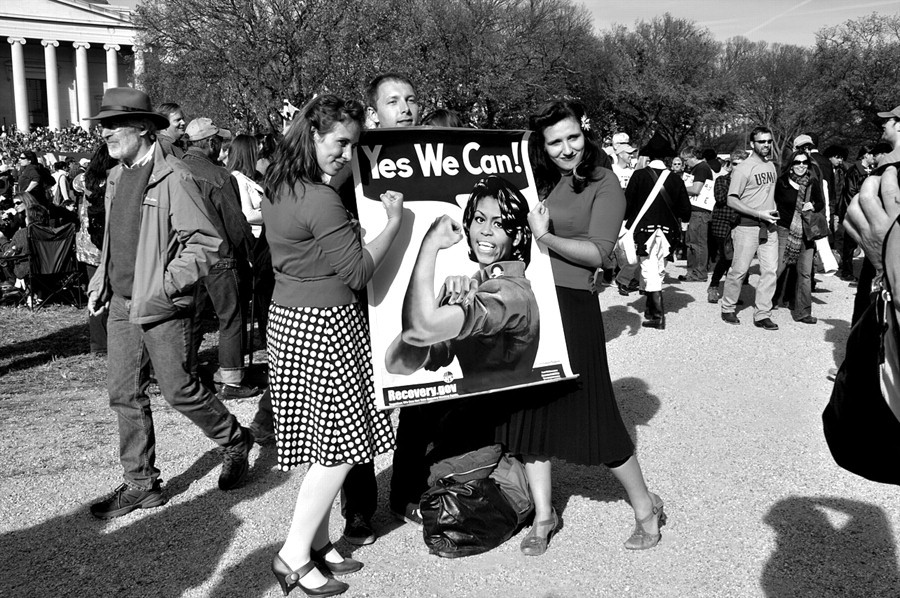
At the “Rally to Restore Sanity and/or Fear” in late 2010, women adopt their own Rosie personae.
This Rosie figure promises “riveting action.”
In addition to pointing out these myths about the origins of the image, Kimble and Olson question its lauded female empowerment message. Current readings of the poster as a feminist emblem assume this female worker is calling out to other women, inspiring them to leave their kitchens and join her on the factory floor. In fact, Westinghouse workers would have seen it in a different context, as just one of many similar posters displayed in the plant. When taken as just one in a series directed at workers, the collective “we” in “We can do it!” can’t be read as women, but all Westinghouse employees, who were used to seeing such statements posted in employee-access-only areas of the plant.
Further, the message wasn’t designed to empower workers, female or otherwise; it was meant, as were the other posters in the series, to control Westinghouse’s workforce. One of the major functions of corporate war committees was to manage labor and discourage disputes that might disrupt production. Images of happy workers expressing support for the war effort and praising workers’ abilities served as propaganda meant to persuade workers to identify themselves, management, and Westinghouse itself as a unified team with similar interests and goals. The posters commonly encouraged employees to meet production goals and align themselves with corporate values, while discouraging them from discussing unionizing or organizing to improve working conditions or wages.
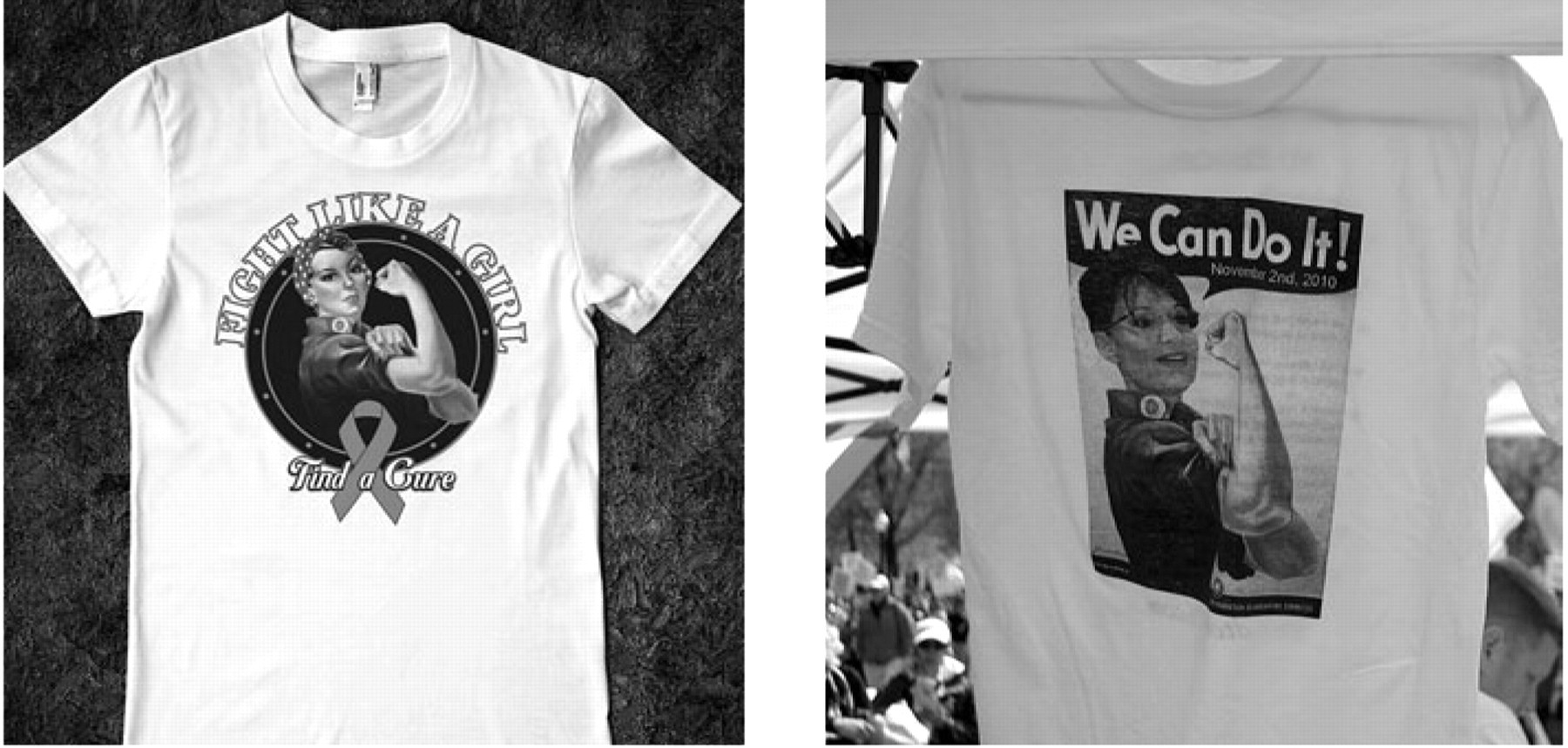
Rosie’s image is adopted and adapted to causes of all kinds. Here she encourages people to “fight like a girl” against breast cancer and, presumably, to support Sarah Palin for Vice President.
Kimble and Olson write: “…by addressing workers as ‘we,’ the pronoun obfuscated sharp controversies within labor over communism, red-baiting, discrimination, and other heartfelt sources of divisiveness.” Indeed, the authors note that such measures were effective, since “patriotism could be invoked to circumvent strikes and characterize workers’ unrest as un-American.”
Today, we see the poster through a lens shaped by what came later, particularly Second Wave feminism. The women’s rights movement of the 1960s and ‘70s fostered a gender-based form of identity politics in which women identified with each another as women and viewed themselves as sisters in a struggle against gender inequality (work was an explicit area of contention). Cultural perceptions of the 1950s as a period of particularly rigid gender roles contrasted with the apparent freedom briefly available to women during World War II. Within this context, now we look at the “We Can Do It!” poster and take for granted that “we” means other women. Yet Kimble and Olson remind us that this understanding isn’t an obvious interpretation, but the outcome of efforts to frame womanhood as a meaningful social identity—one that unites members through shared experience in a patriarchal society.
Placing this poster in its original context illustrates the way in which historical myth-making has obscured its real role. Ironically, the iconic image that we now imagine as an early example of girl-power marketing served not to empower women to leave the domestic sphere and join the paid workforce, but to contain labor unrest and discourage the growth of the labor movement.