




Abstract
Heterozygous GABAA Receptor β3 Subunit N110D Knock-In Mice Have Epileptic Spasms Qu S, Jackson LG, Zhou C, Shen D, Shen W, Nwosu G, Howe R, Catron MA, Flamm C, Biven M, Kang J-Q, Macdonald RL. Epilepsia. 2023;64(4):1061-1073. doi:10.1111/epi.17470
Infantile spasms is an epileptic encephalopathy of childhood, and its pathophysiology is largely unknown. We generated a heterozygous knock-in mouse with the human infantile spasms-associated de novo mutation GABRB3 (c.A328G, p.N110D) to investigate its molecular mechanisms and to establish the Gabrb3+/N110D knock-in mouse as a model of infantile spasms syndrome. We used electroencephalography (EEG) and video monitoring to characterize seizure types, and a suite of behavioral tests to identify neurological and behavioral impairment in Gabrb3+/N110D knock-in mice. Miniature inhibitory postsynaptic currents (mIPSCs) were recorded from layer V/VI pyramidal neurons in somatosensory cortex, and extracellular multi-unit recordings from the ventral basal nucleus of the thalamus in a horizontal thalamocortical slice were used to assess spontaneous thalamocortical oscillations. The infantile spasms-associated human de novo mutation GABRB3 (c.A328G, p.N110D) caused epileptic spasms early in development and multiple seizure types in adult Gabrb3+/N110D knock-in mice. Signs of neurological impairment, anxiety, hyperactivity, social impairment, and deficits in spatial learning and memory were also observed. Gabrb3+/N110D mice had reduced cortical mIPSCs and increased duration of spontaneous oscillatory firing in the somatosensory thalamocortical circuit. The Gabrb3+/N110D knock-in mouse has epileptic spasms, seizures, and other neurological impairments that are consistent with infantile spasms syndrome in patients. Multiple seizure types and abnormal behaviors indicative of neurological impairment both early and late in development suggest that Gabrb3+/N110D mice can be used to study the pathophysiology of infantile spasms. Reduced cortical inhibition and increased duration of thalamocortical oscillatory firing suggest perturbations in thalamocortical circuits.Objective:
Methods:
Results:
Significance:
Commentary
Infantile spasms (IS) syndrome is an epileptic encephalopathy of early childhood with dozens of etiologies that result in similar syndromic features—seizure type/semiology (spasms), electroencephalography (EEG) features (interictal hypsarrhythmia), medication responsiveness (adrenocorticotropic hormone, corticosteroids, vigabatrin), and natural history (subsequent epilepsy and neurocognitive impairments). The mechanism(s) of IS remain enigmatic. Novel gene mutations leading to IS are being identified at a rapid pace and hopefully, mutation-specific treatments can be developed. To identify appropriate novel treatments, it is essential to understand the neurobiological basis underlying IS, which requires animal models.
Animal models of IS have been limited, partly due to inherent species differences. Over the years, criteria for an informative animal model have been proposed, acknowledging that some features of IS in humans are not likely to be replicated exactly in other species; yet, valuable insights can be gleaned from models even if every criterion is not satisfied. 1 -5 That is, a model without ideal face validity may nevertheless provide valuable information about disease mechanism. The existing IS models span a range of etiologies similar to those in humans, both acquired and genetic. Among genetic models, IS have been associated with knock-in (KI) 6 or knock-out 7 mutations of Aristaless-related homeobox (ARX), a transcription factor critical for interneuron development and migration, and with Down syndrome models. 8,9 Gamma-amino-butyric acid (GABA) dysfunction has been implicated in all of these models as well as in human IS.
The current article by Qu and colleagues takes the putative role of GABA in IS a step further. 10 Given the role of abnormal GABA-mediated inhibition in epilepsy (and in IS in particular), targeting the GABA system is a rational approach. Indeed, various mutations in GABAergic function have been identified in human cases of IS. 11 In the Epi4K project, 12 one child with IS harbored a mutation in the gene encoding the GABAA receptor β3 subunit, GABRB3 (c.A328G, p.N110D). GABRB3 plays a critical role in neuronal development and is localized widely throughout the brain, including seizure-prone areas such as cortex, hippocampus, and thalamus. Using homologous recombination, the authors created a heterozygous mutation, Gabrb3+/N110D . They inserted this gene mutation into mice and used the resulting KI line to explore IS. Previous work from this laboratory documented the role of GABRB3 in seizure predisposition. 13
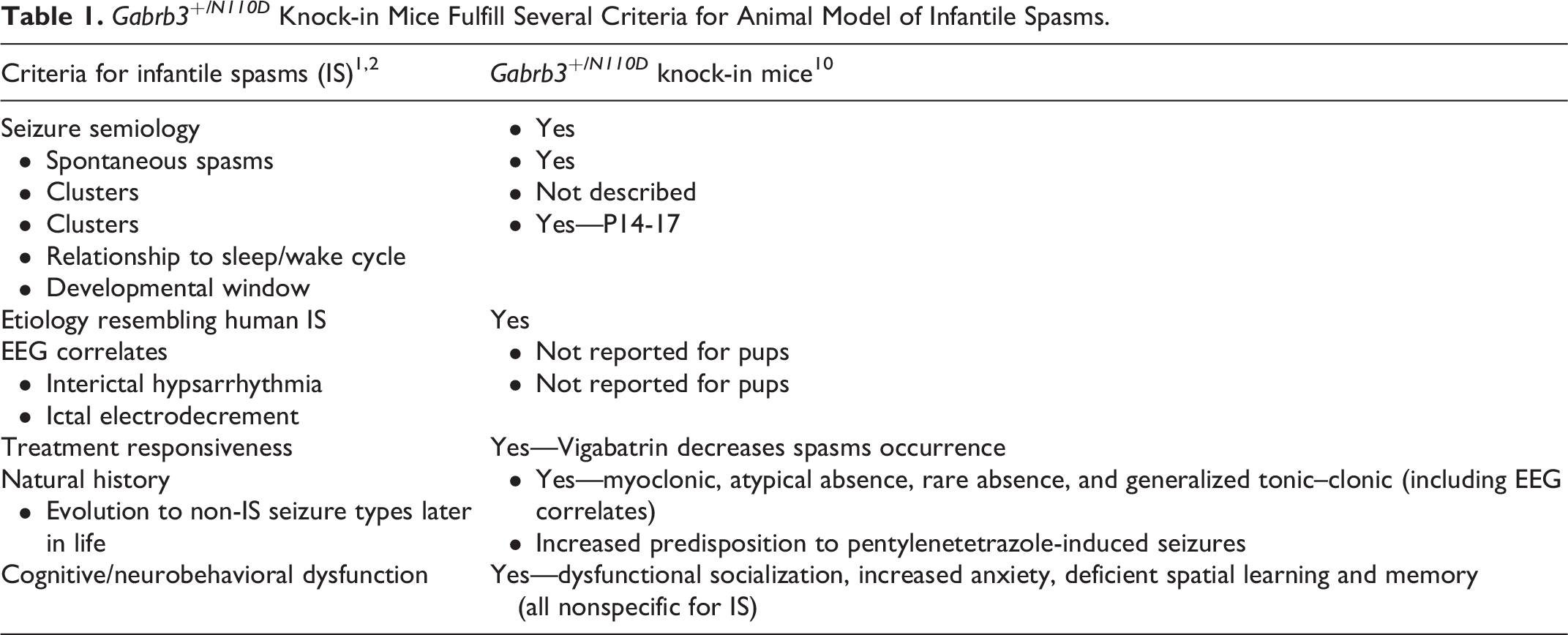
The authors used several techniques to validate their model. Only during the limited time window—P14-17—KI mice demonstrated clusters of brief spasms involving trunk flexion or extension, and head drops. While EEG was not studied in these young mice, the spasms did decrease when animals were treated with vigabatrin, a GABA transaminase inhibitor that is beneficial in some etiologies of IS such as tuberous sclerosis complex. Electroencephalography was performed when KI mice reached 2 to 6 months of age, at which time various seizure types were observed, most prominently myoclonic and atypical absence. In addition, KI mice had lower thresholds to seizures elicited by the GABAA receptor antagonist, pentylenetetrazole.
The Gabrb3+/N110D mutant KI mice displayed impairments on a variety of behavioral and psychosocial tests: decreased mobility in the three-chamber socialization test (autism-like behaviors), hyperactivity in the open field test (anxiety), and deficits in the Barnes maze (impaired spatial learning and memory). This battery of neuropsychological tests is not specific for IS but IS patients do manifest all of these deficits.
Finally, the authors began investigations into mechanisms by which Gabrb3+/N110D KI mice exhibit neuronal hyperexcitability that might account for their propensity to IS and subsequent additional seizure types. First, they used whole-cell patch clamp recordings in acute brain slices from KI mice, showing decreased GABAA receptor-mediated miniature inhibitory post synaptic currents in layer V-VI neocortical pyramidal neurons, indicating decreased cortical inhibition. Second, multiunit recordings were made from the ventral basal nucleus of the thalamus to assess spontaneous thalamocortical oscillations; they found excessive synchronization and hyperexcitability and the findings followed a developmental pattern. The results suggest that thalamocortical circuitry is altered in this model but further work will be required to elucidate cellular and structural correlates and whether other neural circuits are also involved.
In summary (Table 1), loss of neuronal GABAA subunit GABRB3-mediated inhibition in Gabrb3+/N110D KI mice appears to make them prone to IS-like seizures during a developmental window early in life, followed by increased propensity to multiple seizure types as adults. Whether these clinical observations indeed represent IS requires further study. Additional support for an IS-like phenotype includes multiple neurological impairments in cognition and behavior, hyperexcitability of thalamocortical and neocortical circuits, and EEG patterns that are abnormal but not hypsarrhythmia per se. With the lack of EEG in the P14-17 KI mice, hypsarrhythmia and ictal electrodecrement are the main criteria missing for an optimal model of IS.
Gabrb3+/N110D Knock-in Mice Fulfill Several Criteria for Animal Model of Infantile Spasms.
As the major inhibitory neurotransmitter in the brain, dysfunction of various aspects of the GABA system has been strongly implicated in epilepsy as well as in IS. Of course, many other neurological mechanisms could be operative in this mutant model. Outstanding questions include circuit function and brain structure, EEG correlates early in life during the spasms window, susceptibility to stress, relationship of spasms to the sleep-wake cycle, effects of corticosteroids, and detailed cellular mechanisms that may increase seizure predisposition. Overall, by investigating the role of a specific human gene mutation with a rational relationship to seizures and IS, this work represents an exciting new approach. Acknowledging that this mutation was identified in only a single patient, the results represent proof-of-principle that a human GABAA-receptor mutation can cause IS when inserted into mice, “knocking on the door” to many avenues of investigation and potential intervention and treatment for this devastating epileptic encephalopathy.

