



Abstract
In 2008, the governments of Mexico, United States, and Canada signed the North American Rabies Management Plan (NARMP). 1 The plan was designed to meet the challenge of long-term rabies management by strengthening the National Laboratory Network within each country and strengthening the capacity for a coordinated response across shared borders.
Lyssaviruses are an important public health threat for North America. Epidemiological surveillance in animal and human populations has become a critical component of public health systems. There are 16 species of Lyssaviruses that have been classified within 3 or possibly more phylogroups. 2 All Lyssaviruses are capable of causing encephalitis in mammals, but some of them seem to be more prone to produce spillovers to other species, including humans. The vaccines currently used to prevent rabies are effective against all Lyssaviruses in phylogroup 1 but ineffective against Lyssaviruses in phylogroups 2 and 3.
Mexico embarked on a successful urban dog and cat rabies control program through mass vaccination campaigns, enhanced rabies surveillance along the Mexican–US border, and implementation of vampire bat population control programs. Mexico was the first country in the world to have been recognized by the World Health Organization/Pan American Health Organization as a country free of human rabies transmitted by dogs and to control dog-to-dog rabies transmission.
By fostering the communication between several agencies and effective risk assessment to optimize the existing resources in the region as well as strengthening biosafety programs, Mexico began a 2-year program of emergency preparedness and response training with the RNSLP (Spanish acronym for the Public Health Laboratory Network). The first phase provided training on infectious substance shipping for the safe and secure transportation of biological samples from the local laboratories to the Reference Rabies Laboratory at the Instituto de Diagnóstico y Referencia Epidemiológicos (InDRE). Category A containers were distributed to the RNSLP for shipping samples from cases of suspected encephalitis.
For the second phase of the training, a strategy for containment and diagnostics was developed. A flow chart for decision making was designed (Figure 1). With this flow chart, the technical experts of the RNLSP can detect in a timely manner the potential and serious threat indicated by the introduction of a nonendemic rabies virus variant or another Lyssavirus species.
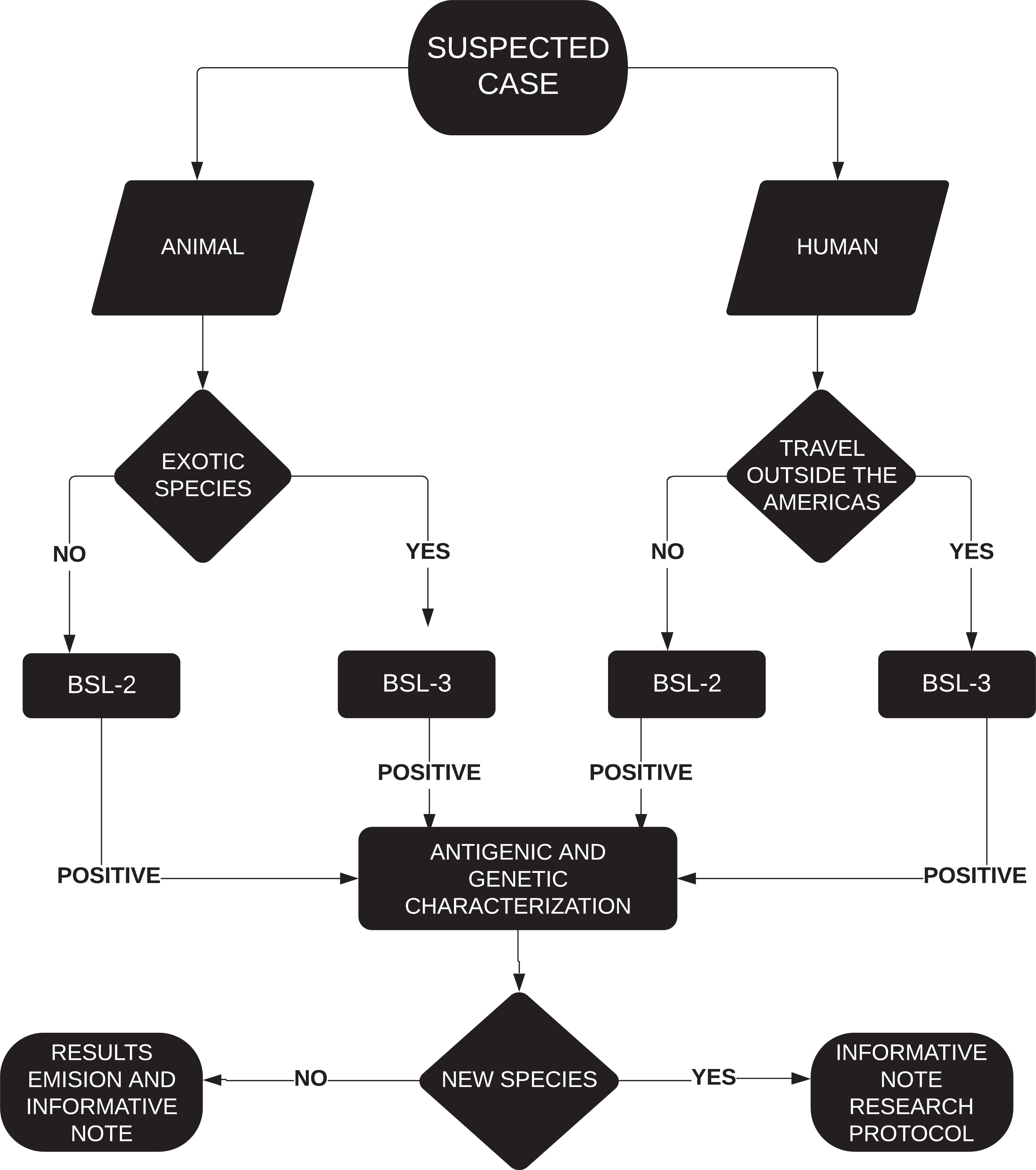
Flow chart of decision making in suspected cases of nonendemic rabies virus variants or different species of Lyssavirus.
In 2019, during the framework of “1er Foro Nacional para los Laboratorios que realizan el Diagnostico de Rabia,” the members of the RNLSP signed an agreement to use this strategic plan and the shipping instructions of all suspected and potential samples to the Biosafety Level 3 laboratory at InDRE.
Long-term priorities identified for the success of a rabies management program include the development of improved or new oral vaccines and baits to immunize target species. To optimize the achievement of rabies management program goals, public health programs need to share their plans, research, transfer of technology, and direct actions in managing rabies across borders.
The Mexican RNSLP plan is designed for (1) timely detection of events that may present a public health threat, (2) appropriate risk assessment for decision making, and (3) effective communication among first responders (veterinarians, medical experts, technicians) by providing the technician with the assistance required to guide the nation’s efforts to optimize response to a disease outbreak. These tools are critical for regional public health systems and improve communication across shared borders and threats.
Footnotes
Acknowledgments
The authors wish to acknowledge Karla Paola Puebla Rodríguez for technical help in the design of the flow chart as well as the InDRE’s Rabies Laboratory for their continuous support and extraordinary work. This work was presented as a keynote lecture at the Canadian Biosafety Symposium (CABS) held in Toronto, Ontario, September 18-19, 2019, as a specific epidemiological surveillance plan and laboratory emergency preparedness and response protocols for nonnative rabies virus variants and/or different species of Lyssaviruses.
Declaration of Conflicting Interests
The authors declared no potential conflicts of interest with respect to the research, authorship, and/or publication of this article.
Ethical Approval Statement
Not applicable to this study.
Funding
The authors received no financial support for the research, authorship, and/or publication of this article.
Statement of Human and Animal Rights
Not applicable to this study.
Statement of Informed Consent
Not applicable to this study.
