



Abstract
Early 2016, investigators at Emory University challenged the Biosafety Office with the task of reviewing and guiding how research with Zika virus, an emerging infectious disease, could be conducted at the institution. The challenge was not new, as the Biosafety Office has experience with reviewing other flaviviruses, such as West Nile, dengue, and yellow fever. Many of the practices and procedures were already in place. However, Zika virus posed a critical new challenge—the potential for reproductive hazards not seen in other flaviviruses. The reproductive hazard changed the risk assessment. This article aims to present the rationale and strategies used by Emory University to guide and implement the recommendations set forth by the Institutional Biosafety Committee for in vivo and in vitro research.
Keywords
What the Biosafety Officer Needs to Know Regarding Zika Virus
Infection by Zika virus (ZIKV) was declared a public health emergency of international concern in February 2016 by the World Health Organization. 1 The high incidence of cases in South America prompted a rapid increase in research and funding to understand this virus.
At Emory University, the Biosafety Office was presented with a number of research proposals to study ZIKV both in vivo and in vitro. There, the risk assessment of the proposed research drives the procedures and requirements needed to safely perform such research. When conducting the risk assessment, the biosafety officer (BSO) considered the following elements related to the infectious agent and the disease.
Characteristics of the Infectious Agent
ZIKV is a flavivirus from the same genus as dengue virus (DENV), West Nile virus, chikungunya virus, St Louis encephalitis virus, and Japanese encephalitis virus. Yet, among the flaviviruses, phylogenetic clusters are formed according to the transmission route, as in vector borne and nonvector borne, with the former into tick borne and mosquito borne. 2 Morphologically, ZIKV is an enveloped single-stranded RNA virus, and the complete coding sequence of a ZIKV strain from Africa has been published.3,4 Knowledge about the different circulating strains was important because the virulence of viral strains varies depending on the geographic location or the host from which it has been isolated. In the case of ZIKV, there are more virulent strains, such as the Puerto Rican strain, and those less virulent and less adapted to human cells, such as the reference strain MR766.
Host vs Reservoir
Does the infectious agent require a host, or does it have a reservoir? ZIKV is an arthropod-borne virus (arbovirus). It was first isolated in Africa from the mosquito species Aedes africanus 5 and has been isolated from various other Aedes species—notably, Ae africanus, Ae albopictus, Ae polynesiensis, Ae unilineatus, Ae vittatus, and Ae hensilli. 6 However, experimental transmission was first confirmed at high-titer viremia in Ae aegypti, but the studies were not conclusive for transmission of low-titer viremias. 7 Importantly, transmission of ZIKV outside Africa has only been confirmed for A aegypti.
The only evidence that ZIKV may have a nonprimate reservoir comes from an earlier survey conducted at the Vertebrate Pest Control Centre in Karachi, Pakistan. There, antibodies against this virus and 7 other togaviruses were found in rodents without causing disease. 8 The Flaviviridae family separated from the Togaviridae family in 1984 due to structural differences. 9
Susceptibility of the Host
ZIKV causes symptoms in 20% of humans. Literature shows that other hosts are susceptible to this virus, such as nonhuman primates (NHPs; eg, rhesus macaques) and interferon alpha/beta-deficient mice.1,10 The characteristics of the susceptible host are yet to be understood.
Transmission of the Infectious Agent
ZIKV can be transmitted from person to person via the bite of an infected mosquito. To date, multiple cases of transmission from man-to-man or man-to-woman have been documented. The Centers for Disease Control and Prevention (CDC) has issued specific guidance for prevention of sexually transmitted ZIKV in the United States. 11 Transmission has also been documented from mother to child during pregnancy. Mother-to-child transmission is associated with microcephaly and other neurologic defects.12,13 Although ZIKV has been detected in breast milk, its transmission by breastmilk has not been demonstrated. 14 Currently, there is no advisory against breastfeeding. 15 In the past 6 months, ZIKV has been detected and confirmed in body fluids (eg, blood, urine, amniotic fluid, semen, saliva, cerebrospinal fluid) and tissues (eg, brain, placenta). 15 Barzon et al 16 recently reported detection of ZIKV in saliva from a traveler returning from the Dominican Republic. The saliva sample was collected on day 6 after onset of symptoms. The sample was cultured in vitro following standard procedures for growing West Nile virus. ZIKV was detected in the saliva and urine samples of this patient for up to 29 and 10 days after the onset of symptoms, respectively. It has been demonstrated that males shed the virus in semen, as confirmed by culturing semen for 6 days and then testing with real-time reverse transcription polymerase chain reaction. 17 Furthermore, infective ZIKV was isolated from the urine of 2 of 9 patients after incubating urine collected during the acute phase in Vero cells; as such, more studies are needed to determine if urine contributes to viral transmission. 18
Symptoms Caused by the Infectious Agent
Symptoms associated with ZIKV infection appear 3 to 12 days after inoculation. The most frequent symptoms include fever, a maculopapular rash, joint pain, and nonpurulent conjunctivitis (pink eye). Importantly, 80% of individuals infected with ZIKV are asymptomatic. The 20% of individuals presenting symptoms may range from mild to severe. Neurologic symptoms in the form of Guillain-Barre syndrome have also been associated to ZIKV infections. In a case-control study from the ZIKV outbreak in French Polynesia between 2013 and 2014, 98% of patients with Guillain-Barre syndrome had anti-ZIKV IgM or IgG. 19
Availability of Treatment
Specific antiviral therapy for ZIKV infection or an anti-ZIKV vaccine is not available yet. Many compounds are being tested with repurposed drugs. 20
Background on Biosafety Guidelines of Emerging Diseases
Guidance for appropriate practices and containment was obtained from “Laboratory Safety for Arboviruses and Certain Other Viruses of Vertebrates,” published in 1980 by the Subcommittee on Arbovirus Laboratory Safety of the American Committee on Arthropod-Borne Viruses. 21 This publication included data on human infections caused by laboratory accidents and recommendation for biocontainment. Also, the CDC’s Biosafety in Microbiological and Biomedical Laboratories include section VIII-F for arbovirus and related zoonotic viruses. Section VIII-F includes definitions of biocontainment levels for working with arboviruses and a list of 597 arboviruses and hemorrhagic fever viruses, including biocontainment and potential requirement for HEPA filter. 22 According to the CDC Biosafety in Microbiological and Biomedical Laboratories, work with ZIKV does not need HEPA filtration on laboratory exhaust.
A review on the laboratory response to ZIKV-infected samples was recently prepared by the World Health Organization.
23
Knowledge gaps related to the laboratory response were identified in the response at the international level, specifically for laboratories where ZIKV infection is endemic. These gaps included:
validation of available tests in endemic areas and in areas welcoming returning travelers, monitoring of genetic diversity in circulating strains of ZIKV, establishment of external quality assessment and proper positive and negative controls (false-positive and false-negative controls), understanding of the infection kinetics (how long does virus remain in fluids, such as urine, saliva, plasma, or any combination of these), and availability of diagnostic reagents.
In the United States, the Occupational Safety and Health Administration recently issued an interim guidance focused on occupational exposure to ZIKV. 24 It reminds health care and laboratory workers to follow universal precautions for potential blood-borne pathogen exposure: “Treat all human blood and certain human body fluids as if they were known to be infectious for HIV, HBV and other bloodborne pathogens,” as required by law in the blood-borne pathogen standard, 29CFR1910.1030(b). In addition, health care providers can extend to applying standard precautions; the CDC recommendations include “hand washing, appropriate personal protective equipment such as gloves, gowns, masks, whenever touching or exposure to patients’ body fluids is anticipated.” Importantly, laboratories should ensure the use of adequate containment for the type of work to be performed.
The Precedent: Laboratory-Acquired Flavivirus Infections
Laboratory-acquired infections by flavivirus have been reported. In a review of published data between 1930 and 2008, Pedrosa and Cardoso 25 showed a breakdown of laboratory-acquired infections in research laboratory and hospital settings for arboviruses, including alphavirus (16 cases), flavivirus (22 cases), phlebovirus (6 cases), and vesiculovirus (6 cases). Fifty cases were caused by arboviruses, and 38 of those cases occurred in the research laboratory setting. The most frequent route of transmission was aerosol/inhalation (16 cases by alphaviruses and 10 cases by flavivirus), and less frequent were percutaneous or mucocutaneous routes of transmission. Sometimes, the specific route of infection cannot be determined, and the aerosol/inhalation route cannot definitively be confirmed. A case-in-point was reported in 2011 whereby a scientist at a research laboratory in Australia acquired DENV type 2 (DENV-2) while conducting a routine experiment that included using a membrane feeding apparatus to feed mosquitoes with DENV-2. The research worker had worn the required personal protective equipment for working with DENV in Australian laboratories. The individual reported a mosquito bite from an escaped non-blood-fed mosquito and denied needlestick injury or mucocutaneous contact with the infectious mixture. Ten days following the onset of symptoms, DENV-2 was confirmed through real-time polymerase chain reaction, which matched the genotype of the DENV-2 used to feed the mosquitoes. 26
Institutional Guidance for In Vivo and In Vitro Work
In January 2016, the Emory University Institutional Biosafety Committee (IBC) was presented with the task of reviewing research protocols for in vivo and in vitro work with ZIKV. Investigators were asked to complete project and pathogen forms provided in the electronic platform for management of research safety protocols (www.bioraft.com). The pathogen form allowed the investigator to provide specific details regarding the source of the agent, procedures, experiments, associated risks, and personnel experience, among other parameters. The pathogen form was provided to designated IBC members for peer-review.
The IBC discussed the ZIKV-related protocols submitted and determined that despite the biocontainment level recommended by the CDC, Emory scientists would work in a containment level of biosafety level 2 (BSL-2), with restricted access and BSL-3 work practices. See Table 1 for details of the guidance and implementation.
Risk Mitigation Implemented at Emory University for Work with ZIKV.
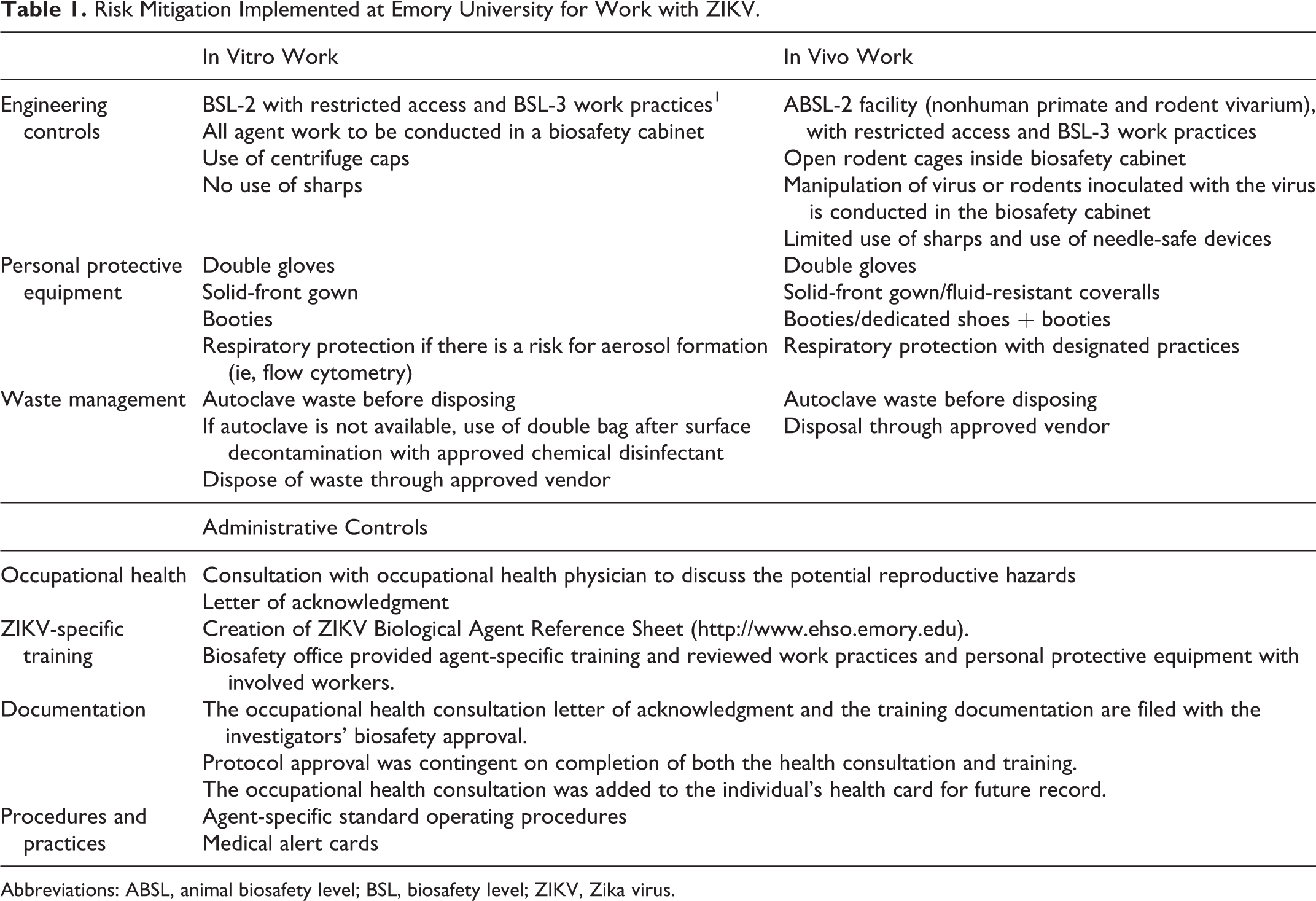
Abbreviations: ABSL, animal biosafety level; BSL, biosafety level; ZIKV, Zika virus.
Implementation of the Emory University IBC Guidance
Since ZIKV has high public attention, resources have become readily available for obtaining preliminary data, which translates into the need for immediate approvals from institutional committees (animal care and use, biosafety, institutional review board).
Biological Agent Reference Sheet
There was a need to consolidate known information about ZIKV, so we used the Biological Agent Reference Sheet for ZIKV (available at http://www.ehso.emory.edu/). This document was reviewed by infectious disease and occupational health (OH) physicians to ensure accuracy. The sheet is provided to individuals during the biosafety training, and it is posted in the laboratory suites and animal facilities.
Acknowledgment Letter
All individuals who would be working with ZIKV were provided with an opportunity to discuss the associated risks with the OH physician. The BSO created the acknowledgment letter to be signed by the individual, principal investigator, OH physician, and BSO. This letter includes specific information about the agent, containment, and work practices. Workers planning on pregnancy discussed this with the OH physician and were provided alternative job responsibilities. Consultation with other biosafety colleagues was critical in determining information to be included on the acknowledgment letter. The final document was reviewed and approved by the legal department and human resources.
Biosafety Training and Standard Operating Procedures
A deck of slides was prepared according to the most current information available. The training included review of ZIKV, biocontainment, and procedures, as well as what to do in case of exposure, which numbers to call, and who to contact. The information included in this presentation required frequent revision as more information became available and interim guidance from CDC was issued.
Similar evaluation and training were provided to other personnel, including animal handlers, veterinary staff, containment managers, facility management staff, and core facility staff (ie, flow cytometer).
Standard operating procedures (SOPs) included emergency numbers for the BSO, the environmental safety officer, and the principal investigator, as well as instructions for small- and large-spill cleanup.
Each project proposal was reviewed by the BSO and the IBC with special attention to experimental procedures, techniques to be used, and potential risk of exposure (ie, aerosol generation, parenteral inoculation, contaminated animal bedding, sample transportation, waste disposal). The biosafety approval for work was granted after completion of personnel training, OH consultation, and SOP development. The biosafety approval letter specifically documented the containment levels, personal protective equipment, engineering controls, and training requirements. Prior to initiating the work, the BSO visited each facility and conducted the walk-through with the principal investigator to ensure that all controls were in place and that the principal investigator understood all the conditions described in the approval letter for working with this agent.
Lessons Learned on the Implementation of Requirements for the Research Community
After a few months of implementing the measures described here, the biosafety team learned a number of important lessons about working with ZIKV, summarized in turn.
Biosafety Professionals Must Stay Informed
Information on emergent pathogens changes rapidly. Some options include searching PubMed (http://www.ncbi.nlm.nih.gov/pubmed), talking to investigators working on the agent, attending conferences, and monitoring the CDC website regularly.
Be Aware of the Complexities Associated with In Vivo Work
With in vivo work, the complexity of completing the OH consultations increased. It was necessary to make arrangements for training of weekend and off-shift personnel. Ancillary personnel, such as facilities and animal care (veterinarians, veterinary technologist, research resources, behavioral enrichment), needed to be included in the consultation process because they access the animals physically for collection of samples, examination, feeding, cleaning, enrichment, and so on.
Challenges of Working with NHPs
Additional risks were encountered during work with NHPs. Some procedures related to animal care (eg, cage washing) increased the potential for aerosolization. The facility needed to modify animal housing rooms (ie, installation of air curtains) to prevent intrusion of the Aedes mosquitos (this is Georgia! both Ae aegypti and Ae albopictus are residents of this area). An increase in pest control was implemented in the animal facility and the grounds to address any standing water and mosquito breeding areas.
Necropsy Procedures
Necropsy procedures were scheduled in the experiment for the collection of tissues and required a specific risk assessment to evaluate the location, instruments, and procedures. Additional needs were encountered during work with NHPs, such as the need for a clinical laboratory functioning at BSL-2 containment with BSL-3 practices that could provide clinical diagnostic evaluation to monitor the animals’ health during experiments.
Containment Requirements and Practices
The IBC recommended the work of ZIKV to be performed in BSL-2 containment with restricted access and BSL-3 practices, with special emphasis on the use of double gloves, no use of sharps, and autoclaving of waste (if possible). During the ZIKV-specific training, investigators were reminded to review the BSL-3 manual available online prior to initiating work. Regarding the use of sharps in the animal facilities, syringes and scalpels with safety devices were encouraged.
Inactivation and Disposal of Waste
The risk assessment was used to determine inactivation procedures in accordance with each facility. Some biocontainment rooms had an autoclave available. For those that did not have an autoclave available, the SOPs included how the waste would be collected in a biohazard bag and the surface decontaminated, after which it was placed inside a second bag and finally inside the cardboard box lined with a third bag. This box was disposed by an approved vendor scheduled to come to the facility as needed.
Face-to-Face Interactions
Frequent communication and interactions with the principal investigator, supervisors, veterinarians, and research staff during the review process and postapproval were critical for the rollout of ZIKV research at Emory University. Direct communication allowed for onsite discussions about procedures as well as collaborative problem solving to ensure safe practices and containment.
Conclusion
This work highlights the process that was followed to approve researchers to work with ZIKV in vitro and in vivo. The review process involved hazard evaluation, potential for exposure, and mitigation strategies to be implemented for performing safe research. Individualized risk assessments were performed for each biosafety protocol submitted, with consideration for use of equipment in experiments, animal use (small animals and NHPs), and propagation of virus. The OH consultation was an integral part of the review; the BSO ensured that the approval letter clearly indicated who had received the biosafety training and OH consultation. The success of this process relied on a team effort with multiple players, including the OH physician, biosafety professional, Division of Animal Resources, and researchers.
Footnotes
Acknowledgments
We acknowledge the contributions of Dee Zimmerman, environmental health and safety consultant at The University of Texas Medical Branch at Galveston, for sharing her experience and resources related to working with ZIKV. We also acknowledge the contribution of Dr Scott Henderson, occupational health physician, who has provided consultations to Emory University employees as they prepare to conduct research with ZIKV.
Declaration of Conflicting Interests
The author(s) declared no potential conflicts of interest with respect to the research, authorship, and/or publication of this article.
Funding
The author(s) received no financial support for the research, authorship, and/or publication of this article.