



Abstract
The Arizona Biosafety Alliance, Federal Bureau of Investigation, and Arizona State University hosted a workshop in December 2017 to confer and deliberate on interdisciplinary considerations regarding biosecurity. The primary focus of the event was to address a perceived gap in the knowledge between the experts discussing technical and policy implications of biosecurity, professionals in the trenches managing biosecurity risks, and the public perceptions of the risks and benefits of emergent biotechnology. This article summarizes the event, identifies common themes among presenters, highlights key outcomes, and offers recommendations for future considerations.
Keywords
The second Arizona Biosecurity Workshop, held December 7 and 8, 2017, at the Arizona State University (ASU) Tempe campus, was a forum to discuss emerging biosecurity concerns. More than 160 people attended the workshop—representing academia, industry, law enforcement, Native American nations, policymakers, regulators, and members of the public—to discuss the risks and hazards associated with novel biological research and biotechnology.
A prominent goal of the workshop was to define the topic of biosecurity, which was intentionally not addressed as part of the 1975 Asilomar Conference on Recombinant DNA Molecules.1 -3 Since Asilomar, new security concerns, such as those associated with synthetic biology,4,5 cyberbiosecurity, 6 dual-use research (DUR) and dual-use research of concern (DURC),7,8 do-it-yourself (DIY) biology,9,10 and gene drive technology,11 -13 have come to the forefront. Now that recombinant nucleic acid technology is considered mainstream within the scientific community, greater emphasis needs to be placed on the social, ethical, and legal ramifications of novel biological technologies.
The term biosecurity has evolved over the past 2 decades. In an attempt to provide a shared starting point for the workshop, participants were provided the 2017 definition from the ABSA International:
Biological security (biosecurity) is the risk-and threat-based control measures established to prevent the unauthorized access, misuse, loss, theft, diversion and intentional release of valuable biological materials, pathogens, toxins, information, expertise, equipment, technology and intellectual property that have the potential to cause harm to humans, animals, plants, the environment, public safety or national security.
14
Structure for the 2017 Arizona Biosecurity Workshop
Feedback from attendees of the first Arizona Biosecurity Workshop in 2016 established that the workshop was valuable and attendees wanted to learn more about synthetic biology, genome editing, gene drives, community-based maker spaces, and governance strategies. In addition to these topics, the 2017 workshop included DUR, DURC, oversight of safety and security at the International Genetically Engineered Machine (iGEM) competition, and community involvement in conversations about novel biotechnologies.
The 2017 workshop was designed to bring together participants with a range of expertise to address the gaps in the knowledge between the scholars discussing technical and policy implications, the professionals in the trenches managing biosecurity risks, and the public perceptions of the risks and benefits of emergent biotechnology. Nine topical areas were included in the workshop program: (1) biosecurity in developing economies; (2) biosecurity in Native American communities; (3) cyberbiosecurity; (4) DIY biology; (5) dual-use issues; (6) gene drives; (7) gene therapy; (8) iGEM; and (9) partnership with the Federal Bureau of Investigation (FBI). The organizers invited subject matter experts with the FBI Weapons of Mass Destruction (WMD) Directorate in Washington, DC, and the Phoenix FBI Field Office WMD program to assist in developing and leading the workshop. The Arizona Biosafety Association was also invited to participate.
Biosecurity in Developing Economies
While some countries are equipped with resources to develop and access emerging technologies, others lack these opportunities. Developing economies face the challenge of volatile funding sources, thereby creating a critical lack of available biosafety and biosecurity training, personal protective equipment, engineering controls, and support personnel to ensure effective biosecurity. The presenters described how countries that share borders have common interests that are independent of political factors. For example:
Epidemiological surveillance of emerging and reemerging infectious diseases that could represent a public health threat Effective transfer of technology, which includes training in technical and ethical aspects Protection of agricultural and economic interests Preservation of existing and shared natural resources
Genetic manipulation technologies have changed the landscape and perspective of biosecurity, requiring scientists engaged in molecular biology, microbiology, and infectious diseases to become a responsible custodian for global biosecurity. One concern is with scientists who have limited training regarding genetic manipulation—such as an engineer with limited knowledge and training in the life sciences—as they may not fully understand the risks associated with their work. Another issue is when scientists have not been systematically trained to consider the ethical consequences of biological research, yet have access to an inexpensive, easy-to-use genetic engineering tool. These situations can lead to several problems, including the following:
Exposure to a biohazard with unknown hazard potential (eg, a needlestick with a viral vector with an unknown or poorly understood payload) Release of a genetically modified organism Use of a highly pathogenic agent in minimal containment facilities Noncompliance with formal treaties or regulatory requirements
The speakers discussed the importance of having an international biosecurity program that fosters a culture attentive to public health priorities. Institutions worldwide need to evaluate resources and strengthen the knowledge of safety and security professionals overseeing biological research, as well as the scientists performing the work. Despite ample guidelines that exist for institutions and researchers, biosafety norms and expectations are not yet harmonized at the global level. An update to the World Health Organization’s “Enhancement of Laboratory Biosafety” publication could incorporate new biosafety and biosecurity issues in the current era of synthetic biology. 16
Biosecurity in Native American Nations
A member of the Oglala Lakota Nation discussed how biosecurity is a largely unexplored issue in Native American communities and how it may be different from tribe to tribe, representing the diverse lifestyles and priorities of sovereign nations. 17 For example, Native American nations have water sources, plants, and seeds, which are an integral part of their culture. Participants discussed how biosecurity measures could be implemented as a way to protect unique resources, such as herbs used in medicines, clays and straw used for artisan and architectural purposes, and other products of their agricultural heritage.
Attendees discussed the need to invite Native American nations to participate in conversations about biosecurity, biosafety, and emergency response. This effort could promote trust between outside entities and tribal communities. For example, developing and implementing a Native American biosecurity working group in collaboration with ABSA International, tribal leaders, and the Intertribal Council of Arizona or similar state tribal councils could be an effective way for each tribe to have a voice in biosecurity discussions.
Cyberbiosecurity
Cyberbiosecurity is described as the intersection between biological activities and information security. Presenters described hacking methods used to obtain sensitive information through improperly secured networks and vulnerabilities in information technology (IT) systems. The following methods for assessing and strengthening resources were recommended:
Keeping software up-to-date and ensuring computing systems are protected with the latest antivirus software Installing software from trusted and reliable sources Implementing authentication protocols (eg, biometrics, 2-factor authentication) Maintaining a strong password protection program (eg, updating passwords frequently, making passwords unique, safeguarding passwords) Protecting sensitive data, encrypting systems, and performing security reviews Implementing a Continuity of Operations Plan (COOP) and conducting drills to test the effectiveness of the COOP
The presenters also discussed how risk outcomes from a cyberbiosecurity event in research could lead to the following:
Loss or theft of data (eg, intellectual property) Loss of funding for not adhering to requirements Extortion (eg, demanding money in return for access to stolen data) Compromised infrastructure from cyberattacks (eg, unlocking electronically controlled doors) Penalties for violating laws (eg, Health Insurance Portability and Accountability Act of 1996, Family Educational Rights and Privacy Act of 1974)
Modern Internet-enabled embedded devices called Internet of Things (IoT) were identified as significant cybersecurity risks. Presenters discussed how it is important to consider how Internet-enabled devices can be leveraged to attack internal IT infrastructure, facility controls, and other IoT devices. IoT generally does not conform to even basic information security best practices such as service and software updates, audit logging, file integrity checks, host firewall or intrusion detection systems, or employing antivirus or antimalware software. Furthermore, IoT was described as lacking in code visibility, design transparency, and network layer security.
Many processes in modern research facilities depend on computer-controlled instruments, which could be compromised in a cyberattack and have negative impacts on the entity, research, and personnel safety. 18 It was noted that third-party vendors may be provided temporary, as needed, access to door-locking systems and camera controls for troubleshooting, programming, and installing networks, among other tasks. In these situations, specialized cyberbiosecurity experts are needed to evaluate all systems involved and their vulnerabilities in the protection of biological materials. Oversight personnel should be assigned the responsibility to continuously verify that there are appropriate levels of safeguards in place. Institutions should consider the implementation of a fully encompassing cyberbiosecurity plan, such as those required by the US Federal Select Agent Program (FSAP). These plans should address issues such as prohibiting self-granting access to vulnerable systems within the facility, monitoring accurate inventory records of biological agents, and ensuring IT systems are protected.
The severity and impact of cyberbiosecurity risks were demonstrated by providing several examples of high-profile data security breaches:
US Department of Energy compromised 159 times between 2010 and 2014
19
Target retail stores data breach affected 41 million consumers in 2013
20
Multiple nuclear power plant cyberattacks in 2017
21
Cyberattacks at Bank of America, JP Morgan, Wells Fargo, and other leading financial institutions in 2012
22
In the United States. the FSAP requires a cybersecurity component. However, most biological laboratories do not fall under the jurisdiction of the FSAP. Therefore, the presenters discussed the need to include IT professionals (eg, systems administrators, database analysts) at non-FSAP entities into cyberbiosecurity conversations. When working with biological research, the vetting of IT staff must be at a level commensurate with the risk present in the research. Attention must also be given to personnel suitability to include mental wellness and workplace culture.
DIY Biology
Citizen-science and DIY communities are defined as a “group of people with or without formal training who perform research either as a hobby or to foster societal learning and open science.” 23 Presenters discussed how DIY biology has grown from a few laboratories in garages and an online forum to more than 50 groups across the United States and nearly 200 around the world.
These laboratories, existing primarily as volunteer-run public facilities, pose inherent biosafety and biosecurity implications. For example, these facilities were often not constructed with the capability to support contained biological research, and few (if any) regulatory agencies monitor them. Having a community-based DIY laboratory can reduce the chance of negative outcomes when compared to research occurring in garages or homes because others in the facility can assist in managing safety and security, and there is greater transparency in a public space. 23 In addition, the FBI has been involved in organizing and meeting with international DIY groups to address biosecurity.24,25
While DIY biology laboratories are a place for motivated high school or even grade school students to learn, there are unique challenges. For example, it is important to consider what assessments are necessary to determine whether participants have the appropriate knowledge to safely perform experiments. There was agreement among attendees that the training and mentoring of DIY personnel would lead to more biosafety and biosecurity knowledge and a greater awareness of risks in these facilities.
Dual-Use Issues
Conversations were held regarding DUR and DURC policies, how best to balance the risks with the need to perform research, 26 and how to communicate important findings while safeguarding sensitive information. 27 Currently, three US policies lay the framework for reviewing and conducting potential DUR, DURC, and gain-of-function (GOF) research. The first 2 policies focus on the required review of research of 15 agents and 7 experimental effects. The third policy addresses GOF, a subset of DURC, which includes research with a potential pandemic pathogen that is likely highly transmissible and likely capable of wide and uncontrollable spread in human populations and is highly virulent and likely to cause significant morbidity and/or mortality in humans. 28
DUR is defined by the US government as research conducted for legitimate purposes that generates knowledge, information, technologies, and products that could be used for both benevolent and harmful purposes.29,30 DURC is defined as life sciences research that, based on current understanding, can be reasonably anticipated to provide knowledge, information, products, or technologies that could be directly misapplied to pose a significant threat with broad potential consequences to public health and safety, agricultural crops and other plants, animals, the environment, materiel, or national security.29,30
The presenters discussed the limitations of the current policies, responsible communication of research results, and the need for the greater research community to proactively come together and integrate biosecurity into the research culture. For example, attendees discussed whether DUR and DURC are subjective descriptors that might not always capture the true biosecurity risk of specific research activities. This may be attributed to unknown factors such as changing technologies, access to materials and information, and additional scientific discoveries.
Attendees discussed the need to incorporate safety-related material into manuscripts and presentations. For example, authors should include the approvals from oversight committees such as an Institutional Biosafety Committee (IBC) and Institutional Review Entity (IRE), the specific risks posed by the approved research, the biosafety level (BSL) of the facilities used, and recommendations to address any DUR or DURC that might arise from the published article or presentation (including available countermeasures and risk mitigation strategies). The group came to the consensus that the most difficult task was designing experiments for DUR, DURC, and GOF to preclude any potential misuses of research results and to instill biosecurity in the research culture.
Gene Drives
A deficiency identified during the proceedings was related to the governance of emerging biological technologies, specifically the lack of governance for human genome editing and gene drives. Gene drives are often described as unique, requiring an innovative method to assess their risk. For the purposes of the workshop, the definition of gene drive was taken from the 2016 National Academies of Science report on gene drives: “Gene drives are systems of biased inheritance that enhance the ability of a genetic element to pass from an organism to its offspring through sexual reproduction.” 31
Gene drives are currently being studied to reduce vector-borne diseases,
32
control invasive pests,
33
reduce pesticide use, and improve crop production.
34
However, gene drive technologies present a degree of uncertainty for the future of synthetic biology. To this point, gene drives are being described as sociotechnical anomalies in the regulatory landscape with political implications because of the following:
13
Gene drives affect the shared environment in ways that will not allow individuals and communities to opt out. Gene drives can be developed and released and thereby produce effects unilaterally. Some forms of gene drives are anticipated to spread across international borders to most or all populations of the target species (thereby making a “contained field trial” unrealistic).
Due to this, speakers had more questions than answers about the technology. Specifically, the presenters shared 3 questions that they felt should be answered before gene drives are released into the environment, including the following:
What are the technical obstacles to overcome to develop gene drive technology and employ it outside of the lab? What threats are posed by a gene drive technology? What skills and resources are needed to advance gene drive technology to understand the risk of uncontrolled spread?
While there were no specific answers to these questions provided, attendees were referred to the 2015 article discussing confinement strategies to safeguards against gene drives in research settings. 35 It was apparent from the conversations in the room that additional discussions regarding gene drives and their global ramifications were needed.
Gene Therapy
Biosecurity concerns involving gene therapy, specifically through the use of genome editing, were discussed. Presenters described how the use of Clustered Regularly Interspaced Short Palindromic Repeats (CRISPR)-based genome editing may be used to eliminate human disease. The following challenges for gene therapy were discussed:
High manufacturing costs and difficulties in scaling when working with large patient populations Large genes with defects that are more difficult to correct due to limitations in delivery methods Challenges with gene silencing over time Undesirable immune responses (eg, cancer, death) to the gene therapy system Incorrect targeting that may result in off-target effects
Biosecurity implications of gene therapies include high manufacturing costs that could result in market pressure to reduce costs or render supply chains and production opaque in efforts to avoid necessary safety and security concerns. Without high visibility and a culture of safety, there is a risk that the biosecurity infrastructure may be inadequate or lack stringent containment facilities.
The use of CRISPR to modify genomes has the potential to cause off-target effects, which could result in unpredictable gene expression and systemic consequences. There is a particular challenge to identifying and monitoring off-target effects due to limitations in knowledge and technology. The range of possible outcomes and delayed expression of off-target effects introduce biosecurity challenges (eg, defining appropriate intervals of observation to confirm that long-term risks are not present).
iGEM
Presenters discussed the nontraditional synthetic biology organization known as iGEM. Since 2003, more than 30,000 people, from over 40 countries, have participated in iGEM-related events, primarily in 3 programs: iGEM competition, iGEM labs program, and the iGEM Registry of Standard Biological Parts. 36 The iGEM competition promotes projects that use synthetic biology to create solutions for everyday global problems. Multidisciplinary teams work together to design, build, test, and measure a system of their own design using interchangeable biological parts and standard molecular biology techniques.
The presenters discussed how iGEM is a fast-paced environment where hot button topics (eg, biosafety, biosecurity, animal welfare, environmental release, human-based research) quickly emerge in projects, often requiring timely intervention with team members. However, as a nongovernmental entity, iGEM has limited tools to encourage participants to self-regulate their activities. For example, to compete in iGEM competitions, teams must complete safety forms and submit them for review by a volunteer safety committee. Since there is no comprehensive international risk assessment framework in place, teams are required to do the following:
Maintain full compliance with competition rules, institutional requirements, and country-specific laws Refrain from using risk group (RG) 3 and 4 organisms Refrain from using parts from RG-4 organisms Identify the appropriate BSL for each project Refrain from using BSL-3/4 laboratories Follow safe and compliance shipping practices Refrain from releasing or deploying created materials outside of the laboratory
Past iGEM safety models primarily relied on pathogen-driven risk assessments. The new model incorporates the risk assessment of synthetic biology parts and how they function, in addition to the specific risks of the biological agents being used. This is done to assess the entire product and materials used, not just the pathogenicity of the chassis organism. Examples of questions asked on the safety form include the following:
Would any of the project ideas raise safety issues in terms of researcher safety, public safety, or environmental safety? Has a local biosafety committee approved the project? Do any of the new synthetic biology parts made in the project raise any safety issues? What risks does the project pose to laboratory personnel and the environment? The group discussed how the iGEM safety reviews could be considered a model for other nontraditional spaces, such as DIY laboratories.
Partnership with the FBI
Any discussion of biosecurity inevitably involves the roles and responsibilities of law enforcement in securing biological materials, facilities, and intellectual property from nefarious actors and in prosecuting crimes. The FBI cosponsored the workshop to collaboratively discuss biosecurity concerns and explain the role law enforcement plays in these efforts.
The FBI shared challenges of biosecurity implementation as well as best practices from a law enforcement perspective. Challenges include the problem that biosecurity scope is often narrowly defined and excludes a full range of security measures. In addition, biosecurity principles are not as widely accepted as are biosafety principles, and biosecurity often lacks emphasis on prevention of deliberate acts and the role of law enforcement. The FBI stated that personnel vetting, personnel reliability and violence prevention programs, biosecurity training, oversight of DUR, cybersecurity upgrades and training, and standardization of material control and accountability are best practices implemented in some institutions.
Speakers discussed how in 2008, the FBI implemented a change in how it approached the challenges of cutting-edge biological research by moving toward a multidisciplinary approach of collaborating with academia, industry, and other governmental agencies. The goal was to better protect US and international communities from the intentional misuse of biological materials, knowledge, and technologies by criminal and terrorist elements. One method to achieve this goal was to proactively identify and prevent incidents through targeted measures such as community engagement involving private industry stakeholders, citizen scientists, law enforcement, first responders, health professionals, academia, and the intelligence community.
At the heart of this mission is the FBI WMD coordinator program. There are WMD coordinators serving as a single point of contact with the life science communities in each of the 56 FBI field offices. WMD coordinators are highly trained and certified to act as subject matter experts in the mission to prevent the use of chemical, biological, radiological, nuclear, and explosive materials.
The consensus among participants in attendance was that biosecurity risks are not limited to select agents alone. For example, non–select agent pathogens and toxins, as well as cyberthreats, can cause unwanted harm to the public health, life science, agriculture, and wildlife sectors. Workshop attendees commented that to be a leader in biosecurity, the FBI must remain committed to building relationships with key stakeholders.
Visualizing and Conceptualizing Biosecurity
To visualize the different terms used at the workshop, a word cloud was developed. Word clouds are an effective way to convey major content from a document instantly. 37 They have been described as a “simple yet powerful visualization paradigm in text analytics.” 38 The word cloud shown in Figure 1 reflects the words used during the workshop. The biohazard shape was chosen as a means to visually convey the overriding themes. The visual combination conveys the prevalent ideas, concepts, and terms in use within the biosecurity community.
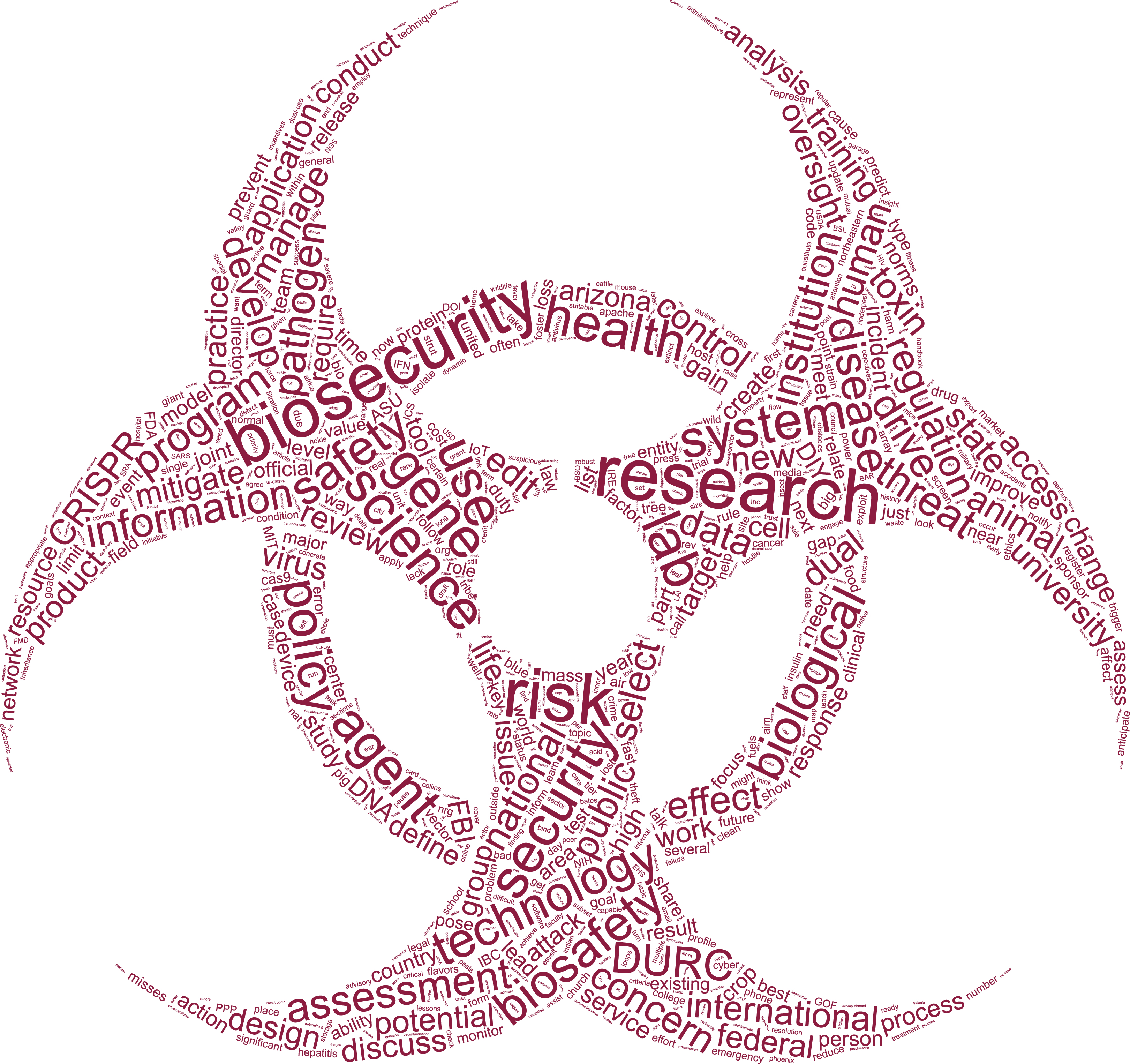
Word cloud generated from presentations, surveys, and other official documentation inside the biohazard symbol.
Code of the Wild
One creative effort to communicate gene editing to the public is through visual mass media. A media production company (Rhumbline Media) and a media innovation platform team (Filmstacker, LLC) attended the workshop and interviewed participants for a project titled Code of the Wild: The Nature of Us Edited. The team stated that its goal was to explore the implications of genome modification and its impacts on society. This will be accomplished by recording personal stories and documenting points of views from genomic researchers, regulators, social scientists, philosophers, members of the biohacking community, and the general public from around the world, particularly in China and the United States, to provide a real-life snapshot of today as rapid scientific advances are taking place. For example, what happens when the work taking place in top research institutions, hospitals, and neighborhood DIY laboratories comes up against our current regulatory landscape?
The project will unfold in 2 phases:
Phase I will use the collaborative online video platform (https://codeofthewild.org) to invite collaborators to upload their stories related to genetic engineering. It will enable viewers to combine the stories easily to make their own personal video, which can be shared via social media or used for the educational purposes. Even more interestingly, the statistical analysis toolset incorporated within the platform gathers data on public likes, which then can be used for scientific analysis of public perceptions within different demographics and cultures. All uploaded contents will be reviewed by a panel of experts and an advisory board. In phase II, the professional documentary team will produce the Code of the Wild documentary, which will follow protagonists involved in various plots centered on gene editing. The Code of the Wild web platform is anticipated to roll out by the end of summer 2018.
Recommendations for Moving Forward
The workshop illuminated several gaps in knowledge among participants. This observation may also further be generalized to apply to society as a whole. The first gap involves risk communication, which has been extensively studied in the interdisciplinary, sociotechnical, academic disciplines.39 -41 The act of measuring the potential for harm associated with an action or situation is a common method when assessing risk. When a new technology (eg, round wheel, gunpowder, gene drive) is created, there is an inherent unpredictability as to how it will be used and if harm will arise from its use. Novel biotechnologies are no exception.
Scientists are specialized in their areas of research and may or may not know the full implications of how their research will ultimately affect society. However, scientists do not have complete knowledge and are not in full control of their domains, nor are they masters of the technological artifacts they create. Therefore, the process of determining the point at which something becomes a security concern is also an uncertainty and is an ongoing feedback loop between inventor, regulatory bodies, and society. 5
A significant challenge in risk communication is the disconnect between the method and in what fora (eg, news soundbites, town hall meetings) scientists talk to the public about risk vs how scientists talk to each other about risk. This workshop was freely open to everyone who could attend to facilitate a diverse dialogue on the topic of biosecurity. The announcement for the event was posted on several websites and listservs to reach a wide and diverse group of attendees. Personal invitations were sent to a curated mailing list that included previous attendees and newly identified stakeholders. Every effort was made to allow for the expression of values and opinions from stakeholders and to elucidate the impacts of biosecurity in a transparent manner.
A second gap involved the knowledge between biosecurity experts and nonexperts and the myriad of people in between who have varying skill sets, educational backgrounds, work experience, and other qualifications. The major challenge identified is the ability to communicate between these different groups in a manner that makes sense to all parties.
A third gap identified was a universally accepted definition for the term biosecurity as many definitions have been proposed since 2003, and the word itself is poorly translated into other languages. 42 While workshop presentations provided a better understanding of the issues facing biosecurity, attendees discussed the need for continued conversations. Specific areas that should be further examined include: (1) examining the role of the public in gene drive releases into the environment; (2) assessing the economic impacts of synthetic biology; (3) analyzing the use of publicly available genomic sequence data to create pathogens; (4) investigating methods to protect and detect biological warfare agents; (5) studying off-target effects from genome editing; (6) exploring governance practices for novel biotechnology; (7) integrating biosecurity into research and technology enterprises; (8) identifying the role of governmental agencies responsible for implementing a functional biosafety and biosecurity program; (9) examining biosecurity in Native American nations; and (10) including social, legal, and ethical considerations of biological research in biosecurity assessments.
Moving forward, workshop participants requested to be included in transparent dialogues about biosecurity and the biological activities taking place globally. Participants discussed the need to harmonize knowledge regarding biosecurity by encouraging additional publications, training opportunities, workshops, and roundtables that are freely accessible to the public. Last, participants discussed the need for developing a biosecurity credential to ensure professionals in the field have a common foundation from which to work.
Footnotes
Acknowledgments
We are extremely grateful to Emma Frow for encouraging us to do this project and for introducing us to many of the workshop speakers several year ago. We wish to thank all of our speakers and sponsors for making the event so memorable. Finally, we are indebted to Morgan Olsen, Nichol Luoma, Leon Igras, Michael Kingery, Heather Clark, Jackie Murrill, Paula Dobler, Shelly Granados, MarKetta Roemke, Giorgio Scarpellini, Travis Lane, Delia Carlyle, and many others who helped us coordinate the event.
Authors Note
It is important to note that the definition of biosecurity provided at the workshop was broader than previous connotations of the term that may have only focused on agricultural, food, water, or other forms of biosecurity. Instead of focusing on specific applications, the encompassing definition allowed attendees to have a broad, rich dialogue on the subject.
Ethical Approval
This article summarizes a public meeting designed to train attendees about biosecurity. In order to maintain high ethical standards, all names of attendees, presenters, and titles of presentations were removed, and the data cited in this paper is not connected to any individual. Information from publicly accessible sources and author experiences are included in this article.
Statement of Human and Animal Rights
The Arizona Biosecurity Workshop was a public meeting and attendees were informed, prior to and during the meeting, that that the event was being recorded (ie, audio, visual) for media and publication purposes. This article is based on public discussions. No animals were involved in this project.
Statement of Informed Consent
Although an informed consent statement was not required for this project, individuals at the event were informed that the 2017 Arizona Biosecurity Workshop was being recorded (ie, audio, visual) and that multiple articles (eg, news features, journal manuscripts) would be published after the event. Signage was posted at the entry to the venue and at multiple locations within the room, stating that the workshop was being recorded (ie, audio, visual) and photographs were being taken for publication purposes. All attendees were required to sign photograph and filming release statements.
Declaration of Conflicting Interests
The authors declared the following potential conflicts of interest with respect to the research, authorship, and/or publication of this article: Dr. Samira Kiani is a co-producer of Code of the Wild, which is referenced in this article. Code of the Wild is a communication campaign in production with Rhumbline Media and is not affiliated with any current basic or clinical science research projects.
Funding
The authors disclosed the following financial support for the research, authorship, and/or publication of this article: Sponsorship for the 2017 Arizona Biosecurity Workshop was provided by AZBA, FBI, Camfil Clean Air Solutions, BioRAFT, BioSafe Engineering, CEM Testing and Certification Services, and VWR. Partners from ASU included Environmental Health and Safety, Ira A. Fulton Schools of Engineering, School for the Future of Innovation in Society, Knowledge Enterprise Development, School of Life Sciences, and School of Molecular Sciences.