Biosafety risk assessment and containment framework strategies for research involving gene drives pose a challenge, as there are no published guidelines or regulatory information yet written specifically addressing biosafety and gene drive use. Since the risk is more at an ecologic population level than an individual risk to the researcher, this further confounds the typical risk assessment process, which traditionally places emphasis on evaluating biosafety risks to the user and how the agent is spread among permissible hosts. We also realize that many of the publications currently available for gene drive biosafety are written with the assumption that readers have a good grasp of molecular biology and genetics. We have good reason to believe that this assumption is neither correct nor justified among all biosafety professionals. Our goal here is to create a resource that would offer a basic primer on gene drive technology while providing enough resources to start the risk assessment process of a gene drive proposal. We developed several questions and answers that we believe will make tackling the biosafety aspects of a gene proposal less formidable.
The ability to edit and modify genomes is experiencing an unprecedented revolution with the advent of CRISPR (clustered regularly interspaced short palindromic repeats) and CRISPR-associated (Cas) genome-editing technology.1 Hailed as the largest game changer in biology since the invention of polymerase chain reaction,2 CRISPR-Cas9 has made genome editing cheaper, easier, and more available to the public than ever before.
Biosafety oversight, in the form of regulations, policy, guidelines, and other governance strategies, is constantly challenged to keep pace with the ever-changing landscape of biomedical research. For example, by using novel tools such as CRISPR, scientists are able to create genetically modified (GM) crops (eg, glowing plants, nonbrowning mushrooms) that go unnoticed or unaddressed by government agencies in the United States.3 Biosafety guidance at research institutions often plays catch-up with easily accessible, inexpensive, and efficient genome-engineering technologies.
Performing a risk assessment for novel technologies is often very difficult, especially when the risk assessor does not completely understand either the risks associated with the process to create and use the technology or the implications of an incident or release. This is especially apparent in the case of assessing the risk involved with research that proposes to create a CRIPSR-Cas9-based modification of the genome that can be passed on to subsequent generations in an acutely biased fashion that violates the basic laws of genetic inheritance.4 This synthetic selfish genetic element, or gene drive, is one example of new biotechnology that is presenting challenges in understanding, measuring, and reducing risk.
Risk assessment and containment framework considerations for research involving gene drives pose an increasingly ongoing challenge to biosafety professionals. For example, the consideration of ecologic hazards at the population level confounds the biosafety risk assessment process, which traditionally places emphasis on evaluating the hazards of an agent (eg, how an agent is spread among permissible hosts) and the risks to the user (eg, preventing laboratory-acquired infections).
Many of the publications currently available for gene drive biosafety are written with the assumption that readers have a good grasp of molecular biology and genetics. We have good reason to believe that this assumption is neither correct nor justified among all biosafety professionals.
With the assistance of the scientists and experts studying gene drives, a healthy dialogue regarding the aforementioned challenges has been fostered by presenting pertinent information in a simple question-and-answer format. The goal is to encourage a constructive conversation within the biosafety and research communities about this topic as well as to provide guidance to researchers submitting proposals for gene drive research.
Question: What is a gene drive?
Answer: Gene drives are genetic elements that are inherited in frequencies significantly higher than normal mendelian inheritance ratios. Gene drives can occur in nature (eg, P element found in Drosophila genome) and can be engineered with gene-editing technologies such as CRISPR-Cas systems to target specific genes with precision and accuracy.
Question: What complicates the risk assessment framework for gene drive research?
Answer: Classically, biosafety professionals have been taught to assess for individual risk first and then propose containment measures to mitigate that risk. Gene drives in sexually reproducing organisms pose a very low individual risk in terms of probability of disease transmission, but they have far-reaching consequences when released into the environment where favorable conditions may exist for propagation of the gene drive element.
Question: Who is responsible for ensuring that risks of gene drive proposals are adequately assessed?
Answer: Biosafety officers (BSOs), Institutional Biosafety Committees (IBCs), scientists, politicians, and in short, everyone, share the onus of safeguarding gene drive experiments. However, increased responsibility comes with an increase in gene drive knowledge, which means that the experts conducting gene drive research have the greatest responsibility to use them safely and ethically. To put this into perspective, consider a person who spots a child drowning but is unable to swim. That person is not as morally and ethically culpable as the person who does know how to swim and does nothing to save the child.
Question: How should BSOs perform risk analysis for gene drives?
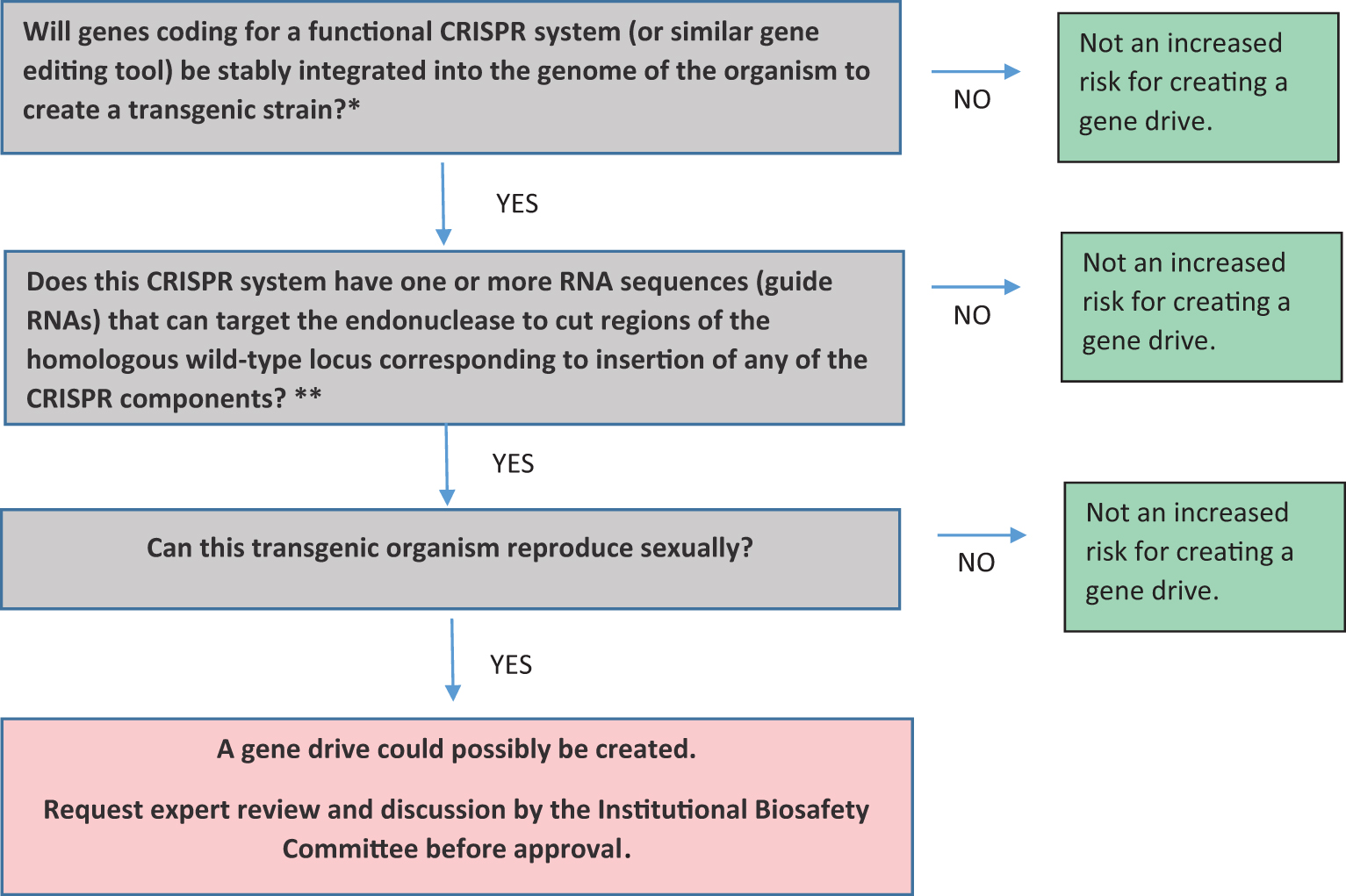
Answer: IBCs, BSOs, and researchers should be fully aware of the biosecurity and environmental containment requirements for gene drives. For example, Adelman et al provide a summary of guidance documents for gene drive use and containment in arthropods, which may serve as a useful resource for risk analysis.5 As the technology for creating gene drives moves forward at a rapid pace, it is also important to stay up-to-date on proceedings from professional workshops on this subject.6,7 These proceedings capture the collective wisdom of diverse stakeholders in the field and are likely to be sensitive to new advances in gene drive research and containment strategies. Individually, BSOs could develop a simple flowchart to go through a proposal to flag it for further IBC review (a sample flowchart is shown in Figure 1). When a review is conducted, there are 2 recommended questions to ask researchers:
Is a gene drive being created? *The components of the functional CRISPR system—which include a catalytically active endonuclease (eg, Cas9 or similar), guide RNA sequences that bind to the endonuclease, and/or edited sequences of the target gene to replace—need not be present together. If these components are split, there is still a possibility of creating a gene drive due to recombination. **For a diagrammatic explanation of this question, refer to Figure 1 in Esvelt et al.4
Will 1 or more DNA sequences be inserted that collectively encode Cas9 or a related endonuclease, and will compatible guide RNAs be stably inserted into the genome of a sexually reproducing organism to create a transgenic organism? Yes / No
Can at least 1 of the inserted guide RNAs target the endonuclease to cut regions of the homologous wild-type locus corresponding to the insertion of any of the CRISPR components? Yes / No
If yes to both, then the BSO and IBC should scrutinize the research very closely. Another tool to consider using is a keyword search to screen a protocol. Some suggested keywords based on frequency of occurrence within gene drive proposals include the following:
CRISPR/Cas9
Gene editing
Gene drive
Guide RNA
Protospacer
Homing drive
Global drive
Endonuclease
Homology-directed repair
Nanos promoter
Drosophila (fruit flies)
PAM sequence
Question: What experiments should BSOs be more concerned about at their institutions?
Answer: Model systems that are easy to create a global gene drive in or that may be largely unregulated due to a perceived notion of lower risk, as well as any potential for open field trial experiments. For example, fruit fly research needs a closer look, as research with fruit flies may go under the radar due to a perceived notion of minimal individual risk.
Question: Are there any gene drive experiments that would be an absolute no?
Answer: Any global gene drive system that does not rely on multiple layers of containment is of the utmost concern. Intrinsic and extrinsic confinement strategies (eg, molecular, ecologic, reproductive, and barrier controls) must be employed when gene drives are created.8 Unrestricted global gene drive systems should not be approved or allowed to be performed, as there is simply no scientific justification for this to happen.
Question: What is the definition of a global gene drive system?
Answer: Global gene drive systems are self-sustaining. Consequently, they will spread to most of the local population and quite possibly to every population of that species in the world.
Question: What should IBC approvals of gene drive project be contingent on?
Answer: As detailed by Akbari et al, all laboratory gene drive experiments should employ at least 2 stringent confinement strategies unless the probability of release is “acceptably low as decided by the relevant biosafety committees and scientists.”8 We highly encourage all BSOs to review this publication to have a deeper understanding of containment strategies for gene drives. Also, the IBC should be informed of off-target effects or the potential for off-target effects to occur through the use of statistical modeling software.9
Question: Do you believe that most researchers, BSOs, and IBC members fully understand the hazards associated with using gene drives?
Answer: No. There has been a precedence for researchers submitting projects, BSOs reviewing projects, and IBCs approving projects, without fully understanding the risks involved. We are aware of at least 1 institution where a global gene drive proposal was approved as an amendment and the institution in retrospect modified its review process to assess the risk associated with gene drives by incorporating pertinent questions in its registration documents.
Question: Should gene drive research proposals be required to be reviewed by an entity qualified to properly review them? If so, what would that entity look like?
Answer: BSOs or persons responsible for research oversight at their institutions should work with the research investigator with the proposed gene drive project to facilitate information for the IBC or an equivalent panel of experts. The guidance resource documents mentioned here should be used to develop strategies for approval of the project. Should the committee need additional input, specific members of the National Institutes of Health’s Recombinant Advisory Committee may be contacted for their individual and unofficial opinion. If the project has planned release of a gene drive or if it has the potential for release into the environment, experts in the field of gene drive biosafety, as well as environmental scientists, should be consulted before research plans are further developed.
Question: Should IBCs considering gene drive projects have a bioethicist on the committee?
Answer: Having a bioethicist on the IBC would certainly provide a broader perspective on gene drive research. However, if bioethicists are not voting members, they could participate on an ad hoc basis.
Question: Which areas, besides biosafety, should BSOs and IBCs be concerned about in gene drive research?
Answer: When it comes to gene drives, a greater focus on biosecurity is prudent. For example, there are significant biosecurity concerns associated with vectors derived from pathogens (eg, lentiviral vectors) that may use technologies similar to CRISPR-Cas9, which need greater attention from the biosafety community. Experiments that expand the host range of the organism carrying the drive would be a definite biosecurity concern and may overlap with experiments considered dual use research of concern, or DURC.10 Since the components required to assemble a functional gene drive can be easily obtained (consider the work being done by do-it-yourself [or DIY] biologists), vendors of these materials could be asked to adhere to governmental standards on security screening of orders. Another option to enhance biosecurity of gene drive research would be the preregistration of experiments as a requirement for grant of funding sources for the project.11
Question: How is biosecurity defined in this context?
Answer: In this context, biological security (biosecurity) is defined as the risk- and threat-based control measures established to prevent the unauthorized access, misuse, loss, theft, diversion, and intentional release of valuable biological materials, pathogens, toxins, information, expertise, equipment, technology, and intellectual property that have the potential to cause harm to humans, animals, plants, the environment, public safety, or national security.12
Question: How should BSOs address accidental needlesticks or other exposures to gene drives?
Answer: On a case-by-case basis, depending on the type of gene, vector, and the associated risk assessment. However, ecologic risks are the primary hazard for gene drives. Gene drive researchers should have documented procedures describing the steps to take in the event of a needlestick (or other exposure in the laboratory) or a release outside of containment.
Question: What should the future of CRISPR-based gene drives outside of containment be based on?
Answer: Any release of GM organisms into the environment should be after community authorization is obtained through tailored active engagement with the community, stakeholders, and larger public.13 The failure of Oxitec’s planned release of GM mosquitoes was due to a lack of perceived public trust among community residents affected by the proposed project.13 One great example of actively involving the community in a planned release of a gene drive is a project to reduce Lyme disease on Nantucket Island.14,15 In this approach, community members’ opinions are sought well before the experimental design stage in terms of risk mitigation strategies and location of planned releases.13 This type of approach is designed to earn the trust of all concerned parties, as the community now becomes part of the research team rather than a mere spectator in the process; this earned trust must be a critical component for any release of GM organisms.
Question: What is the public perception about gene drives?
Answer: Credible and easily understandable information about gene drive technology is not widespread. Public perception may be based more on a lack of credible information, or misinformation, rather than hard facts. It may also be a general lack of trust between experts and the public due to information beyond the comprehension of a layperson. Science reporters for major media outlets play a significant role in bridging this knowledge gap. For example, the mainstream media is beginning to cover the issue of gene drives, explaining in simple language their potential use and the potential challenges faced in the environment.16,17
To counter these issues, scientists, IBCs, and BSOs should put checks and balances in place to earn and safeguard public trust in gene-editing technologies and to make concerted efforts to engage the public through ongoing discussions and forums. Mandatory community engagement is needed before and after any approval of gene drive projects that affect natural ecosystems.
Footnotes
Acknowledgments
We gratefully acknowledge the support of Kevin Esvelt, Zach Adelman, Ken Oye, Bertram Jacobs, Angela Birnbaum, Alexis Brubaker, Joshua Turse, Irene Mendoza, Catherine Mancini, Giorgio Scarpellini, Andie Smidler, and Mark Bennett for a healthy discussion on this topic.
Declaration of Conflicting Interests
The author(s) declared no potential conflicts of interest with respect to the research, authorship, and/or publication of this article.
Funding
The author(s) received no financial support for the research, authorship, and/or publication of this article.
References
1.
DoudnaJA, CharpentierE. The new frontier of genome engineering with CRISPR-Cas9. Science. 2014; 346(6213):1258096.
2.
LedfordH. CRISPR, the disruptor. Nature. 2015; 522(7554):20–24.
3.
CamachoA, DeynzeAV, Chi-HamC. Genetically engineered crops that fly under the US regulatory radar. Nat Biotechnol. 2014; 32(11):1087–1091.
4.
EsveltKM, SmidlerAL, CatterucciaF. Concerning RNA-guided gene drives for the alteration of wild populations. Elife. 2014; 3(1):E03401.
5.
AdelmanZ, AkbarO, BauerJ. Rules of the road for insect gene drive research and testing. Nat Biotechnol. 2017; 35(8):716.
6.
RobertsA, De AndradePP, OkumuF. Results from the workshop problem formulation for the use of gene drive in mosquitoes. Am J Trop Med Hyg. 2017; 96(3):530–533.