




Abstract
With increased research efforts on vector-borne diseases such as malaria, dengue, and recently Zika, there has been a need to maintain in captivity arthropods that are known or believed to be involved in the transmission of pathogens to humans in a well-controlled laboratory environment. Therefore, it is pivotal to establish safe yet practical procedures inside an insectary to minimize the associated biosafety risks and prevent the potential escape of the arthropods used into the environment. This article provides a detailed overview of an arthropod disease vectors facility features with a focus on arthropod containment level 2 (ACL-2) laboratory and aims to support health safety and environment (HSE) and biosafety professionals as well as scientists who work on vector-borne diseases by detailing safety procedures inside an ACL-2 environment. In particular, I detail here the associated safety procedures of an ACL-2 and the insectary-specific equipment required for this type of facility. Research on mosquitoes was used here as an example of a disease vector and presents procedures relevant to usage of this vector in the context of Zika virus. The work presented here shows that risks associated with working on infected arthropod vectors can be minimized to an acceptable level and in turn facilitate the research on the diseases they help spread. Similar principles can be applied to other vector-borne diseases research as well, although the work may have a distinct nature.
Keywords
Due to the recent outbreak of vector-borne disease caused by the Zika virus (ZIKV), scientists have been actively working on antiviral therapies, developing vaccines for this virus, and performing genetic manipulation or other alteration of the vectors such as introducing the intracellular bacterium Wolbachia to block the transmission of ZIKV by the mosquitoes such as Aedes aegypti. 1 To carry out this type of work in a well-controlled laboratory environment, effective containment and safety procedures must be established to prevent the laboratory personnel from being infected by the arthropod vectors during the experimentation and also to avoid the release of these often nonendogenous vectors into the local environment and establish populations that may become a concern for public health. The American Committee of Medical Entomology (ACME), affiliated with the American Society of Tropical Medicine and Hygiene (ASTMH), developed a set of arthropod containment guidelines that are in line with the Centers for Disease Control and Prevention’s (CDC) Biosafety in Microbiology and Biomedical Laboratories (BMBL). 2 The Arthropod Containment Guidelines (ACG) by ACME 3 defined the arthropod containment level into 4 levels based on risk assessment. The assignment of biosafety level to a particular research activity requires the consideration of multiple factors. Here are a few questions for the insectary designer and planner to consider: (1) What are the biological agents to be studied in the insectary other than the vectors? Typically, you need a biosafety level 3 (BSL-3) laboratory for risk group 3 (RG-3) infectious agent. (2) What are the vectors to be used in the insectary? Are these endogenous species or are these vectors considered exotic species? If they escape, would they be able to colonize the local environment? (3) Will genetically modified vectors be used in the study, and what kind of eco impact will they cause to the local population? (4) What does the local regulation say? When all these factors are considered, it is quite intriguing that even the same containment level may have different implications in one and another country. However, the general principles to work safely and prevent escapees are always consistent. Here, we present use of infection of mosquitoes with a risk group 2 (RG-2) agent to elaborate the work inside an arthropod containment level 2 (ACL-2) insectary.
ACL-2 Facility Features
The major features of an ACL-2 facility, for mosquito research, are to prevent the accidental or intentional release of these vectors. Therefore, the design has to put both biosafety and biosecurity into consideration. The laboratory should have a few layers of physical barriers at the main entrance (ie, main door with access control, double doors access, and a physical curtain, etc). There should be a mosquito trap (Biogents AG, Germany) between the main door and the second door, and the 2 doors should have interlock system in place. There are different kinds of mosquito traps available on the market: some use UV and some have ventilation systems plus the mosquito attractants such as fragrant substances. The best way is to test them in house to confirm the traps indeed work. In the schematic illustration of an ACL-2 lab layout (Figure 1), anteroom 1 is the space between the first two doors. It is advisable to have a book inside anteroom 1 to record login/logout activity of facility users. Furthermore, only trained and approved personnel should be allowed to have entry access to the facility. The authorized personnel will generally be research investigators and operation staff who have completed appropriate training and access will not be extended to vendors, visitors, and so forth. Underneath all the doors inside the insectary, it is highly recommended to install a brush aimed at minimizing the likelihood that insects may escape through the gap underneath the doors. Finally, a curtain that can be fabricated with some kind of heavy fabric should be designed in a way that insectary users would need to let it brush their body when entering or exiting the insectary.
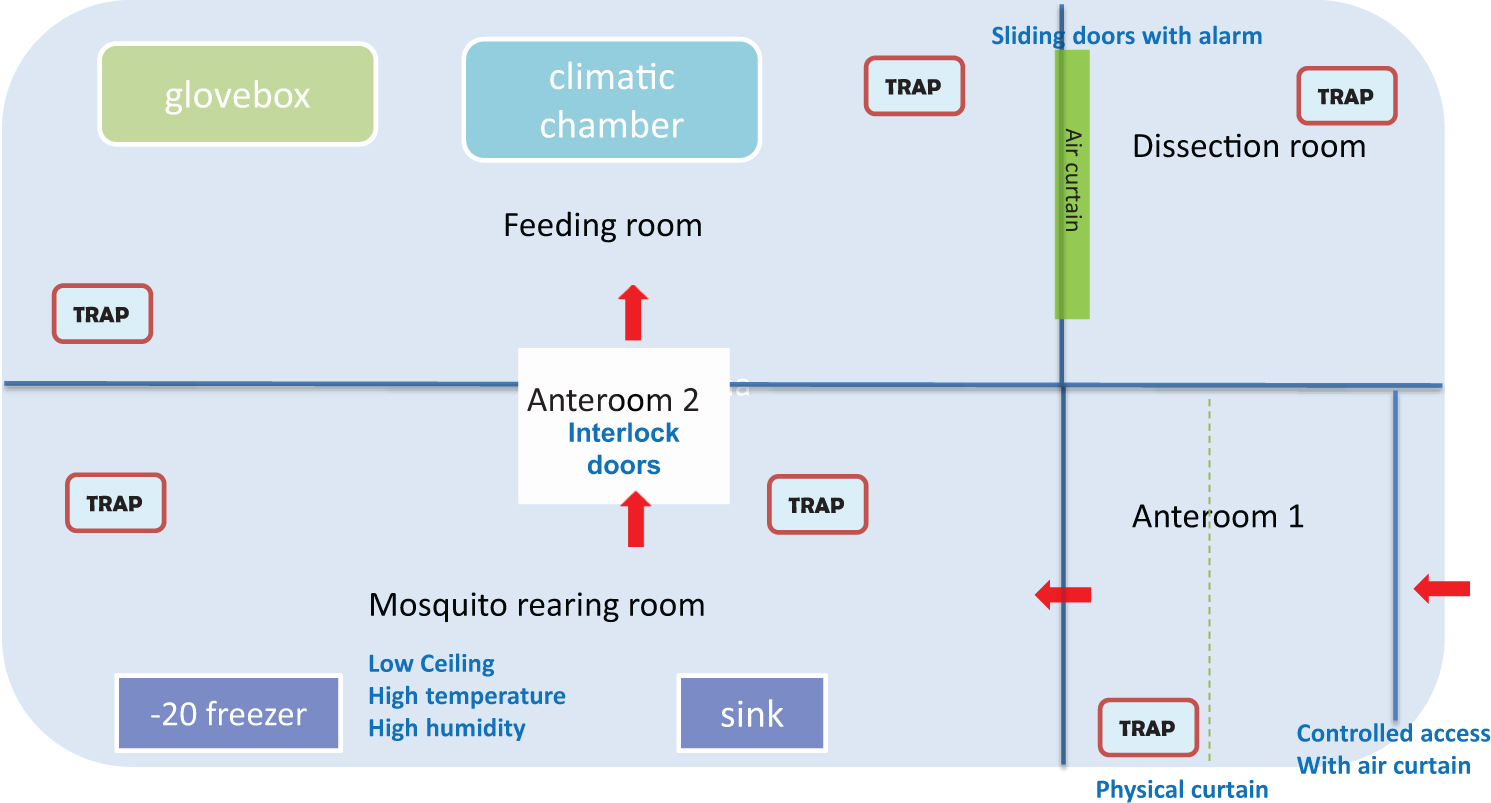
A schematic illustration of an arthropod containment level 2 (ACL-2) laboratory layout.
Immediately after anteroom 1, the laboratory personnel will enter the mosquito-rearing room. This is the room used to colonize the mosquitoes, and hence it has several special features, such as high temperature and humidity, used for rearing mosquitoes. 4 A lighting system with 12/12 light/dark schedule and daylight dimming system is recommended for the room to rear mosquitoes. Since this is the room that holds most of the mosquitoes, the chance of having escapees is also the highest among all the rooms inside the ACL-2 laboratory, although mosquitoes reared in this room should not be carrying any infectious agents at this point. Therefore, it is advisable to have several mosquito traps installed inside this room. In addition, using white laboratory furniture and flooring and bright lights will help identify more readily any potential escapees. Furthermore, all the laboratory fixtures such as sprinklers, plumbing, or exhaust, should be covered with fine mesh so that no mosquitoes can fly through them. You should also consider high-grade stainless steel shelving or laboratory benches due to high temperature and humidity in this room.
The anteroom 2 is used to segregate infectious and noninfectious areas and should provide an interlock door system to ensure that neither door providing access to the rearing or feeding room can be opened simultaneously. An electrical zapper should be on standby in this small room to allow the authorized personnel to kill any loose mosquitoes identified when passing through this anteroom. The first room after anteroom 2 is the feeding room. This room is used for feeding the vector with the infectious agent of interest, as shown in Figure 1. It is unnecessary to have the same environmental conditions as in the rearing room for the comfort of the people working in this area in an effort to avoid any human error that could arise due to the harsher climate engineered in the feeding room as well as reduce the likelihood of any escapee surviving in these less favorable conditions. Instead, it is usually easier to have one or a few climatic chambers to simulate the mosquitoes’ living conditions. These chambers (eg, Binder KBF 720, Binder GmBH) should come with humidity/temperature display and a glass window that can function as another barrier to prevent any escapees. After feeding, all mosquito containers should be kept inside the chamber.
Mosquito feeding with RG-2 agent-infected blood must occur inside a glovebox to ensure operator safety. Cases of laboratory-acquired infection with dengue virus were reported, potentially due to mosquito bites during the infectious feeding procedure, 5 highlighting how critical safety precautions are during this step of the process. Mosquito infectious feeding is discussed in details in the following section. The glovebox used here is often custom-made to fit into the needs of the research facility and its specific space constraints. Hence, there is no universal specification for it except that ideally, it should not have any ventilation system connected to it. Any mosquito that escapes from the infection procedure will be contained and destroyed. Several publications, including ACG by the ACME, mentioned the difficulty of manipulating tiny arthropods inside a biosafety cabinet because of the strong airflow. The airflow can blow the mosquitoes around the cabinet into the filters and make it extremely hard to find them later on; therefore, rather than offering addition protection, presence of the airflow will more likely jeopardize safety. The glovebox provides a safe processing chamber for biohazards and prevention of mosquito escapees. Adjacent to the feeding room is the dissection room, which is usually a small and compact room with the furniture in white ideally. Only limited equipment such as microscopes or a small freezer should be placed inside this room to identify any loose mosquitoes more easily.
Figure 1 shows an example of a simple ACL-2 laboratory layout. Variations can be an animal biosafety level 2 (ABSL-2) laboratory inside the insectary or a BSL-2 laboratory set up next to the insectary and will depend on the research needs (eg, infecting animals by mosquitoes). The setup of the room should be planned in an effort to simplify the upstream and downstream work, particularly with respect to the transportation of research materials, which can potentially be infectious. Even with all the doors and air curtains, movement between these rooms must be done carefully, and doors should never be left open for a long time. For additional safety, an alarm triggered by a door being opened longer than a set amount of time could be installed at each door.
It is important that infected (feeding and dissection room) and noninfected mosquitoes (mosquito-rearing room) remain separated. Some literature shows the possibility for vertical transmission of Zika virus in A aegypti mosquitoes. 6 In other words, the F1 adult progeny may carry the virus from their mothers, which would have serious biosafety consequences and may create scientific issues as well. Data related to the mode of transmission in the vector shall be taken into consideration at the Institutional Biosafety Committee (IBC) review, and appropriate segregation might be suggested for the study of transmission mode in the vector. Sometimes when exotic species are reared, additional layers of safety and security control measures may be required in the facility such as closed-circuit television (CCTV) or netted enclosures inside the insectary as an additional containment.
General Operations of an ACL-2 Facility
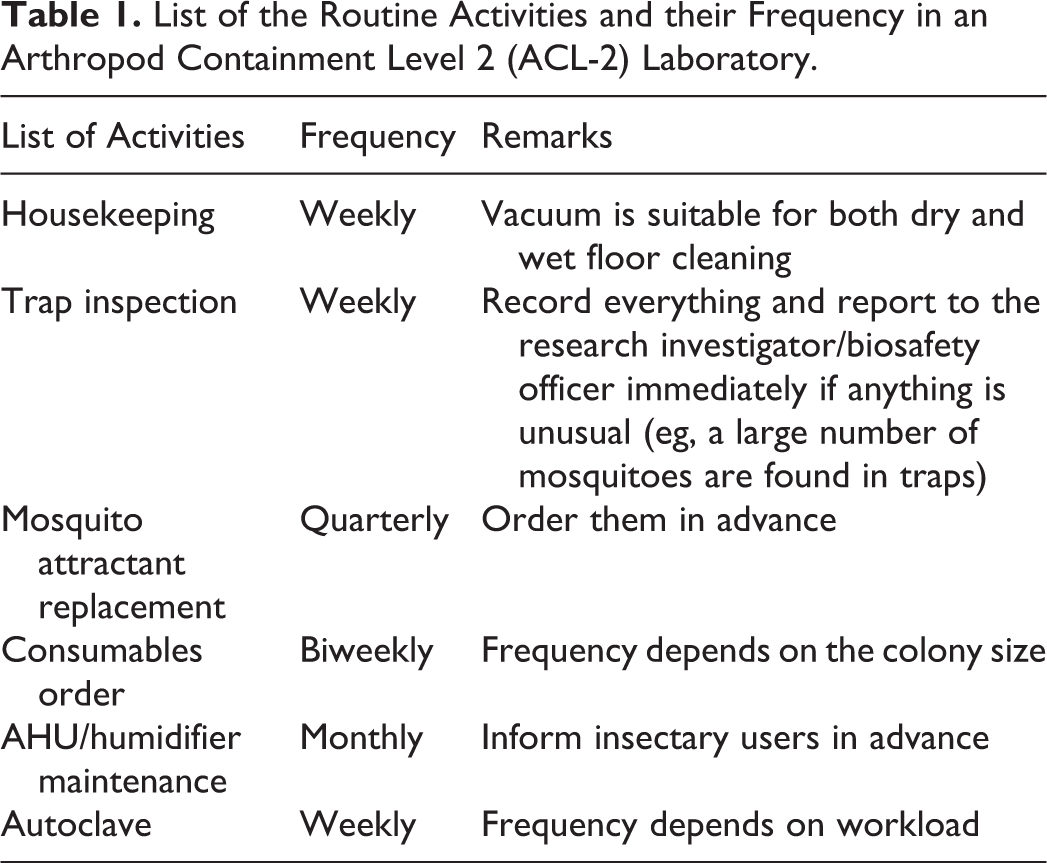
Similar to the maintenance of a BSL-3 containment facility, ACL-2 laboratory operations also need a careful plan and schedules to ensure that the containment is not compromised and that the manpower is allocated effectively according to its operational need. Table 1 lists the routine activities that need a schedule, and this list is not exhaustive. The regular equipment, preventive maintenance (PM), is not mentioned here because PM frequency depends heavily on the usage of the equipment and on the local regulations. Each activity can be expanded to a table that captures all the items in that particular activity. For example, housekeeping is very crucial to run an insectary because the items used can easily get moldy or rusty in the warm and humid environment. In addition, the mosquito cages need regular cleaning as well. The housekeeping staff must be trained properly to perform this task correctly. For instance, larvae containing water must not be disposed into sink directly because it may still contain mosquito eggs, which can hatch at a later time, or live larvae, which could be released into the environment. Instead, water in the trays has to be boiled first. Mosquito cages and larvae trays should be placed in –20°C freezer overnight prior to washing to kill any live vector. It is necessary to list all these activities in a table with clear and simple instructions for the operation staff to follow. Mosquito trap (BioGents AG) checking is also a critical job to monitor the status of the containment in the insectary. The checking record must be documented according to institutional policy. Any unusual situation, such as mosquitoes found in the traps of the feeding room where all the experiments shall be carried out inside the glovebox, must be reported immediately and followed up by the relevant parties (eg, biosafety officer, research investigators, and research staff).
List of the Routine Activities and their Frequency in an Arthropod Containment Level 2 (ACL-2) Laboratory.
Working with the Arthropod Vector
Mosquito Rearing
The most challenging part of rearing mosquitoes is the need to have dedicated personnel working nearly every day to ensure that the vector is being taken care of, with its short and multistage life cycle. In the absence of frequent maintenance, the likelihood of larval starvation or maturation of adult mosquitoes able to emerge and fly away is high. Thus, it is necessary to make a duty roster in advance to cover duties during the weekends or public holidays. A few measures can and should be used to mitigate some of these risks, such as using an automated food dispenser to avoid starvation of the larvae, putting a netted shield on the top of the larvae tray, or putting all the trays in another netted enclosure inside the rearing room to prevent the adult mosquitoes from flying. When someone opens the sleeve of mosquito cage to change their food daily (usually glucose cotton balls) or aspirate some mosquitoes for other tasks, mosquitoes may fly out of the cage during this short time (∼30 seconds). Generally, this task should be performed by 2 scientists. While one holds an electrical zapper and swats any escapees, the other can open the cage and perform the required tasks. Prior to performing the task, make sure that the battery of the electric zapper is fully charged.
The conditions used in the room to culture mosquitoes can attract other insects because of the large amount of glucose and protein-rich larvae food that is constantly used, as well as the warm and humid conditions. As a result, it is critical to regularly clean the room and ensure that any food droppings are cleaned swiftly. The insectary users have to consciously keep the room clean and tidy. Usage of shoe covers is highly recommended because mosquito eggs are extremely small and cannot be detected if some of these are stuck on shoes. It is also highly recommended to keep the insectary floor clean by routine housekeeping, shown in Table 1.
Mosquito Infection
Only a small number of female mosquitoes from the entire colony are taken into the feeding room for infection. Usually, they are kept in a relatively small container such as a mosquito cage or some DIY cup that can be made from a coffee cup with netting tightly secured on the top. For infection of mosquitoes, one may prefer to use ex vivo blood feeding using an apparatus (Hemotek, UK) or in vivo when directly feeding on infected animals. As mentioned earlier, infectious feeding should only occur inside a glovebox no matter what method is adopted. In addition, use of animals for mosquito feeding requires the local animal welfare committee (Institutional Animal Care and Use Committee [IACUC]) approval.
After feeding, the scientists need to sort out the nonengorged mosquitoes and only keep the engorged ones inside the mosquito container. It is visually easy to perform the task, but this step poses a high risk to the operators because all mosquitoes, including the nonengorged ones, can be a potential source of infection. 5 Most of the insectarium uses ice to sedate the mosquitoes and open up the top netting to sort out the nonengorged ones. Using a buddy system is strongly recommended during this step: one person uses mosquito forceps (BioQuip, CA, USA) to pick up mosquitoes, while the other counts and holds an electrical zapper to kill any revived mosquito immediately. The total number of mosquitoes after infection should tally with the number before infection. Once sorted, the netting on the top of the mosquito container should be carefully closed, and a piece of cotton soaked with glucose should be placed on the top of the enclosure. The cotton needs to be changed regularly to prevent mold growth. Finally, the container should be placed in the climatic chamber for observation.
A few administrative control measures can be helpful for the infectious feeding procedure: (a) place a notice on the door of the insectary to warn all the laboratory personnel about the ongoing infection work. This will help reduce any contamination risk to authorized personnel and avoid unnecessary risk to irrelevant people such as housekeeping staff or visitors during infection. (b) It is good to conduct a mock mosquito infection with noninfectious blood. This will tremendously build the team’s confidence level and help the scientists learn from their mistakes. Some institutions may impose a very strict personal protective equipment (PPE) requirement for the infection procedure such as a Tyvek coverall to protect the operators. These are generally good practices and should be implemented if possible.
Mosquito Dissection
There are many different approaches to starting the dissection process. One such method is to spray 70% ethanol to soak and immobilize the mosquitoes in their containers first and then transfer them to the dissection room, where the mosquitoes in ethanol will be poured out together for further washing. This method appears to be the most efficient technique for the scientists to line the mosquitoes on dissection slides and count their numbers. Meanwhile, another scientist can dissect the mosquitoes under a microscope. Dissection itself can be done in different ways, too. For instance, some remove the head and press thorax at the same time, while some do it in 2 steps. Nevertheless, all these methods cannot do away with the use of needles, which poses a challenge for biosafety professionals. Dissection requires excellent coordination of 2 hands and eyes to see the micro-movements under a microscope. One has to practice this technique from time to time to be completely comfortable to handle needles. In general, there is no shortcut but to exercise on noninfectious mosquitoes many times. The number of mosquitoes after dissection should tally with the number before dissection. Under any circumstance, if the numbers prior and after dissection do not tally or if one mosquito escapes during the infection or dissection procedure, everyone in the team must stop what he or she is doing, close the mosquito container properly, and search for the missing mosquito. The incident must be reported and escalated to all the affected parties (eg, biosafety officer).
Conclusions
It is important to recognize the intrinsic risks associated with the study on arthropods such as infected mosquitoes. When we conduct a risk assessment on the research of vector-borne agents such as malaria, dengue virus, or Zika virus, the risk level increases when the vector itself also comes into the picture. Even the noninfected vectors may become a threat when they are released into the environment if they are not endogenous to the area, and these risks must not be neglected. However, the overall risk level can be mitigated to an acceptable level by careful planning in every single step of the facility design, the training with competency assessment, the design of clear standard operation procedures and protocols, and the regular monitoring of the scientists in terms of the individual’s performance, containment, integrity, and so on. Similar principles should be applied to other arthropod vectors as what we describe here for mosquitoes. Safety and health of the laboratory personnel and environmental release are always of pivotal importance in all these studies, and hence, a detailed insectary safety manual that aligns with the institutional health safety and environment goal must be established. Overall, it takes huge efforts for different parties such as principal investigators, scientists, operation staff, and biosafety professionals to work cohesively and run a highly efficient and productive insectary.
Footnotes
Acknowledgments
The author thanks G. Bonamy, PhD, for vetting through an earlier version of the manuscript.
Declaration of Conflicting Interests
The author(s) declared no potential conflicts of interest with respect to the research, authorship, and/or publication of this article.
Funding
The author(s) received no financial support for the research, authorship, and/or publication of this article.