




Abstract
What are the human health and environmental risks posed by synthetic biology research and development (R&D) for energy applications? We found it surprisingly difficult to answer this seemingly straightforward question in our review of the risk-related synthetic biology literature. To our knowledge, no entity to date has published a comprehensive review of this literature. Thus, this analysis aims to fill that void and, at a high level, answer the question that we pose. Risk-related synthetic biology literature addresses risk from different perspectives. Much of the literature that we reviewed treats the concept of risk in synthetic biology R&D broadly, enumerating few specific risks. Nevertheless, after reviewing >200 documents, we identified 44 discrete risk issues; 18 of those related to human health and 26 to the environment. We clustered these risk issues into categories that reflect and summarize their content. We categorized human health risk issues as follows: allergies, antibiotic resistance, carcinogens, and pathogenicity or toxicity. Environmental risk issues were categorized as follows: change or depletion of the environment, competition with native species, horizontal gene transfer, and pathogenicity or toxicity. Our efforts to understand what the synthetic biology R&D-related risk issues are stemmed from a larger research project in which we used risk issues identified in the literature as a point of departure in interviews with biosafety professionals and scientists engaged in synthetic biology R&D. We wrote this article after multiple biosafety professionals told us that accessing our risk-related literature analysis would aid them in their work.
The cluster of innovative technologies and practices known as synthetic biology has been of interest to scientists and laypersons alike for at least a decade. Synthetic biology is a field of research that spans multiple disciplines, scientific techniques, and potential applications. There is no single or consensus definition of synthetic biology, 1 but Wagener and Bollaert’s description in Applied Biosafety nicely captures its distinctiveness: “While synthetic biology has its roots in classical recombinant DNA research, it moves to the next level by incorporating de novo synthesis of DNA with non-life science disciplines including computer science, physics, and engineering and by utilizing highly standardized components.” 2
Accounts differ on when the field got its start, but funding levels for research and development (R&D) in synthetic biology have grown rapidly since 2010.3 -5 That growth is expected to continue. 6 The emergence of synthetic biology has prompted many groups to examine the field’s implications for matters of risk, safety, and governance. In 2010, an independent White House commission was established to consider the scientific, ethical, and social issues surrounding synthetic biology. 7 In 2013, the US National Institutes of Health completed a multiyear effort to revise its instructional document NIH Guidelines for Research Involving Recombinant or Synthetic Nucleic Acid Molecules to encompass “synthetic nucleic acid molecules” in addition to nonsynthetic or traditional recombinant DNA molecules. 8 Several other federal entities in the United States are reviewing the laws, regulations, and policies that govern the processes or products of biotechnology, in an effort to incorporate technical advances such as synthetic biology into their oversight.9,10 In recent years, numerous nonprofit research organizations, industry associations, and third-party advocacy groups have assessed the potential risks of synthetic biology to researchers, public health, and environmental quality.11 -15
The growing capability of scientists to manipulate organisms via “gene editing” techniques, such as the CRISPR/Cas9 system, adds additional complexities to synthetic biology risk-related considerations. These tools are used in synthetic biology but are not unique to it. They allow scientists to “tinker with” the functioning of cells, by easily and precisely altering the genome of “almost any organism.” 5 The ability to manipulate organisms via CRISPR/Cas9 or other techniques has been heralded by leading scientists as a development poised to “transform” biotechnology.4,16 However, the use of these tools raises new risk-related questions.
This article summarizes the human health and environmental risk issues present in the synthetic biology risk-related literature. When we began a research project on risk and containment issues associated with synthetic biology R&D, we found it surprisingly difficult to answer a seemingly straightforward question: What are the human health and environmental risks posed by synthetic biology R&D? Our work focuses on R&D directed toward applications for energy and the environment (particularly for next-generation biofuels), but we reviewed a wider array of risk-related research. We found that much of the literature typically treats synthetic biology–related risks broadly, enumerating few specific risk issues.17,18 Those sources that do offer specificity largely limit their focus to the threat of bioterrorists pursuing harmful or “dual-use” research toward nefarious ends.11,19
We analyzed the literature to fill this void, bounding our analysis by focusing on potential energy-related applications (not medical or bioterrorism applications) and the human health and environmental risks (excluding economic, commercialization, or other potential risks) of these R&D efforts. Our aim was to identify the main human health and environmental risk issues raised in the synthetic biology literature; we identified 4 risk issue categories for each group. Our findings are presented in Table 1 (risks to human health) and Table 2 (risks to the environment), and we discuss each in turn. To our knowledge, no entity to date has published a similarly comprehensive review and analysis of this risk-related literature.
Human Health Risk Issues Emphasized in the Synthetic Biology R&D Risk-Related Literature for Energy Applications.
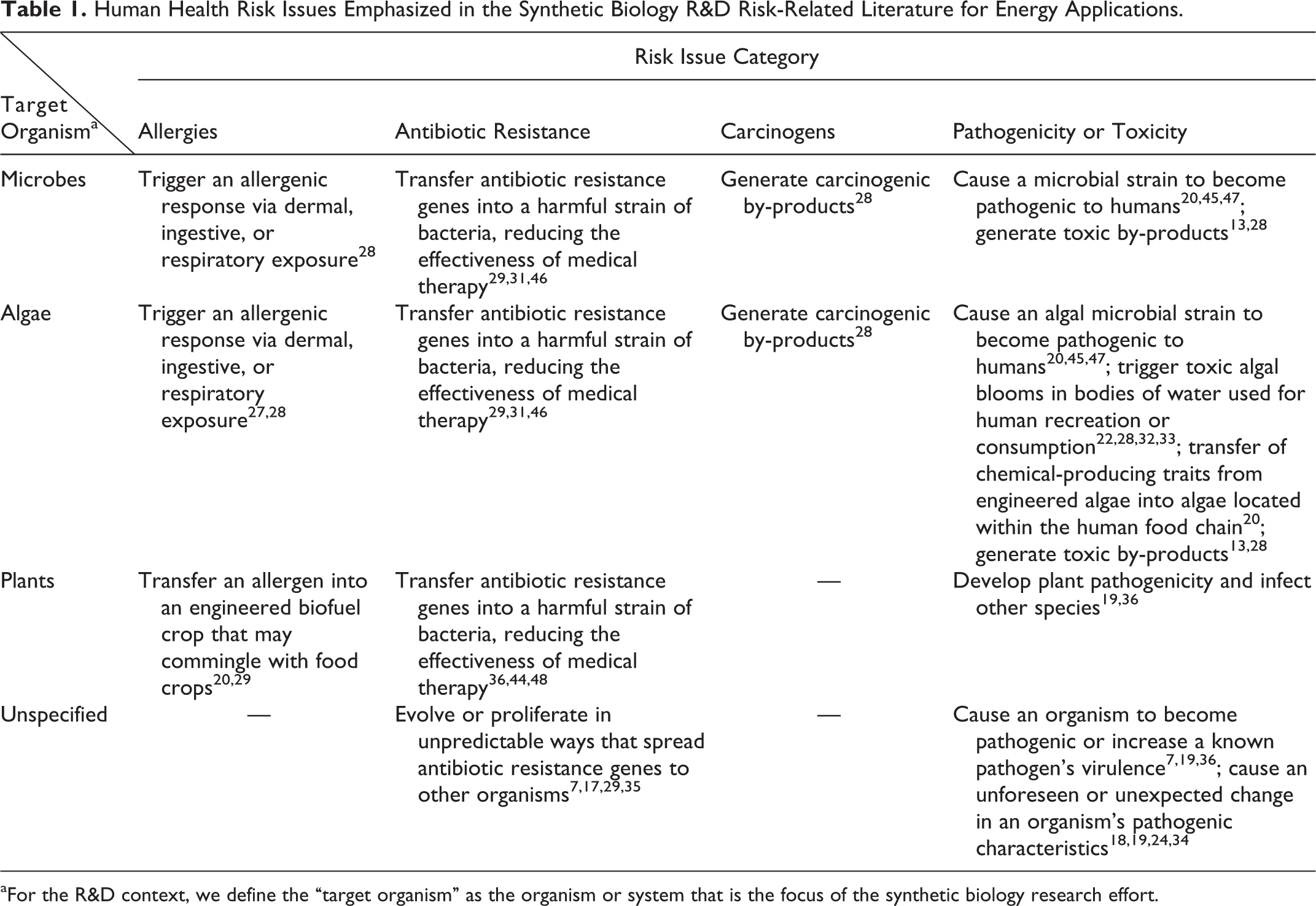
For the R&D context, we define the “target organism” as the organism or system that is the focus of the synthetic biology research effort.
Environmental Risk Issues Emphasized in the Synthetic Biology R&D Risk-Related Literature for Energy Applications.
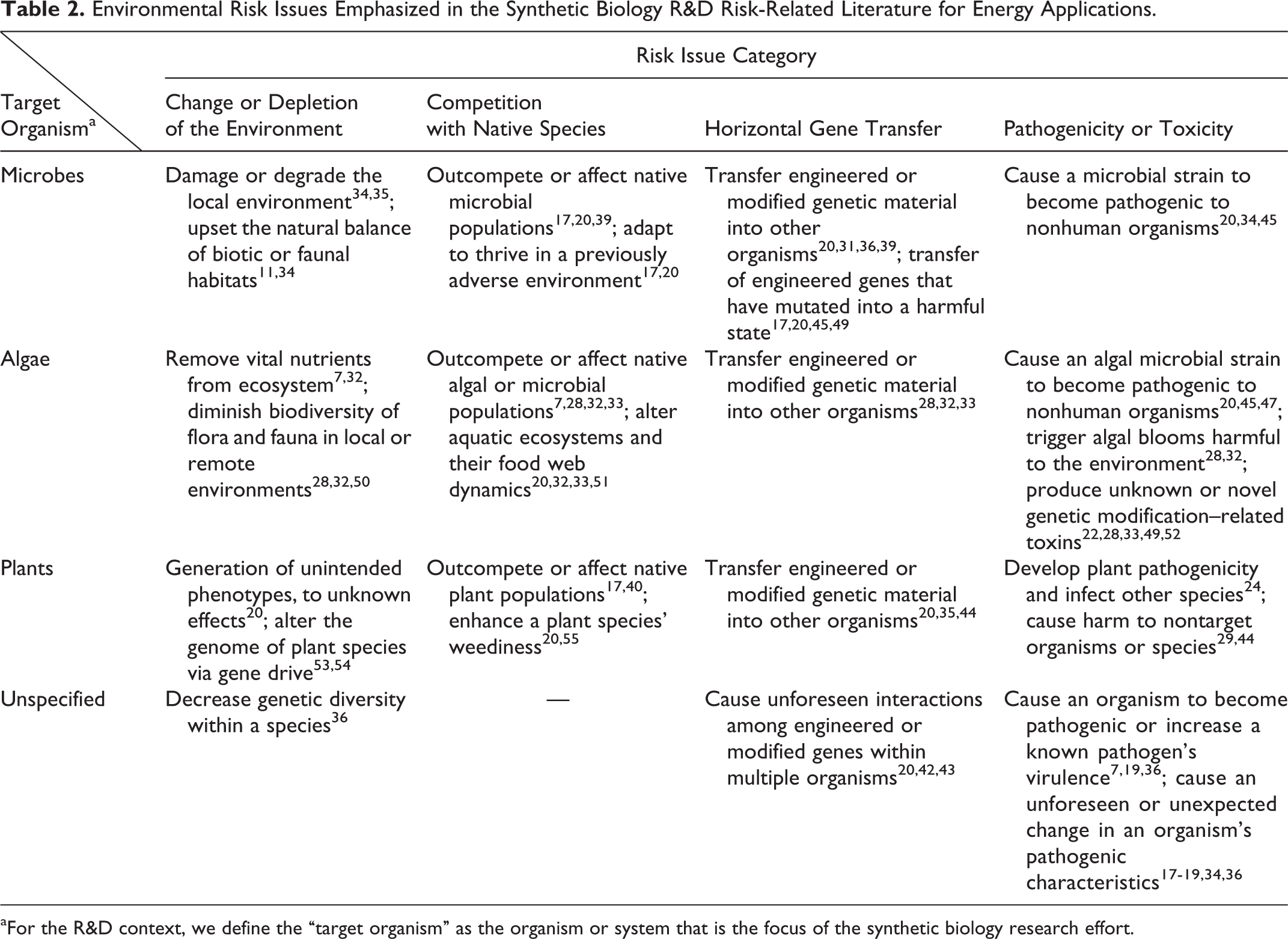
For the R&D context, we define the “target organism” as the organism or system that is the focus of the synthetic biology research effort.
We conducted these analyses for our own research purposes, to use as a basis for questions to ask in our interviews with scientists engaged in synthetic biology R&D and biosafety professionals. During these interviews, multiple biosafety professionals said that our list of risk issues would be useful in their work. Thus, the purpose of this article is to share these lists—and the literature from which they are derived—more broadly with members of the biosafety community.
Methods
We reviewed >200 documents identified through multiple searches of publication databases (eg, Google Scholar) and through prominent sources, such as the aforementioned Presidential Commission for the Study of Bioethical Issues report on synthetic biology 7 and studies by research organizations, including the National Research Council. 20 Our initial queries were aimed at identifying sources that directly address the term synthetic biology and the keyword or subject of risk. To ensure a measure of comprehensiveness, we cross-referenced the bibliographies and citations of key sources against our literature base. Elsewhere, we have noted that this literature regards risk in considerably different ways, taking bioethics, governance, or technical orientations. 21 Here, our aim is to identify what the main human health and environmental risk issues are and to what extent those issues are particular to the types of organisms that scientists study. Because our larger project distinguishes synthetic biology R&D conducted on different target organisms, we analyzed and categorized the risk issues across the 3 major organism types of most interest to next-generation biofuels R&D: microbes, algae, and plants. Following our understanding of laboratory science nomenclature, “target organisms” are those intended to receive and manifest desired modifications or functions. Target organisms differ from the organisms that may serve as source material or that help to effect or mark a transformation.
Results
While most of the sources that we reviewed did not raise specific risk issues, our analysis identified 44 discrete risk issues in total, 18 of which pertained to human health and 26 to the environment. We then grouped these issues into high-level “risk categories,” with succinct descriptive labels, based partly on their prominence in the literature and partly on their potential significance to human health or to the environment. These risk issue categories are not mutually exclusive, nor do they encompass all potential synthetic biology risks. As examples, while such issues as endocrine disruptors, mutagens, teratogens, and other chemical-related hazards are often discussed in relation to human health risk, we did not find any mention of these issues in the risk-related synthetic biology literature that we reviewed. The lists also convey no judgments about risk issue severity, acceptability, or probability of occurrence. Furthermore, the lists do not delineate potential benefits to society, whether those benefits are considered generally, according to sphere of potential application (eg, energy and environmental applications), or in terms of tradeoff analyses.7,11,22
The human health risk issues identified in the literature are grouped into the following 4 categories, ordered alphabetically:
Allergies Antibiotic resistance Carcinogens Pathogenicity or toxicity
The environmental risk issues identified in the literature are grouped into the following 4 categories, ordered alphabetically:
Change or depletion of the environment Competition with native species Horizontal gene transfer Pathogenicity or toxicity
Where a risk issue was raised in the literature without regard to a specific organism type, we grouped it under the heading “unspecified.” Note that the majority of the literature pertaining to synthetic biology–related human health risks presented in Table 1 does not explicitly mention “synthetic biology” but instead addresses R&D risks in “genetic engineering” or “genetic modification.” We cite such sources because the synthetic biology–specific literature generally regards the risks posed by synthetic biology to be similar to, or even “the same kinds of risks” as, those posed by genetic engineering or modification. 11 Many of these synthetic biology sources reference research previously conducted on the genetic engineering/modification of organisms. These references tend to apply the general principles used in risk assessment of genetically engineered organisms to the products or processes of synthetic biology R&D.7,11,23 -26 In contrast to Table 1, almost all of the issues identified in Table 2 were derived from sources that explicitly discuss synthetic biology–specific environmental risks.
Risks to Human Health
Table 1 presents the main human health risk issue categories raised in the synthetic biology risk-related literature: allergies, antibiotic resistance, carcinogens, and pathogenicity or toxicity. The risk-related literature typically addresses potential harm to the general population and not to individual R&D practitioners or researchers. However, some risk issues could pertain to both. For example, a researcher could suffer an allergenic response to a synthetically modified strain of algae, whether through dermal, ingestive, or respiratory exposure while working inside the laboratory.27,28 Members of the public could experience a similar allergenic response if the organism was encountered in the open environment.
Allergies
The literature notes 2 primary allergy-related issues. First, an organism altered by synthetic biology can act as an allergen itself or generate allergenic molecules. This risk is most often discussed for microbes and algae than for plants, due to the highly transmissible nature of microorganisms.27,28 Second, a genetically modified organism could express new allergens through pollen or other molecules. 29 In one documented instance, a strain of corn genetically modified for use in bioethanol production expressed a protein that the US Environmental Protection Agency later deemed to be a potential allergen. 20
Antibiotic Resistance
The literature indicates that risks associated with antibiotic or antimicrobial resistance may occur either through natural development within an organism or through natural or human-mediated transfer of gene segments into an organism’s genetic material. The latter is more likely to occur in an R&D setting. In laboratory research, the insertion of antibiotic resistance genes is often used as a selectable marker to indicate successful transformation of foreign DNA. The modified cells are then exposed to the antibiotic, and those that have not incorporated the foreign DNA will die. The modified organism continues to express the antibiotic-resistant gene, causing potential concern that the gene could be transferred to other organisms or carried up the human food chain. Moreover, potential harm could result from bacterial strains becoming resistant to antibiotics. 29 Such resistance is of heightened concern because many antibiotic drugs for human treatment are becoming obsolete or rendered ineffective due to bacterial resistance. 30 Note that research involving the transfer of drug resistance traits into organisms that do not naturally acquire them requires review and prior approval by the National Institutes of Health, if the transfer may compromise “the ability to control disease agents in humans, veterinary medicine, or agriculture.” 8 Synthetic biology may also make it easier for researchers to remove antibiotic resistance marker genes during the R&D process and prior to commercialization of a modified organism—or to avoid their use altogether. 31
Carcinogens
Carcinogenic chemicals or substances present in the human body may lead to the development of cancerous tissue. Where carcinogenicity is discussed in the literature, sources highlight the creation of products or coproducts of biofuel generation that are themselves potentially carcinogenic. 28 We found no carcinogenic risk issue specific to plants in the literature.
Pathogenicity or Toxicity
We combined pathogenicity and toxicity into a single category, separate from carcinogens, based on their similar capacity to cause acute, nonchronic health effects. 15 There is a potential risk of synthetically modified organisms creating new pathogens or toxins or increasing the virulence or amount of a known pathogen or toxin. This issue is often discussed in the context of dual-use or malicious actions. However, there is also the possibility of inadvertent or unwanted consequences of well-intentioned activities. The literature identifies different issues for microbial organisms than for algal strains. Some types of algae reproduce especially rapidly, causing concern that a synthetically modified algal strain could escape containment and easily flourish, creating algal blooms that have toxic or harmful effects to humans.22,28,32,33
Risks to the Environment
Table 2 identifies the main environmental risk issue categories raised in the synthetic biology risk-related literature: change or depletion of the environment, competition with native species, horizontal gene transfer (HGT), and pathogenicity or toxicity. Synthetically modified organisms may create risks to the environment through intentional release (via field trial) or accidental escape from containment. Often, the literature does not distinguish between these circumstances.
Change or Depletion of the Environment
This category addresses the potential of synthetic biology to cause a change to, or depletion of, the quality, functioning, or stability of the environment. The literature emphasizes the potential for decreased biodiversity and a loss of balance in the functioning of ecosystems.11,34,35 A decline in biological diversity may also extend to the species level. A synthetically modified organism’s function in the environment could trigger a decline in the diversity of a species’ genome.36 -38 Other sources point to the possibility of a general degradation of environmental quality, which could occur if modified algal strains remove nutrients that are critical to the healthy functioning of other species or local ecosystems.7,32
Competition with Native Species
A modified organism may negatively alter the environment by competing with (or outcompeting) species indigenous to an ecosystem. This risk is often discussed in the literature in reference to the introduction of invasive species that could diminish biodiversity. There is a concern that invasiveness could occur if a synthetically modified organism expresses a trait that provides an enhanced survival advantage relative to wild-type organisms.7,20,39,40 Not only might such an organism outcompete native species, thus reducing or depleting natural populations, but modified organisms might alter the food web dynamics of entire ecologic niches.20,32,33
Horizontal Gene Transfer
Synthetically modified organisms may also affect the environment through HGT, which is the movement of genes or genetic material between or among organisms. Horizontal or lateral gene transfer is a naturally occurring and typically benign process. However, HGT has the potential to contribute to or exacerbate a number of other risk issues.20,31,36,39 For example, HGT is a potential vehicle for spreading antibiotic resistance genes throughout ecosystems, including the food chain of animals or humans.29,31,36,41 HGT can occur between a modified and a wild-type organism or among multiple genetically modified organisms simultaneously. Such an interaction, potentially among genes or organisms modified by different scientists or laboratories, may lead to an unintended “stacking” of engineered genes, with unknown consequences.20,42,43 The risk of HGT is applicable to modified microbes, algae, and plants, although there may be heightened concern for microbes and algae because of their comparatively short growth cycles. 44
Pathogenicity or Toxicity
As with our analysis of the human health risks posed by synthetic biology R&D, we combined pathogenicity and toxicity into a single risk category for the environment. There are more pathogens capable of infecting nonhuman species than humans, making an array of biological diversity susceptible to infection from a synthetically modified organism that has acquired pathogenic characteristics.20,24,34,45 The literature also details how a genetic modification could trigger unforeseen changes or mutations that could alter the dimensions of an organism’s pathogenic characteristics.19,36
Conclusions
At one level, this article simply delineates the key human health and environmental risk issues raised in the risk-related synthetic biology literature related primarily to potential energy and environmental applications that typically target or manipulate organisms classified as Risk Group 1 or 2 organisms. We observed that the human health risk literature tends to refer to, or incorporate risks associated with, “traditional” genetic engineering, unlike much of the environmental risk literature, which more often addresses synthetic biology explicitly. Nevertheless, summarizing the literature in this way can provide biosafety professionals and other interested parties with a quick overview that otherwise would be time-consuming to discern from a broad set of documents.
We took this synthesis one step further by examining how the literature describes risk issues in relation to 3 types of target organisms important to next-generation biofuels R&D: microbes, algae, and plants. Most of the literature that we reviewed discusses risk issues generically, rather than in ways that are particular to the kinds of organisms involved or, for that matter, the settings in which they may be deployed. There is some consistency across organism types in the kinds of risk issues identified in the literature, but there are also some notable differences. For example, we did not see carcinogenicity discussed as a risk issue in the literature that focused on plant-related energy R&D, although that issue was raised for microbes and algae. Yet, potential risks associated with generating unintended phenotypes and harming off-target organisms were raised primarily in plant-specific literature.
Pathogenicity or toxicity risk issues associated with algae are notable because they do not align fully with the risk issues raised for either microbes or plants. Some algae are classified as plants and others as microbes, but the energy-related synthetic biology literature pertaining to algae discussed microalgae R&D exclusively. Despite their similarity with regard to many biological properties and traits, the literature highlights different pathogenicity or toxicity risks when discussing microalgae versus microbes. One distinction is discussions about the possibility of toxic algal blooms. Second, insofar as the algae-specific literature discusses potential risks associated with harmful effects in the human food chain, microalgae are more akin to plants than microbes in their risk profile.
Most of the literature that we reviewed described target organism-related, even if not organism-specific, risks. This tendency raises 2 questions. First, to what extent does this way of framing risk assessments ignore potential risks associated with what is being modified and the scale of modification? Are there different potential risks that could arise from altering many genes or long strands of genetic material, changing metabolic pathways and regulatory mechanisms, or targeting 1 particular function, which are not adequately captured by current approaches to risk assessment?
Second, to what extent does an organism-specific way of framing risk issues ignore potential risks associated with particular techniques? Assessments of the burgeoning use of gene-editing techniques such as CRISPR/Cas9 and its implications are only just starting to appear in the risk-related literature. We wonder if the advent and rapid adoption of gene-editing techniques may prompt the need for technique-related and not predominantly organism-related assessments of risk. We ask whether risk assessments that are predicated on analyzing specific gene sequences or components are sufficient to address the potential results of genome editing.
Our purpose in conducting this review was to identify synthetic biology risk-related issues raised in the relevant literature. In focusing on what can go wrong, we explicitly ignored assessments of the magnitude of those risks, what can go right, or the degree to which (or contexts in which) different parties judge the risks to be worth taking.
Footnotes
Acknowledgments
We thank Brian H. Davison and Anthony Q. Armstrong for their assistance and comments.
Declaration of Conflicting Interests
The author(s) declared no potential conflicts of interest with respect to the research, authorship, and/or publication of this article.
Funding
The author(s) disclosed receipt of the following financial support for the research, authorship, and/or publication of this article: This article was funded by the Office of Biological and Environmental Research in the US Department of Energy Office of Science, through its Genomic Science Program. The opinions expressed are the authors’ own.