



Abstract
Introduction:
Breast cancer patients and survivors frequently report fatigue, emotional, and cognitive disturbances, which reduce performance at all levels of occupation and make life quality issues a considerable clinical concern. The aim of this study is to evaluate attention and emotion regulation across radiotherapy period and the possible effects of complementary alternative medicine (CAM).
Methods:
Fifty-seven patients with unilateral breast cancer underwent surgery and systemic chemotherapy before participating in this double-blind randomized study. Two thirds were given CAM (n = 38) while the rest received placebo (carrier only, n = 19). Patients’ attention and anxiety were physiologically tested at baseline, 2 and 4 weeks during the radiation period as well as 1-month after the end of radiation session.
Results:
Both groups showed similar levels of anxiety with no significant differences at baseline nor post-radiotherapy. Long-term significant recovery of attention performance was observed in the CAM patients, accompanied by a similar tendency in anxiety level, measured by the eye-blink probability.
Conclusions:
This study physiologically validates the attention impairment reported among breast cancer survivors; also, it depicted a beneficial late-effect of a routine CAM on attention dysregulation. The suggested non-invasive physiological measures can physiologically monitor patients’ psychological and cognitive well-being as well as evaluate the beneficial effect of CAM in breast cancer patients by assessing their coping ability to support the treatment plan. Thus, the results have potential clinical implications on patients’ and survivors’ quality of life.
Trial Registration:
NIH, NCT02890316. Registered July 2016, http://www.ClinicalTrials.gov
Keywords
Introduction
Breast cancer is a chronic medical condition frequently associated with fatigue, cognitive disturbances, and psychological distress according to subjective reports among patients and survivors.1-8
Fatigue and tiredness symptoms are experienced by up to 60% of breast cancer patients9-12 during and after their treatment trajectory.13-15 These symptoms may persist for years post treatment,16-20 and therefore negatively impact quality of life,11,21,22 even compared with the impact of pain. 23 A strong association between fatigue and patients’ objective cognitive performance may propose the existence of functional reciprocal relations. 24
Breast cancer survivors commonly report deficits in attention span and memory functions before, during, and after treatments, which reduce confidence and performance at all levels of occupation.7,25 As opposed to fatigue, cognitive impairments are not only subjectively reported as perceived symptoms, but also objectively supported in the literature up to 20 years after completion of radiotherapy and chemotherapy. 26 Accordingly, animal studies of chemotherapy-induced cognitive impairment have confirmed learning and memory alterations. 27 Human neuroimaging studies validate how chemotherapy and psychological distress potentially influence hemodynamic activity in attention network brain areas which reduces attention performance in breast cancer patients 28 after treatments are over, even for months. 29 Thus, treatment-induced attentional dysfunction may contribute to subjective and objective memory and concentration complaints in breast cancer survivors; emphasizing the importance of sensitive objective measures for subjective complaints of treatment-related attention impairments.7,25,30
Accordingly, both fatigue and cognitive dysfunction have been observed as post-treatment outcomes of chemotherapy and/or radiotherapy;20,31 and a strong association between fatigue and cognitive performance suggests they are functionally related. 32 This association has been studied mainly in the context of sleep deprivation. Indeed, fatigue, low alertness, and sleep deprivation are suggested as candidates in altering33,34 and impairing35-37 cognitive functions, attention, and behavioral performance. 38
Breast cancer patients are also at high risk for developing psychiatric disorders such as anxiety and depression. 39 Accordingly, in a study among survivors, the prevalence rates 5-years post-diagnosis were 26.3% and 9.6%, respectively. 40 Since anxiety and depression negatively affect quality of life, there is a need to assess the mental health of patients 41 for maintaining their psychological well-being. Notably, level of anxiety is a more significant psychological state than depression in contributing to the feeling of distress experienced by patients, thus should be evaluated and monitored. 42
The pre-pulse inhibition (PPI) is a physiological operational measure associated with pre-attentional mechanisms 43 based on a neurological sensorimotor reflexive phenomenon, in which a weaker acoustic pre-pulse inhibits the reaction to a subsequent strong startling pulse. The reduction of response amplitude reflects the ability of the nervous system to temporarily adapt to a strong sensory stimulus when a preceding weaker signal is given. It has been suggested by us44,45 that such reflexive inhibition of response is modulated by attention mechanisms, thus can be referred to as an Auditory Sustained Attention Test (ASAT). In the present study, we investigate the impact of breast cancer following surgery, chemotherapy, and during radiotherapy on patients’ attention functioning. We used the ASAT, which comprised of objective physiological measures for both attention and emotional dysregulation mechanisms.
The approach for fatigue, cognitive functions, and quality of life management during and after radiotherapy is yet to be defined 20 and the use of CAM for this purpose, such as herbal, vitamin, and nutritional supplements, has increased over the past decade. 46 Homeopathy is one of the most popular CAM modalities for cancer patients in 7 European countries. 47 Clinical studies have shown homeopathy to potentially reduce many toxic effects of oncology treatments, while improving global health and well-being.48,49 In a double-blind study of lung cancer patients, homeopathy was found to positively influence not only quality of life but also survival time.50,51
Cancer-treatments significantly reduced mortality, 52 but at the same time they increased fatigue, emotional changes, and cognitive impairments among cancer patients during treatment and into survivorship, making quality of life issues a considerable clinical concern. Therefore, additional evidence-based management strategies to objectively measure and reduce the fatigue-induced cognitive and emotional burden are required.
Accordingly, the current study aims are 2-fold. First, to physiologically evaluate attention and emotion dysregulation across radiotherapy period. Second, to evaluate the possible effects of a routine CAM compared with placebo effects on radiotherapy related cognitive and emotional functions. We hypothesize that all patients will endure cancer-induced attention and emotion dysregulation at baseline and throughout radiotherapy sessions as well as after treatments are done. However, the experimental group is assumed to benefit from the CAM and demonstrate a more balanced cognitive and emotional performance during and after radiation compared to the control-placebo group.
Methods
We used the CONSORT Reporting Guidelines
In advance, a random list was generated using a random generator ( Random.org ) and was transferred in a blind labeling to a pharmacist. Accordingly, a pharmacist prepared and provided serial numbered sets of Homeopathic Medicinal Product (HMP) from 111 to 175 which were given to each patient by the treating doctor, according to the recruitment order. Two-thirds of the HMP sets contained a routine homeopathic treatment and the rest contained the carrier only, in the same size, color, and shape (ie, placebo). Each serial number of the HMP was identified as treatment or placebo in a list that was kept in a sealed envelope and opened only after data collection was over. Thus, both patients and researchers were blinded to the assigned treatment. Homeopathy treatment was administered to 38 participants during the radiotherapy period while the rest received placebo (n = 19). Since no special reaction/side-effects were observed or reported during the research period, the code of treatment/placebo was revealed only after the study was over.
The preparation of the homeopathic treatment (5 gr of 100% sucrose granules containing the homeopathic dilution) was performed in a licensed pharmacy. To prepare the HMP: 1 g of the raw material is triturating with 99 g of lactose for 1 to 3 hours to create 1 ch (Centesimal Hahnemann) potency of the raw material. To prepare 2 ch: 1 gr of the 1 ch is triturating with 99 g of lactose.
54
Raising up the potency of the established HMP can be continued in the same manner or it can be done by dissolving 1 g of the established ch potency in 99 cc of 70% alcohol following 40 successions. To raise the potency of the dissolved HMP, every 1 cc of the former solution dissolved in 99 cc of 70% alcohol following 40 successions makes the following ch potency, until it reaches desired potency.
55
Sixty granules of sugar are wetted in the final diluted solution, dried for several minutes and packed in the pharmacy to be consumed by the patients. Placebo treatment is 1% sugar globule, similar in form and hedonic value to the aforementioned granules. The HMP used in the study are: Cadmium sulphuratum - Cd SO4, 4H2 O (Cadm-s; 30 ch)
55
Phosphoricum acidum - HPO3 (Phos-ac; 30 ch)
55
Radium Bromide -Ra br2, 2H2O (Rad-br; 30 ch)
56
X-ray (6 ch)
57
Carcinosinum burnett (Carc; 30 ch)
58
Carc 30 ch – 1 granule once a day every morning for 8 weeks. Phos ac, Rad-br, X-ray and Cadm-s – 1 granule every morning, noon and evening for 8 weeks. Patients were instructed to make no break between the different HMPs
The session starts with a 3-minute acclimatization period with 60 dB background noise level that is delivered continuously throughout the session. The session is comprised from 98 pseudo-randomly delivered trials at 10 seconds average Inter-Trial-Interval ranging from 8 to 12 seconds. Forty startle trials comprised of single 40 ms 96, 102, 108, or 114 dB “pulse alone” startle stimuli (10 trials per intensity) to evaluate both the individual startle response (ie, the amplitude level following startle stimuli) and the eye-blink probability (ie, the relative frequency of response occurrence following startle stimuli) that form together the emotional dysregulation measure. 59 Ten “No stimulus” trials were recorded in order to evaluate baseline noise levels. In order to evaluate Pre pulse inhibition (PPI), 40 “pre + pulse” trials consisted of a single 114 dB pulse preceded (100 ms inter-stimulus-interval) by a 30 ms pre-pulse of 6, 12, 18, or 24 dB above background noise (ie, 66, 72, 78, or 86 dB), in addition to 8 “pre alone” stimuli trials (66, 72, 78, or 86 dB). The PPI is calculated as percent of the habituated/inhibited response as follows: 100-(max response to “pre + pulse” trial/max response to “pulse alone” trial × 100), 45 using the Mindtension software (Mindtension, Ltd, NirAm, Israel).
Results
All participants were unequally randomized with an allocation ratio of 2:1 (treatment vs placebo). Fifty-seven completed the study after 9 losses to the experimental group and 4 losses to the control group. The reasons were lack of motivation, sudden occurrence of hearing deterioration and other medical conditions such as Herpes zoster, personal preference to participate in another simultaneous clinical trial and schedule related personal inconvenience issues (Figure 1). Chi-Square test analysis revealed that treated and placebo groups did not differ in their characteristics relative to their group size except for estrogen receptor measurement which was found to be significantly higher in the treated group (Table 1).

Enrollment flow chart.
Patient Characteristics.
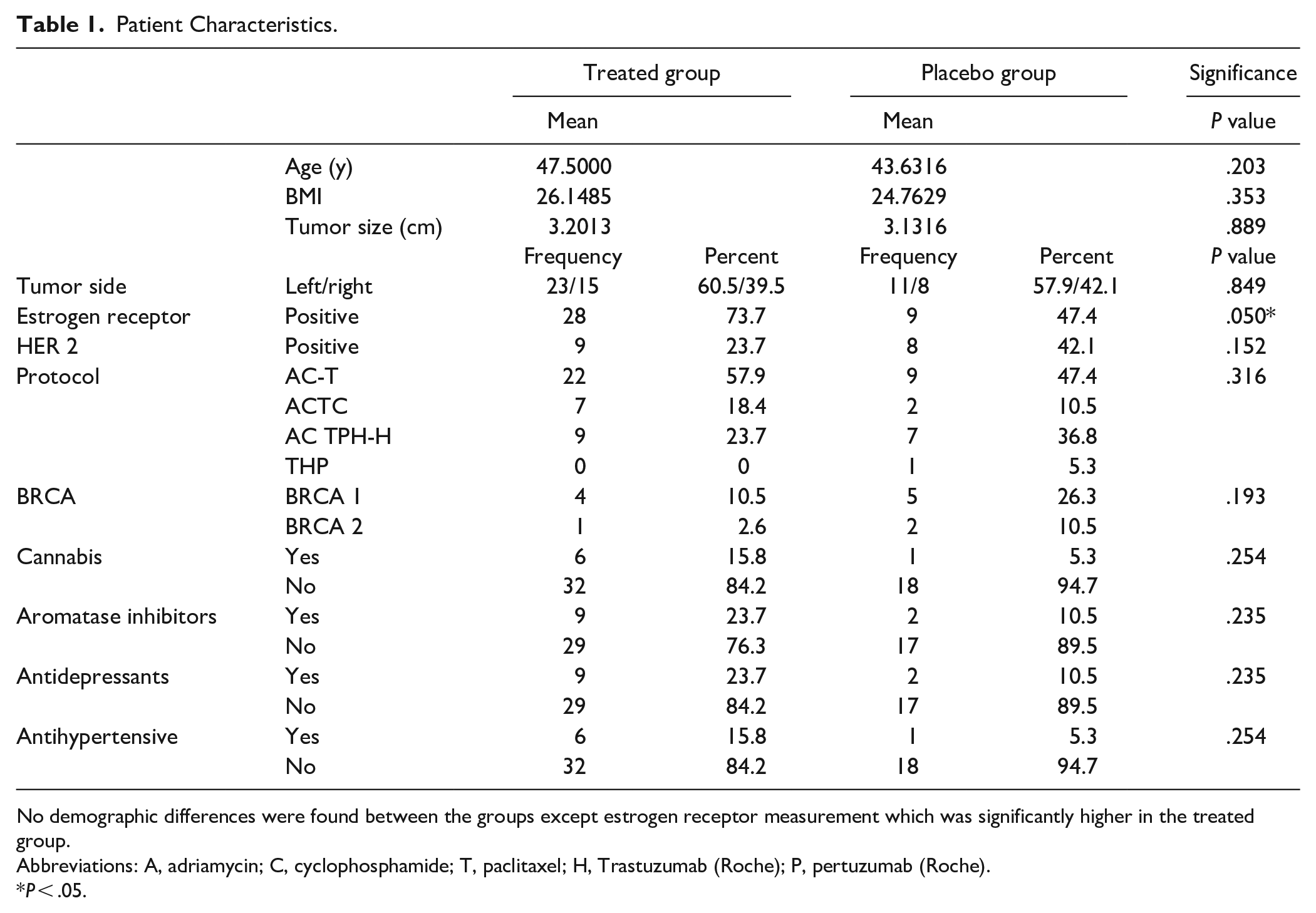
No demographic differences were found between the groups except estrogen receptor measurement which was significantly higher in the treated group.
Abbreviations: A, adriamycin; C, cyclophosphamide; T, paclitaxel; H, Trastuzumab (Roche); P, pertuzumab (Roche).
P < .05.
Auditory Sustained Attention Test (ASAT)
Performance on the ASAT was comprised of the following measures:

Startle response intensity during and post-radiations. No emotional dysregulation effect was found in both treated and non-treated groups according to the startle response during and post-radiation period.

Electro-dermal activity during and post-radiations. No emotional effect over anxiety level was found in both treated and non-treated groups according to the EDR during and post radiation period.

Startle response probability during and post-radiations. Radiotherapy had a non-significant tendency to decrease the probability of producing eye-blinks following an acoustic startling pulse as observed in the placebo group, while the homeopathic treatment preserved baseline performance level.

Response inhibition during and post-radiation. Homeopathic treatment ameliorated the radiotherapy-induced decrease in cognitive performance back to baseline level as observed 1-month after the end of radiation period.

Representative signals of the startle response inhibition between groups. The placebo-control group (a) inhibited 9% of the baseline startle response while the treated group (b) inhibited 19% of the baseline startle response intensity.
Discussion
The aim of the present study was to monitor cognitive (ie, attention) and emotional (ie, anxiety) dysregulation that commonly occurs in breast cancer patients for a variety of psychological conditions and medical factors that disrupt quality of life.62,63 Generalized cognitive disturbances are commonly reported by cancer patients and evident following chemotherapy and radiotherapy. 64 Specifically, more than 60% of cancer survivors reported difficulties with concentration and attention. 65
As expected, the physiological measure of attention indicated a significant late adverse effect due to radiotherapy as observed by the deterioration in performance of the placebo group. Furthermore, although it was not an individualized homeopathic study following the “Law of Similars,” the routine complementary homeopathic treatment yielded a beneficial effect as it maintained baseline attention function level in the treated group. Note, these effects were revealed at the recovery phase, 1-month post completion of radiotherapy treatment.
Neuroimaging findings offer indications for structural 66 and functional 67 alterations in brain areas related to cognition (eg, prefrontal cortex) compared to untreated controls. Moreover, the ability of radiotherapy to generate late effects is supported by earlier studies.17,19,20 For further support, breast cancer chemotherapy treated patients had significant selective deficits in alerting and executive control but not in orienting attention networks, compared to breast cancer patients who had not received treatment as well as healthy controls. Their memory and information processing abilities were also damaged. 68 Furthermore, breast cancer survivors demonstrated an abnormal pattern of sustained attention and resource allocation compared to healthy controls. 30
Fatigue in cancer patients is strongly associated with high levels of anxiety. 69 Also, fatigue is considered related to emotional state and even suggested as a complex emotion itself instead of a physical event, which is affected by motivation and other emotions like anger or fear. Further, emotional states such as anger and fatigue involve physiological changes which can be scientifically measured.70,71
Surprisingly, the startle reflex and EDA measures had no evidence for emotional effect in both groups. Another study which revealed negative lasting cognitive impairments among breast cancer patients also did not find a significant difference in their profile of mood states. 72 Further, previous study which evaluated the emotional state of breast cancer patients, before, during and after chemotherapy, found a progressive reduction in anxiety level throughout the testing points and suggested it may result from a better understanding of the treatment steps and acquired ability to face the illness compared to the recent awareness of having cancer at the first assessment before treatment. 64 Accordingly, in the present study, subjects were emotionally assessed for the first time after they have already completed chemotherapy and the cancer was gone; therefore, a long time has passed since they received their initial diagnosis and they have had enough time to mentally process the fact of facing illness. Hence, at the time points measured, the homeopathic treatment did not affect anxiety level. Noteworthy, to our current knowledge, this is the first study to use both measuring techniques on cancer patient population.
Interestingly, although cancer treatment-induced fatigue had no effect over the startle response amplitude (ie, eye-blink intensity), the eye-blink probability showed tendency toward significant decrease. This result provides additional support for the importance of response probability as a measure of fatigue in human model. 59 Furthermore, it has been demonstrated before how sleep deprivation potentiates loss of reflexivity and reduction in responsiveness to environmental stimuli induced by anesthetics. 73 Therefore, it could be suggested that the radiation induced-fatigue may serve as an explanation for the observed decrease in producing reflexive response (ie, eye-blink probability) in the placebo group. If so, the homeopathic treatment prevented this tendency as the treated group maintained baseline level of eye-blink probability which may indicate lower level of fatigue and better alertness.
Limitations
Anxiety level might have become significantly different if a larger sample size was used. Also this study addressed breast cancer patients during radiotherapy only; thus, it highlights female patients with this type of cancer and treatment trajectory. Future studies should address additional types of cancer.
Conclusions
The present results serve as addition to the growing research emphasizing the need for symptom management study as essential for decreasing distress among cancer survivors.62,63,74 Accordingly, in this randomized double-blind placebo-controlled study, results provide evidence-based support for the effectivity of CAM in reducing treatment-induced cognitive disturbance and therefore improving life quality of breast cancer patients. Taking into consideration the high prevalence of anxiety and depression in cancer patients and survivors, future research can fully determine if the suggested non-invasive physiological measures may serve as a monitoring tool for patients’ psychological and cognitive well-being as indicated by the results, and thus support the treatment plan.
Footnotes
Acknowledgements
The authors thank the Super-Pharm homeopathy laboratory and pharmacy for their generous donation of the HMP supply. We thank Sara Finkel for the valuable assistance in administrative coordination.
Authors’ Note
The authors Merav Ben-David and Yaakov Freed have moved to new institutions since completing the research. Dr. Ben-David’s new affiliation is Faculty of Health Sciences, Ben-Gurion University of the Negev, Beer Sheva, Israel; Assuta Medical Center, Ramat-Hahayal, Tel-Aviv. Dr. Freed’s new affiliation is Oncology Division, Sourasky Medical Center, Tel-Aviv, Israel.
Declaration of Conflicting Interests
The author(s) declared the following potential conflicts of interest with respect to the research, authorship, and/or publication of this article: Avi Avital discloses a patent (16/541,517) of the ASAT “an EMG-based method to evaluate attention”. All other authors declare that they have no competing interests.
Funding
The author(s) received no financial support for the research, authorship, and/or publication of this article.
