




Abstract
Background. Breast cancer survivors frequently present long-lasting impairments, caused either by the disease or its treatment, capable of compromising their emotional health and quality of life. Meditation appears to be a valuable complementary measure for overcoming some of these impairments. The purpose of the present investigation was to assess the effect of pranic meditation on the quality of life and mental health of breast cancer survivors. Design. This study was a prospective single-arm observational study using before and after measurements. Methods. The subjects were 75 women submitted either to breast cancer therapy or to posttherapy control who agreed to practice pranic meditation for 20 minutes, twice a day, during 8 weeks, after receiving a formal training. The quality of life of the practitioners was assessed by the European Organization for Research and Treatment of Cancer (EORTC) QLQ-C30 and EORTC BR-023 questionnaires, and the mental health status by the Goldberg’s General Health Questionnaire. Results. After 8 weeks of pranic meditation practice, the subjects showed a significant improvement of their quality of life scores that included physical (P = .0007), role (P = .01), emotional (P = .002), and social functioning (P = .004), as well as global health status (P = .005), fatigue (P < .0001), pain (P = .007), sleep disturbances (P = .01), body image (P = .001), arm symptoms (P = .007), and breast symptoms (P = .002). They also showed a reduction of the side effects of systemic therapy (P = .02) and being upset by hair loss (P = .02). Moreover, meditation was associated with improvement of the mental health parameters of the practitioners that included psychic stress (P = .001), death ideation (P = .02), performance diffidence (P = .001), psychosomatic disorders (P = .02), and severity of mental disorders (P = .0003). The extension of the meditation period from 8 to 15 weeks caused no substantial extra benefits in practitioners. Conclusions. The results of this pilot study showed that breast cancer survivors presented significant benefits related to their mental health and quality of life scores after a short period of practice of pranic meditation, consisting of simple and easy-to-learn exercises. However, because of the limitations of the study, further research is required using a more rigorous experimental design to ascertain whether pranic meditation may be an acceptable adjunct therapy for cancer patients.
Introduction
Cancer characteristically affects all dimensions of human health. The tumor growth compromises the physical health by causing pain, 1 and several cellular 2 and organic dysfunctions, 3 including impairment of the immune system. 4 Cancer also affects the mental-emotional health, as manifested by anxiety and depression and several distressing feelings as sadness, fatigue, anger, hopelessness, fear, resentment, bitterness, and guilt.5,6 These feelings, in turn, may compromise the interpersonal health of cancer patients 7 and also their spiritual health. 8 This multidimensional impairment of the health of cancer patients supports the adoption of multidimensional therapies as adjunct to specific cancer therapy. 9 Integrative therapies such as mind-body interventions fit this role with excellence as has been demonstrated by numerous clinical assays (see reviews by Tacón, 10 Astin et al, 11 Carlson and Bultz, 12 Daniels and Kissane, 13 Monti et al, 14 Ledesma and Kumano, 15 Cramer et al, 16 and Culos-Reed et al 17 ). These interventions aim at providing patients with knowledge and skills to cope with and achieve personal control over their symptoms, 18 and take advantage of the principle that by learning how to focus the mind it is possible to control the emotions and the bodily functions. Some mind–body interventions used as complementary therapy have been shown beneficial effects for controlling the clinical, emotional, behavioral, and spiritual disorders associated with cancer and its therapy, including relaxation, 19 guided imagery, 20 yoga, 21 tai chi, 22 qigong, 23 and meditation. 15
Meditation encompasses an array of techniques and procedures that have in common the focusing of attention either on breathing, visualizations, and mantras, or on the practitioner’s own thoughts. This focused attention leads to a state of quietness and relaxation that reduces anxiety and, in some meditation techniques, facilitates achieving the “meditative state,” when the practitioner loses the sensation of space, time, and body, in association with the expansion of consciousness. 24 Meditation can benefit cancer patients by reducing pain, 10 ameliorating chemotherapy-induced nausea and emesis, 25 reducing cancer-associated immunodepression, 26 improving quality of life, 26 reducing fatigue, 27 stabilizing mood, 27 improving cognition, 28 increasing coping, 29 improving interpersonal relationships, 30 and strengthening spirituality. 31
It has been recognized that meditation techniques have different purposes and, therefore, they differently affect practitioners. 32 Some techniques pursue the achievement of relaxation and reduction of anxiety, whereas other go further and seek self-knowledge. Very few meditation practices deal with the capture and balance of “subtle energies,” known as prana by Indian tradition, qi or ch’i by Chinese tradition, ki by Japanese tradition, and biofield or bioenergy by Western science. 33 The balance of these “energies” is considered as essential for maintaining or recovering health.34,35 Since they have attributes that make them different from all the 4 known physical energies or forces in the Universe, 36 we coined the term biometenergy [bio = life + met(a) = beyond + energy] to encompass them, and will use it hereafter. Indeed, biometenergy is thought to have astonishing properties: It is asserted that it is not limited by space,37,38 is capable of crossing electromagnetic shields, 38 and is influenced by human intention.39,40 Absorbing, concentrating, balancing, and projecting biometenergy are important features of qigong or qi-training,41,42 and also of pranic meditation. 43
Pranic meditation is a novel method of secular meditation developed by one of the authors (CET), and is based on the ancient Vedic teachings that consider that the imbalance of prana affects all dimensions of the human health: physical, mental/emotional, interpersonal, and spiritual. 44 To recover this balance, pranic meditation practitioners use easy-to-learn techniques of concentration, breathing, and visualization. This meditation method has been submitted to scientific evaluation by our multidisciplinary research group at the Faculty of Medicine, University of Brasília, over the past 6 years, using either healthy volunteers or groups with special conditions as cancer, chronic pain, anxiety, or depression. We have found that the benefits associated with pranic meditation appear very early, usually after a few weeks of practice, and are expressed by the increase of vigor and mental concentration, improvement of physical and mental well-being, and quality of life, together with reduction of pain, anxiety, and depression.45,46 Practitioners of pranic meditation show a decrease of corticotrophin plasma levels, a trend to reduction of plasma cortisol, and to increase salivary melatonin levels, as well as a heightened phagocytic capacity of their blood monocytes and neutrophils, and an increased production of hydrogen peroxide, but not of nitric oxide, by these cells. 47 These results have been recently published 43 or have been submitted for publication. In the present investigation, we evaluated the effect of pranic meditation on the mental health and quality of life of women surviving breast cancer.
Materials and Methods
Study Group
The subjects of the study were recruited among the oncology outpatients from a university hospital and private clinics from 2008 to 2009. The eligibility criteria were age ≥18 years, new/recurrent breast cancer (stages I-III) diagnosis within previous 4 years, and not practicing any other meditation or relaxation technique during the period of the investigation. A convenience sample of 75 women was selected among the participants of training courses on pranic meditation for breast cancer survivors ran at the University Hospital of University of Brasília. The volunteers agreed to practice pranic meditation daily for 20 minutes in the morning and in the evening during 8 or 15 weeks and to fill in a log to record the actual duration of daily practices, and the difficulties and feelings associated with them. The participants who missed 3 or more sessions of meditation were excluded from the study.
The study group had the following demographic profile: women, averaged 54.4 years old (range = 44.8-64.0 years), married (55%), with a mean familiar monthly income of US$3500 or more (68%), university schooling (70%), nonsmokers (96%), non–alcohol users (96%), followers of a religion (66%), and receiving familiar support for dealing with their health problem (86%). The diagnosis of primary breast cancer had been confirmed between 3 and 4 years earlier in 57% of the participants, between 2 and 3 years in 21%, between 1 and 2 years in 13%, and 1 year or less in 9% of them (average of 3.5 years). None presented metastasis. All participants had been submitted to mastectomy, 54% between 3 and 4 years earlier, 20% between 2 and 3 years, 12% between 1 and 2 years, and 14% 1 year earlier or less. A total of 75% of the participants had been treated by chemotherapy, 42% of them were under treatment or received the last dose less than 1 year earlier. Radiotherapy had been applied to 54% of the participants, 31% of them 1 year earlier or less.
The investigation was previously approved by the Human Research Ethics Committee of the Faculty of Medicine, University of Brasília, and informed consents were obtained from all participants.
Study Design
This was a prospective single-arm observational study, using before and after measurements. At the beginning (first week) and by the end of the period of meditation practice (eighth week), the 75 practitioners filled in self-rated questionnaires for evaluating their quality of life and mental health status. To investigate whether an extension of the period of meditation would influence the effects of meditation, a subgroup of 25 practitioners were further evaluated at the 15th week of practice using the same instruments.
Intervention
Breast cancer survivors received a 30-hour training course on pranic meditation, delivered by a qualified instructor with more than 25 years of experience, consisting of a presentation on the theoretical grounds of the technique followed by collective practices, with individual orientation. The practices, which lasted a minimum of 20 minutes, included exercises of concentration, breathing, and visualization aiming at quieting the mind, and absorbing, balancing, and projecting prana. Pranic meditation is practiced in the sitting position, with closed eyes, and comprises 3 basic exercises. The purpose of the first exercise, the “growing peace respiration,” is to increase concentration and relaxation, and to absorb prana by breathing (pranayama). It is practiced by slowly and smoothly forcing the air out of the lungs through the nose, by contracting the abdomen, when the word peace is visualized; then breathing is held by a few seconds, followed by slowly and smoothly breathing in, by expanding the abdomen, when the word growing is visualized, and again breathing is held by a few seconds, before starting the next cycle of breathing out and in. In the second exercise of relaxation, practitioners are encouraged to imagine a blue light that, while slowly moving upward from the feet to the head, impregnates the organs and tissues it crosses, causing a feeling of deep peace and relaxation. When the blue light reaches the top of the head, it is visualized as dissipating into the air, and carrying with it our tensions, worries, and pains. In the third exercise, practitioners concentrate their attention on each of the 7 main chakras—vortices of prana—from the first, projected on the perineum, to the last, on the top of the head, followed by circulation of prana and mantra with intention. A fourth exercise was introduced in the program of pranic meditation for cancer survivors: a guided imagery that aimed at strengthening the immune system. After being presented to a sequence of images of tumor cells been attacked and destroyed by the cells of the immune system, the practitioners were encouraged to imagine a similar phenomenon occurring in their body.
Evaluation of Quality of Life
For evaluating the effect of pranic meditation on the quality of life of breast cancer survivors, 2 self-rated questionnaires developed by the European Organization for Research and Treatment of Cancer (EORTC) were used: the core module EORTC QLQ-C30, for cancer patients, version 3.0, and the breast cancer specific module EORTC BR-23.48,49 The 30 items of the EORTC QLQ-C30 comprise 5 multi-item functional scales (physical, role, cognitive, emotional, and social functioning), 3 multi-item symptom scales (fatigue, nausea and vomiting, and pain), 6 single-item symptom scales (dyspnoea, insomnia, appetite loss, constipation, diarrhea, and financial difficulties), and a 2-item global quality of life scale. The Brazilian Portuguese version of the EORTC QLQ-C30 used in this investigation showed excellent reproducibility when applied to Brazilian patients. 50 The breast cancer module EORTC QLQ-BR23 comprises 23 items that include systemic therapy side effects, arm symptoms, breast symptoms, body image, and sexual functioning, evaluated by means of 5 multi-item scales, and 3 single items assessing sexual enjoyment, upset by hair loss, and perspectives for the future.
Evaluation of Mental Health Status
The General Health Questionnaire (GHQ-60) developed by Goldberg 51 was used for evaluating the mental health status of the practitioners at the beginning and by the end of the period of meditation. It is a self-rating screening test for the detection of current nonpsychotic mental disorders. The questionnaire is composed of the following scales: psychic stress (13 items), death ideation (8 items), performance diffidence (17 items), sleep disorders (6 items), and psychosomatic disorders (10 items). The full version comprising 60 questions was chosen since it shows both sensitivity (95.7%) and specificity (87.8%) higher than the 3 shorter versions of the questionnaire, together with a high degree of reliability and validity. 52 The GHQ-60 was designed to cover 4 elements of distress: depression, anxiety, social impairment, and hypochondriasis (chiefly indicated by organic symptoms). The version of the GHQ-60 used had been previously adapted and validated for Brazilian subjects. 53
Statistical Analysis
Initially, the Kolmogorov–Smirnov test for evaluating the normality of the distribution was used. Since our data presented a nonnormal distribution, the Wilcoxon rank sum test for 2 samples (pre- and postintervention) was adopted. The Prism GraphPad software package (GraphPad Software, San Diego, CA), version 5.0, for Windows was used for the statistical analysis.
Results
By the end of the 8-week period of pranic meditation, practitioners showed a significant improvement of their quality of life that included physical (P = .0007), role (daily life; P = .01), emotional (P = .002), and social functioning (P = .004), as well as their global health status (P = .005), fatigue (P < .0001), pain (P = .007), and sleep disturbances (P = .01), as evaluated by the EORTC QLQ-C30 (Table 1). Although some individual practitioners showed improvement of their cognitive functioning, no significant beneficial influence could be demonstrated when the group was evaluated as a whole (P = .09). The number of respondents who referred to the occurrence of nausea and vomiting, dyspnea, appetite loss, constipation, diarrhea, and financial difficulty before the intervention was too low to allow for any conclusion on the effect of meditation on these conditions. We also found that after practicing pranic meditation, cancer survivors showed improvement of their body image (P = .001), and of their arm (P = .007) and breast symptoms (P = .002), together with decrease of the systemic therapy side effects (P = .02), and upset by hair loss (P = .02), as assessed by the EORTC QLQ-BR23 (Table 2). On the other hand, as shown in Table 2, no association between meditation and modification of sexual functioning (P = .83) or future perspectives (P = .09) of practitioners could be detected. No extra improvement of the quality of life scores was demonstrated in a subgroup of 25 breast cancer survivors who extended the period of meditation practice from 8 to 15 weeks, except for the physical functioning scale (mean = 77.86 × 84.53; quartiles = 63.35-96.65 × 73.35-100.00; P = .04, Wilcoxon test).
Comparison of the Quality of Life Scores of 75 Breast Cancer Survivors, Before and After Daily Practices of Pranic Meditation for 8 Weeks, using the European Organization for Research and Treatment of Cancer Core Module (EORTC QLQ-C30) Questionnaire.
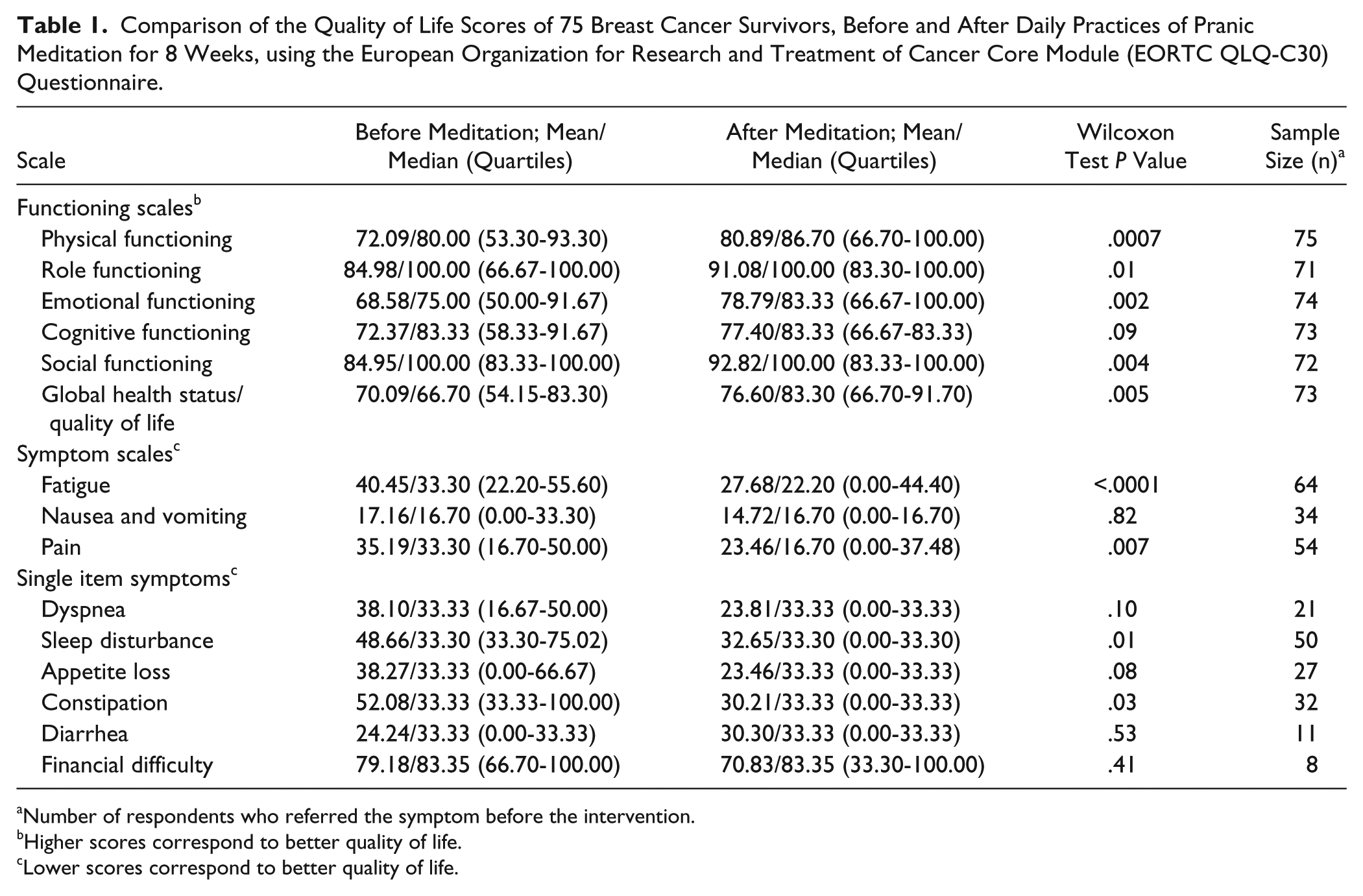
Number of respondents who referred the symptom before the intervention.
Higher scores correspond to better quality of life.
Lower scores correspond to better quality of life.
Comparison of the Quality of Life Scores of 75 Breast Cancer Survivors, Before and After Daily Practices of Pranic Meditation for 8 Weeks, Using the European Organization for Research and Treatment of Cancer Specific Breast Cancer Module (EORTC QLQ-BR23) Questionnaire.
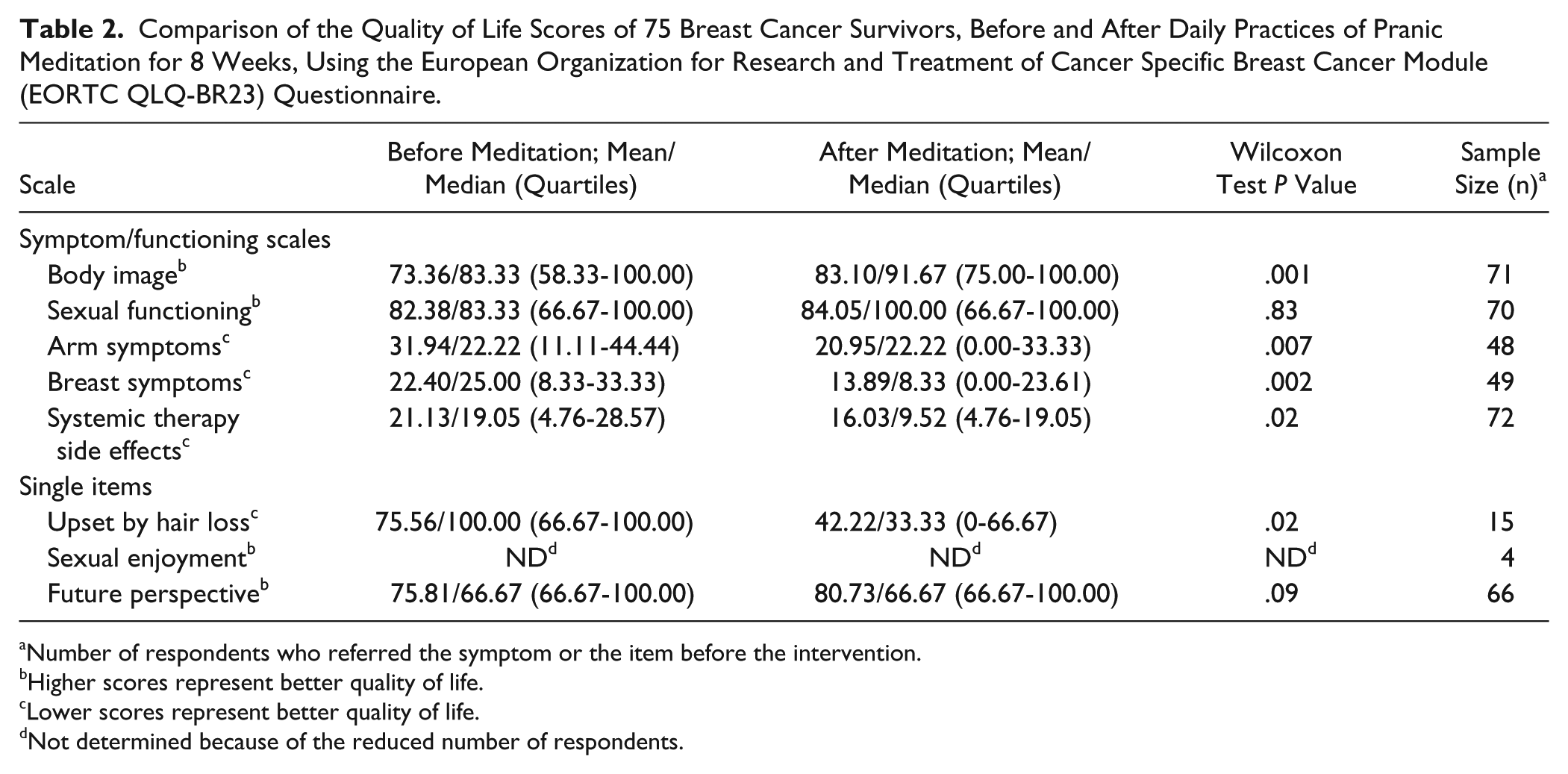
Number of respondents who referred the symptom or the item before the intervention.
Higher scores represent better quality of life.
Lower scores represent better quality of life.
Not determined because of the reduced number of respondents.
Cancer survivors who practiced pranic meditation also showed improvement of their mental health parameters, as assessed by the GHQ-60. These included psychic stress (P = .001), death ideation (P = .02), performance diffidence (P = .001), and psychosomatic disorders (P = .02). GHQ-60 detected only a trend for improvement of sleep disorders (P = .06). The general status of the mental health of practitioners, based on all the 60 items of the questionnaire, substantially improved after meditation (P = .0003; Table 3). No extra improvement of the mental health of breast cancer survivors could be demonstrated in a subgroup of 25 practitioners who extended the period of meditation practice from 8 to 15 weeks (Table 4).
Comparison of Mental Health Scores of 75 Breast Cancer Survivors, Before and After Daily Practices of Pranic Meditation for 8 Weeks, Using the Goldberg General Health Questionnaire (GHQ-60).

Number of respondents who referred the symptom before the intervention.
Comparison of Mental Health Scores of 25 Breast Cancer Survivors, After 8 Weeks or 15 Weeks of Pranic Meditation Practices, Using the Goldberg General Health Questionnaire (GHQ-60).

Number of respondents who referred the symptom before the intervention.
Discussion
Breast cancer compromises the global health of patients before, during, and after treatment. The side effects associated with the conventional treatment together with the emotional involvement associated with the disease, frequently lead to important medical and psychological impairments in breast cancer survivors, considered as those who are living after a cancer diagnosis. 54 The main complaints of this group are fatigue, sleep disorders, cognitive impairment, pain, arm symptoms, depression, and anxiety.55,56 These manifestations can last for years after treatment or can even be lifelong, 57 and pose a heavy toll on the quality of life of these persons.
Yoga and mindfulness-based stress reduction (MBSR) are meditation methods that have been widely used as adjunct therapies for improving the quality of life of cancer patients.10,12,15-17 MBSR is a standardized intervention that incorporates mindfulness meditation and yoga, whose purpose is to develop in the practitioner the capacity to be relaxed and aware in each moment, while maintaining a nonjudgmental attitude. It has been demonstrated that MBSR improves the quality of life of cancer patients by reducing fatigue, sleep disorders, anxiety, and depression.27,55 Yoga is an ancient doctrine originated from India that comprises a wide range of practices whose ultimate intent is to allow the practitioner attaining self-realization and enlightenment, 58 in other words, to achieve the union with the Whole. 59 Although there is a tendency in the Western world to understand yoga in terms of physical postures and controlled breathing, yoga is basically an exercise of meditation, when properly practiced. The use of yoga as a complementary intervention for cancer survivors has shown several benefits, including a significant improvement of vitality, and physical, mental, social, and spiritual well-being.60-62
Pranic meditation is rooted in the principles of yoga but uses different techniques. It is practiced in a static sitting position, uses exercises of focusing attention to quiet the mind and attain serenity, and allow practitioners to master their ability to absorb, concentrate, balance, and project prana, and to use it toward the recovery and maintenance of their health. We found that breast cancer survivors showed an expressive reduction of most of their physical and mental/emotional impairments after a short period of 8 weeks of meditation practice. Based on the responses to 3 validated questionnaires at the beginning and by the end of the intervention period, practitioners showed improvement of their mental health, assessed by the reduction of psychic stress, death ideation, performance diffidence, and psychosomatic disorders, and also amelioration of their quality of life, as expressed by the improvement of the physical, role, emotional, and social functioning, and of the global health status, fatigue, pain, sleep disturbances, body image, arm and breast symptoms, and systemic therapy side effects, upset by hair loss. These gains were maintained, with a little improvement, when meditation practices were extended from 8 to 15 weeks, suggesting that the beneficial effects of the practices had nearly reached their maximum by the eighth week. Some practitioners showed improvement of their cognitive functioning, but this condition could not be demonstrated in the group as a whole.
The evaluation of the daily log of meditation practice allowed monitoring the difficulties and progresses of the practitioners during the program of meditation. As expected, during the first weeks of practice the complaints of difficulty to concentrate the attention and to be skilled at the techniques, together with of discomfort at the sitting position were frequent. In some cases, these limitations caused a degree of anxiety in the practitioners and the length of the practices was less than ideal. However, usually starting from the third week of practice, these difficulties were progressively diminishing, and the first benefits soon manifested as increasing in serenity and focusing of attention, together with improvement in the quality of sleep, stabilization of humor, enthusiasm, and joyfulness.
Different mechanisms could explain the beneficial effects of the pranic meditation program on breast cancer survivors. The focusing of attention, by means of the breathing and visualization techniques, leads to the reduction of anxiety, which could positively affect fatigue, sleep disturbances, pain, depression, psychosomatic disorders, and immunity.63-66 Moreover, the expectancy of the practitioners that meditation represented an instrument for improving their health and quality of life, and the fact that they could use it autonomously in their benefit, probably prompted them to increase their self-assurance and hopes, which might have contributed toward the reduction of their psychic stress, death ideation, performance diffidence, and improvement of their physical, role, emotional, and social functioning, as we observed. Practitioners of pranic meditation learn how to absorb, concentrate, balance, and project prana (biometenergy) and how to use it toward the recovery and maintenance of their health. A growing body of evidence supports the action of biometenergy on biological systems,34,67,68 and their use to deal with clinical situations is presently a reality.69-71
The most impressive feature of biometenergy is the fact that it can be submitted to intentionality,39,40,72,73 either for reducing pathological manifestations (eg, pain, inflammation, discomfort, anxiety, depression) or for enhancing some beneficial conditions (eg, immunity, vigor, sleep, serenity, self-assurance). The role played by intentionality in the process of healing, including that proceeded at a distance, has been increasingly acknowledged.73-75 In fact, intentionality has been considered as an essential condition for achieving healing. 76 Our investigation reinforces the beneficial role played by volition, as a manifestation of positive intentionality, in the process of cure: we observed that those practitioners who presented a higher degree of volition, expressed by their strong commitment to the practice of meditation, achieved the best scores of quality of life and mental health (data not shown).
Although our study showed very promising results that support the practice of pranic meditation by breast cancer survivors, there are several possible limitations to be considered.
Selection: Since the subjects were self-selected to participate in a study that required a great deal of time commitment, they were presumably also highly motivated, which could represent a possible selection bias. However, motivation and commitment are necessary requirements for those engaging in mind–body interventions. It would be impossible to reach any result if nonmotivated and noncommitted subjects were included in the investigation simply because they would quit the program before it had finished.
Experimental design: Our investigation had been designed as a randomized wait-list control study. However, at the enrollment in the program, the majority of volunteers referred that they would prefer to start immediately the meditation training, instead of been assigned to the waiting list, which meant the need to wait for more than 15 weeks, till the next training course would begin. In respect for their choice, the investigators decided to change the design to a prospective single-arm observational study, using before and after measurements. This pre–post design is considered a suitable experimental strategy for assessing the impact or effectiveness of an intervention. 77
Lack of control group: It has been amply acknowledged that controlled assays present higher strength than noncontrolled ones. However, it has also been acknowledged that experimental designs have to be submitted to ethical constraints. Since we had already shown that pranic meditation improved the quality of life of the practitioners, we decided that it would be unethical to invite distressed cancer survivors to act as controls and, therefore, impeding or postponing such benefits. The consequence of not including a control group in the experimental design is the possibility that some of the benefits reported as associated with the meditation practice could actually be caused by confounding factors such as the participant expectancy (placebo effect), social interactions, and group support due to being members of a group. Since these factors will be always present in meditation programs, this question becomes a theoretical rather than a practical issue.
Sample size: A bigger sample size would allow for a proper stratification of the subjects of the study and, therefore, to respond to questions that were kept unanswered as “what was the impact of meditation on recently diagnosed subjects as compared with those formerly diagnosed?”
Losses: From the initial group of 109 subjects enrolled in the program, only 75 (69%) were included in the study. The reasons for the reduction of the sample size were failure to complete or to return the questionnaires exclusion from the study of those who missed three or more sections of meditation, usually due to coincidence with their sections of chemotherapy or radiotherapy, or to the discomfort caused by their side effects unwillingness to make an effort to learn the techniques dropping out because of difficulties to perform meditation techniques or to doubts about their benefits dropping out because of self-sabotage, which usually occurred when the initial gains of meditation became evident. No case of death or worsening of the disease occurred; neither among the dropouts nor among the subjects of the study during the period of the investigation. High numbers of dropouts, as found in the present investigation, are frequently found in studies involving application of complementary therapies in cancer patients (see Targ and Levine
31
and Moadel et al
78
), probably because of the clinical–psychological characteristics of this group. Moreover, the frequency of 31% of dropouts found in our study with cancer survivors was not essentially different from that of 28% usually observed in the programs of pranic meditation directed to the healthy community.
Lack of blinding of subjects and instructors: This is an unavoidable limitation of the study because of the nature of the intervention.
Lack of immunological data: A technique of guided imagery that aimed at strengthening the immune system was included in this program of pranic meditation directed to breast cancer survivors, but its impact on the subjects was not evaluated.
Limited follow-up: The follow-up of our study was restricted to a period of 7 weeks after completing the 8-week program. It would be interesting to extend the length of the follow-up period to assess the sustainability of the favorable effects of meditation, both in those who continued meditating and in those who had given up.
Confrontation of results: Since the present study is the very first one to use pranic meditation for treating cancer patients, no data from other researchers are available to allow for a confrontation with our results.
Setting: The meditation program was administered in an academic setting; the feasibility and benefits of its administration in a different setting remains to be determined.
Conclusion
We found that breast cancer survivors showed an expressive reduction of most of their physical and mental/emotional impairments and improvement of their quality of life after a short period of eight weeks of pranic meditation practice, consisting of simple and easy-to-learn exercises. The benefits included a significant improvement of the physical, role, emotional, and social functioning, the global health status, fatigue, pain, sleep disorders, body image, arm and breast symptoms, and reduction of the side effects of systemic therapy, and upset by hair loss. Moreover, practitioners also showed improvement of their mental health parameters, which included psychic stress, death ideation, performance diffidence, psychosomatic disorders, and severity of mental disorders. These astonishingly favorable outcomes were probably because of the ability of practitioners to absorb, concentrate, balance, and project prana, a metenergy considered as essential for maintaining and recovering health, and that can be endowed with intentionality. However, because of the limitations of the study, further research is required utilizing a more rigorous experimental design, to ascertain whether pranic meditation may be an acceptable adjunct therapy for cancer patients.
Footnotes
Acknowledgements
The authors thank the participants of the research for their high commitment to the project and to truth. We also express our gratitude to Harco Ofugi and Cristina Gobbi for their dedication in organizing the pranic meditation sessions. Juarez I. Castellar and Cesar A. Fernandes are students of the Post-graduation Program in Medical Sciences, Faculty of Medicine, University of Brasília.
Declaration of Conflicting Interests
The author(s) declared no potential conflicts of interest with respect to the research, authorship, and/or publication of this article.
Funding
The author(s) received no financial support for the research, authorship, and/or publication of this article.