



Abstract
Objective. The major aim of this study was to present 2 cancer cases treated with anticancer herbal formula Panax notoginseng and Cordyceps militaris. Methods. Two patients, with pancreatic adenocarcinoma and mucosa-associated lymphatic tissue type lymphoma, respectively, were treated with P notoginseng and C militaris herbal formula without conventional treatments. Their tumor masses were compared using computed tomography during early and later periods of herbal formula treatment. Results. On computed tomography, reduction in tumor mass in both patients after 17 and 13 months of herbal treatments was noted, and the patients maintained stable disease and good quality of life until the last contact in November 2008. Conclusion. C militaris and P notoginseng are potential anticancer herbal prescriptions for adenocarcinoma and mucosa-associated lymphatic tissue type lymphoma.
We report two advanced cancer cases treated with Cordyceps militaris and Panax notoginseng based anti-cancer herbal formula known as Hang-Am Dan.
Case 1
Case 1 is a 59-year-old man in whom an abnormality in the pancreas was noticed during physical examination for dyspepsia in January 2006. He was diagnosed with pancreatic cancer by abdominal pelvic computed tomography (CT) on February 15, 2006. Laparoscopy for pancreatic biopsy performed on March 22, 2006 noted adenocarcinoma with extension to perinodal soft tissue (T4N1M0, stage III; Figure 1A). The patient began chemotherapy of gemcitabine combined with cisplatin (DDP) as a part of his conventional treatment regimen on April 6, 2006, but he refused further chemotherapy after 1 cycle because of severe side effects. On April 27, 2006, after discontinuation of conventional therapy, abdominal CT showed the presence of increased mass. On April 30, 2006, after obtaining informed consent, oral treatment with 500-mg capsules of a Cordyceps militaris– and Panax notoginseng–based anticancer herbal formula 3 times a day was initiated. Subsequently, CT performed on June 27, August 28, October 30, 2006, and March 2, 2007, noted slight decrease in tumor size (Figures 1B and 1C). Disease was maintained stable for 17 months and the patient was reported to be well and alive at our last contact in November 2008.
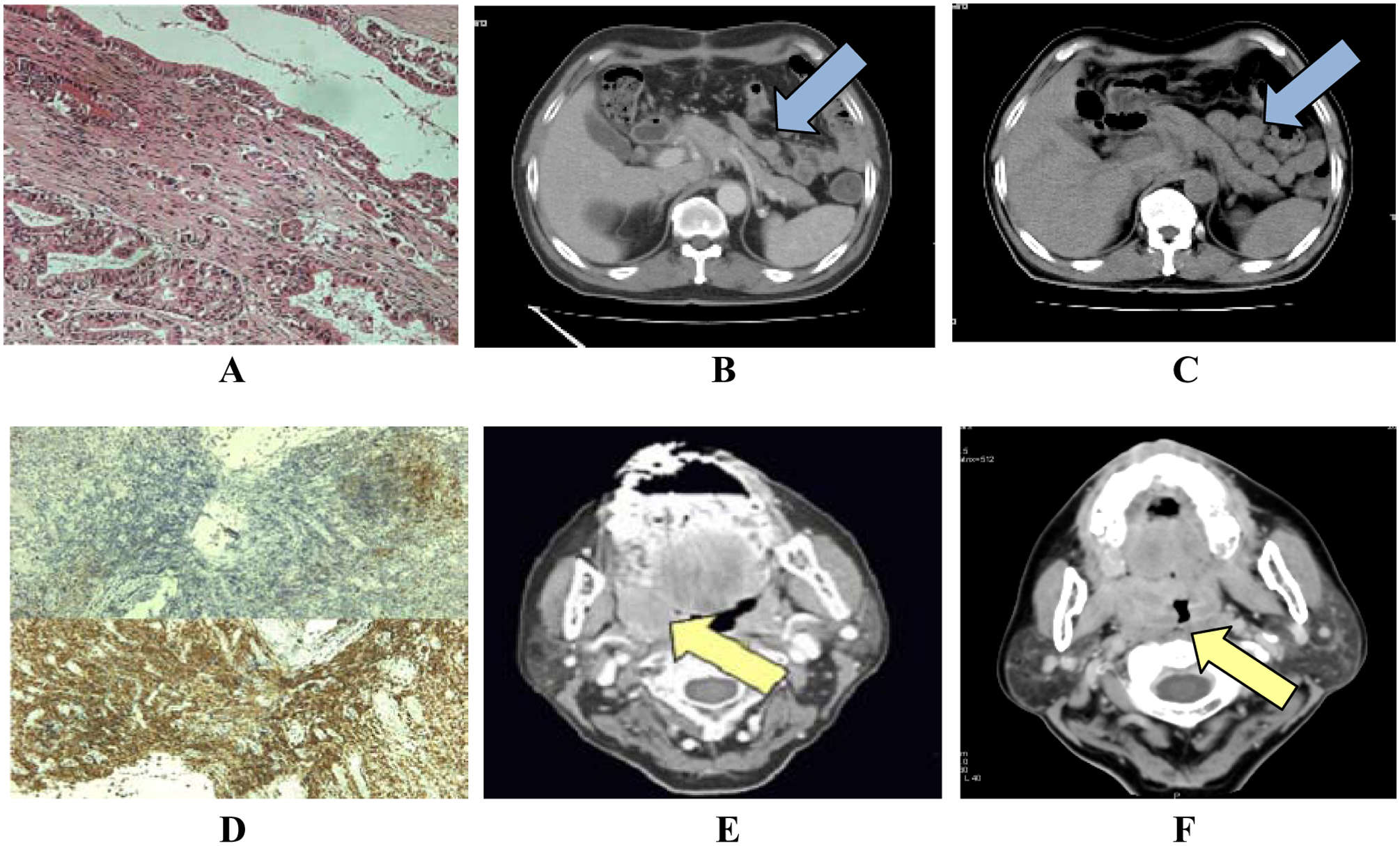
Case 1: (A) Pancreas biopsy (Bx). (B) Abdominal computed tomography (CT) on April 27, 2006. (C) Abdominal CT on March 2, 2007. Case 2: (D) Nasopharynx Bx—(top) CD-20 positive and (bottom) BCL-2 positive (April 8, 2005). (E) Neck CT: 2 months after treatment initiation on April 25, 2006. (F) Neck CT: 14 months after treatment initiation on March 7, 2007
Case 2
Case 2 is a 70-year-old woman who presented with sore throat in April 2005. She was diagnosed with extranodal marginal zone B cell mucosa-associated lymphatic tissue (MALT) type lymphoma by nasopharynx tissue biopsy performed on April 8, 2005 (Figure 1D). Neck CT scan showed lymphoma involving the nasopharyngeal walls, adenoids, lingual tonsils, and right palatin tonsil on April 25, 2005. Abdominopelvic CT from the same day showed severe splenomegaly, diffuse lymphadenopathy around the common hepatic artery, mesentery, and focal pulmonary infiltration. Whether the patient should receive conventional cancer treatment was debated between medical staff and family members because of her old age. Two months after the diagnosis, patient had a stroke, which delayed any cancer treatment.
No cancer treatment was thus performed between April 2005 and February 2006. On February 13, 2006, the patient made a decision not to receive conventional therapy but only to receive 500-mg of Hang-Am Dan herbal capsule 3 times a day. After 2 months of herbal treatment, neck, abdominopelvic, and chest CTs performed on April 25, 2006, and again on August 30, 2006, and March 7, 2007 showed no interval change. After 13 months of C militaris and P notoginseng herbal treatments, however, neck, chest, abdomen, and pelvis CTs on March 7, 2007, revealed decreased tumor mass compared with the scans of April 25, 2006 (Figures 1E and 1F). After 14 months of the therapy, tumor showed stable disease, and the patient reported good general condition at our last contact in November 2008.
The C militaris– and P notoginseng–based anticancer herbal formula called Hang-Am Dan (HAD) consisted of 9 herbal ingredients (Coix lachryma semen, Panax notoginseng radix, Hippocampus kelloggi, Cordyceps militaris, Cremastra appendiculata tuber, Panax ginseng radix, Bos taurus calculus, Pteria martensii, and Moschus moschiferus). 1 In 2007, 6 HAD-treated cases were evaluated by the Best Case Series Program (BCSP) at the National Cancer Institute (NCI) Office of Cancer Complementary and Alternative Medicine (OCCAM). As a result, cases of lung cancer and endometrial cancer were classified as persuasive and supportive, respectively, and published in a peer-reviewed journal. 2 Additionally, 4 cases were submitted again and 2 cases were classified as supportive by BCSP in March 2008 after rigorous evaluations of NCI OCCAM. Of the 9 ingredients of HAD, C militaris and P notoginseng have been studied the most. C militaris is a well-known Korean traditional medicinal mushroom that functions as an apoptosis-inducing agent. 3 It contains cordycepin and ergosterol peroxide, which have been found to induce apoptosis of cancer cells, reduce tumor size, and increase lifespan in an in vivo nude mouse study. 4 Notoginseng, the main root of P notoginseng is also known to have anti-inflammatory and antitumor effects, and it is also known to influence the functional balance of the immune system. 5 Also, an in vitro study indicated that P notoginseng inhibits the growth and metastasis of various cancer cells, which is associated with cell cycle arrest and the stimulation of apoptotic cell death.5,6
Overall, these cases indicated that HAD is a potential herbal formula for pancreatic ardenocarcinoma and MALT lymphoma, respectively. The results are more reliable because NCI BCSP classified the documents as supportive cases. Although Zia and White 7 stated the necessity of remission as one of the main criteria in evaluation of NCI BCSP persuasive case, maintenance of dormancy in disease state without side effect may indicate positive prognosis in cancer patients. Therefore, further clinical studies on this category of anticancer herbal formula are required to confirm the efficacy and safety on cancer treatments based on reliable evaluation such as BCSP.
Footnotes
The author(s) declared no potential conflicts of interest with respect to the research, authorship, and/or publication of this article.
The author(s) received no financial support for the research, authorship, and/or publication of this article.