




Abstract
Considerable challenges arise for managers and human resource development professionals while designing non-traditional (distributed) work arrangements that ensure productivity and foster the continuous learning and growth of employees. In this paper, we thus explore, analyze, synthesize, and systematically present the main insights emerging from the intersection of distributed work (DW) and work design domains. Specifically, an overlap approach to a multi-technique bibliometric review was adopted and a DW design framework established. The proposed framework unifies, corroborates, and extends existing conceptual models, thereby: (1) improving understanding of the current conceptual landscape; and (2) identifying promising future research directions. The paper also offers practical advice on how to successfully introduce and align DW arrangements with corporate-wide goals, human resource policies, and employee development priorities.
Keywords
Introduction and Theoretical Background
The nature of work has evolved considerably, going from master craftsmen and industrial factory workers to the digital workforce and AI-driven robots (Phan et al., 2017; Thite, 2022). Recent studies have highlighted the critical role of management in shaping new work arrangements (Sneppen, 2025). In today’s increasingly complex work environments, human resource development (HRD) professionals are expected to take on a strategic role in tackling organizational challenges and shaping effective learning and development strategies (Loon et al., 2020). Work design (i.e., “the content and organization of one’s work tasks, activities, relationships, and responsibilities,” cf. Parker, 2014, p. 662), as an ever important human resource management (HRM) and organizational psychology (OP) topic, has become even more complex with the move to distributed work (DW) environments (Parker et al., 2017; Vough & Parker, 2008). This shift is also reshaping HRD, calling for fresh approaches to employee learning, skill development, and career growth in settings that are dynamic, digital, and flexible (Byrd, 2022).
HRD professionals traditionally concentrated on training, career, and organizational development. Yet, today, with the rise of digital technologies such as artificial intelligence (AI), big data, and analytics, HRD professionals are increasingly expected to align people strategies with digital innovation and broader business goals (Werner, 2014). The integration of AI into HR functions highlights this shift, offering improved decision-making, operational efficiency (Tinguely et al., 2023), and more adaptive, personalized employee development (Ekuma, 2024). These advancements not only enhance productivity but also transform how people learn and grow, reinforcing the idea of technology as HRD’s “fourth dimension” (Bennett et al., 2011). The rapid spread of ICT across geographic and cultural boundaries has expanded the community of knowledge workers; those who create, apply, and share knowledge (Burke & Ng, 2006). Combined with the impact of the COVID-19 pandemic (Benitez et al., 2023; Ratten & Thaichon, 2021), these technologies have accelerated the shift toward DW (Gajendran & Harrison, 2007). In response, HRD must develop strategies that integrate technological tools with human-centered work design to support employee engagement, performance, and well-being. This includes designing AI-supported work that safeguards autonomy, promotes meaningful tasks, and ensures supervisory support (Rick et al., 2024), as well as fostering cultures that value autonomy and organizational support (Gajendran et al., 2024).
The integration of digital technologies has revolutionized traditional business models, enabling organizations to adapt to the evolving landscape (Hu et al., 2024). This means line managers and HRD professionals are more than ever expected to re-think the “traditional” work environment without remote working and introduce distributed/hybrid or location-independent work arrangements (Dulebohn & Hoch, 2017). Governments and companies around the world increasingly state that remote and/or flexible working is a workforce priority (Shellenback & Polovina, 2020). The research on remote and virtual work, telework, work from home, e-work, mobile work, multi-site working, and telecommuting follows these trends, reinforcing their legitimacy in modern workplaces (Lamovšek & Černe, 2023).
DW significantly shapes how HRD professionals design work models. As Hughes and Niu (2021) highlight, the COVID-19 pandemic rapidly introduced new career dynamics, prompting HRD to rethink career development strategies in response to ongoing technological advances. This shift has also cast doubt on the effectiveness of traditional, centralized, face-to-face training for a geographically dispersed workforce (McGuire et al., 2020). To make appropriate work design decisions in DW environments (Parker & Jorritsma, 2020), organizations must define optimal task content and job structures (Hackman & Oldham, 1976; Parker, 2014), while also understanding the unique work characteristics of modern roles (Morgeson & Humphrey, 2006) and the socio-psychological dynamics of an evolving, distributed workforce (Grant et al., 2013). Researchers have already offered valuable conceptual frameworks connecting ICT and work design (Handke et al., 2020; Parker et al., 2017; Parker & Grote, 2022a; Wang et al., 2020), which help HRD professionals grasp how technology reshapes work and how it can be used to enhance performance, engagement, and well-being. However, as Parker and Grote (2022a) point out, what remains lacking is a comprehensive, systematic, and cross-disciplinary review that integrates these insights into a unified understanding of DW design. To that end, we first need to learn about the theoretical underpinnings of the two fields’ intersection, consider any current issues, and then envision upcoming technological and future work trends. It is vital that HRD professionals understand this since it permits them to design learning and development programs attuned to the realities of DW and make sure that technological advances and employee needs are integrated. Exploring the intersection is namely critical given that DW environments bring their own challenges and opportunities for work design. The integration of ICT into DW contexts does not just facilitate but also transforms the way work is designed, coordinated, and performed (Parker et al., 2001). It helps with understanding the evolving nature of work and ensure that work design principles are suitable for a rapidly changing work landscape. Such a review is timely and appropriate because it can provide insights into the ways ICT developments and corresponding DW arrangements have affected the traditional work characteristics and individual-level design alternatives in organizations (Wang et al., 2020).
Accordingly, this paper seeks to provide a comprehensive systematic overview of the evolution and current state of the two overlapping fields (i.e., DW and work design) to help readers understand the current state-of-the-art knowledge in these areas, while setting the grounds for future research and practice on DW design. With this in mind, we raise two sets of research questions. The first, more general one contains: (1) What is the intellectual structure of the overlapping fields, and how have their theoretical foundations evolved? (2) Which are the main topics associated with DW and work design? (3) Which topics have recently appeared in DW and work design research domains? The second set of questions is HRD-focused, asking: (4) How have the evolving theoretical foundations of DW and work design addressed HRD-specific challenges; (5) How do the main DW and work design topics inform the core HRD initiatives? and (6) How can HRD professionals leverage new trends to design employee learning and development approaches in DW settings?
We applied four bibliometric systematic review techniques (co-citation analysis, co-word/co-occurrence analysis, topic modeling, bibliographic coupling) and complemented them with interpretative logic stemming from the “invisible colleges” framework (Vogel, 2012). Our multi-bibliometric and text analysis approach allowed each research question to be simultaneously addressed with a given technique and the cited authors, influential texts, and documents’ actual content to be examined to capture the reviewed fields’ structural and temporal components. We thus considered DW arrangements from qualitative and quantitative perspectives while handling large quantities of objective data.
The present research holds the potential to add to the HRD literature in several ways. First, we complement the review by Wang et al. (2020) that explicitly concentrated on the ways the use of ICT affects individuals and what (and how) aspects of work design change following the adoption of ICT. We expanded their search beyond technology into DW arrangements. Further, we developed practical implications for HRD professionals concerning how to design learning and development initiatives, manage talent in remote settings, and assure employee engagement in increasingly digital work environments. We also conducted additional co-occurrence analysis, topic modeling, and bibliographic coupling analysis, comparing differences before and after the COVID-19 pandemic. The pandemic acts as a key break in time that allowed us to systematically assess the shifts in DW research topics and thereby determine how HRD strategies must adapt to the new realities (Park et al., 2021). The study also provides a foundation for future research that should bridge the technology, work design, and HRD domains to bring HRD strategies in line with the needs of a distributed workforce.
Second, we attempt to add to the authoritative review of work design (Parker et al., 2017) by highlighting the context of DW and referring to future research suggestions for studying ICT-driven work design practices. Although Parker et al. (2017) focused on work design generally, we explored how this field has been developing parallel to (yet independently of) the field of DW, showing the trajectories and conceptual space of scholarly discussions over time. The mentioned targeted approach saw us focus on the intersection of these two noteworthy fields to gain rich insights into how work design principles are applied and transformed in work environments that are distributed. Following other robust reviews (Parker et al., 2017; Parker & Grote, 2022a), we considered the sociotechnical systems perspective together with the social and technological aspects of work, which enabled a more comprehensive picture of work and its organizational determinants to emerge.
Third, we conceptually upgraded existing well-established work design models. A thorough bibliometric review guided us while conceptualizing the DW design framework. Specifically, we added a new category of ICT-related work characteristics to the Work Design Questionnaire (Morgeson & Humphrey, 2006). The developed integrative framework contributes to work design (by renewing and enriching the toolkit of work characteristics and identifying promising new research avenues) and HRD literature (by offering practical advice on designing resilient learning and development strategies and implementing DW arrangements within contemporary work environments).
To achieve these contributions, we conducted a comprehensive, multi-technique bibliometric review aimed at systematically mapping the intersection between DW and work design. This approach enabled us to uncover the intellectual structure of the field, identify emerging trends, and highlight HRD-relevant insights. The following section outlines the methods and analytical procedures used to generate these findings.
Methods and Analysis
Four different systematic review techniques were conducted as part of the presented overview. Co-citation analysis was applied to describe how the overlap between work design and DW literature has developed over time (Small, 1973). Next, (authors’ keyword) co-occurrence and topic modeling analysis were performed to reveal the overlap’s conceptual structure (Cobo et al., 2011; Culpepper & Aguinis, 2011), while bibliographic coupling addressed a temporally unbiased idea of interrelationships among the articles, revealing current “hot” topics and possible future research opportunities (Kessler, 1963).
Database and Search Protocol
We searched and exported the data from the Web of Science Core Collection (WoSCC), an especially relevant database for bibliometric research given its rigorous journal selection, preferring high-impact publications and assuring a curated, robust database. Its more extended history has seen it widely regarded as the “gold standard” for citation indexing, particularly in fields prioritizing quality and selectivity (Zupic & Čater, 2015). Our search strategy aimed to identify documents/articles appearing at the intersection of DW and work design.
To ensure methodological transparency, we carefully developed our keyword strategy based on a preliminary scoping review of core literature across DW and work design. For part of the search related to DW, we used the same search terms as Raghuram et al. (2019), followed the recent approach to a systematic review of the field of DW taken by Lamovšek and Černe (2023) and upgraded this search with other related and relevant terms: work from home, home working, working remotely, and e-work. The additional keywords were included to capture the evolving and multidisciplinary terminology used in recent DW literature. Their selection was informed by previous systematic reviews (e.g., Charalampous et al., 2019), empirical studies post-2020 (e.g., Rudolph & Zacher, 2025; Wang et al., 2021), and the rise of these terms in policy and practitioner reports during the COVID-19 pandemic (e.g., PwC, 2021). Their inclusion ensures the comprehensiveness, relevance, and interdisciplinary scope of the review, especially in the context of HRD-focused research. The DW search part was complemented with relevant terms related to work design (stemming from the aforementioned theoretical models) to provide the inputs required for writing an informative (descriptive) and critical (prescriptive) review of the overlap of the two fields. These terms were selected based on their centrality in foundational theoretical models, such as Hackman and Oldham’s (1976) Job Characteristics Model (JCM) and Morgeson and Humphrey’s (2006) Work Design Questionnaire (WDQ). Additionally, the evolving nature of work in the digital age has prompted a shift in focus toward digitally mediated work environments, as highlighted in recent contributions (e.g., Parker, 2014; Parker & Grote, 2022a), justifying the inclusion of terms such as “digital work.” By integrating both classic and emerging constructs in work design research, we ensured comprehensive coverage of the conceptual space at the intersection of work design and DW.
The final database searching included a Boolean search operator AND to combine general (“work design” OR “job design” OR “digital work” OR “job characteristics”) with more specific search terms (“virtual team*” OR “virtual group*” OR “virtual work*” OR “distributed team*” OR “distributed group*” OR “distributed work*” OR “mobile work*” OR “remote work*” OR “dispersed group*” OR “dispersed team*” OR “dispersed work*” OR “technology-mediated work*” OR “technology mediat*team*” OR “technology-mediated group*” OR “computer-mediated group*” OR “computer mediat* team*” OR “computer mediat* work” OR “telework*” OR “telecommut*” OR “distance work*” OR “distance team*” OR “work* from home” OR “home working” OR “working remotely” OR “e-work*”).
As for inclusion/exclusion criteria, we included peer-reviewed journal articles published in English that addressed DW, work design, or their intersection. We excluded editorials, conference proceedings, book chapters, and publications without abstracts or full-text availability.
Analytical Approach
We used these terms to search fields, including titles, abstracts, and keywords of articles from journals published up to2020 1 , resulting in 93 articles. The most represented WoSCC categories were Management (36), Psychology applied (20), and Business (14).
To strengthen the robustness of our findings, we implemented several checks: (1) title and abstract screening, (2) full-text validation for relevance, (3) de-duplication, and (4) triangulation across co-occurrence analysis, topic modeling, and bibliographic coupling. Additionally, we compared thematic patterns across pre- and post-COVID-19 publication periods to validate the consistency of our conceptual insights. We also compared outputs from topic modeling and co-word analysis to identify convergence across thematic clusters.
VOSviewer, a bibliometric software developed by van Eck and Waltman (2010), was used to analyze the data obtained from WoSCC. The software visualizes records based on influence and closeness to explore and depict bibliometric networks (van Eck & Waltman, 2010) with clusters. We looked at five articles with the highest total link strength 2 within each cluster, reviewed them, and labeled clusters based on them. Four systematic review analyses were performed, with their characteristics being described below.
Bibliometric Techniques
To analyze the intersection of DW and work design, we applied bibliometric techniques to provide actionable insights for HRD. Co-citation analysis mapped the field’s intellectual foundations, offering HRD professionals a deeper understanding of key concepts shaping DW and work design. Co-word analysis highlighted themes such as employee development, learning, and well-being, helping HRD practitioners navigate the challenges and opportunities of DW. Topic modeling grouped research into thematic clusters, equipping HRD with a nuanced view of emerging and established areas to inform adaptive work design practices. Finally, bibliographic coupling identified current trends and influential contributions, enabling HRD to align with cutting-edge developments and integrate innovative strategies for DW design.
Co-citation Analysis
First, to obtain a dynamic representation of the historical perspective of the overlap between the DW and work design research domains, we performed a co-citation analysis on secondary papers (i.e., those that the fields cite). This technique addresses our first research question by identifying crucial theoretical works and their relationships, helping to understand how DW and work design have developed over time. By focusing on the relationships between cited works, this method reveals the theoretical underpinnings and foundational knowledge that guide a particular area of study (Small, 1973). Insights are provided into which studies have been most influential in shaping the field’s conceptual frameworks, highlighting central themes, seminal works, and the evolution of ideas over time. Using network analysis—a graph-theoretic approach for portraying the most important units of analysis and their interrelationships (Nerur et al., 2008), we: (1) delineated the subfields that constitute the intellectual structure of DW research and identified its leading knowledge domains; (2) determined the relationships between the subfields; (3) identified papers (and authors) with a vital role of bridging two or more conceptual domains of research; and (4) graphically mapped the conceptual foundations in order to visualize relations between intellectual areas (clusters of conceptual underpinnings). This approach was also used with the subsequent bibliometric techniques.
We divided the articles into three temporal parts, similar to the approach taken by Lamovšek and Černe (2023). The first one included articles up until 1995 (a turning point when influential articles on DW by Handy (1995) and Mayer et al. (1995) were published), the second one between 1996 and 2010 (when Barack Obama signed the Telework Enhancement Act as President of the U.S.A., which transformed the federal telework (Snyder, 2012), and the third one between 2011 and 2020. As expected, the first period includes the smallest number of articles (14), the second one somewhat more (25), and the last one the most (67). The number of articles has grown according to the development and popularity of the DW concept, which has further accelerated since the COVID-19 pandemic.
Documents published until 1995 had the minimum number of citations of a cited reference set to four; the group between 1996 and 2010 this minimum number was set to 28; for the group between 2011 and 2020 the number was set to 54; while for the group between 2021 and mid-2023 was set to five. Cutoffs for all analyses are set to obtain then optimal ratio between complexity and what is still interpretable (Zupic & Čater, 2015).
Co-occurrence (Co-word) Analysis
Next, to understand the conceptual structure of the overlap of DW and work design fields, we analyzed the co-occurrence of the keywords (Cobo et al., 2011) of primary documents (those constituting each field). This technique helps answer our second research question by revealing the key topics and emerging research areas at the intersection of DW and work design, offering insights relevant to HRD practices. Unlike citation-based methods, co-word analysis examines the frequency and co-occurrence of terms to identify patterns in how concepts are discussed and connected across the literature. The output of this method is a thematic “network” that visually represents the relationships between different ideas, effectively mapping the conceptual space of a scholarly field. With this technique, we were able to extract and analyze key conceptual themes within the DW research domain, revealing how ideas are clustered, interrelated, and evolving.
Topic Modeling
Topic modeling describes a set of machine learning techniques able to automatically extract thematic information from a corpus of text documents. Latent Dirichlet Allocation (LDA) is the most used topic modeling technique (Blei, 2012), originally developed by Blei et al. (2003). LDA is a Bayesian generative model of text documents that reliably discovers meaningful topics among unstructured collections of text documents. Accordingly, it is helpful to think about LDA as principal component analysis (PCA) for text where raw text is reduced to topics (i.e., a distribution over a fixed vocabulary).
LDA assumes that documents are created according to this model and seeks to estimate the model’s hidden parameters. A topic is defined as a distribution over a fixed vocabulary. The algorithm assumes that topics are specified before any documents have been generated. The words are then generated following a two-stage process (Blei, 2012): (1) randomly choose a distribution over topics; and (2) for each word in the document choose one of the topics selected in the previous step and then randomly choose a word from this topic’s distribution over the vocabulary. Besides topics, the LDA model’s hidden structure consists of topic distribution per document and the assignment of words to topics. Recent research used LDA to examine disruption research (Hopp et al., 2018) and innovation systems (Rakas & Hain, 2019).
We employed topic modeling to discover the ‘hidden’ thematic structure of the intersection of DW and work design literature. This technique provides a systematic understanding of both established and emerging research areas, allowing future directions to be identified while informing HRD professionals of critical areas of focus for DW work design. The bibliographic data were first imported into the R environment (Culpepper & Aguinis, 2011). We used the topicmodels package for implementing LDA analysis and tm package capabilities for preprocessing. The preprocessing involved several steps. First, we excluded those entries without abstracts. All words were transformed into lowercase. Numbers and punctuation were removed. Since texts often contain several stopwords that carry very little meaning (e.g., “in”, “and”, “this” …), these were removed (both those appearing on the list of the R tm package and additional research-text specific stopwords like “study”, “paper”, “research” etc.).
The Document-Term matrix has documents on rows and terms in columns (in our case, terms were both one- and two-word). Entries in the matrix show the frequency of each term that appears in every document. The list of all possible terms is extensive; this makes the Document-Term matrix sparse. We removed any terms that appear in fewer than 1% of documents to reduce the processing time. This step gave us the final Document-Term matrix, the standard input for the LDA algorithm in the R topicmodels package. At the end, we ran the LDA algorithm to determine topics that make up the thematical structure of the distributed work–work design intersection.
Bibliographic Coupling
We performed bibliographic coupling to gain a temporally unbiased perspective on the interconnections among journal articles, influential themes, and recent developments in the field (Kessler, 1963). The technique helps address our third research question by identifying contemporary studies impacting the current and future discourse concerning DW and work design, informing HRD strategies for evolving work environments. This technique reveals contemporary studies and emerging areas of influence in DW and work design by mapping documents which cite similar sources. Using a threshold of 180 citations and a full counting method, we concentrated on identifying the most impactful and boundary-spanning papers.
Findings
Co-citation Analysis
Results for the First Period (up to 1995)
In this group, 14 articles were analyzed, making a single cluster labeled Job design, organizational systems, and different outcomes. The cluster consists of 14 items (objects of interest) and 91 links (see Figure 1). Co-citation Map: Documents Forming the Intellectual Structure of the Field Between 1900 and 1995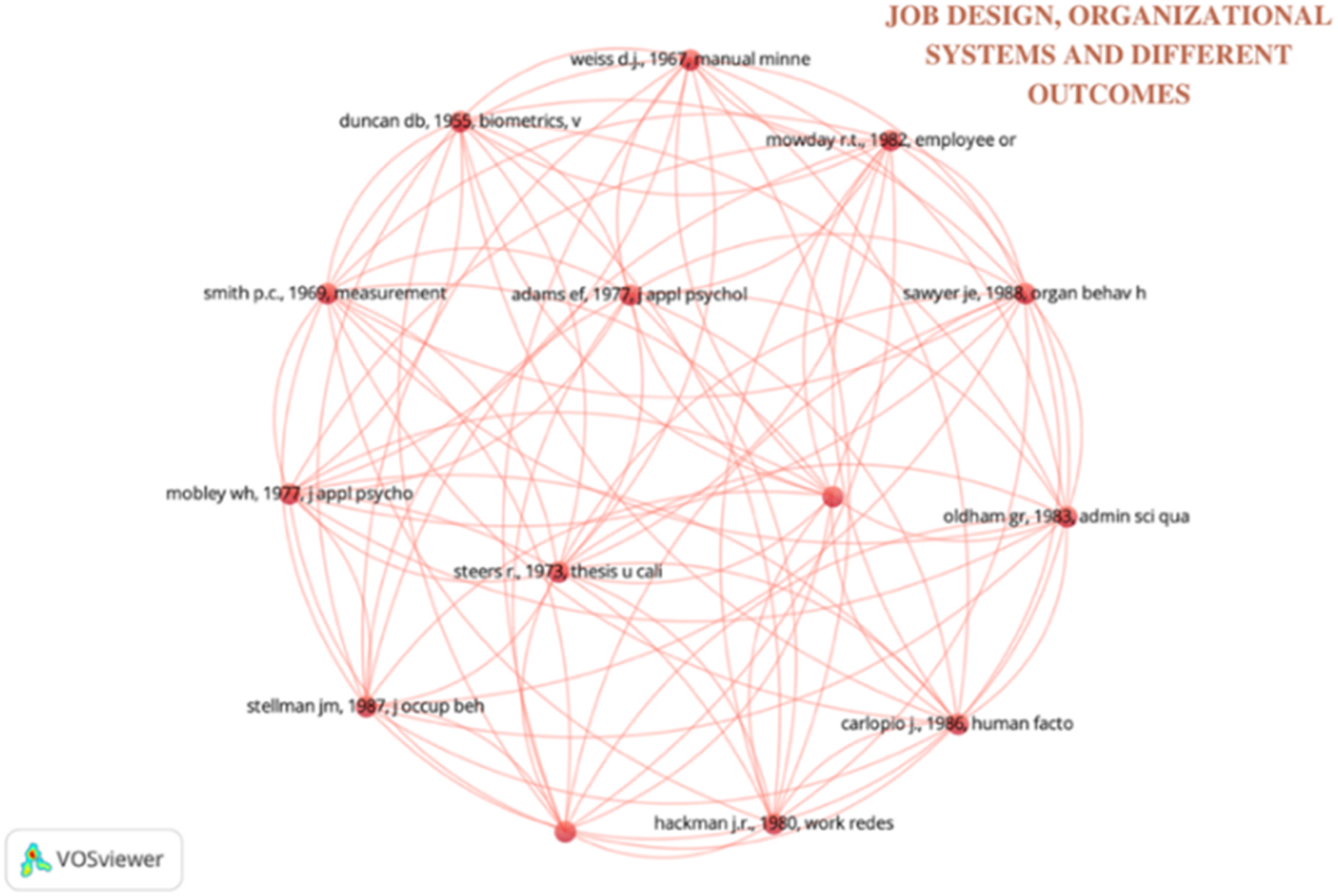
Results for the Second Period (1996–2010)
In this group, 25 journal articles were analyzed. From those, we obtained 41 items that formed three clusters: (1) HRM, capabilities, and leadership; (2) Telework, firm resources, and competitive advantage; and (3) Factors of (effective) telecommuting. The total link strength was 432, with 360 links between those articles (see Figure 2). Co-citation Map: Documents Forming the Intellectual Structure of the Field (1996–2010)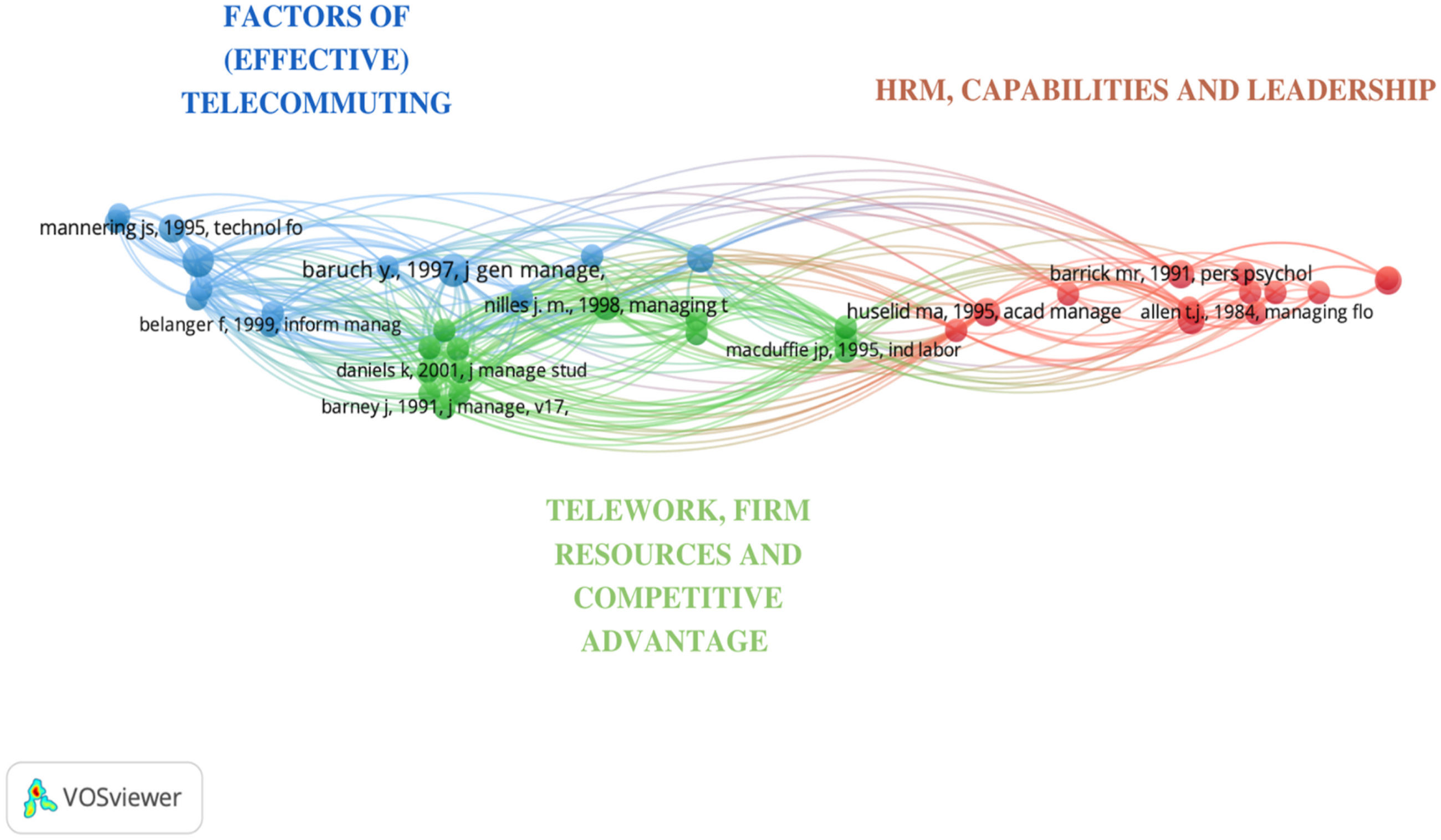
Results for the Third Period (2011–2020)
This was the largest of three groups and 67 articles were analyzed. From these, we obtained 55 items, forming four clusters: (1) Work (re)design; (2) Antecedents and consequences of telework; (3) Work design research 2.0 (i.e., the second generation of work design research); and (4) Digital work design. The total link strength was 1,622, with 911 links between those articles (see Figure 3). Co-citation Map: Documents Forming the Intellectual Structure of the Field (2011–2020)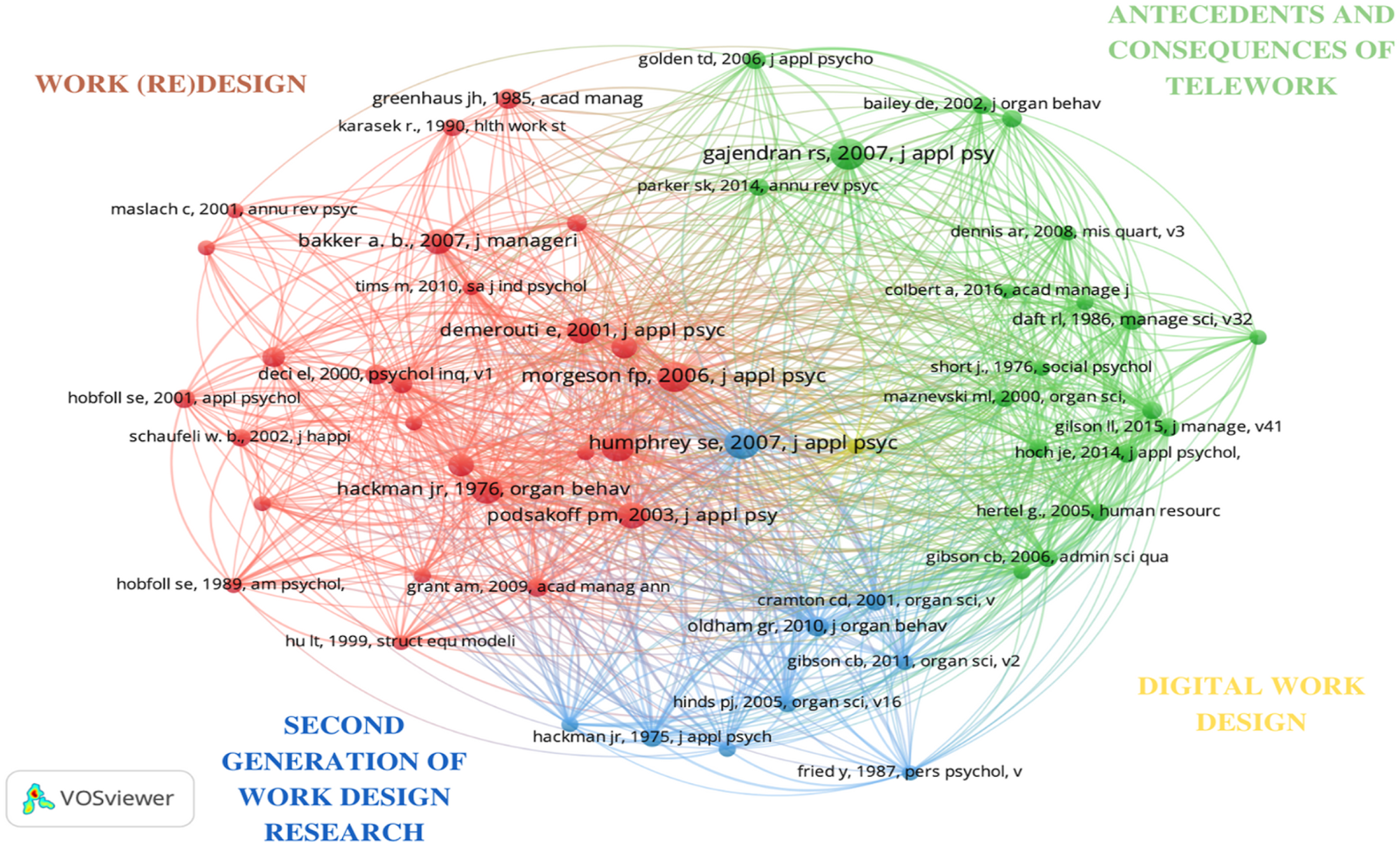
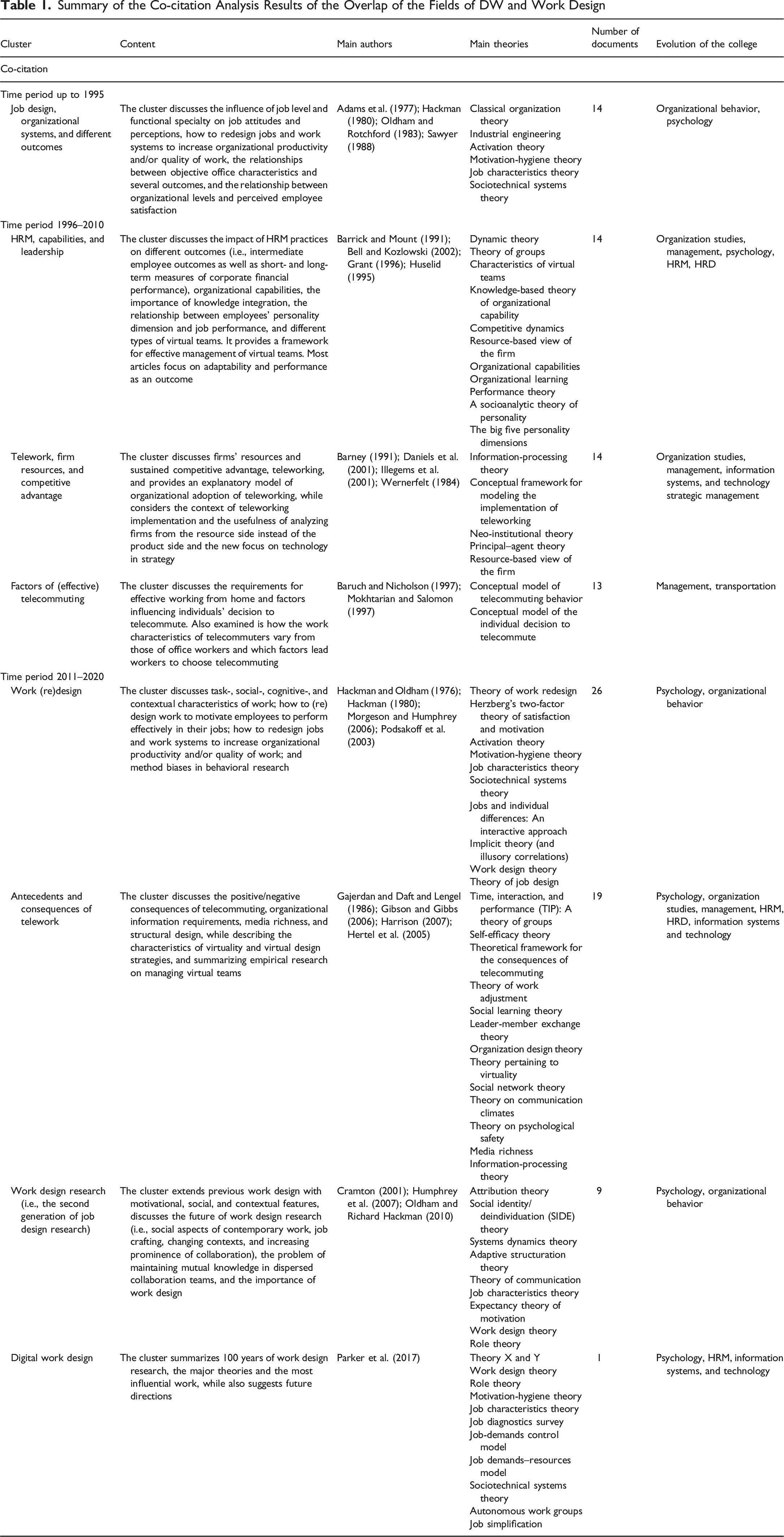
Summary of the Co-citation Analysis Results of the Overlap of the Fields of DW and Work Design
Co-occurrence (Co-word) Analysis
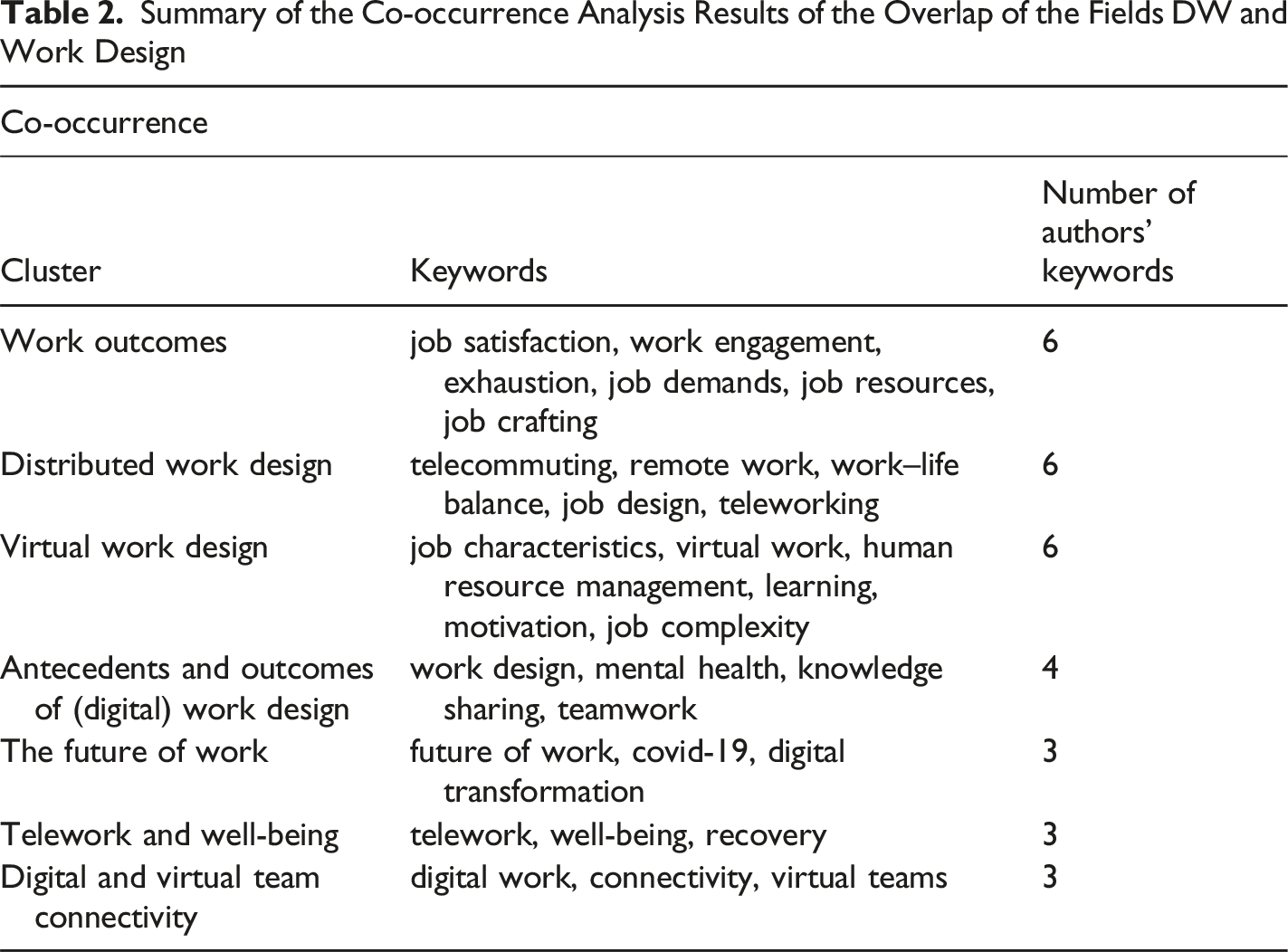
We analyzed 93 primary articles (obtained via a set of a maximum 16 keywords). With the minimum number of occurrences of the author’s keywords set to two, we obtained 31 items that made seven clusters (Figure 4): (1) Work outcomes; (2) Distributed work design; (3) Virtual work design; (4) Antecedents and outcomes of (digital) work design; (5) The future of work; (6) Telework and well-being; and (7) Digital and virtual team connectivity. A recap of these is shown in Table 2, which presents each cluster’s label, the list of highest-frequency keywords, and the number of all keywords included. Co-occurrence (Co-word) Map of Key Themes Associated With the Studied Area Summary of the Co-occurrence Analysis Results of the Overlap of the Fields DW and Work Design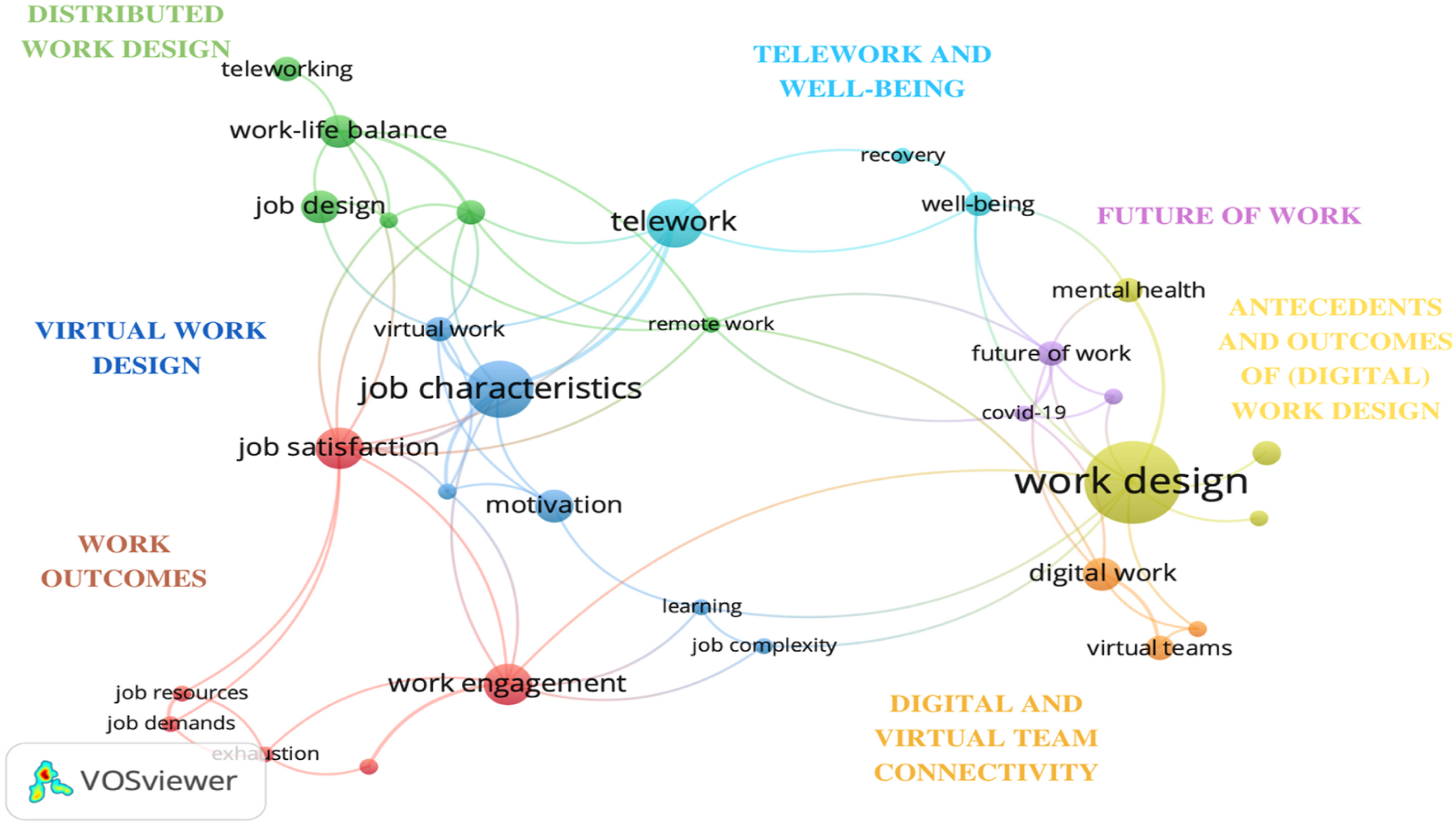
Topic Modeling
Summary of the Topic Modeling Analysis Results on the Overlap of the Fields of DW and Work Design
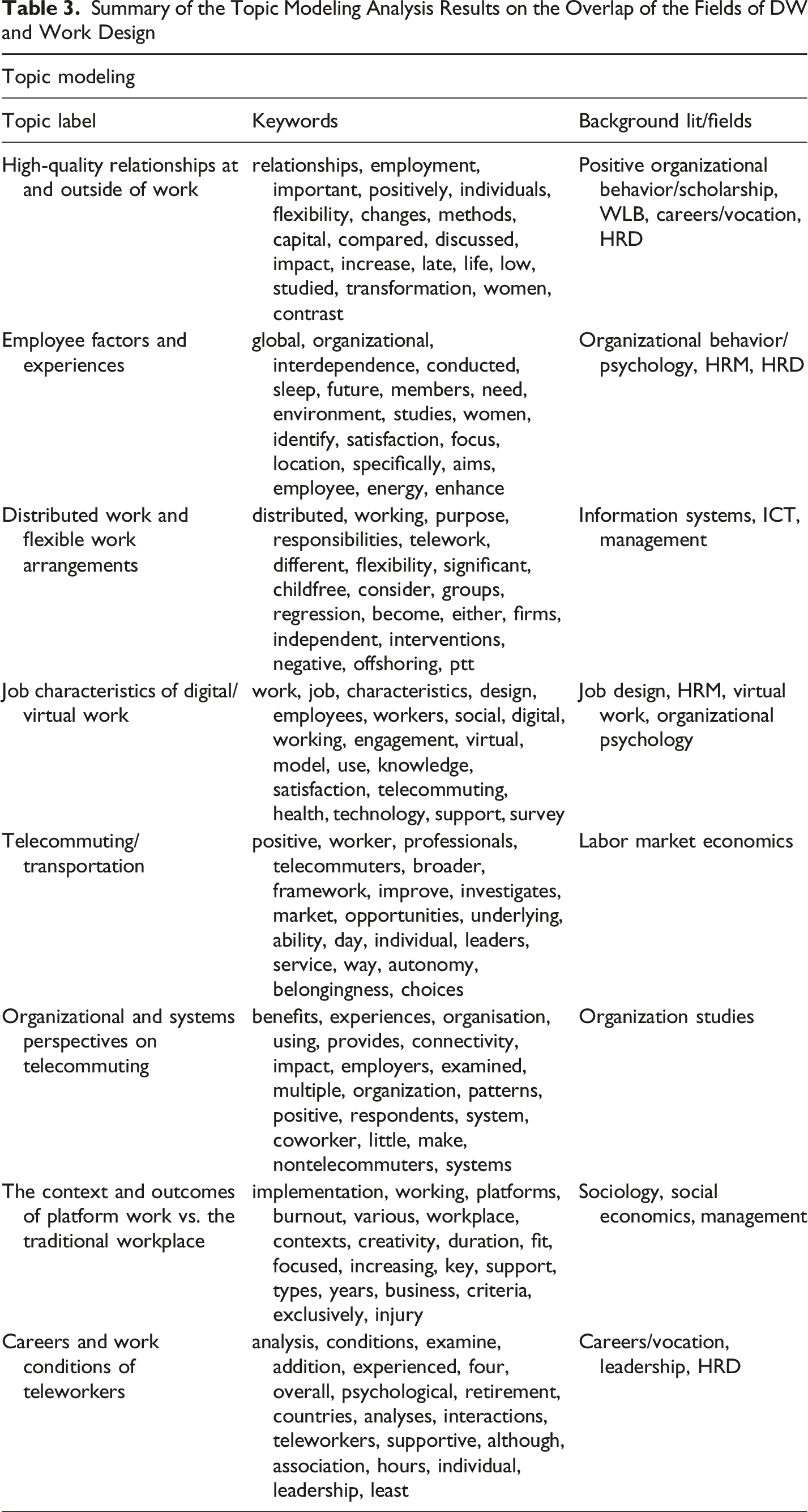
These topic modeling results provide more than just thematic organization—they offer insights into how DW reconfigures foundational work design concerns. For instance, topics featuring “belongingness” and “support systems” suggest a reemergence of social and relational job elements, echoing the importance of interpersonal context emphasized in Morgeson and Humphrey’s (2006) relational work design characteristics. Similarly, themes such as “flexibility,” “coordination,” and “hybrid work models” challenge the stability of constructs like task identity and autonomy, which were initially conceptualized in more stable, co-located environments (Hackman & Oldham, 1976; Parker, 2014). The emergence of “leadership,” “motivation,” and “job crafting” also signals that adaptive, individualized work structuring—often absent in traditional models—is increasingly central in DW environments. These findings point to theoretical areas where core work design constructs may require reinterpretation or expansion to remain relevant in distributed settings.
Bibliographic Coupling
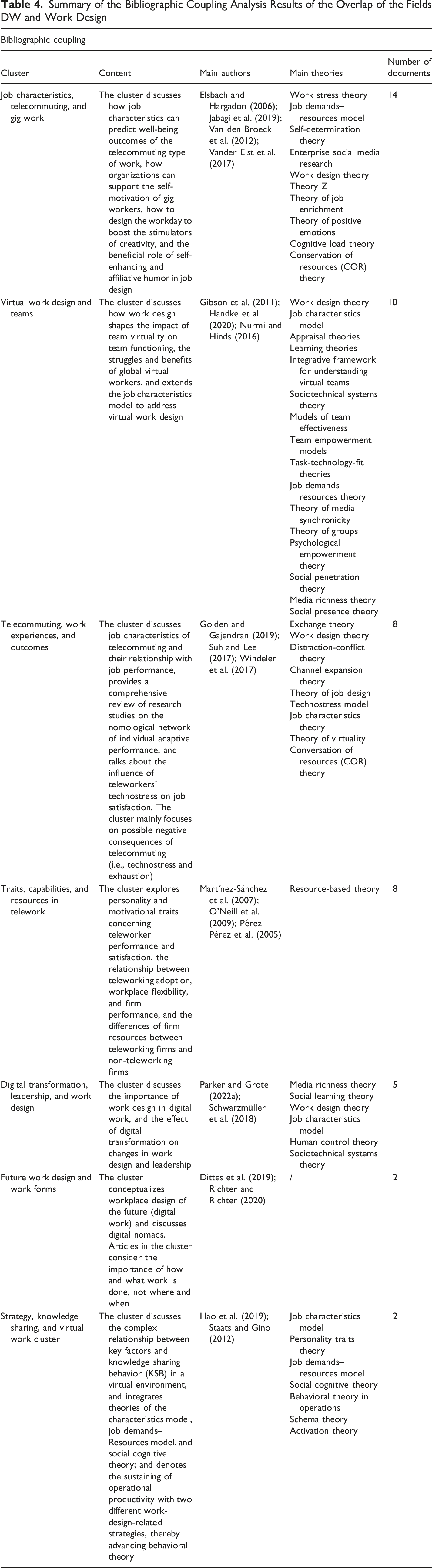
We analyzed 93 articles and obtained 49 items, forming 7 clusters (see Figure 5): (1) Job characteristics, telecommuting, and gig work; (2) Virtual work design and teams; (3) Telecommuting, work experiences, and outcomes; (4) Traits, capabilities, and resources in telework; (5) Digital transformation, leadership, and work design; (6) Future work design and work forms; and (7) Strategy, knowledge sharing, and virtual work. The total link strength was 693 and 325 links were found between those articles. Bibliographic Coupling Map of the Research Front of the Field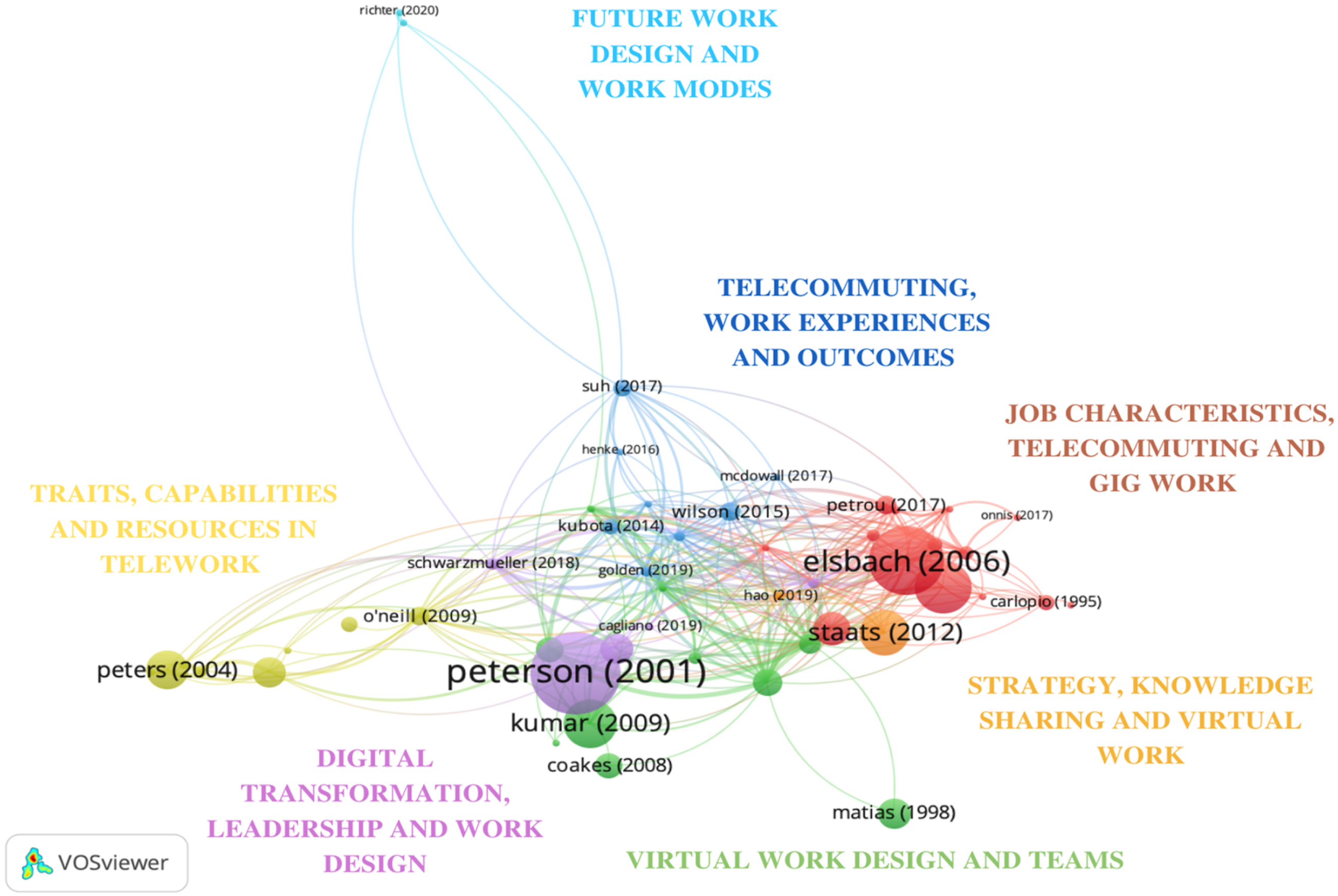
Summary of the Bibliographic Coupling Analysis Results of the Overlap of the Fields DW and Work Design
The Post-covid-19 Pandemic Period: Co-occurrence, Topic Modeling, and Bibliographic Coupling
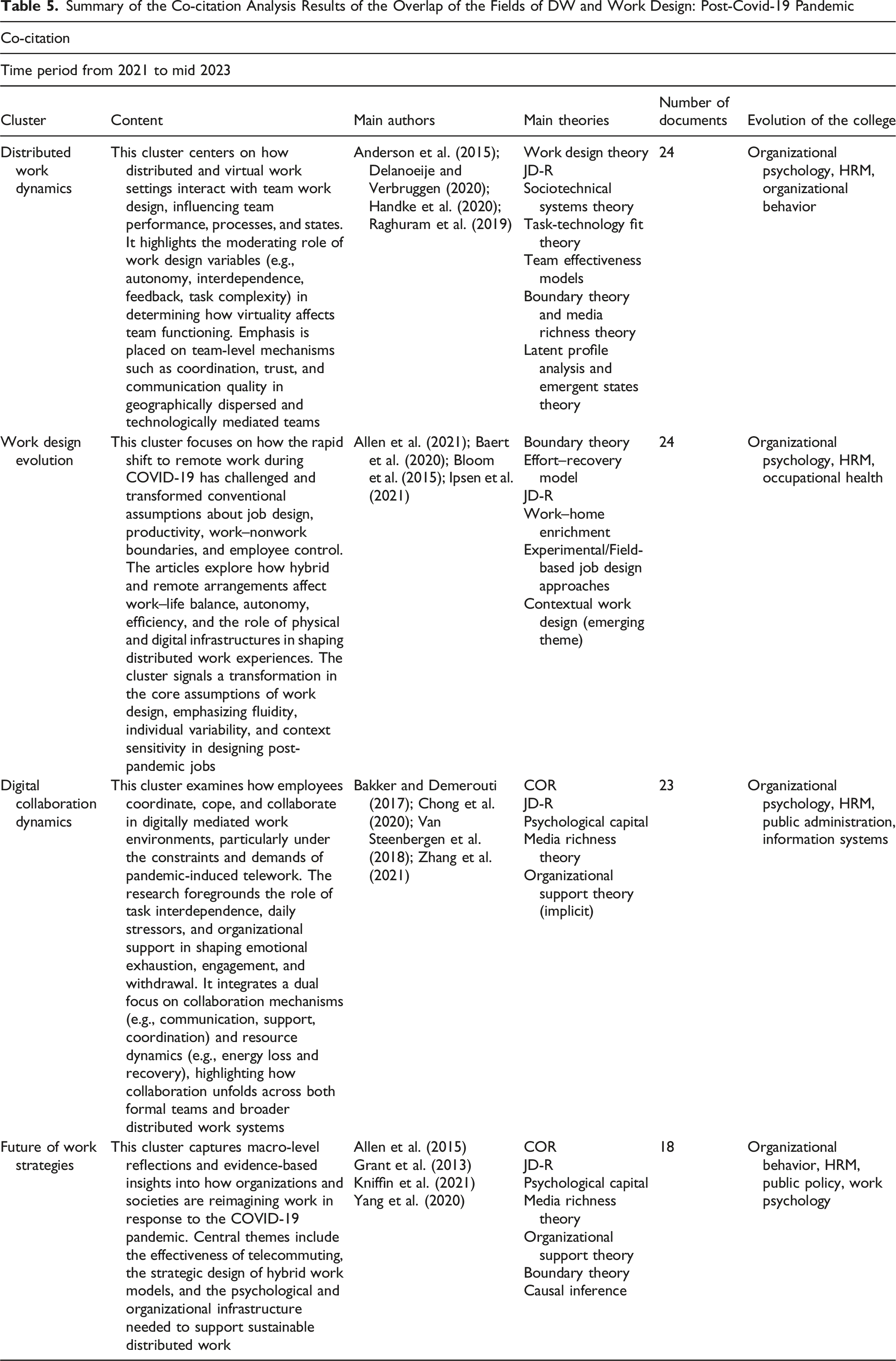
Summary of the Co-citation Analysis Results of the Overlap of the Fields of DW and Work Design: Post-Covid-19 Pandemic
Co-citation Analysis: Post-covid-19
After setting a threshold of minimum number of citations of a cited reference to five, we obtained 89 items, forming four clusters: (1); (2); (3); and (4). The total link strength was 4,201, with 2362 links between those articles (see Table 5 and Figure 6). Co-citation Map: Documents Forming the Intellectual Structure of the Field (2021-Mid-2023)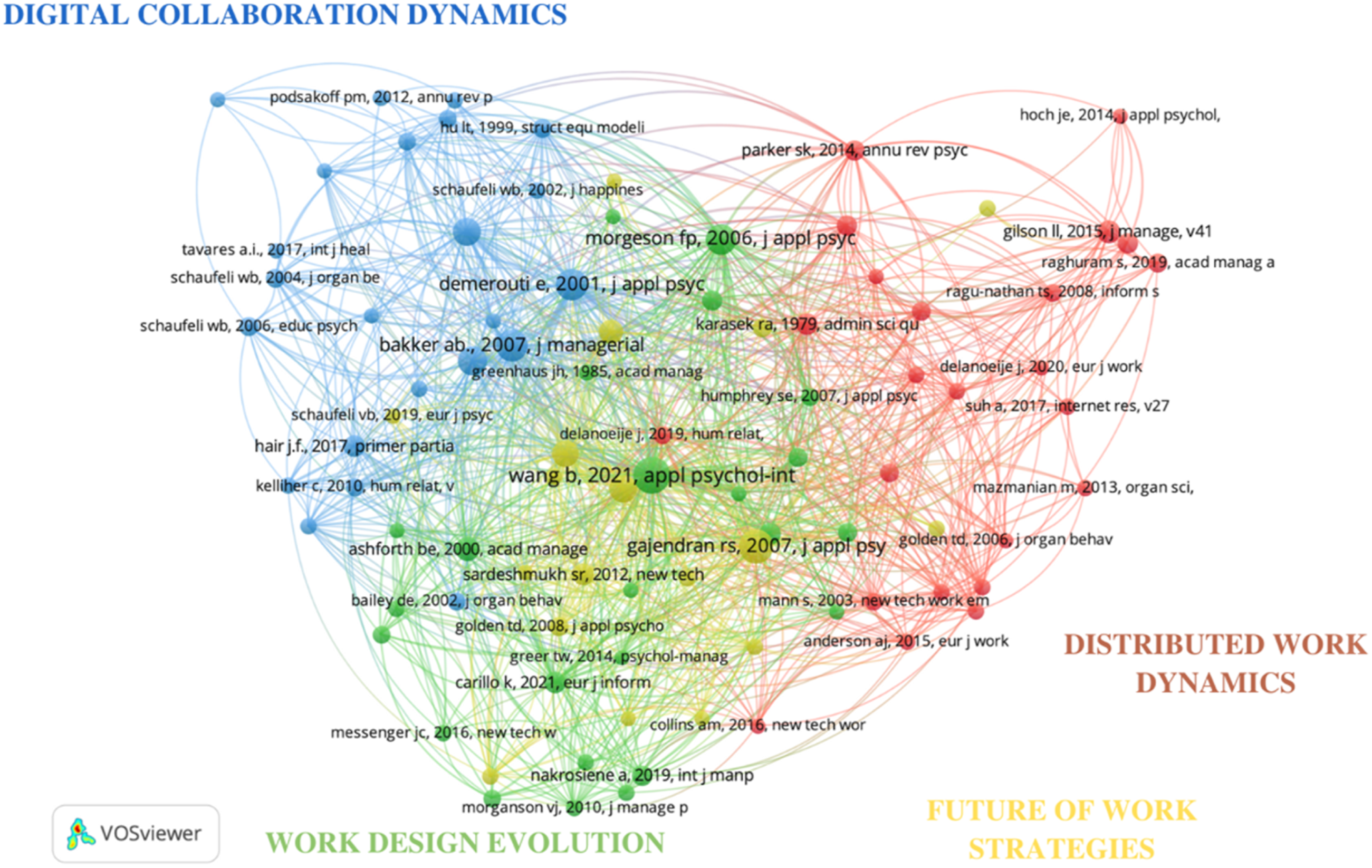
Figure 7 displays the development patterns of DW research related to work design. These development patterns were selected based on the conceptual framework of “invisible colleges,” which suggests that colleges can evolve in seven ways (i.e., the college’s appearance, and its transformation, drift, differentiation, fusion, implosion, and revival). They are founded on observations and interpretations of the findings of the co-citation analysis (see Figures 1–3 and Figure 6). Development Patterns of DW Research in Connection With Work Design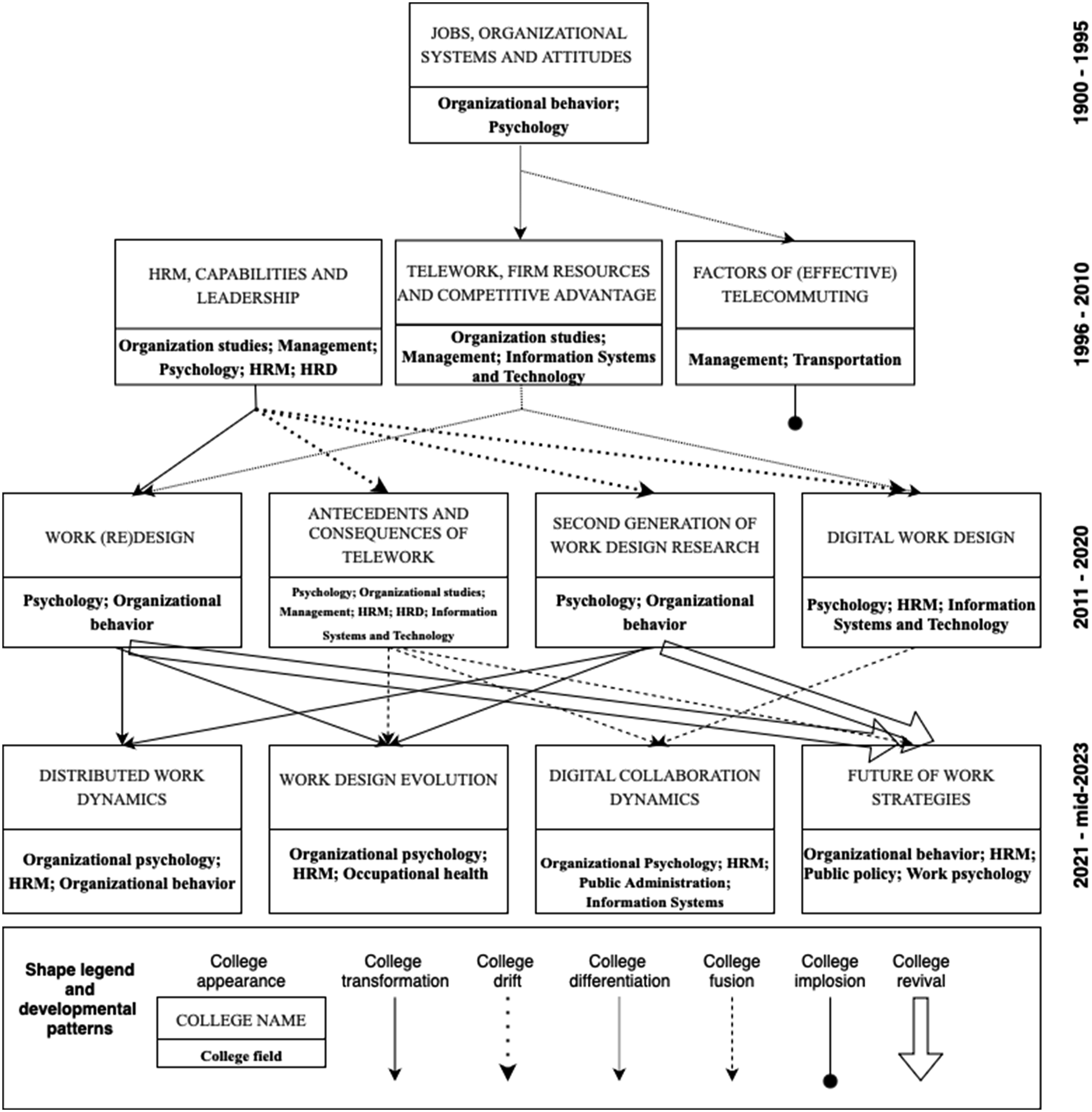
In the first period, there was only one college, Jobs, organizational systems, and different outcomes, with studies largely rooted in organizational behavior and psychology (OB/OP), drawing on theories such as Activation theory, Motivation-hygiene theory, Job characteristics theory, and Sociotechnical systems theory. This college later evolved into HRM, capabilities, and leadership, where earlier topics were reframed through the lenses of HRM, HRD, and general management. At the same time, parts of the original college drifted into two new colleges: Telework, firm resources, and competitive advantage and Factors of (effective) telecommuting, reflecting growing interest from information systems, technology, and transportation fields. Research in this phase began to differentiate work design characteristics across work forms and introduced conceptual frameworks related to telecommuting.
In the third examined period, Antecedents and consequences of telework and Digital work design emerged through the fusion of earlier colleges, while Work re(design) and The second generation of work design research formed through differentiation from HRM, capabilities, and leadership. This stage marked a shift toward future-focused work design, incorporating technological, motivational, social, and contextual elements, and saw increasing application of Social Networks, Media Richness, and Information Processing theories. In the fourth and most recent period (2021 to mid-2023), four new colleges emerged as the field responded to the global disruption of work brought on by the COVID-19 pandemic. These colleges reflect both conceptual renewal and methodological expansion. Distributed work dynamics represents a transformation of prior work design research, emphasizing how design variables (e.g., autonomy, feedback, interdependence) shape functioning in technologically mediated, team-based remote settings. Work design evolution also follows a transformation pattern, revisiting foundational assumptions of job design by incorporating empirical insights from hybrid work, boundary management, and post-pandemic flexibility, while partially fusing with prior telework research. Digital collaboration dynamics reflects a clear fusion of the Digital work design and Antecedents of telework colleges, integrating resource-based theories and support mechanisms to explain how collaboration unfolds in distributed, digitally mediated environments. Lastly, Future of work strategies marks a revival of older research on telecommuting and work design, reenergized by global attention to flexible work, and fuses empirical and conceptual contributions from multiple domains, including organizational behavior, public policy, and computational social science, to propose future-oriented, strategic approaches to distributed work. These developments signify a broadening of theoretical perspectives, an integration of macro- and micro-level insights, and an increasing emphasis on adaptability, resilience, and sustainability in the design of DW.
Co-word Analysis: Post-covid-19
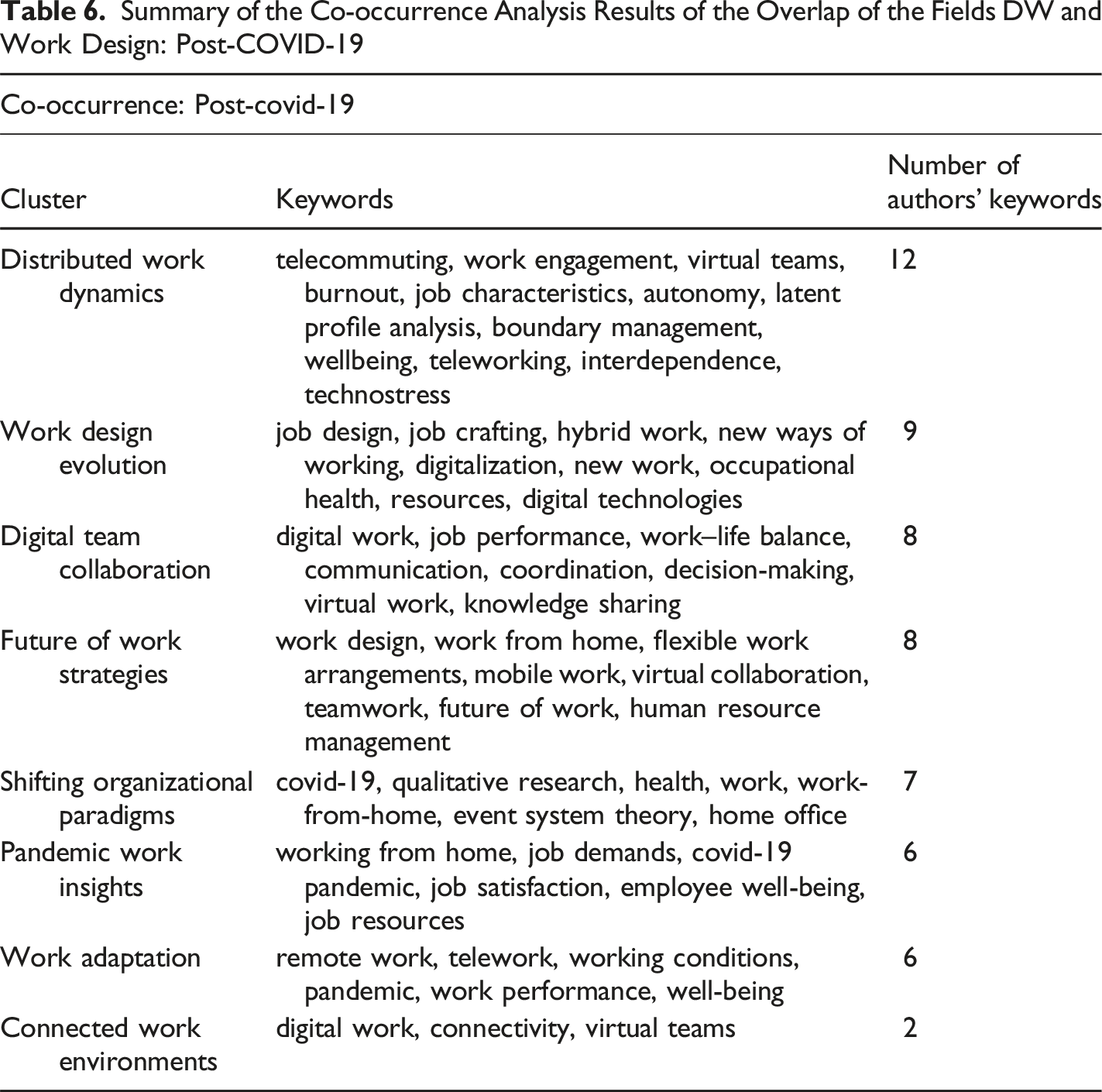
We analyzed 115 primary articles that contained 413 authors’ keywords. We set the minimum number of occurrences of author keywords to two, yielding 58 items that formed 8 clusters (Figure 8; Table 6): (1) Distributed work dynamics; (2) Work design evolution; (3) Digital team collaboration; (4) Future of work strategies; (5) Shifting organizational paradigms; (6) Pandemic work insights; (7) Work adaptation; and (8) Connected work environments. There were 235 links and the total link strength was 312. Co-occurrence (Co-word) Map: Themes Post-Covid-19 Pandemic Summary of the Co-occurrence Analysis Results of the Overlap of the Fields DW and Work Design: Post-COVID-19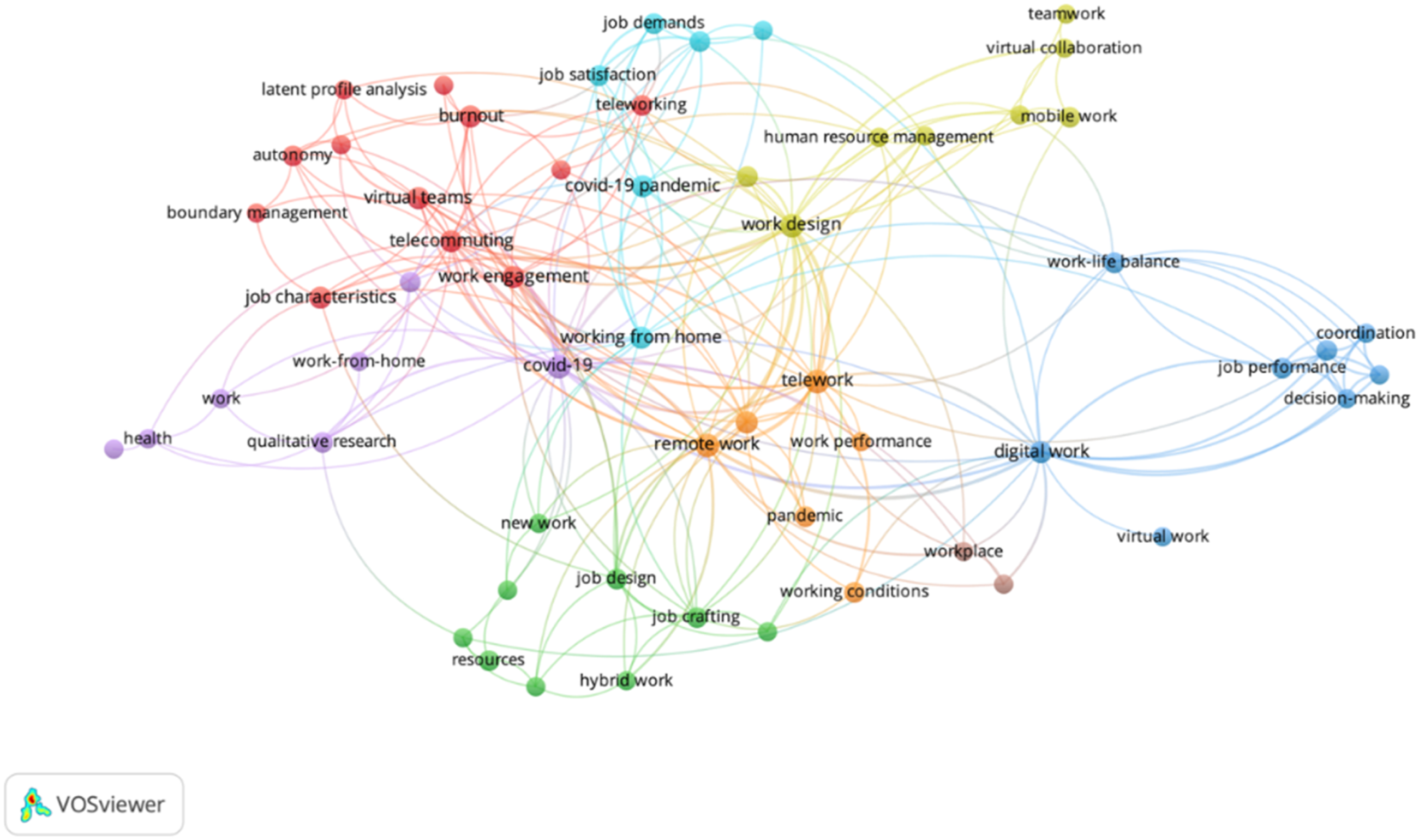
Topic Modeling: Post-covid-19
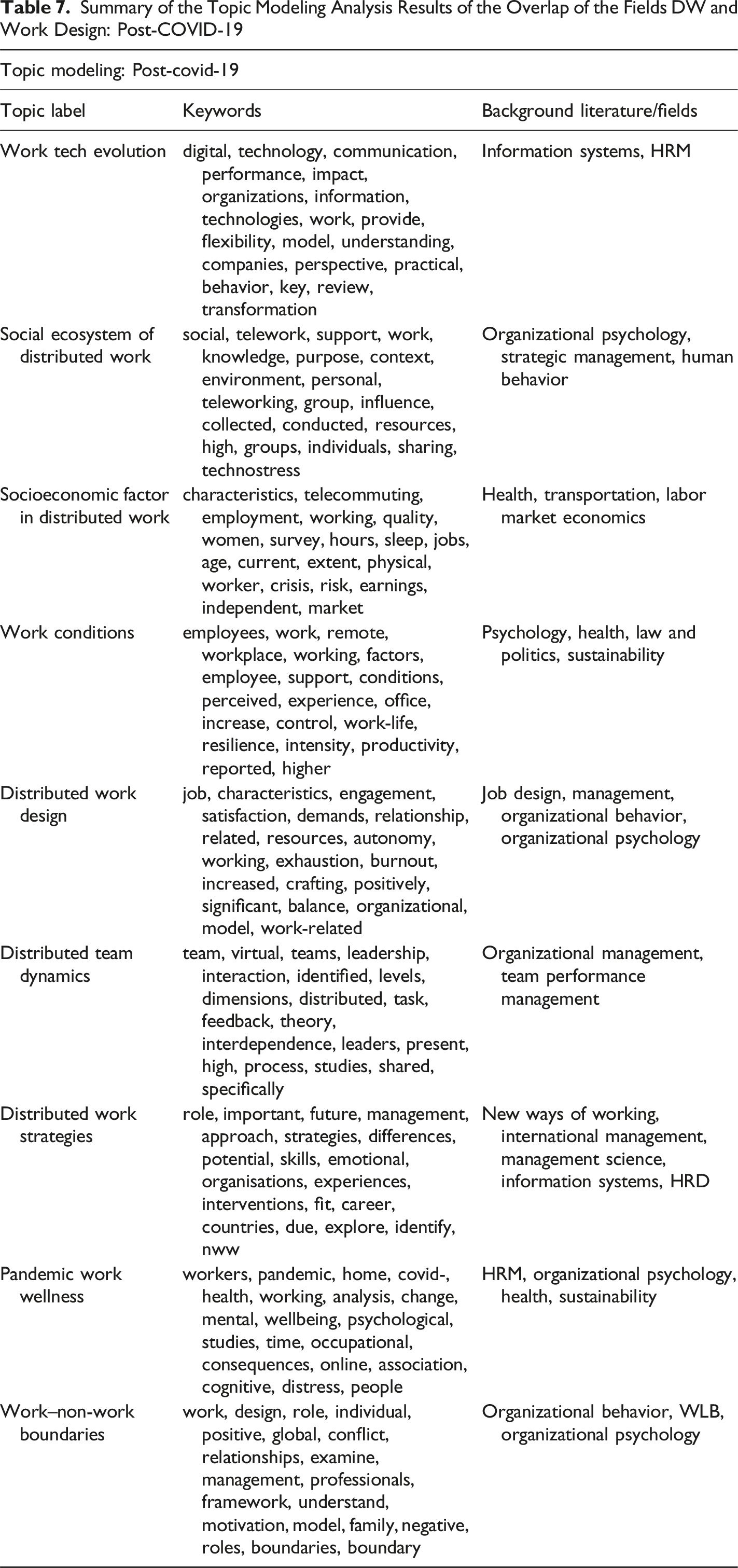
Summary of the Topic Modeling Analysis Results of the Overlap of the Fields DW and Work Design: Post-COVID-19
Bibliographic Coupling: Post-covid-19
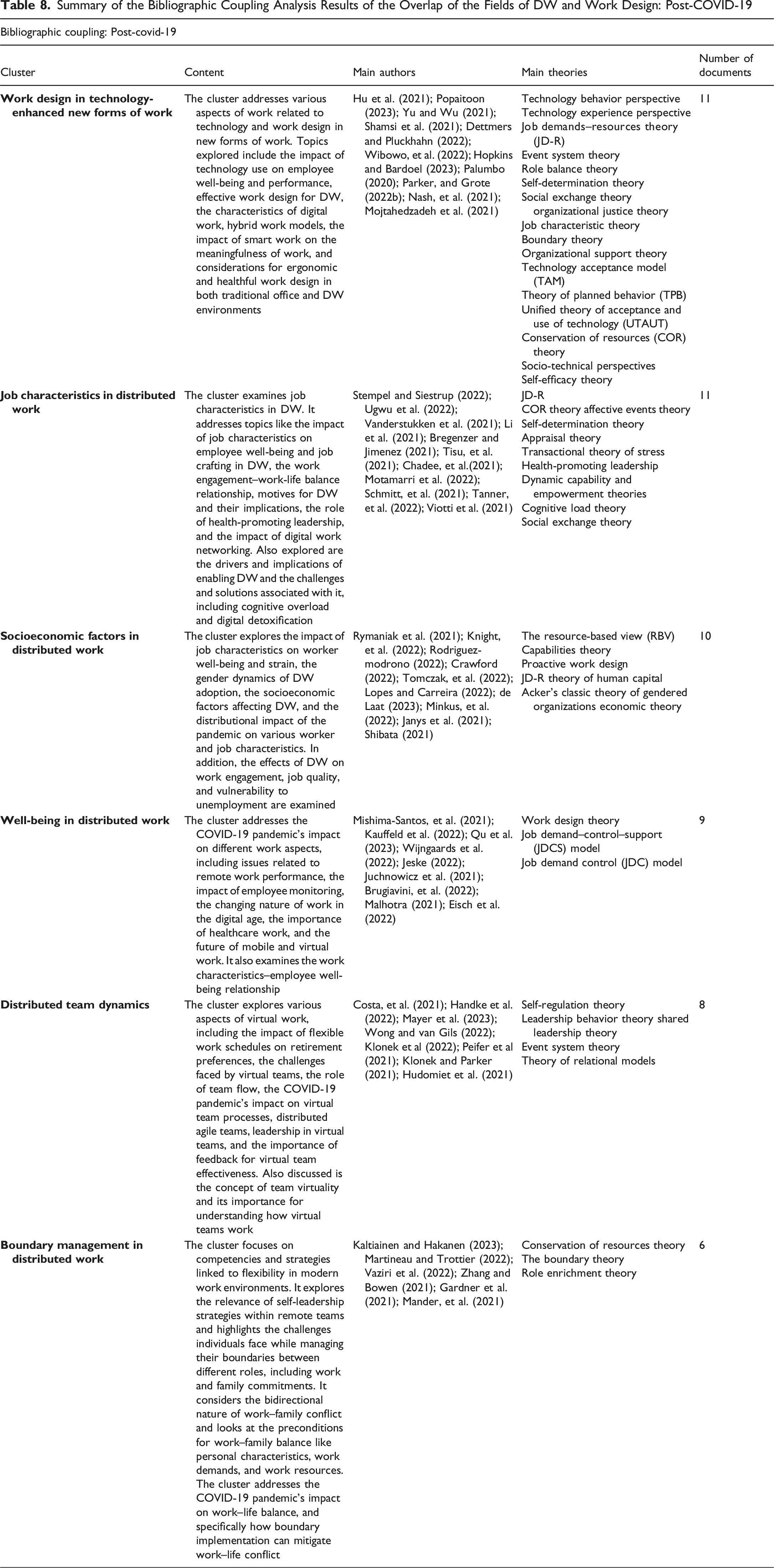
For the new set of articles, the same analysis steps were performed as before, with the minimum number of citations set to 2. All 115 of the most recent articles were analyzed. This resulted in 55 items, which formed six clusters (see Figure 9, Table 8): (1) Work design in technology-enhanced new forms of work; (2) Job characteristics in distributed work; (3) Socioeconomic factors in distributed work; (4) Well-being in distributed work; (5) Distributed team dynamics; and (6) Boundary management in distributed work. The total link strength was 1,204, with 517 links being found between those articles. Bibliographic Coupling Map: Research Trends Post-Covid-19 Pandemic Summary of the Bibliographic Coupling Analysis Results of the Overlap of the Fields of DW and Work Design: Post-COVID-19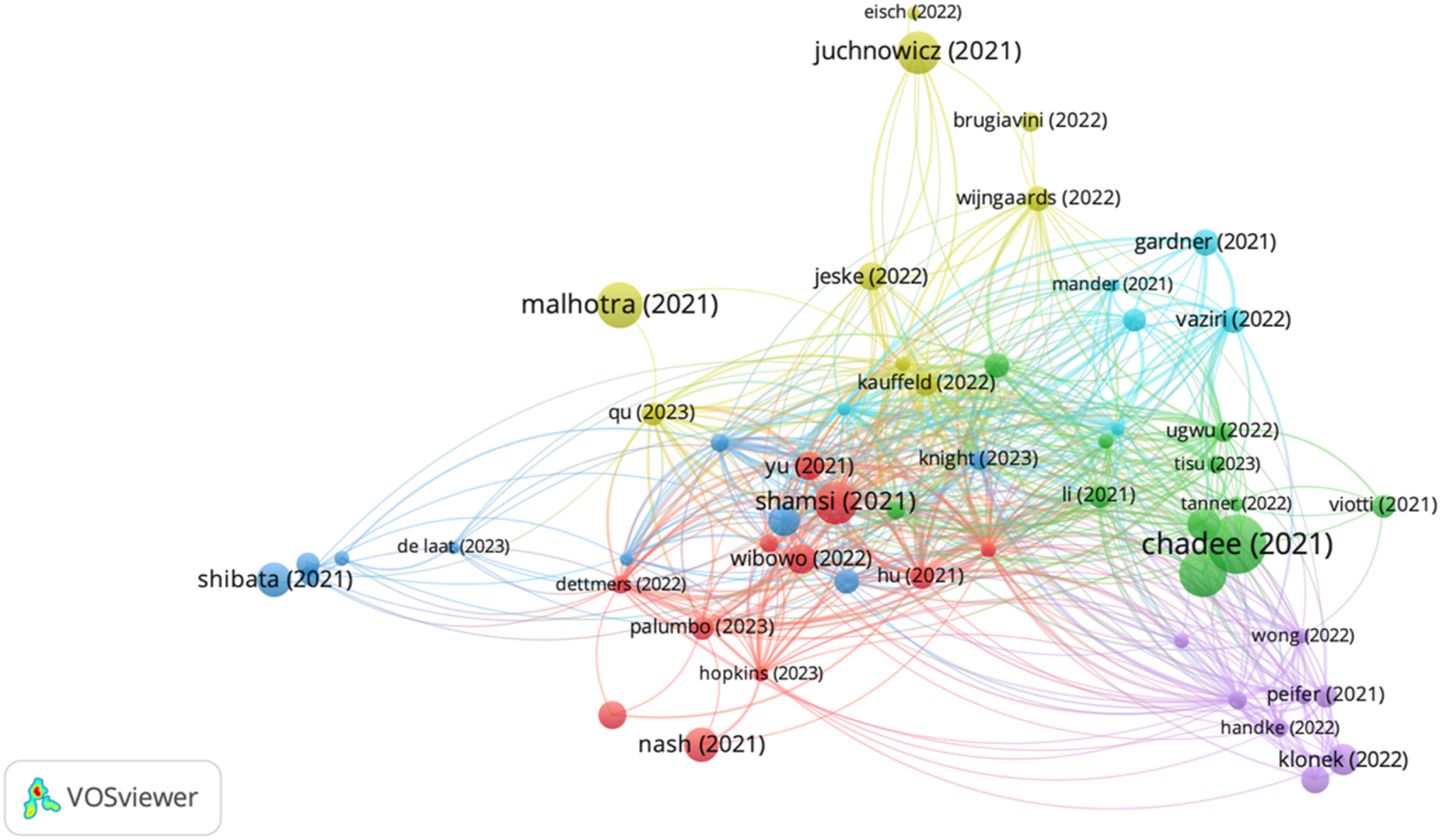
Discussion and Conclusion
Overview of the Findings
Combining four (bibliometric and text analysis) systematic review techniques enabled us to answer all research questions. It revealed, perhaps surprisingly, that few primary papers addressed the overlap of DW and work design, leaving ample room for future research. Still, we were able to generate three sets of valuable insights.
The Intellectual Structure at the Intersection of the Fields of DW and Work Design and Its Evolutionary Path
To portray trajectories of scholarly discussion over time based on intellectual foundations in certain periods, the developed ‘invisible colleges’ framework shows that research related to the intersection of DW and work design has significantly increased in the last decade. Although this research niche initially stemmed from the OB/OP field, it was later built by embracing theoretical insights from management, HRM, HRD, and information systems and technologies. In the first observed period, using Activation, Job design characteristics, and Motivation-hygiene theories, authors noted the need to redesign jobs away from routine work, and to motivate workers by making their work more meaningful and identifiable. The literature began to incorporate Sociotechnical systems theory, which is about people working with technology in ways that would benefit society and further the organization’s goals. We observe that the literature on job design started to include technology as an important factor in work, and that technology was recognized as a potential future work component, albeit it was not yet specifically discussing DW forms.
While research in the first examined period focused primarily on the micro level—individuals within their work context—the second period introduced a macro-level perspective, emphasizing strategic, industrial economics, and firm competitiveness angles. The RBV gained prominence, positioning technology and work design as key organizational resources linked to performance and competitive advantage. During this time, many core concepts related to DW were conceptualized, and models such as the conceptual framework for modeling the implementation process of teleworking began to emerge, signaling the rise of new work forms requiring deeper exploration. Researchers provided valuable insights into the implementation, benefits, and challenges of these arrangements, offering practical relevance for HRM and HRD. This period also saw increased focus on team dynamics in new versus traditional work forms, with studies drawing on information processing theory to highlight the importance of regular, computer-mediated communication in building interpersonal connections in virtual environments. In the final observed period, research included both micro (e.g., self-efficacy theory) and macro (e.g., organization design theory) theories. Although in the first period the issues of work design and technology were basically separate, in this period they are beginning to intertwine, with the intersection of work design and DW growing much larger in scope. The fields of OP and management, specifically HRM and HRD, started to be integrated into the fields of information systems and computer science, as may be seen in overflowing theories like social identity/deindividuation and media richness theories.
Evolution of Theoretical Foundations for Addressing HRD-specific Challenges in DW and Work Design
In the early period (pre-1995), theoretical foundations concentrated on individual motivation and job design, establishing the grounds for understanding how meaningful work supports employee development. In the middle period (1996–2010), theories expanded to strategic and firm-level perspectives, considering HRD challenges linked to telework implementation, organizational resources, and employee adaptability within DW environments. In the most recent period (2011–2020), theories integrated both individual and organizational perspectives, addressing nuanced HRD challenges like developing communication strategies, enhancing self-efficacy, and creating work design frameworks that support continuous learning and adaptability in DW contexts. ADD.
The Main (Mostly Studied) Study Topics Associated with DW and Work Design: a Systematic Approach to DW design
The present research shows that DW is not adequately explained by existing work design models (i.e., JCM, WDQ, JD-R). Thus, by juxtaposing the two generally unrelated research domains of DW and work design, we developed an integrative framework for DW design (Figure 10). Our framework represents a build up to the WDQ as we incorporated the workplace ICT use (Wang et al., 2020) in the work design characteristics repository on the job level, together with two DW characteristics that with co-word analysis and topic modeling we revealed to be extremely relevant: form of work (i.e., work at the office, hybrid work, DW) and intensity of telework (i.e., the extent of scheduled time employees spend doing tasks away from the central work location; Gajendran & Harrison, 2007) on the individual level. ICT characteristics include the following characteristics: IT complexity, IT presenteeism, pace of IT change (also labelled techno uncertainty) that were already recognized by Suh and Lee (2017) as well as technology overload and information exchange via ICT that involves information exchange frequency and quality (Fonner & Roloff, 2010). Integrative Framework for DW design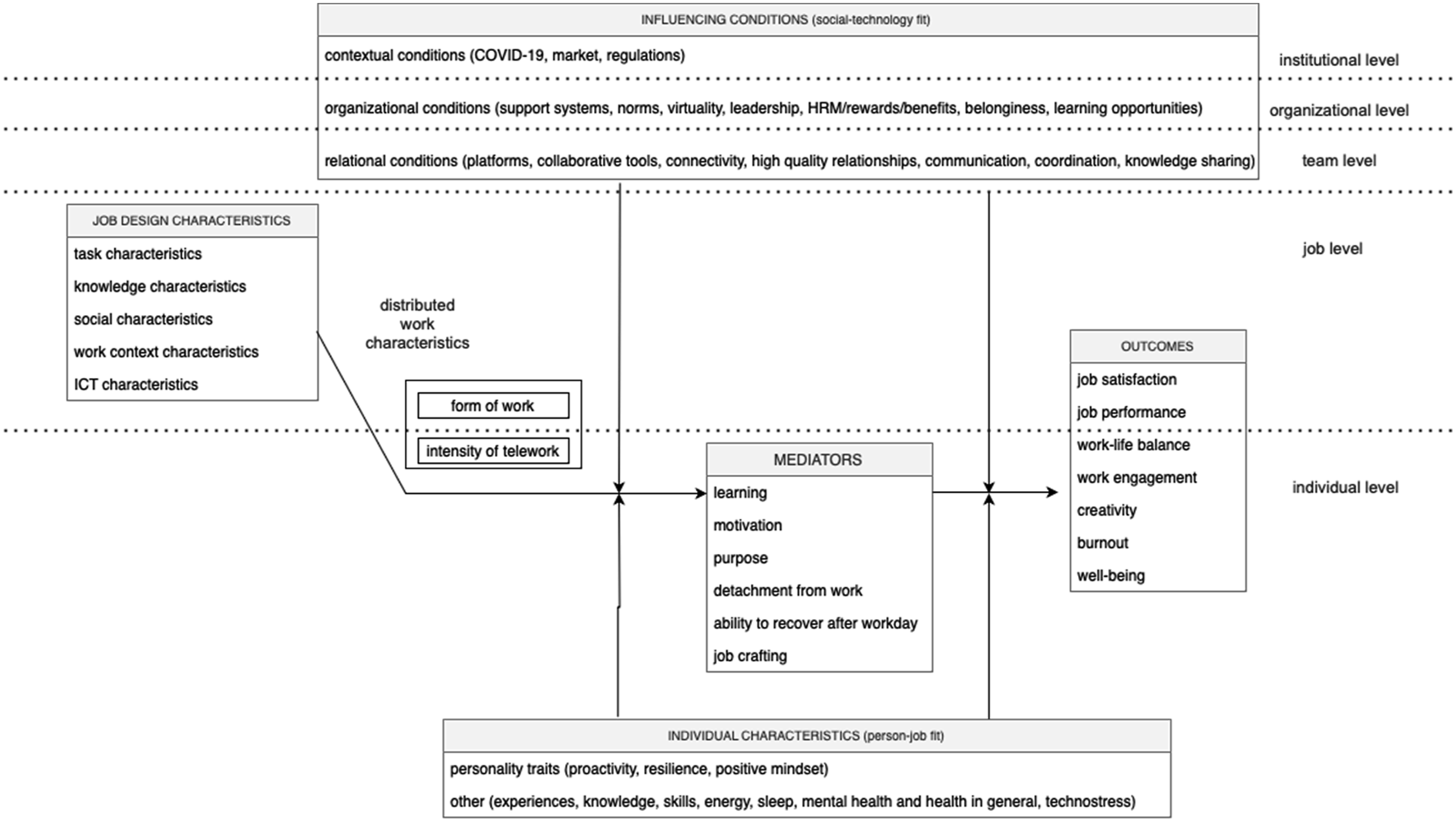
Influencing (contextual or boundary) conditions targeting the social–technology fit represents another extension of the existing work design theory, especially from an HRD perspective. Specifically, with the help of the co-occurrence analysis, we recognized and added contextual (i.e., COVID-19, market, regulations) conditions on the institutional level, which are critical for understanding how HRD strategies must adapt to evolving work environments. Topic modeling further assisted us to identify additional organizational conditions, including HRM/rewards/benefits, belonginess, virtuality, leadership, support systems, norms. These factors are essential for HRD professionals since they design and implement learning and development programs that are responsive to the needs of a distributed workforce. On the team level, relational condition, such as digital platforms, collaborative tools, connectivity, high-quality relationships, communication, coordination and knowledge sharing, were identified. These are key considerations for HRD in fostering effective team dynamics and promoting continuous learning in DW settings.
Next, as underlying mechanisms or mediators, we included two factors relevant for HRD on the individual level (beyond motivation and purpose) which were recently highlighted in the literature as being among the most important for a successful digital workplace: learning and detachment from work/importance of reset after work (Nurmi & Hinds, 2016), and job crafting that was shown to be a hot topic in the most current observed period (from 2021 to mid-2023). This underscores the growing need for HRD strategies that empower employees to tailor their roles to align with their own strengths and preferences, particularly in DW environments. Finally, both individual characteristics (as person–job fit moderators) and individual-level outcomes (as a desired work–life alignment) that complement contextual, organizational, and relational conditions, ICT and work flexibility considerations make our framework more coherent.
Informing HRD Initiatives: Fostering Skills Development, Collaboration, and Leadership in Distributed Teams
Our integrative framework identifies key areas that inform HRD initiatives. The inclusion of ICT characteristics like IT complexity, technology overload, and information exchange quality points to the need for digital skills training to make sure employees can effectively use tools, manage information, and adapt to evolving technologies. Contextual factors such as COVID-19 and market dynamics stress the importance of HRD programs that enhance agility and resilience in response to external changes. Organizational conditions, including belongingness and leadership, emphasize the fostering of inclusive cultures, effective virtual leadership, and robust support systems to ensure psychological safety and connection in remote work. On the team level, communication, collaboration, and knowledge sharing show the need for HRD programs which develop virtual teamwork skills and relational dynamics. Empowering employees by way of job crafting initiatives that promote autonomy and self-directed learning boosts engagement and motivation. Finally, addressing well-being and work–life balance via training on time management, boundary-setting, and mindfulness is essential for managing workload pressures and preventing burnout in DW settings.
Current Debates and Emerging Topics of Interest at the Intersection of DW and Work Design
The bibliographic coupling method revealed which themes presently attract the attention of this field. For instance, strong emphasis has been placed on the future of work topics in the light of digital technology. Therefore, digital and virtual team connectivity, digital transformation, the functionality of virtual teams, and the antecedents and outcomes of (digital) work are associated with the intersection of the fields of DW and work design.
From an HRD perspective, these findings highlight the rapidly evolving landscape in which professionals must operate. The growing emphasis on digital work environments underscores the need for HRD interventions that enhance virtual team functioning, build digital literacy, and foster connectivity across distributed teams. Importantly, emerging research also points to the rising value of relationship-based leadership and individual consideration (Schwarzmüller et al., 2018), which promote leadership practices tailored to employees’ individual characteristics and needs. We propose that similar personalization should extend to work design, as bibliometric evidence shows increasing attention to individual traits such as proactivity, resilience, and positive mindset; motivational factors like self-motivation in gig work; workplace experiences including high-quality relationships, humor, engagement, and job satisfaction; and personal outcomes such as mental health, recovery, and work–life balance. These trends suggest that future work design must account for individual differences and the growing interconnection between work and non-work domains. HRD professionals can respond by developing leadership programs and work design strategies that embrace personalized, human-centered approaches in distributed settings.
The post-COVID research front further reveals increasing consideration of socioeconomic factors such as age and gender, as well as heightened concern for boundary management and employee well-being. This includes attention to cognitive overload, digital detox strategies, and newer theoretical lenses such as Acker’s theory of gendered organizations, boundary theory, and event system theory. These developments point to a broader, more interdisciplinary intersection between information systems and work design, with a notable integration of organizational psychology constructs like well-being and mental health. For HRD, this signals a growing need for nuanced strategies that address the diverse experiences of distributed workers. The focus on boundary management and well-being reinforces HRD’s role in creating interventions that not only support skill development but also promote resilience, mental health, and healthy work–life boundaries in technology-driven work environments.
Leveraging Emerging Trends to Design Innovative Approaches for Employee Development and Career Progression in DW Settings
To design innovative approaches for employee development and career progression in DW settings, HRD can leverage emerging trends that offer actionable insights for creating adaptable, personalized, and effective strategies. The growing reliance on digital tools and virtual collaboration highlights the need for robust digital literacy programs, including training in collaborative technologies, information management, and cybersecurity. Upskilling in emerging areas such as AI and automation ensures that employees remain competitive in rapidly evolving environments. Personalized work design and leadership approaches, supported through self-assessments, job crafting, and coaching, enable employees to align their roles with their strengths and aspirations, boosting engagement and satisfaction.
Virtual mentoring and coaching create accessible avenues for leadership development and continuous learning, while wellness initiatives addressing mental health, stress management, and work–life balance help sustain motivation and prevent burnout. HRD can further enhance team effectiveness by offering training in virtual collaboration, communication, conflict resolution, and trust-building. Addressing diverse employee needs through inclusive, flexible learning options supports equitable career progression across distributed teams. Adaptive leadership development that emphasizes empathy and virtual team management prepares leaders to effectively support their teams. Finally, fostering continuous learning and enabling job crafting empowers employees to actively shape their roles and career trajectories, ensuring long-term development and resilience in dynamic work environments.
Theoretical Implications for Management, Information Systems, and HRD Research
Our bibliometric findings underscore the need to reframe traditional work design theories in light of DW realities. It demonstrates that the field of DW is not merely an applied extension of traditional work design but represents a context with distinct demands, challenges, and enablers. Across the co-word analysis, topic modeling, and bibliographic coupling, recurring themes such as individualized support, coordination complexity, leadership adaptation, and virtual communication revealed a consistent tension between established design constructs (e.g., autonomy, task variety, feedback) and the fluid, technology-mediated structures typical of distributed settings. These findings suggest that DW does not merely extend conventional work design—it reshapes it. As such, we argue that HRD and organizational scholars must re-theorize how work characteristics are conceptualized and operationalized in contexts where flexibility, digital intermediation, and geographic dispersion are no longer exceptions but standard features of the workplace.
Our analyses demonstrate that DW is not simply an applied extension of traditional work design but represents a context with distinct demands, challenges, and enablers. The co-word and topic modeling results illustrate how clusters such as job satisfaction, telework intensity, mental health, autonomy, and connectivity reveal patterns of themes that go beyond conventional job design models. These themes collectively suggest that constructs like autonomy, feedback, or task identity may manifest differently in distributed contexts; being refracted through technology, virtual collaboration, and boundary permeability. Instead of treating these as entirely novel constructs, we see a pressing need to update and re-contextualize foundational models such as the JCM (Hackman & Oldham, 1976) and the WDQ (Morgeson & Humphrey, 2006) to reflect distributed realities. In this sense, our findings support the theoretical integration of DW into work design theory rather than treating it as an isolated or add-on concern.
Moreover, the bibliographic coupling and co-occurrence analyses reveal an emergent strand of literature that embeds DW considerations directly into theoretical development, particularly through constructs like digital overload, boundary management, job crafting, and virtual leadership. These constructs call for a multi-level theorizing approach that captures how digital infrastructure and distributed coordination shape job-level experiences and organizational outcomes. As such, our framework not only connects DW to traditional work design theory but also lays a foundation for a sociotechnical expansion of job design research. By explicitly accounting for ICT characteristics and distributed team dynamics, we propose a shift from static task-focused design toward adaptive, contextualized, and digitally enabled work design models.
Our multi-technique bibliometric review goes beyond mapping the conceptual terrain of DW and work design. It offers fertile ground for the theoretical advancement of multiple disciplines, especially HRD, work design, and information systems, by unpacking the conceptual intersections where these literatures converge, and more importantly, where they should be more meaningfully integrated. In particular, by exploring the intersection of work design and DW, our study provides an understanding of how HR practices must evolve in response to the changing nature of work. This holds significant implications for theoretical frameworks in HR and HRD, notably in areas like remote work management, employee engagement, and talent development in DW environments. Our findings show the need for HRD to adapt strategies for the learning and development of employees, leadership, and supervision, in ways consistent with the realities of today’s increasingly virtual and hybrid workplaces (Bennett & Health, 2011; Torraco & Lundgren, 2019). The findings also provide empirical researchers with a rich context for exploring new hypotheses, such as the impact of virtual work environments on team dynamics, leadership effectiveness, and employee well-being—key concerns of HRD professionals.
We build on Wang et al.’s (2020) integrative framework of workplace ICT use by expanding their literature scope to include DW arrangements (e.g., telework, remote, hybrid work) and by applying a more comprehensive search strategy using the full Web of Science database rather than focusing solely on top journals. We also follow their call to consider temporal dynamics by offering a broader overview—past, present, and future—of the DW and work design intersection. An additional search for the post-pandemic period revealed a sharp rise in DW-related studies and the emergence of more specific and interconnected topics, particularly between 2021 and mid-2023, marked by increased link strength among publications. Our study also advances Mulder and Beer’s (2020) HRD-focused work on the impact of new technologies by embedding ICT-specific characteristics into established work design models like the WDQ and JCM. While they emphasize openness to change and minimizing job insecurity, our integrative framework has implications for HRD research by showing how work design must evolve to meet the dual demands of technology integration and employee well-being in DW contexts. We extend Parker et al.’s (2017) influential review by taking up their call to elaborate work design in light of technological change, combining work design perspectives with the context of DW. By integrating sociotechnical systems thinking, we consider both the social and technological aspects of work to offer a more holistic view of modern organizational realities.
We also build on Torraco’s (2005) review by addressing gaps in the applicability of traditional models like the JCM and Sociotechnical Systems Theory to virtual work. Our framework incorporates ICT-specific characteristics, helping HRD better align work design with technology use in DW settings. We introduce a dynamic, time-sensitive perspective and account for individual differences through job crafting, personalized leadership, and boundary management to support resilience and well-being. Taking a multilevel approach, we identify institutional, organizational, and relational factors that connect employee development with broader goals, offering HRD practical guidance for balancing human needs with digital transformation.
This integrated view is particularly relevant to HR development because it illustrates how learning, development and performance management strategies must be adapted to take account of the technological change and teleworking trends that are redefining the organization of work. For scholars considering the future of work and work design, our bibliometric review offers critical insights and research directions that bridge the topics of technology and work even further. By identifying key research streams, HRD practitioners and academics can better understand the evolving dynamics of work design in a world ever more impacted by the digital transformation and distributed forms of work. This approach not only responds to the call for deeper research into the impact of technology on work design, but also provides HRD practitioners with practical guidance for developing strategies in line with the needs of a modern, digitally-driven workforce.
We also advance Morgeson and Humphrey’s WDQ grounded in Hackman and Oldham’s JCM along with other foundational work design models such as the JD-R and job demands-control frameworks. A key implication for future research is in conceptual expansion of these models by embedding specific technological characteristics—such as tool use, technological intervention/invasion, and complexity—into the core of DW design. This shift moves beyond viewing technology as an external influence, positioning it as an integral part of work design itself. For HRD, this integration is critical, underscoring the need to incorporate technology into the foundations of job design when creating training programs, leadership development strategies, and performance management systems. In digitally mediated workplaces, where technology permeates daily tasks, HRD must rethink how employee skills, engagement, and development are supported. Rather than treating technology and work design as separate or interacting elements, research and practice should approach them as a unified, interdependent system shaping modern work behavior and outcomes.
Practical Implications
Based on the comprehensive findings of our research, the following practical implications can be drawn to inform practice in the areas of work design and DW.
Adapting Work Design Models to DW Contexts
Managers must recognize that traditional work design models may not fully capture the complexity of DW environments. The integrative framework developed in our study, which includes the specific characteristics of DW, should serve as a guide while redesigning work roles and tasks. This means that factors like the form of work, intensity of telework, and ICT characteristics (e.g. IT complexity and technology overload) need to be taken into account when designing workplaces. HR developers accordingly need to tailor learning and development strategies that align with these DW dynamics and assure that training programs and career development plans are relevant and effective in these new contexts. HRD can empower employees to take ownership of their roles through structured job crafting workshops, helping them align personal strengths with organizational objectives in distributed settings.
Adaptation of Work Structures Based on Social-Technological Fit
The inclusion of contextual, organizational, and relational conditions in our framework suggests that managers should adapt work structures to fit both the social and technological context of their organizations. This includes a consideration of factors like market conditions, virtuality, leadership styles, and collaboration tools that are critical for an effective social-technological fit. HRD professionals can support this by designing leadership development programs that focus on leading remote teams, fostering virtual collaboration, and improving the workforce’s digital literacy. Leadership development programs, specifically, should be adapted to the challenges of managing virtual and hybrid teams, with an emphasis on cultivating digital trust, effective virtual communication, and remote feedback practices.
Personalized Work Design
Our findings reveal the growing importance of individualized work design that focuses on personal characteristics and preferences. For HRD, this means creating flexible learning pathways, offering personalized development plans, and providing support for mental health and well-being. Such efforts can contribute to employee engagement, satisfaction, and long-term career growth in a DW environment. The rise of asynchronous and flexible work therefore requires a redesign of learning and employee development programs to support self-paced, digitally delivered learning modules that accommodate diverse schedules and work locations.
Integration of Socio-economic Factors and Boundary Management
Post-COVID research stresses the importance of integrating socio-economic factors such as age and gender into work design. In addition, boundary management becomes critical in DW environments. HR developers should develop strategies to help employees navigate the boundaries between work and personal life, offering initiatives such as digital detox programs, flexible work arrangements, and training to manage cognitive overload. These measures are essential for promoting sustainable productivity and well-being in distributed teams. In practice, HRD can conduct needs assessments to tailor these interventions to different employee segments and embed boundary management modules into onboarding and leadership development programs.
Use new Theoretical Insights for Organizational Development
The emergence of new theories and the focus on integrating elements from organizational psychology shows that managers have to keep up with the latest research to bridge the science-practice gap (Božič et al., 2022). Applying insights from theories like Acker’s classic theory of gendered organizations or boundary theory can help in developing more subtle and effective work designs. HRD can support this by organizing regular research-to-practice workshops, integrating these theories into leadership training, and equipping managers with practical tools for recognizing and addressing hidden biases and boundary tensions in team structures and workflows.
Future-proofing Work Design Strategies
Trends observed in our research point to an expanding overlap between information systems and work design. Managers should anticipate and prepare for these changes by continually updating their work design strategies to adapt to technological advances and the changing needs of employees. For HR development, this means preparing the workforce for future change by promoting lifelong learning, improving digital skills, and making sure that employees remain adaptable in the face of rapid technological change.
Limitations and Future Research Directions
While this study provides sound theoretical contributions, it is not without limitations. One limitation is the exclusive use of the WoSCC, which, while rigorous, does not cover all potentially relevant publications, particularly those indexed in Scopus. Future reviews could benefit from integrating multiple databases to ensure greater coverage and inclusivity. The bibliometric techniques used gave us inclusiveness, comprehensiveness, and objectivity in conducting a systematic review. However, all these are based on citations as a measure of impact, which has its own well-documented drawbacks (Zupic & Čater, 2015), such as they do not capture the context and intention of citations that can also be a result of self-legitimization strategies, micro-politics, and criticisms. Bibliometric studies thus need to be complemented with other review methods like meta-analyses and qualitative reviews of a systematic nature (e.g., meta-syntheses). Meta-analytic procedures might be especially promising in evaluating the relationships proposed by our integrative framework since they could bring empirical findings concerning specific parts of the model together.
This research aimed to deepen understanding of the current state-of-the-art of the intersection of DW and work design specifically because studying them would directly correspond to changes presently occurring in practice. Yet, the systematic review revealed that very few (if any) studies directly explicitly target this matter. Therefore, we suggest future studies take steps to provide additional conceptual clarity and empirical evidence that would enrich the current work design models with job characteristics directly embedding the features of DW into dimensions and facets of work itself.
Future Research Directions
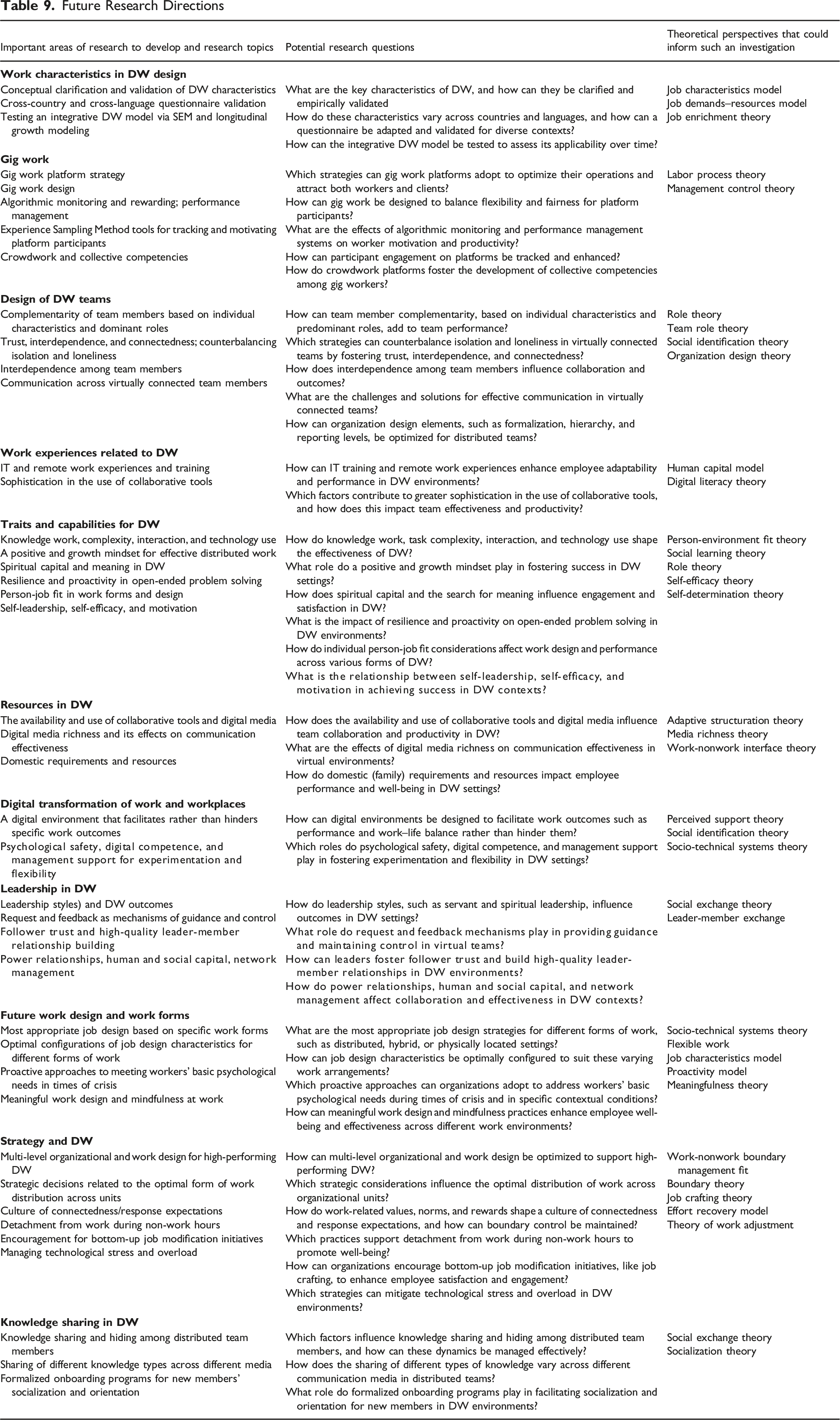
Future research could also focus on individual person-job fit considerations in forms of work and work design, self-leadership, self-efficacy and motivation (e.g., Haines, 2021). This promising direction for future HRD research could build on the work of Kim and colleagues (2024) who suggest that self-leadership plays an important role in fostering HRD initiatives. Their study illustrates how self-leadership interventions enable individuals to take control of their development and effectively align personal and organizational goals. When used strategically, self-leadership has been shown to improve HRD practices in key areas like training, organizational development, and career development, which benefits employees and employers. Future research could build on this to explore how self-leadership strategies can be tailored to DW environments, where the absence of traditional managerial oversight forces employees to rely more heavily on self-directed behavior. Further studies could also explore integrating self-leadership training with digital tools and remote learning platforms to better understand how workforce development can promote employee resilience, motivation, and growth in flexible work environments.
Another important aspect is the design of DW teams where researchers could further explore the complementarity of team members based on individual characteristics and dominant employee (team) roles. Further, trust, interdependence, connectedness, isolation, and loneliness are also relevant and could be studied based on team role theory, social identification, and/or organizational design theory. Finally, researchers could apply the proposed integrative model of DW design and test it in practice using structural equation modeling techniques or longitudinal research designs (also proposed by Wang et al., 2020) which could apply growth modeling to capture the proposed effects and interactions over time. Including a diverse sample of different job incumbents with regard to the amount of knowledge work, complexity, interaction, and technology use is particularly important here. Conceptual clarification and empirical underpinning of the characteristics of DW should be provided, along with the cross-country, cross-language validation of a DW characteristics questionnaire.
Conclusion
DW predates COVID-19 and will continue to evolve across occupations and organizations, making it vital to deepen our understanding of its characteristics. This review not only maps the conceptual terrain of DW design but also equips HRD professionals with an evidence-based foundation for action. By uncovering key themes—such as learning in digitally mediated environments, relational coordination in dispersed teams, and ICT-related job demands—our study highlights where traditional HRD approaches must evolve. In particular, we show that the success of DW arrangements depends not only on technological infrastructure but also on the thoughtful design of work and the intentional development of human capabilities. HRD practitioners can use our framework to assess current gaps in training, leadership, and career development programs and to design interventions that are aligned with the lived realities of DW. As the boundaries of work continue to shift, HRD’s role in enabling adaptive, well-designed, and meaningful work becomes more critical than ever.
Highlights
• Distributed work is inadequately explained by existing work design models. • An integrative framework of distributed work design. • Expansion of research from micro to macro levels. • Integration of management and information systems/computer science fields. • Uptake of the field post the pandemic.
Footnotes

Funding
The authors disclosed receipt of the following financial support for the research, authorship, and/or publication of this article: This research has been supported by the Slovenian Research Agency (Core Project Funding J5-4574, J7-50185, and P5-0441).
Declaration of Conflicting Interests
The authors declared no potential conflicts of interest with respect to the research, authorship, and/or publication of this article.
Data Availability Statement
The data that support the findings of this study are available from the corresponding author upon reasonable request.


