



Abstract
The study aims to identify psychological symptoms (depression and anxiety) and their relationship to the quality of life among dementia patients’ caregivers, and whether there are differences in the level of each of them due to the gender variable. The study follows the correlational approach, with a sample of 174 dementia patients’ caregivers. To pursue the analysis, the study uses 3 measurement tools: anxiety, depression, and quality of life. The results show that the level of depression, anxiety, and quality of life among dementia patients’ caregivers is moderate. It also finds that there is a positive relationship between anxiety and depression, and there is a negative relationship between quality of life and anxiety and depression. There are no differences in the level of depression and anxiety due to gender, as the study finds female caregivers to have a higher level of quality of life.
Introduction
The aging stage is characterized by changes in aspects of personality such as physical changes, such as weakened sensory and motor performance, and increased susceptibility to chronic diseases. 1 There as also psychological and emotional changes, as several differing factors impact the mental state of the elderly such as their physical, social, cognitive, and mental health.2,3,4
Recently, the concept of quality of life has received great attention from healthcare providers and health administration, due to the underlined importance of evaluating or determining the general health status of individuals suffering from chronic illness. 5 However, numerous factors taint healthcare providers’ perception of the quality of life of individuals suffering from mental illness, such as stigma and the experience of the patient as a burden. 6 These experiences highlight the importance of investigating and identifying how they affect the quality of life of families affected by mental illness. According to the World Health Organization, quality of life is defined as an individual’s perception of their place in life in the context of the culture and value systems in which they live, in relation to their goals, expectations, standards, and interests. 7
Families spend long hours caring for their sick family members, which includes assisting with daily activities and granting financial, emotional, and social support.8,9 Therefore, most of these patients’ families face unexpected daily stressors as well as unusual behaviours from their patients. In this regard, it is not enough to only provide basic care needs (personal care and financial support) for the patients, caregivers must also adapt to the patient’s symptoms through controlling and managing them. 10
Generally, the experience of illness has a great impact on the mental and physical health of family members, referred to as “hidden patients”.8,11,12 Caregivers of these patients are exposed to the risk of diseases and complications such as anxiety and depression, loss and anger, despair, shame, and stress, as well as difficulties in communication and caregiving.13-15 According to some studies, the rate of stress, anxiety, and depressive symptoms among caregiving providers is 68%-98.67%, 32%-100%, and 29.4%-100% respectively.9,16,17 Therefore, many caregivers need specialized help. 8
Caring for a person with a mental illness affects the caregivers emotionally, financially, and physically, leading to some restrictions in their routines.18,19 This has an impact on the caregivers’ well-being, and quality of life, and is often accompanied by impediments in their daily routines and social relationships. In a study conducted by Nielsen et al (2021), it was mentioned that care providers for mentally ill patients experience difficulty finding time for themselves, are unable to handle other responsibilities towards family and work, and experience weakness in physical and mental health. 20 Building on these findings Idstad et al (2010) found that care providers for individuals with chronic mental illness who face these difficulties have significantly lower levels of mental well-being than those who do not provide such care. 21
In Jordan, dementia patients are often cared for by their family members, and caring for patients has different effects.22-24 Usually, women are responsible for providing care more than men, while Sharma et al, (2016) prove that women are more susceptible to caregiving stress than men, 25 as well McDonnell and Ryan (2011) hypothesize that one of the reasons why men are less susceptible to stress is that they are not willing to admit anxiety and that they receive support from wives and family members more than females. 26
The studies (Pöysti & colleagues, 2012; McConaghy et al, 2005; Takano & Arai, 2005) did not show differences between men and women in depression and life satisfaction,27-29 2 studies (Pillemer et al, 2018; Gallicchio, 2002) showed that women are more susceptible to depression than men.30,31 Penning (2016) showed that care has a greater impact on mental health in women than in men. 32
This study aims to increase awareness among mental health professionals about the physical and psychological consequences providing care for dementia patients may have on caregivers. The provision of such care may lead to various psychological problems such as depression, anxiety, and increased worry. The specific issue of the study lies in its attempt to answer the following questions: • What is the level of psychological symptoms (depression and anxiety) and quality of life among Dementia patient caregivers? • Is there a statistically significant relationship (.05 = α) between the level of psychological symptoms (depression and anxiety) and the quality of life among Dementia patient caregivers? • Are there any gender differences in the level of psychological symptoms (depression and anxiety) and quality of life among Dementia patient’s caregivers?
Aims of the Study
Identify the level of psychological symptoms (depression and anxiety) and quality of life among Dementia patient caregivers.
Identify any differences in the level of psychological symptoms and quality of life among Dementia patient caregivers due to gender.
To examine the relationship between quality of life and psychological symptoms (depression and anxiety).
Method
Research Design
This study uses a quantitative approach to investigate the levels of psychological symptoms (depression and anxiety) and quality of life among caregivers of dementia patients and possible relationships among these variables.
Participants
The participants in this study are a random sample of 174 caregivers of dementia patients in Amman aged between 20-47 (M = 31.4), they included 96 females, and 78 males, 97 of them were from the patient family and 59 participants were not specialists, while only 18 participants were specialists who were with the Dementia patients in Hospitals and nursing homes in 2022.
Data Collection Tools
Quality of Life Scale
The researchers used the Quality-of-life scale (SDS) which was developed by Altawalbeh et al (2022). 33 The inventory is comprised of 29 items and 3 dimensions (psychological, social, physical), each of which participants rated on a four-point scale, from 1 (‘Strongly Disagree’) to 4 (‘Strongly Agree’). Higher scores reflect a higher level of Quality of life. The researchers extracted the validity and reliability and found that the discriminate validity ranged between .31 and .89. Cronbach’s alpha ranged between .78 and .92.
Anxiety Scale
The researchers use the anxiety scale (SDS) which was built by Turluin et al (2006). 34 The inventory is comprised of 12 items, each of which participants rated on a four-point scale, from 1 (‘Never’) to 4 (‘Always’). Higher scores reflect a higher level of anxiety. The researchers extracted the validity and reliability and found that the discriminate validity ranged between .37 and .71. Cronbach’s alpha was .91.
Depression Scale
The researchers used the Zung Self–Rating Depression Scale (SDS) which was built by Zung (1965). 35 The inventory is comprised of 20 items, each of which participants rated on a four-point scale, from 1 (‘Never’) to 4 (‘Always’). Higher scores reflect a higher level of depression. The researchers extracted the validity and reliability and found that the discriminate validity ranged between .42 and .84. Cronbach’s alpha was .88.
Data Collection
The researchers obtained approval for this study from the Institutional Review Board. Data was collected in the form of online questionnaires on 3 scales: depression, anxiety, and quality of life, all participants of the caregivers of dementia patients agreed to be in the study.
Data Analysis
The researchers used SPSS version 26 software to analyze the data. For the first 3 questions that is, the level question means and standard deviations were calculated, while for the correlation questions, the Pearson correlation coefficient was used to find relationships between the variables. Finally, for the last question, an Independent T-test was used.
Findings
Level of Psychological Symptoms and the Quality of Life Among the Caregivers of Dementia Patients
Means and Standard Deviations of the Psychological Symptoms and the Quality of Life Scales.
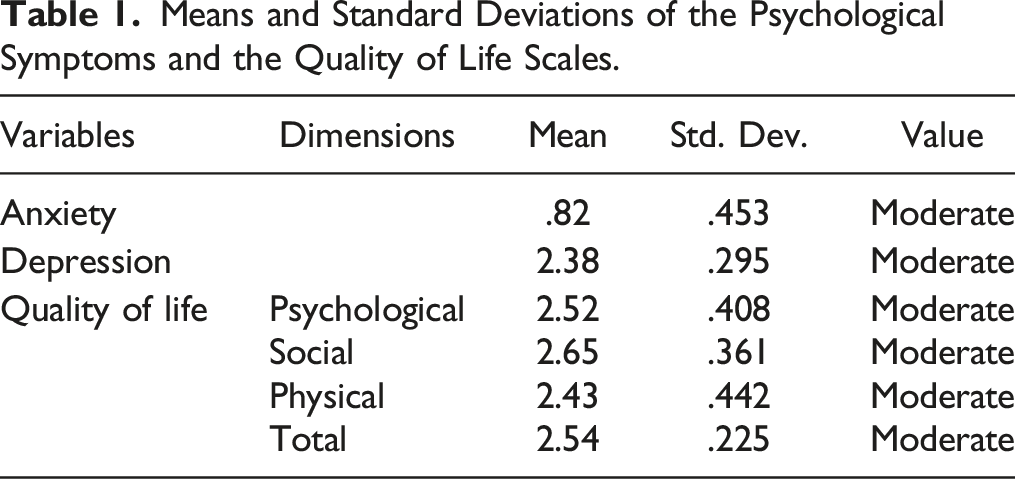
The caregivers of dementia patients have moderate levels of anxiety, depression, and quality of life, with the means being .82 for anxiety, 2.38 for depression, and 2.54 for quality of life, and the means of the dimensions of the quality of life ranged between 2.43 and 2.65.
Relationships Between Psychological Symptoms and the Quality of Life Among the Caregivers of Dementia Patients
Pearson Correlation Coefficient Values Between Psychological Symptoms and the Quality of Life.
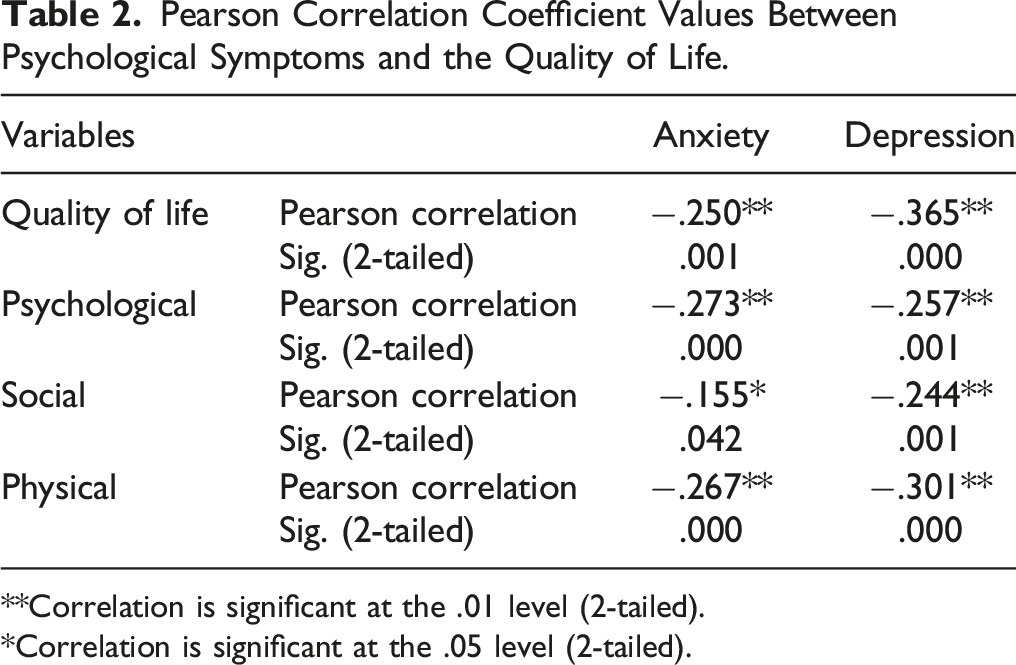
**Correlation is significant at the .01 level (2-tailed).
*Correlation is significant at the .05 level (2-tailed).
Table 2 shows a statistically significant correlation between anxiety, depression, and quality of life among the caregivers of dementia patients in this study. This correlation is negative which indicates that higher levels of anxiety and depression decrease the levels of quality of life among participants. The highest coefficient of correlation was found between quality of life and depression −.365, while the correlation between quality of life and anxiety −.250. Also, the results show that there is a correlation between both anxiety and depression and psychological, social, and physical disorders.
Differences in the Levels of Psychological Symptoms and the Quality of Life Among the Caregivers of Dementia Patients According to Gender
Independent T-Test Results for the Anxiety, Depression, and Quality of life Scores According to Gender.
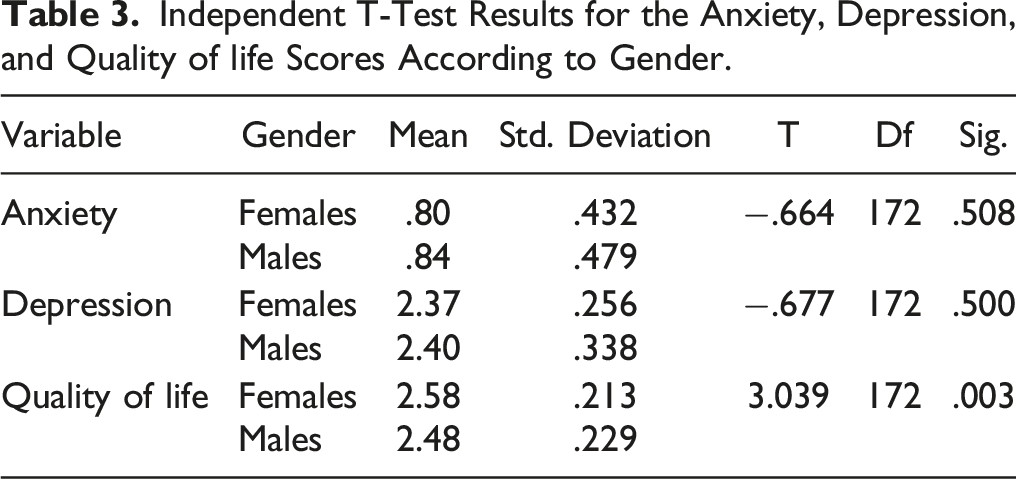
Table 3 indicates that there are no statistically significant differences at the level of (α = .05) in the levels of anxiety and depression among the caregivers of dementia patients according to the gender variable, and there are statistically significant differences at the level of (α = 0.05) in the level of quality of life Among the caregivers of dementia patients according to the gender variable with the female participants scoring higher on mean than males.
Discussion
Level of Psychological Symptoms and the Quality of Life Among the Caregivers of Dementia Patients
The results of the study indicate that the Level of psychological symptoms and the quality of life Among the caregivers of dementia patients was moderate, it may indicate the ability of some to handle such situations without complaining or feeling despair. This could also be due to the feeling of exhaustion and fatigue among care providers due to their dedication to performing their jobs effectively for the patient’s well-being. They require continuous monitoring and support, which conflicts with the daily routines of individuals with regular jobs, leading to anxiety related to the need to coordinate their daily lives with the provision of care, scheduling medical appointments, and ensuring timely medication consumption. There was a moderate level of anxiety and depression among caregivers with dementia patients, due to the immense pressure of waiting in mental health clinics, as revealed during the application of study tools on the sample in public hospitals and clinics. Patients with dementia also require necessary resources, whether therapeutic or physical, such as special food and equipment. These factors, along with emotional and psychological stress, may contribute to a moderate level of anxiety and depression.
Similarly, some of them have families and social obligations, which puts them in a conflict between fulfilling the obligation of providing care or neglecting to fulfill these roles. This conflict played a significant role in the emergence of symptoms of anxiety and depression. This result is interpreted in terms of the nature of the environment in which the sample individuals live, where the environment is characterized by strong family and social ties, and this is reflected in the religion they follow. It is a result of the attention, care, and dedication to providing all that is needed for the mentally ill person, which gives them a feeling of comfort, especially when the caregiver is a son or daughter. This acts as a reward for them. This study is consistent with the results of the study by Lloyd et al (2016), which showed that caring for someone with a mental illness has an emotional, financial, and physical impact on the caregivers and leads to some constraints in their routine. 18 These results differ from the results of the study by Cummings & Kropf (2014), which indicate that caregivers show a high degree of anxiety and depression. 36
Relationships Between Psychological Symptoms and the Quality of Life Among the Caregivers of Dementia Patients
The symptoms of anxiety and depression can be seen as negative variables that significantly affect individuals in all aspects of their lives and overall quality of life. As previous literature has pointed out, anxiety is the root of mental disorders. The individual’s feelings of anxiety and depression will impair their ability to fulfil their role in providing care for patients with anxiety disorders. Quality of life, as a positive variable, gives the individual a sense of comfort, security, and ability to adapt to the demands of life. The higher the quality of life, the more it will reflect on the individual’s life, and this comes from the caregiver’s belief in their role in providing services to patients with anxiety disorders. There are many factors such as the fear of stigma that can lead caregivers to experience symptoms of anxiety and fear of negative societal judgment. This also affects the quality of life for caregivers of individuals with mental illnesses.
Differences in the Levels of Psychological Symptoms and the Quality of Life Among the Caregivers of Dementia Patients According to Gender
The results of our study demonstrated that the quality of life among the caregivers of dementia patients differed due to gender in favour of females and there are no differences in the levels of anxiety and depression according to gender. This result can be attributed to the nature of the Jordanian community’s environment, which is largely similar, particularly in terms of accepting women’s role in work, where they now play a role similar to men. Therefore, they are required to leave their homes and spend a significant amount of time working, in addition to participating in the widespread cultural practices. This has resulted in both men and women facing similar pressures and life activities, as well as being concerned about the social stigmas associated with genetic diseases and the increased likelihood of being affected by such diseases, which leads to the emergence of anxiety and depression symptoms. Additionally, regardless of whether the caregivers are male or female, the privacy of the patients with dementia causes them stress and anxiety, especially if the patient needs something they are unable to provide them, or if they are exposed to a sudden health complication that requires their constant presence. This in turn causes sleep anxiety and makes their thoughts unclear, as they may hear non-existen.33,37 The researchers explain the results through interaction with the study sample, especially the female participants, who provide care for patients with dementia. This is because men spend most of their time working to secure the necessary financial resources to provide care. This is especially true for those living in the suburbs, where they have to pay a large amount to reach the hospitals, which places a burden on the family, leading to anxiety and depression symptoms.
Regarding the quality of life, the results showed a difference in favour of women, and this result can be attributed to the fact that the emotional aspect of women is more dominant than the intellectual aspect, unlike men. This is due to the maternal instinct that adds an emotional and compassionate aspect to women. On the other hand, the social system allows men to go out at night, whereas women are used to staying at home. As a result, the quality of life of men when caring for patients with dementia is affected by their social aspect with friends, while women who stay at home have their quality of life enhanced by taking care of the patients. The emotional well-being of women is improved by their caregiving role, and often the patient is one of the emotional sources for the woman, and his presence helps improve her mental health and quality of life.
Conclusion
The results of this study indicate that there are moderate levels of depression, anxiety, and quality of life among caregivers of dementia patients. These findings highlight the need for specialized counselling services to improve the quality of life and decrease depression and anxiety levels among caregivers. An examination of the relationship between the 3 measures revealed a negative correlation between quality of life and depression, as well as between quality of life and anxiety. This suggests that depression and anxiety have a detrimental impact on the quality of life and job performance of caregivers. Further research is needed to determine strategies for reducing the levels of depression and anxiety among this population.
Additionally, the study’s results show differences in quality of life based on gender. Thus, future research on these topics should take into consideration the potential influence of gender on the results.
Limitations and Future Directions
This study was conducted with a sample of caregivers of dementia patients enrolled in Jordan in 2022. The results of the study were interpreted from the participants’ responses to the depression, anxiety, and quality of life scales. There was a reluctance to apply the scales among the participants and hard to find volunteering because they were busy most of the time. The researchers recommend further research on the quality of live variables among caregivers. Future research might also relate it to variables such as age, work hours, personality types, and self-efficacy. The creation of counseling and guidance programs to improve and maintain their quality of life, particularly that of males, might also be considered. One of this study’s limitations is there was no control group (either dementia noncaregivers or participants with no dementia caring responsibilities), therefore, this study’s findings are only specific to dementia caregivers.
Footnotes
Declaration of Conflicting Interests
The author(s) declared no potential conflicts of interest with respect to the research, authorship, and/or publication of this article.
Funding
The author(s) received no financial support for the research, authorship, and/or publication of this article.

Data availability statement
The data that support the findings of this study are available from the corresponding author, [M. B. L. A.], upon reasonable request.