




Abstract
Conceptual knowledge is supported by multiple semantic systems that are specialized for the analysis of different properties associated with object concepts. Various types of semantic association between concrete concepts—categorical (CA), encyclopedic (EA), functional (FA), and visual-encyclopedic (VEA) associations—were tested through a new picture-to-picture matching task (semantic association task, SAT). Forty individuals with Alzheimer’s disease (AD), 13 with behavioral variant of frontotemporal dementia (bv-FTD), 6 with primary progressive aphasia (PPA), and 37 healthy participants were tested with the SAT. Within-group comparisons highlighted a global impairment of all types of semantic association in bv-FTD individuals but a disproportionate impairment of EA and FA, with relative sparing of CA and VEA, in AD individuals. Single-case analyses detected dissociations in all dementia groups. Conceptual knowledge can be selectively impaired in various types of neurodegenerative disease on the basis of the specific cognitive process that is disrupted.
Keywords
Introduction
Semantic memory contains the long-term representations of objects knowledge, derived from our own experience in the world. The term “semantic processing” can be referred to the cognitive acts implied in accessing stored knowledge for linguistic purposes and appropriate behavior selection. 1 The way in which concepts are organized within the semantic system and the different mechanisms underlying semantic processing have been an important issue in neuropsychological research in the last 3 decades. Studies of brain-damaged individuals showed that semantic memory could be selectively impaired based on semantic categories, such as living versus nonliving items. 2,3 These findings have been explained in terms of a semantic memory organization based on the different properties associated with objects and concepts. Specifically, while sensory properties (eg, shape and color) contribute predominantly to the representation of living concepts (eg, fruit and animals), functional properties contribute predominantly to the representation of nonliving concepts (eg, tools). In this theoretical framework, semantic cognition is supported by multiple semantic systems, widely distributed in the brain, in which different regions are specialized for the analysis of different aspects of a concept. 4 The basic assumption of this model is that deficits for a given category are associated with disproportionate impairment of the specific sensory/functional knowledge that is critical for the long-term representations of that conceptual category. However, the sensory–functional theory has been challenged because of the existence of patients whose deficits are not consistent with a sensory–functional distinction. 5 For example, individuals with selective deficit for a particular category of items within the living domain (eg, fruit/vegetables) but not for other living items (eg, animals) were reported. 6,7 Moreover, one of these studies demonstrated that selective semantic deficit for fruit and vegetables did not relate to impairment of critical perceptual knowledge for their identification (ie, color). 6 To account for these inconsistencies, recent sensory/functional theories have suggested that an object concept is composed of various types of information, 8,9 derived from an individual’s acquired knowledge and direct sensory/motor experience with that object, which are processed in different brain regions. 9 Thus, the identification of a specific semantic category is supported by different types of knowledge (eg, color for fruit and color as well as motion for animals). 8,10 According to the multiple semantic systems hypothesis, an object concept is represented in different modality-specific semantic subsystems that are specialized for critical semantic attributes of that object. Within this framework of object concepts, recent studies proposed that we are able to associate objects in a flexible manner because of 2 semantic processes—taxonomic versus thematic associations. 11,12 First, a category-based process, which relies predominantly on perceptual similarity of members of the same category, allows us to associate objects that belong to the same semantic category (eg, an apple and a pear or a lion and a tiger), but also to the same sensory–quality category 10 (eg, creamy food such as mayonnaise and barbecue sauce or powdery food such as paprika and curry) when a particular set of sensory/perceptual properties that is critical for their identification is given. Second, an associative process would enable to establish a relationship between objects that often belong to different semantic categories but have complementary roles in events. 11 This means that 2 objects can be semantically related in our semantic memory system because we know from our personal experience in the world that they occur contiguously in space and/or time. For example, “jungle” and “jaguar” are associated because they are spatially related, that is, they are part of the same scenario. This type of associative knowledge is extremely flexible because our object knowledge is based on different types of sensory information (ie, auditory, visual, tactile, taste, and olfactory information), which are stored in multiple, distinct conceptual stores and underlying neural pathways. 9,13 Several studies showed that visual, categorical, and associative-encyclopedic relationships are supported by distinct neuroanatomical processes and thus can be selectively damaged in neurological impaired individuals. 14 -16 Thus, a person with brain damage can still associate objects because they are members of the same category (ie, the person correctly selects the fork in association to spoon because they are both cutlery) but have lost some detailed knowledge associated to them (ie, the person selects the fork, instead of the spoon, in association to soup). Davidoff and Roberson 17 reported the case of a person with aphasia who was impaired in a categorical task requiring to associate, among triads of stimuli, the 2 objects sharing the same basic sensory features such as size (eg, a nail and a screw) or color (eg, closely related shades of red) but had a spared performance, comparable to that obtained by healthy participants, in a functional association task (eg, associate a nail and a hammer). Many studies used visual semantic association tasks (SATs) to evaluate the integrity of semantic knowledge. The most known assessment instrument is the Pyramids and Palm Trees Test developed by Howard and Patterson, 18 which includes different types of semantic associations but does not allow to assess disproportionate deficits for different types of associations because they are not divided into separate subtests. Lauro-Grotto and colleagues 19 developed a semantic assessment battery investigating 6 different semantic categories (household items, vehicles, musical instruments, land animals, birds, and sea-water animals) in 5 tasks, including fluency, naming, word-to-picture matching, definition of spoken name, and a multilevel sorting task. The multilevel sorting task, in particular, requires to associate all pictures of objects belonging to the same category and allows to detect differences between living and nonliving items and between the ordinate and subordinate level of categorization (for the 2 types of item separately). Thus, the multilevel sorting task relies upon a category-based process, while it is not able to evaluate other types of semantic processing that allows to associate objects belonging to different semantic categories (eg, knife and bread) but are specifically related because they have complementary roles in an event (eg, to cut a slice of bread). Similarly, another extensive Italian battery developed by Catricalà and colleagues 20 for the assessment of semantic deficits allows the investigation of category-specific deficits (on the basis of the living/nonliving items distinction) but does not allow to investigate other types of associative semantic processes. Semenza and colleagues 21 developed a visual-SAT with triads of pictures (1 probe picture with 2 possible targets) evaluating both categorical (ie, “class task”) and associative (ie, “theme task”) types of relationship. The main limitation of this task is that the probe picture is semantically related to both possible targets, so that an “erroneous” response corresponds to a “low-frequency” choice, on the basis of healthy participants’ choices. This means that individuals are considered “normal” only when they make the high-frequency choice. However, as Semenza and colleagues pointed out, it sometimes happened that healthy participants unexpectedly chose the low-frequency response, without a clear reason for doing so. To address the issues left unanswered by previous studies, we developed a SAT to explore 4 types of semantic association—categorical (CA), encyclopedic (EA), functional (FA), and visual encyclopedic (VEA) associations—to assess possible semantic damage dissociations in individuals with neurodegenerative diseases. The multiple semantic system hypothesis 4 assumes that dissociable neural areas are differentially involved in processing different types of object information, which allow the identification of different semantic relationships. First, some studies conducted within the multiple semantic systems framework 14,22,23 hypothesized the existence of 2 distinct representations, 1 visually based and 1 verbally based, corresponding to distinct processing subsystems. On the basis of this prior evidence, subsequent studies in the multiple semantic systems framework tried to further explore and identify different types of semantic associations.
The first type of association is category-based and allows to determine whether 2 objects are both exemplars of a same semantic category but also to discriminate between ordinate (eg, the cobra and the viper are both snakes) and superordinate levels of categorization (eg, the cobra and the bear are both animals). 24 In the classical sensory/functional framework, natural objects categorization is dissociable from categorization of artifacts. In fact, while the former is predominantly based on visual features, the latter is predominantly based on object function and, at least for tools, their manipulation. However, some recent studies have proposed that factors other than the categorical nature of our stored knowledge may additionally intervene in determining the dissociation between natural and artifact knowledge, such as the degree to which visual perception is relevant to recognize a particular object. One possibility is that natural items tend to be more visually similar to one another than man-made items. 25,26 For example, individuals with herpes simplex virus encephalitis and inferior–medial temporal lobe damage have been reported to have a category-specific deficit for natural objects. 3,27 However, when semantic knowledge of artifacts was tested between objects that were visually similar (eg, different types of knives, as a smoked salmon knife vs a bread saw knife or a sushi knife), individuals with herpes simplex virus encephalitis and inferior–medial temporal lobes damage were equally impaired on natural and man-made objects, suggesting that categorization processing may rely upon visual similarity for both types of objects. Furthermore, a recent functional magnetic resonance imaging (fMRI) study on healthy individuals 13 revealed that bilateral visual association areas (comprehending cuneus, BA 18 and the lingual gyrus), which would be used in conceptual processing of objects that share similar perceptual features, were active during a CA task for both natural and artifact objects. According to some researchers, the anterior lateral temporal lobes (bilaterally) support categorical processing for both natural and artifact objects and are supposed to be a semantic “hub,” where all modality-specific information about objects converge. 26,28 In accordance with this view, a proportionate disruption of semantic knowledge across different categories was found in individuals having semantic dementia and bilateral anterior temporal lobes atrophy, 29,30 and the application of inhibitory transcranial brain stimulation on the anterior temporal lobes in healthy individuals pointed to a category-general impairment effect. 31 To sum up, all these studies on categorical processing suggest that, even if different types of semantic information may be disproportionately involved in representing distinct object categories, there are also common neural substrates that enable categorization, for both natural and artifact objects, such as the bilateral medial and anterior lateral temporal regions and the associative visual areas.
A second type of semantic knowledge is called Encyclopedic, which has been defined to enclose semantic information that could not be clearly linked to a specific type of knowledge (eg, “it is dangerous for kids” or “it can be found in the kitchen” for a knife), 8 and thus it was clearly dissociable from other types of semantic features tightly related to a specific sensory or motor modality. 32 Encyclopedic associations require a type of semantic knowledge that is not derived from our direct experience in the world but is acquired in an educational context, such as at school (eg, we know that a windmill and a tulip are related because they are both emblems from the Netherlands).
A third type of semantic association is based on functional properties of objects, which derive from our everyday experience with them (eg, we know that the paintbrush has a wooden handle with a lot of bristles at its end, used to convey some paint and decorate something). In functional relations, 2 objects (eg, a paintbrush and a painting can) are related because they are used together in the same event for a specific purpose (eg, painting a door). Recent neuroimaging studies have identified some brain regions that were specifically activated during functional association tasks. Combined behavioral and lesion-based analyses in individuals having left hemisphere stroke lesions showed that poor performance in a conceptual task requiring association of objects that may be used together for a purposeful action (eg, axe-wood) were correlated with damage to the posterior part of the middle temporal gyrus. 33 Two fMRI studies in healthy participants 34,35 focused on brain activations related to performance on a judgment task with pairs of objects that could share the same function. These 2 studies highlighted significant neural activity in a large left-hemisphere network including the prefrontal and premotor cortex, the posterior middle temporal gyrus, and the inferior parietal lobule. These brain areas are also reported in the literature to be active during observation of actions performed by others 36,37 and in a variety of action-related tasks 38 such as listening to action words or sentences. 39,40 This suggests that functional semantic knowledge is related to features that are processed in the sensory/motor system.
Finally, a fourth type of semantic association is called visual encyclopedic. These associations are based on spatial proximity of 2 objects (they usually appear together) but also relate for aspects that were learned in a social or educational context (eg, a camel and a pyramid). Thus, our direct experience that 2 objects are seen together as part of the same scenario (eg, a camel and a pyramid are seen together in the same scenario, that is the desert) and educational aspects are both important, in determining this latter type of association. For this reason, VEAs may be spared after brain damage because they are supported by 2 semantic subsystems. In sum, in line with the multiple semantic systems hypothesis and recent neuroimaging studies, the 4 mentioned types of semantic association (CA, EA, FA, and VEA) are thought to be supported by distinct brain networks so that it would be possible to find selective deficits in brain-damaged individuals. Furthermore, according to the multiple semantic systems hypothesis, a disproportionate impairment for specific acquired knowledge that is critical to identify a semantic association would cause a selective deficit for that type of semantic association. For instance, disproportionate impairment of the processing of functional properties in action-related brain regions of the left hemisphere would cause a deficit in functional associations. Due to the different functional and neuroanatomical foundation involved in various disease types, individuals with neurodegenerative diseases may offer distinct patterns of cognitive functioning at different levels of impairment, 41 thus representing an opportunity to study the way in which cognitive processes interact. Semantic memory deficits can be detected in individuals with neurodegenerative disorders with heterogeneous profiles, at different stages of the disease, coherently with multiple semantic processes and representations involved. 42 Impaired performance in various semantic tasks, such as object naming 42,43 and categorical and verbal fluency, 42 was reported in Alzheimer’s disease (AD) population. These deficits are assumed to reflect deterioration in the long-term representation of semantic memory, which may be disrupted by temporal, frontal, and parietal involvement in AD neuropathology. 44 Frontotemporal lobar degeneration represents a non-AD pathology that can underlie different clinical phenotypes, such as the non-fluent variant of primary progressive aphasia (nfv-PPA), the semantic variant of primary progressive aphasia (sv-PPA), or a profound and selective disorder of social behavior and executive functions, due to a prevalent involvement of (pre)frontal areas (behavioral variant of frontotemporal dementia, bv-FTD). While semantic deficits have been widely studied in sv-PPA 45,46 and nfv-PPA, 47 -49 little research has been conducted to explore semantic disorders in bv-FTD. 50 Although behavioral disorders may be observed in all FTLD subtypes, 51,52 and more severe behavioral dysfunctions were observed in individuals with semantic dementia than in other variants of primary progressive aphasia, 53 it is possible to discriminate between bv-FTD cases and the other variants of FTLD, at least in the first stages of the disease, on the basis of predominant language and semantic deficits versus executive functional deficits and aberrant behavioral disorders. 54,55 Moreover, while lack of emotional responses, social avoidance, greediness, and indiscriminate eating are pervasive in bv-FTD, individuals with semantic dementia present with social seeking, poor emotional responses to fearing stimuli, and exaggerated reactions to sensory stimuli, demonstrating that these 2 conditions may be associated with distinct patterns of abnormal behavior. 56 In the present study, the SAT was administered to individuals with AD, nfv-PPA, sv-PPA, and bv-FTD with 2 principal aims: (i) determine whether the SAT is sensitive to detect semantic deficits in individuals with neurodegenerative diseases and (ii) explore whether the SAT discriminates between different aspects of semantic knowledge, directly involved in AD, bv-FTD, and PPA clinical populations. According to the multiple semantic system hypothesis, 4,13 different kinds of semantic knowledge (ie, specific visual, tactile and auditory sensory-related, action-related FA or verbal acquired knowledge) contribute disproportionately to the representation of a specific type of semantic association (CA, EA, FA, and VEA). The first consequence is that disproportionate impairment of knowledge that is critical to identify a specific semantic association would cause a selective deficit for that type of semantic association. Second, the multiple semantic system hypothesis predicts that distinct types of knowledge are supported by different brain areas, so that it would be possible to find dissociations for a particular semantic association according to different patterns of brain damage. Specifically, persons with sv-PPA should be more impaired on categorical and encyclopedic kinds of association due to their verbal and semantic involvement. Because of temporal atrophy, individuals with AD may also present with verbal impairment and may show the same type of dissociation as individuals with sv-PPA. Visual encyclopedic associations are supported by verbal and visual-associative knowledge so that a deficit for this type of association should be produced after double damage to both these semantic subsystems. For this reason, VEAs may be relatively spared in comparison to other types of semantic associations, especially for individuals with sv-PPA, who have relatively unimpaired visual-associative abilities with respect to verbal knowledge, at least in the early stages of the disease. With regard to functional associations, the current literature hypothesizes that this type of semantic knowledge is impaired in individuals with AD57,58 and is supported by numerous regions of the ventral stream, particularly in the left hemisphere, for object processing,59 including left lateral anterior inferotemporal areas,60 left medial temporal lobe areas,61 and left inferior and middle temporal areas, 34, 35 which may be involved in persons with AD 62 as well as sv-PPA. 55 On the contrary, such type of dissociations should not emerge in individuals with bv-FTD since semantic memory is usually preserved in these clinical population. However, poor executive resources may have a different impact on distinct semantic association types.
Materials and Methods
2.1 Participants
Forty individuals with probable AD clinical diagnosis, according to ADRDA-NINCDS criteria, 62 having mild to moderate cognitive impairment, 13 individuals with probable bv-FTD clinical diagnosis, 63 and 6 individuals with PPA (nfv-PPA: n = 4, sv-PPA: n = 2 according to Gorno-Tempini et al’s criteria 55 ) were recruited at the Neurology Department of Castellanza (Italy). Inclusion criteria encompassed the absence of other neurological, psychiatric, or systemic condition that could interfere with cognitive status. According to clinical indication, some of the participants were taking a standard dose of either a cholinesterase inhibitor or memantine or a low dose of a nonsedating antidepressant. Thirty-seven healthy participants, matched for age and education (age = 71.5 ± 7.9, education = 7.1 ± 3) to the 2 major experimental groups (AD: age = 75 ± 5.5; bv-FTD: age = 73.2 ± 3.5, education = 7.8 ± 2.9; see Table 1), as well as the PPA cases (see demographic variables in Table 2), were tested as a control sample for both group analysis (in comparison to the 2 largest clinical groups) and in multiple single-case analysis (in comparison to each single individual with any clinical diagnosis included in the study). Participants provided informed consent in accordance with the 1975 Helsinki Declaration, as revised in 1983.
Demographic Variables, as well as Mean Values With Standard Deviations for Neuropsychological Tests and the Semantic Association Task in the 2 Larger Dementia Groups and Control Participants.a

Abbreviations: AAT_N, naming subtest of the Aachen Aphasia Test (range 0-120); AD, Alzheimer’s disease; bv-FTD, behavioral variant of frontotemporal dementia; CI, confidence interval; CP, control participants; Educ, education; max, maximum score; MMSE, Mini-Mental State Examination; N, number of participants; NA, not available, ORDT, object reality decision task; RCPM, Raven Colored Progressive Matrices; SAT overall, overall semantic association task score; SAT_CA, categorical associations; SAT_EA, encyclopedic associations; SAT_FA, functional associations; SAT_VEA, visual encyclopedic associations; SRT, story recall test; VCT, visual completion task; VOSP_L, letter subtest of visual object and space perceptual battery; VOSP_S, progressive silhouettes subtest of visual object and space perceptual battery.
a For each task, the maximum score is provided in brackets. ANOVA post hoc differences.
b Statistically different from healthy control participants at P < .001.
c Statistically different from bv-FTD individuals at P < .001.
On the Left: Number and Percentage (In Brackets) of Individuals With AD and bv-FTD Who Performed Below Cutoff in Neuropsychological Tasks and the SAT.a

Abbreviations: CA, categorical associations; SAT_CA, categorical associations; SAT_FA, functional associations.
a On the right: sociodemographic features and adjusted scores of individuals with sv-PPA and nfv-PPA in neuropsychological tests and the SAT. In bold: scores below the cutoff.
Neuropsychological Evaluation
The Mini-Mental State Examination (MMSE), 64 the picture naming subtest of the Aachen Aphasia Test (AAT), 65 the incomplete letter and progressive silhouette subtests of the visual object and space perception battery (VOSP), 66 a short-term memory test (Digit Span, DS), 67 an episodic delayed memory test (story recall test, SRT), 68 and a nonverbal reasoning test (Raven Colored Progressive Matrices, RCPM) 69 were employed on all participants. Mean values and standard deviations for the 3 largest groups (AD, bv-FTD, and healthy participants) for each neuropsychological test are reported in Table 1, whereas individual scores of persons with PPA are reported in Table 2. The VOSP was included among the administered tasks to test the early stages of visual processing, in order to check whether visual perceptual deficits affected participants’ performance on the SAT. The score obtained in the progressive silhouettes subtest of the VOSP is the number of trials required to identify 2 objects in rotating positions, so that a good performance corresponds to a low number of trials (maximum number of trials = 20). In addition, a visual completion task (VCT) and an object reality decision task (ORDT) were specifically designed for the present study and administered to the individuals with dementia as well as to healthy participants. These tasks were included in the testing battery to investigate the hypothesis that the various kinds of conceptual knowledge that are evaluated with the SAT may be differentiated from other types of visual semantic competence. The VCT allows the evaluation of object structural knowledge, which is also part of visual semantic competence, although in the absence of any kind of association processing. The ORDT tests individuals’ knowledge of an object visual structural description, which again should be distinguished from the ability to perform conceptual associations. The VCT consists of 46 cards, divided into 2 subtests (animals vs artifact objects). Each card displays triads of black-and-white drawings, 1 on top of the card (probe drawing) and 2 below it (target vs foil). The probe drawing is an incomplete animal or artifact object, the target drawing is the correct missing part. The foil is always visually plausible. The missing parts can be associated to the incomplete picture by simple transposition, thus not requiring any mental rotation or size manipulation. Participants had to choose the missing part pointing silently at one of the 2 drawings on the bottom part of the card. One practice card was given before each subtest. The ORDT was developed to test individuals’ knowledge of an object visual structural description. Participants had to decide whether a stimulus picture was an existing versus non-existing animal/artifact object. Non-real items are chimeric figures composed of 2 parts of 2 different exemplars. Examples of stimuli presented in the VCT and the ORDT are given in Figure 1.

Examples of stimuli presented in the VCT and the ORDT. On the top: 2 examples of stimuli used in the animals (on the left) and in the artifact objects (on the right) subtests of the VCT. On the bottom: example of a chimeric figure used in the ORDT. ORDT, object reality decision task; VCT, visual completion task.
Semantic Association Task: Realization and Description
Seventy-six couples of semantically related and non-related black and white pictures were selected in order to create triads of stimuli (probe picture, target picture, and foil). The probe picture is the object on the top of the slide, whereas the target and the foil pictures are located on the bottom part of the card, one on the left and one on the right. Items were selected to correspond to 4 types of semantic relationships between the probe and the target picture:
– CA: the 2 items belong to the same category at ordinate level (eg, a giraffe and a zebra);
– EA: the 2 items are learned to be related from school or other source of encyclopedic linguistic learning (eg, cow and cheese);
– FA: the 2 items are used together for a common purpose (eg, screw and screwdriver);
– VEA: the 2 items are associated mostly because they are seen together, in spatial proximity (eg, clown and circus big top).
The foils were chosen in order to have different degrees of semantic distance from both the target and the probe pictures. In particular:
– the foil could share a semantic relationship with the target, but not with the probe picture (eg, the camping tent [foil] belongs to the same category of the circus tent [target] but is not related with the clown [probe]);
– the probe could be related to both the target and the foil, but the relationship between the probe and the target had to be greater than the relationship between the probe and the foil (eg, the giraffe [probe], the zebra [target], and the white bear [foil] are all animals, but the relationship between the giraffe and the zebra is stronger than that between the giraffe and the white bear);
– the foil could share a similar shape with the probe picture, but not with the target (eg, water mill [probe], hut [foil], and ear of corn [target])
A pilot study on 2 samples of young patients each composed of 20 participants was conducted in order to evaluate the correspondence of each couple of probe and target to 1 of the 4 semantic association types and to balance the strength of association within the 4 semantic categories. Participants were students attending the bachelor or master’s degree programs at the University of Milan-Bicocca (mean age: 31.6 ± 11.5; mean education: 15.6 ± 1.8; sex: 10 males and 30 females). A total of 80 triads of stimuli was included in the pilot study. A first group of raters was asked to assign the probe–target couples to 1 of the 4 semantic relationships (CA, EA, FA, and VEA). Raters could suggest more than 1 type of semantic relationship, but they had to give a progressive number for each possible relationship. In this way, 3 points were given to the first (or only) semantic relationship that was identified by the rater, 2 points were given to a possible second relationship and 1 point to a third possible relationship. Each couple was finally assigned to a specific type of semantic association if the sum of all scores given by the 20 raters was ≥50. The strength of the association was evaluated between each probe–target couple and between each probe–foil couple on a 7-point Likert scale by a second group of 20 young healthy participants. Means and standard deviations were calculated for each probe–target and each probe–foil couple, for the probe–target and the probe–foil couples within each semantic relationship and for the difference between the probe–target and probe–foil couples within each semantic relationship. Three distinct 1-way analysis of variance (ANOVA) analyses were conducted to compare the strength of the association of the probe–target couples and the probe–foil couples between the 4 types of semantic relationship and within each type of semantic relationship. Results show that the strength of the association of the CA probe–target couples was lower than the strength of association of the other 3 types of semantic relationship (F = 3.09, P = .03). The strength of the association of the probe–foil couples, instead, did not differ across the 4 semantic relationships (F = 2.32, P = .08). The strength of the association of the differences between probe–target and probe–foil couples was significantly lower for the CA and the VEA semantic relationships than the EA and FA relationships (F = 3.19, P = .03). Therefore, 3 triads belonging to the CA subset and 1 triad of the VEA subset were excluded from the total sample and statistical analyses were repeated on the remaining 76 stimuli. No comparisons between probe–target couples (F = 2.60, P = .06) and probe–foil couples (F = 1.64, P = .19) and the differences between probe–target and probe–foil couples (F = 1.72, P = .17) were anymore significant. Eventually, the final version of the SAT included 76 of 80 cards, which were presented in a randomized order, based on the type of relationship between the probe and foil. In CA associations, probe–target couples were represented by either living (ie, fruit and vegetables, as well as animals) or nonliving items (ie, vehicles, objects, musical instruments, tools), chosen in order to cover different semantic categories. In FA, all probe–target couples are represented by nonliving items, whereas in VEA and in EA, the most frequent probe–target association is between a living and a nonliving item (eg, camel–pyramid or grapes–wine, as an example of VEA and EA, respectively). Four sub-scores (range 0-19) were obtained for each of the 4 subsets composing the SAT test. Figure 2 provides 4 items of the test, 1 for each type of association.

Examples of cards used in the SAT task. From the left top corner: categorical associations (CA), encyclopedic association (EA), functional association (FA), and visual encyclopedic association (VEA).
Persons with dementia and healthy participants were required to point silently at 1 of the 2 drawings on the bottom part of the card. Verbal instructions were the following: “Could you please indicate which of the two below pictures is related most, in your opinion, with the picture on the top?” Only pointing performed within 5 seconds from the presentation of each card was accepted as a valid answer. Four warming up cards (1 for each type of association) were provided at the beginning of the task. If a participant committed a mistake in these items, the experimenter explained the task once again and eventually provided the correct answers.
Statistical Analyses
Group comparisons
Due to the small sample size (nfv-PPA: n = 4, sv-PPA: n = 2), data obtained from the individuals with PPA were not included in the group analyses. The 2 largest clinical groups and control participants were compared on all neuropsychological tests through a 1-way ANOVA with Bonferroni correction for multiple comparisons and post hoc analyses. Furthermore, the 4 sub-scores obtained by individuals with AD and with bv-FTD on the SAT subsets were compared to healthy participants’ performance through a repeated measures ANOVA. Since individuals with AD had object recognition deficits, as demonstrated by poor performance in the progressive silhouettes VOSP subtest, that could affect their behavior on SAT, the performance obtained on this task was included as a covariate variable in the analysis. Post hoc analysis was conducted with Bonferroni correction for multiple comparisons.
Cutoff scores calculation
Cutoff scores are important in clinical practice to differentiate between presence/absence of a deficit and are good detectors in case series to define the number of participants who are impaired in a particular cognitive function. Specifically, for SAT subsets, they can be used to detect disturbances on a specific type of semantic association. Cutoff scores for MMSE, the naming subtest of AAT, DS, SRT, RCPM, and VOSP subtests were derived from normative data in the literature.
64
-69
The cutoff score for the VOSP progressive silhouettes subtests corresponds to 15 points for the nonreversed score,
66
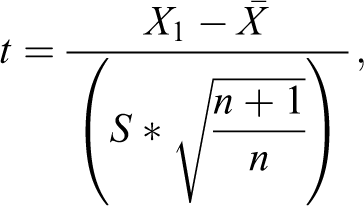
whereas when considering the reversed scores, the cutoff score corresponds to 5 points. In this study, we considered the reversed cutoff score. For the VCT, the ORDT, the overall SAT score, and each SAT subset, cutoff scores were calculated, for the present study, with the Crawford formula.
70
Single-case analyses
Even though group analyses are robust enough to detect a difference among SAT subtests, focusing on group means only may be misleading since mean results do not reflect variability across individuals of such sample. For example, within each group, a good performance of some participants in a particular kind of association would be statistically canceled out by extremely poor performance of other participants or by a patient showing the opposite pattern of performance. Furthermore, it would be possible that the mean performance of the AD clinical group, which includes both relatively high and low scores, would not differ from performance of the bv-FTD group, in which the performance of all participants is similar. For this reason, all dementia individuals’ performance on the 4 SAT subsets was compared at a single case level with Crawford program for dissociations (http://www.abdn.ac.uk/∼psy086/dept/Compare_Two_Cases.htm-Dissocs_ES.exe). 71 First, the program estimates whether each individual’s performance is significantly worse than the control sample’s performance on 2 SAT subsets, separately. 70 Second, the program tests whether a person performs significantly different on these 2 subsets and whether this difference is significantly greater than the difference between the 2 subsets in the control sample. In this way, the program is able to detect whether classical or strong dissociation criteria are satisfied.
Results
Neuropsychological Profiles
Table 1 displays demographic features, neuropsychological data, and SAT scores for the 2 largest clinical groups (AD and bv-FTD) and healthy participants, as well as ANOVA significant differences between the 3 groups. No significant difference was revealed between the 3 groups for sex, age, and education (sex: χ2 = 2.882, P = .410, age: F = 2.4551, P = .066; education: F = 2.688, P = .051). Between-groups ANOVA revealed that the 2 clinical groups performed significantly poorer than the healthy control group on the MMSE. In addition, individuals with AD performed significantly poorer than healthy participants on all neuropsychological measures, whereas persons with bv-FTD performed significantly poorer than healthy participants in the VCT and the ORDT. Finally, individuals with AD performed significantly poorer than bv-FTD on STR and on VOSP_S. Table 2 reports the percentage of individuals with AD or bv-FTD who performed below the calculated cutoff scores on the different tasks and sociodemographic features and adjusted scores of individuals with sv-PPA and nfv-PPA in neuropsychological tests and the SAT. Individuals with AD were generally impaired on all neuropsychological measures. Performance of this group on the SAT was also impaired (65%) in all subsets, but especially for the EA (75%) and FA (65%) subsets. Individuals with bv-FTD were generally impaired on the MMSE (69%), the ORDT (70%), the VOSP_L (54%) and, less frequently, on the VCT, the RCPM and the SRT (38%) and the AAT naming subtest (31%). About 54% of persons with bv-FTD showed an abnormal performance on the overall SAT score. A higher percentage of individuals with dementia were impaired on FA and VEA (54%) than on EA and CA conditions (46% and 39%, respectively). Differently from individuals with AD and bv-FTD, the 6 PPA cases (nfv-PPA = 4; sv-PPAS = 2) had a normal performance in the Silhouette subtest of the VOSP and in the ORDT. Three of 4 individuals with nfv-PPA were impaired on the MMSE and the AAT naming subtest. Two of 4 nfv-PPA cases were also impaired on the VOSP_L subtest and the VCT. Only 1 nfv-PPA case showed an abnormal performance on the overall SAT and the individual subsets, whereas another person was slightly below the cutoff in the EA, FA and VEA subsets, despite resulting unimpaired on the overall SAT score and on the other types of association. Only 1 of the 2 sv-PPA cases performed below the cutoff scores on the AAT naming subtest and on overall SAT and the EA, FA and VEA subsets.
Repeated Measures ANOVA
Scores obtained by individuals with dementia in the 4 SAT subsets were compared between individuals with AD, individuals with bv-FTD and control participants through a repeated measures ANOVA. The analysis was conducted including performance on VOSP_S subtest as a covariate, to control for visual recognition deficits. Results are displayed in Figure 3 and Table 3. Mauchly test indicates that the assumption of sphericity was respected, χ2 (5) = 1.754, P > .05. The main effect of SAT subsets was not significant, F (3, 258) = 2.524, P >.05, and performance on VOSP_S did not significantly predict different performance on SAT. On the contrary, the analysis showed a significant group*SAT subsets interaction effect, F (6, 258) = 2.335, P < .05. Contrast tests showed a significant difference for EA subset with respect to the other 3 types of semantic association. Finally, the main effect of group was significant, F (2, 86) = 18.522, P < .05, and post hoc tests with Bonferroni correction showed a significant difference between control participants and the 2 clinical groups, but no difference emerged for AD with respect to bv-FTD individuals. Thus, 2 other repeated measures ANOVAs were conducted to compare performance of control participants to each clinical group separately. Mauchly test indicates that the assumption of sphericity was respected both for AD versus control participants (χ2 (5) = 1.983, P > .05) and for bv-FTD versus control participants (χ2 (5) = 5.376, P > .05) comparisons. Results revealed a significant main effect of SAT, F (3, 222) = 2.866, P < .05, and a significant group*SAT subsets interaction effect, F (3, 222) = 3.616, P < .05, when AD individuals were compared to control participants. Contrast test analysis confirmed that AD individuals performed significantly worse than control participants on all SAT subsets, but particularly on EA (see Table 4). On the contrary, no main effect of SAT, F (3, 141) = 0.756, P > .05, and no group*SAT subsets interaction effect were revealed when comparing bv-FTD individuals to healthy controls, F (3, 141) = 1.025, P > .05.
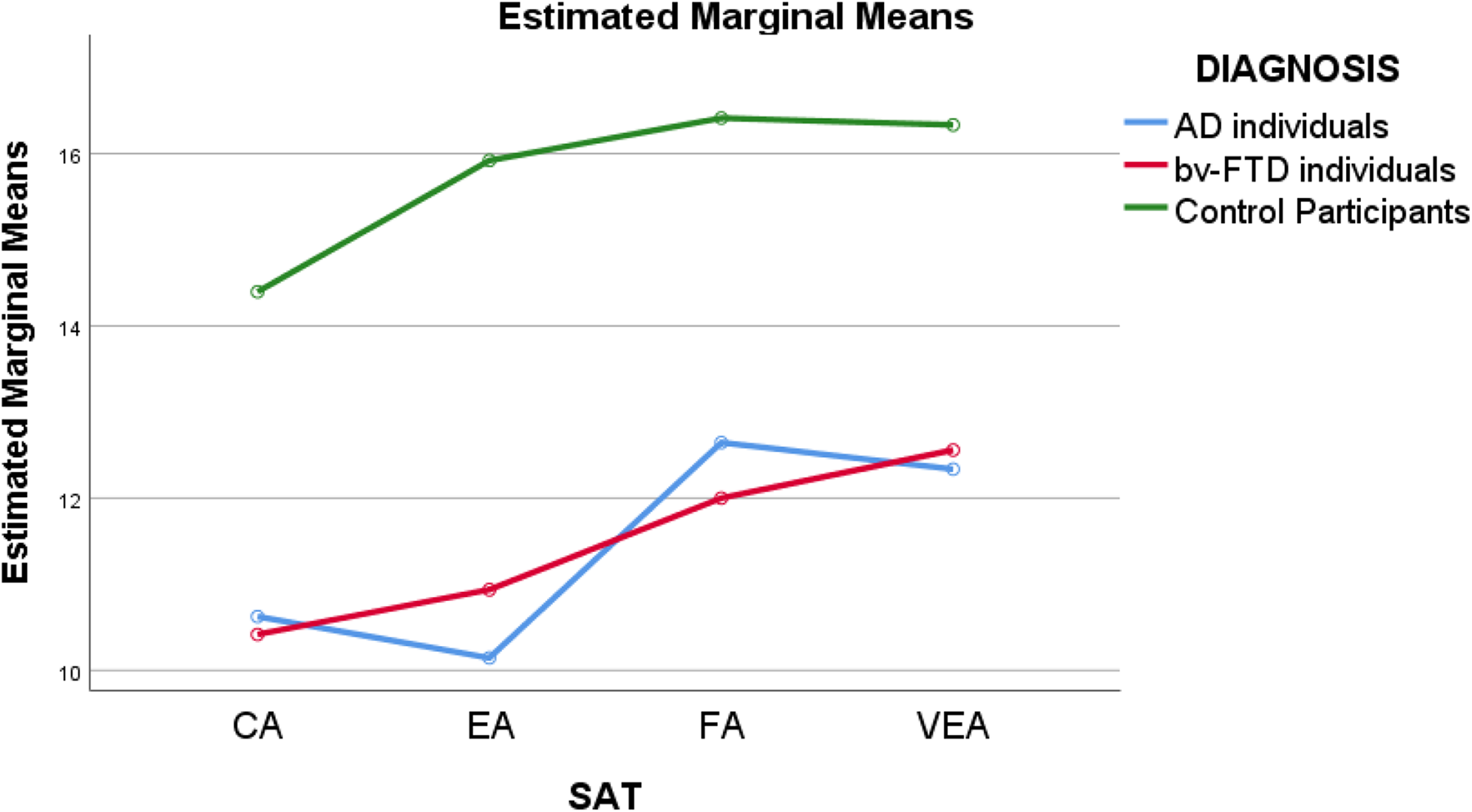
Performance obtained by individuals with AD (in blue), persons with by-FTD (in red) and control participants (in green) on the 4 SAT subsets.
Results From Repeated Measures ANOVA Between the 2 Largest Clinical Groups (AD and bv-FTD) and Control Participants on the 4 SAT Subsets.a

Abbreviations: CA, categorical associations; df, degree of freedom; Sign., level of significance.
a Performance on VOSP_S was included as covariate. From the top: within-subject main effects and interaction; significant contrast tests; between-subject effects and post hoc tests.
Results From Repeated-Measures ANOVA.a

Abbreviation: CA, categorical associations.
a From the top: within-subject main effects and interaction; significant contrast tests.
Single-Case Analyses
Crawford analyses for dissociations (Table 5) confirmed results obtained through the within-group analysis for individuals with AD, who had a significantly poorer performance in the EA subsets than in the CA and VEA subsets. However, the analysis highlighted also a significant poorer performance on FA than on CA and VEA subsets. A similar pattern also emerged in 2 individuals with bv-FTD as well as in 1 nfv-PPA case and 1 sv-PPA case. Thus, while group comparisons did not reveal a significant difference between SAT subset scores in the bv-FTD group, single-case analyses highlighted dissociated patterns, but less frequently than in individuals with AD. In addition, some idiosyncratic behavioral patterns emerged. Three AD and 1 person with bv-FTD performed significantly poorer on the VEA than on the FA conditions. One individual with bv-FTD had major deficit on FA and 1 person with nfv-PPA had major deficit on EA. Furthermore, 1 person with sv-PPA was selectively impaired on the CA subset only, although being still within the normal range on the SAT total score.
Number of Individuals With Dementia and PPA Who Satisfied Crawford Criteria for a Dissociation Between SAT Subsets.

Abbreviations: AD, Alzheimer’s disease; bv-FTD, behavioral variant of frontotemporal dementia; CA, categorical associations; EA, encyclopedic associations; FA, functional associations; nfv-PPA, non-fluent variant of primary progressive aphasia; NS, nonsignificant; sv-PPA, semantic variant of primary progressive aphasia; VEA, visual encyclopedic associations.
Discussion
Semantic categorization is based on 2 main cognitive processes. 11 A first process allows to categorize objects sharing similar properties, for example, visual and functional properties of animals and tools, respectively. A second process allows to associate objects that are related in a specific event (eg, the anchor and the boat are related in the sailing event). This observation is in agreement with the hypothesis that semantic memory is supported by multiple semantic systems that encompass different sources of information and account for our ability to associate objects in a flexible way. 4 The consequence of this theoretical account is that semantic memory is rarely impaired as a whole because concepts are based on various types of information. Instead, a person with semantic memory deficit may have lost only some kind of knowledge that is associated to a concept. Taking into account this theoretical framework, we developed an experimental SAT, which allows to explore different types of semantic relationships—CA, EA, FA, and VEA. The SAT was applied to individuals with different neurodegenerative clinical profiles, which should cause, or not, semantic deficits (AD, bv-FTD, nfv-PPA, sv-PPA). Group comparisons between the 2 major clinical samples allowed to detect 2 different semantic impairment profiles in persons with AD and with bv-FTD. In fact, individuals with AD had severe impairment on all SAT subsets, but particularly on the EA subset, indicating a loss of encyclopedic knowledge. Although individuals with AD were impaired on object visual recognition (ie, silhouette subtests of VOSP), their performance on SAT subsets was not influenced by visual recognition deficits. This evidence suggests that the SAT measures a visual semantic association that is distinct from the visual information that is essential for object identification. This is also in agreement with current theories of semantic memory claiming that semantic knowledge is composed by various sensory, motor, and encyclopedic information derived from multiple modality-specific neural networks. 9 Instead, individuals with bv-FTD were impaired in all subsets compared to control participants, with homogeneous performance in all SAT subsets. Furthermore, all clinical groups had a relatively preserved performance on the CA subset. With regard to the bv-FTD group, results suggest that these individuals have difficulties in all types of conceptual matching, regardless of the specific type of semantic association involved. This evidence indicates that individuals with bv-FTD may be impaired on the SAT because of poor executive abilities, as already suggested by other studies. 51,56 Our hypothesis is also supported by some recent studies suggesting that semantic cognition would require separate and interacting neural networks not only for semantic representations but also for their executive control. 29,72 Unfortunately, the present study did not focus on executive function, and thus no testing for executive abilities that may intervene in semantic control was conducted. This issue has to be explored in future studies. However, Crawford analyses for single cases detected dissociated patterns of impairment across dementia groups. In individuals with AD, single-case analyses confirmed damage to the EA, which already emerged from group comparisons, but also detected major damage to FA with respect to CA and VEA types of association. The worse performance on the FA subset obtained by the AD participants is coherent with recent studies underlining a deficit of conceptual information about the purpose of tool use in this clinical population. 57,58 In agreement with neuroimaging studies exploring the neural basis of functional knowledge, 12,34,35,59 -61 this pattern of deficit is probably due to damage to predominantly left temporal areas, which are usually hypofunctional in individuals with AD. 62 In addition, the single-case analysis revealed some idiosyncratic behavioral patterns across AD individuals. Differently from the AD group, no clear behavioral pattern emerged in the bv-FTD group. Two cases showed dissociations that were comparable with those emerging in individuals with AD, while other individuals showed other specific patterns of impairment (1 case had a major damage for FA, 1 case had a selective damage for VEA, and 3 cases had no dissociated pattern of damage). On the one side, this result suggests that distinct types of semantic association require different degrees of executive resources. On the other side, results show that in individuals with bv-FTD, it is more difficult to predict how semantic processing is affected than in persons with AD. However, another possible explanation is that the semantic deficit in individuals with bv-FTD is due to functional and structural alterations of the anterior temporal lobes structures since deterioration patterns in individuals with bv-FTD usually include frontal and/or anterior temporal atrophy. 63 A consistent amount of studies revealed that bilateral anterior temporal lobes are strictly connected to the sensory and motor systems, which project-specific semantic information about object concepts to the anterior temporal lobes. 26,72,73 Concerning persons with nfv-PPA, only 1 of the 4 cases showed an impairment on overall SAT score, and this is in agreement with current diagnostic criteria, 55 which report relative sparing of semantic abilities in these individuals. One case with sv-PPA had impaired performance on all SAT subsets but on CA, whereas the opposite pattern was observed in the remaining sv-PPA individual, with selective damage to CA and spared performance on the other types of associations. Thus, results on both group and single-case analyses support a broad individual variability of semantic deficit and support the idea that different object properties, and thus different types of semantic associations, may be selectively disrupted. Such disproportionate damage to specific lexical-semantic associations supports the multiple semantic system hypothesis. 4 We are aware that results on individuals with PPA are only provisional due to the small sample size for each single variant. An increase of PPA sample sizes is needed to better explore their behavioral profile on the SAT. Furthermore, 1 of the 2 persons with sv-PPA was impaired on the CA subset only, but not on the overall SAT score. Since this participant was in an early stage of disease, with mild deficit on MMSE (raw MMSE score = 22) and relatively preserved performance on the remaining neuropsychological tests (including the naming subtest of AAT), the lack of impairment on our experimental task may indicate that SAT is suitable to detect early, subtle and selective semantic deficits for a single subset, in the absence of an overall damage to the entire set of tasks. Although previous studies on AD and sv-PPA individuals supported the view that the loss of semantic knowledge reflects a bottom-up hierarchy, with specific features being the most vulnerable and categorical information being preserved the longest, 74,75 recent studies have shown that categorical processing is deeply impaired in individuals with sv-PPA. 29,30 In fact, the anterior temporal lobes are responsible for generalization across concept types, 31,72,73 and cortical atrophy in these brain regions causes a damage to all types of semantic knowledge, as it can be observed in individuals with sv-PPA. Indeed, in the present study, we found that 2 sv-PPA cases showed a contrasting pattern of performance on CA, leaving the question unsolved whether categorical processing may be relatively spared in comparison to other types of association (eg, FA or VEA). This issue should be addressed in future studies. Another limitation of the study is the lack of SAT comparison with other semantic association tasks, such as the Pyramids and Palm trees test. 18 In addition, future research should further investigate the specific role of executive functions versus semantic memory deficits in individuals with bv-FTD.
Footnotes
Acknowledgements
The authors are grateful to participants with neurodegenerative diseases and healthy participants for their support for the research reported here.
Declaration of Conflicting Interests
The authors declared no potential conflicts of interest with respect to the research, authorship, and/or publication of this article.
Funding
The authors received no financial support for the research, authorship, and/or publication of this article.
