



Abstract
Background:
Clean air is considered to be a basic requirement for human health and well-being.
Objective:
To examine the relationship between cognitive performance and ambient pollution exposure.
Methods:
Studies were identified through a systematic search of online scientific databases, in addition to a manual search of the reference lists from the identified papers.
Results:
Air pollution is a multifaceted toxic chemical mixture capable of assaulting the central nervous system. Despite being a relatively new area of investigation, overall, there is mounting evidence implicating adverse effects of air pollution on cognitive function in both adults and children.
Conclusions:
Consistent evidence showed that exposure to air pollution, specifically exposure to particulate matter, caused poor age-related cognitive performance. Living in areas with high levels of air pollution has been linked to markers of neuroinflammation and neuropathology that are associated with neurodegenerative conditions such as Alzheimer’s disease-like brain pathologies.
Introduction
Air pollution is one of a variety of man-made environmental disasters that are currently taking place all over the world. It collectively describes the presence of a diverse and complex mixture of chemicals or of biological material in the ambient air which can cause harm or discomfort to humans or other living organisms. It is recognized as a global public health issue, both in developed and developing countries. Millions of people worldwide are chronically exposed to airborne pollutants in concentrations that are well above legal safety standards. 1 Exposure to air pollution has been associated with a higher incidence of hospitalization 2 and elevated risk of both cardiopulmonary and lung cancer mortalities. 3 Furthermore, combustion emissions and their contribution to ambient particulate, semivolatile, and gaseous air pollutants all contain organic compounds that induce mutagenicity and genetic damage. 4 In fact, air pollutants can cross the placental barrier and directly affect the embryo and fetus. 5,6 These detrimental effects are thought to be caused by particulate matter (PM) in ambient air, of which traffic is a major source. Particulate air pollution is a pervasive component of urban and suburban ambient air pollution. Combustion emissions account for over half of the fine particle air pollution and most of the primary particulate organic matter. Ambient particles are characterized by size and aerodynamic properties: coarse particles with aerodynamic diameter of 2.5 to 10 μm (PM10), fine particles less than 2.5 μm (PM2.5), and ultrafine particles less than 0.1 μm. The PM10 particles are the respirable fraction originating from sources such as road and agricultural dust, tire wear emissions, wood combustion, construction and demolition works, and mining operations. 7 PM2.5 particles are formed from gas and condensation of high-temperature vapors during combustion and industrial activities. 1 Common chemical constituents of PM include sulfates; nitrates; ammonium; other inorganic ions such as ions of sodium, potassium, calcium, magnesium, and chloride; organic and elemental carbon; crustal material; particle-bound water; metals (including cadmium, copper, nickel, vanadium, and zinc); and polycyclic aromatic hydrocarbons; in addition, biological components such as allergens and microbial compounds are found in PM. 8 It has been found that PM, especially PM2.5, can remain in the air for a long time and can travel hundreds of miles 9 and can easily enter buildings. 10
Methods
A systematic research (Cochrane Library and PubMed) on air pollution and cognitive dysfunction was carried out (only upper time limit: November 2017). We found 6 articles using the terms “air pollution” and “brain damage,” 37 articles using the terms “air pollution” and “dementia,” 23 articles using the terms “air pollution” and “cognitive decline,” and 43 articles using the terms “air pollution” and “cognitive function.” Publications found through this indexed search were reviewed for further relevant references. Additional records were identified through other sources (ie, Google Scholar and key journals). We manually screened the reference list of relevant studies identified. At the end of the process, 73 studies were included in our qualitative synthesis.
Entry of Air Pollutants Into the Central Nervous System: The Trojan Horse
The mechanism responsible for PM entry to the brain is a source of debate. Air pollutants affect the central nervous system (CNS) either directly by transport of nanosized particles into the CNS or secondarily through systemic inflammations. 11 -13 The release of nanoparticles to the environment as aerosols from traffic, waste, and industry processes strongly suggests that inhalation is an important access route in humans. Approximately 5% to 20% of the nasal airflow passes through the olfactory region. The olfactory organ is unique in the CNS, since it is the only part in direct contact with the environment and hence exposed to volatile odorants and airborne (toxic) substances. The human nasal passages serve as an effective filter of inhaled particles. The adequacy of the nose–brain barrier to prevent entry of inhalants into the brain is coming under increasing scrutiny. 14 Fine and ultrafine particles may reach the brain through olfactory receptor neurons or the trigeminal nerve. The existence of uptake and retrograde axonal transport of particles via the olfactory nerve has been described by several authors for transport of different materials from the olfactory region to the CNS. 15 Ultrafine elemental carbon-13 particles in the olfactory bulb, cerebrum, and cerebellum in rats were found after inhalation of particles. 16 Particles may enter the body via the lungs through breathing. With each breath, millions of particles enter the lungs, where they may land on the surface of the airways or the alveoli. 17 It has been demonstrated that a fraction of particles that deposits in the alveolar region of the lung may translocate to the systemic circulation and subsequently to extrapulmonary organs. Once in the circulation, a subset of these particles may translocate across the blood–brain barrier (BBB) to the brain parenchyma (systemic route). Depending on the physicochemical properties, particles can pass an intact BBB in several ways including passive crossing by simple (passive) diffusion (lipophilic materials) or via transporter protein- or receptor-mediated, energy-dependent active transport. 18
How Air Pollution Damages the Brain
Fifteen years ago, the CNS has been proposed to be a target organ for the detrimental effects of airborne pollutants. 19 Evidence has been slowly accumulating suggesting that air pollution may negatively affect the CNS through a variety of cellular, molecular, and inflammatory pathways that either directly damage brain structures or lead to a predisposition to neurological diseases. 20 -22 The impact of air pollution upon the brain was first noted as an increase in ischemic stroke frequency found in individuals exposed to indoor coal fumes. 23 Estimates from the World Health Organization indicate that 40% of outdoor air pollution–caused deaths worldwide are attributed to stroke. 24 Researchers observed that about a third (29.2%) of global disability associated with stroke is linked to air pollution (including environmental air pollution and household air pollution). This is especially high in developing countries (33.7% vs 10.2% in developed countries). The data do not differentiate between ischemic and hemorrhagic strokes, but authors say that while the risk factors for different types of stroke may vary slightly at the individual level, global, regional, and national policies tend to look at the overall risk of stroke. 25 Chronic exposure to air pollutants in children has shown to cause prefrontal white matter (WM) hyperintense lesions, production of nuclear factor (NF-κβ), alteration in the BBB, and loss of neurons. 20 Wilker et al 26 studied the associations between air pollution and brain volume or covert brain infarcts (CBIs) in older adults. Exposure to elevated levels of PM2.5 was associated with smaller total cerebral brain volume, a marker of age-associated brain atrophy, and with higher odds of CBI. Although CBI may appear asymptomatic, these small infarcts, typically located in deep regions of the brain, have been associated with neurological abnormalities, poorer cognitive function, 27 and onset of dementia 28 and are thought to reflect small-vessel disease. 29 In human studies, particulate pollution has been shown to induce oxidative damage and inflammation. 30 In a postmortem study of 19 humans aged 34 to 83 years, who had died of non-neurologic causes, brain levels of cyclooxygenase-2, an inflammatory mediator, in the frontal cortex and hippocampus were higher among those who had lived in highly polluted cities than among those who had lived in less polluted cities. 31 The association between exposure to urban air pollution with particulate deposition and inflammation within the brain has also been shown in autopsy samples obtained from children and young adults. 32,33 A coherent pathway linking exposure to air pollution and brain damage starts with a chronic inflammatory process involving the respiratory upper and lower tracts, which results in a systemic inflammatory response with the production of inflammatory mediators capable of reaching the brain. 34 The systemic inflammation is accompanied by the production of pro-inflammatory cytokines such as tumor necrosis factor α, interleukin 6 (IL-6), and IL-1β, for which blood vessels in the brain exhibit constitutive and induced expression of receptors. 1,35 Activation of the brain innate immune responses could follow the interaction between circulating cytokines and constitutively expressed cytokine receptors located in endothelial brain capillary cells, followed by activation of cells involved in adaptive immunity. The cytokines could thus activate cerebral endothelial cells and disrupt the BBB integrity. 32 Then, activation of the brain innate immune responses could follow the interaction between circulating cytokines and constitutively expressed cytokine receptors located in endothelial brain capillary cells, followed by activation of cells involved in adaptive immunity, 36 neuroinflammation, and neurodegeneration. 32 Neuroinflammation constitutes a beneficial process involved in the maintenance of organ homeostasis and the brain response to infection or injury. It may become maladaptive when it persists for longer than necessary. Sustained neuroinflammatory processes may contribute to the cascade of events leading to the progressive neuronal damage observed in aging. 37 Inflammatory reactions in the brain are mediated by cytokines, chemokines, or oxidative stress and can result in aberrant protein aggregation, impaired neurotransmitter and neurotrophin signaling, neuronal remodeling, and neurodegeneration. 35 Thus, neuroinflammation has beneficial or deleterious results in the brain mainly depending on the duration of the inflammatory response. Biochemical and molecular studies have evidenced that another common adverse effect of air pollution is oxidative stress. 38 -40 The brain is vulnerable to oxidative stress damage because of its high energy use, low levels of endogenous scavengers (eg, vitamin C, catalase, superoxide dismutase, etc), high metabolic demands, extensive axonal and dendritic networks, and high cellular content of lipids and proteins. There are substantial data to suggest that oxidative damage evident in Alzheimer’s disease (AD) brains, induced by oxidative stress, is intimately involved in the mechanism of neurodegeneration. 41 Similarly, although not as extensive, elevated levels of lipid peroxidation and depletion of a range of antioxidants have been reported systemically in vascular dementia (VD). 42
Air Pollution and Neurodegeneration: Possible Link to AD
It has been suggested from epidemiological and observational studies that exposure to airborne pollutants can contribute to neurodegenerative disease processes already from early childhood on, especially if the individuals are chronically exposed to the contaminants. Neuropathologically, AD is classically characterized by the accumulation of senile plaques and neurofibrillary tangles (NFTs) mainly comprised of hyperphosphorylated tau in vulnerable brain regions. Senile plaques are composed of parenchymal and cerebrovascular aggregates of β-amyloid (Aβ) 40/42 peptides. β-Amyloid peptides are derived from the sequential cleavage of amyloid precursor protein (APP), and the enzymatic hydrolysis is primarily mediated by β-site APP cleaving enzyme 1. Current theory holds that AD begins with an asymptomatic phase with mild Aβ and tau pathology in the brain approximately 20 years prior to onset of mild cognitive impairment (MCI), which then insidiously culminates over time to neuron damage and dementia with age. 43 Air pollution can accelerate Aβ-42 accumulation, which is a known cause of the neuronal dysfunction that precedes the formation of Aβ peptide plaques and NFTs. 44 -46 Calderón-Garcidueñas et al 32 conducted a study using autopsy brain samples from Mexican subjects, lifelong residents of 2 large cities with severe air pollution and 5 small cities with low levels of air pollution. The low-exposure group included 9 subjects, and the high-exposure group included 10 subjects. The subjects had no clinical history or pathological evidence of short- or long-term inflammatory processes, administration of anti-inflammatory drugs or hormones, or events such as cerebral ischemia, head trauma, or epilepsy. Autopsies were performed 4.1 ± 1.3 hours after death. Residents of cities with severe air pollution had greater neuronal and astrocytic accumulation of Aβ42 compared to residents in low air pollution cities. The presence of neocortical hyperphosphorylated tau with pretangle material and Aβ diffuse plaques in the frontal cortex of individuals exposed to urban air pollution suggests a link between oxidative stress, neuroinflammation, neurodegeneration, and chronic exposure to high concentrations of air pollution. 12,47,48 The first studies exploring whether air pollution is culpable in neurodegenerative disease were investigated in animal (feral dog) populations naturally exposed to polluted urban. 20 More recently, these findings have now been confirmed and extended in humans and additional animal models. 31,49 Human studies have also revealed that individuals living in highly polluted cities show AD-like and Parkinson disease (PD)-like pathology, when compared to individuals living in cities with less pollution. 1,50
Air Pollution and Cognitive Function in Children/Adolescent and Older Adults
Dementia and cognitive decline have no current casual treatment options. The need to understand any potential relationship of cognitive decline, the mechanisms, and etiology of cognitive outcomes becomes increasingly important as the population ages. Even if everybody can suffer the consequences of chronic exposure to atmospheric pollution, some populations are more fragile. Increasing evidence suggests that chronic ambient air pollution exposure may have neurotoxic effects in children and in older individuals (Table 1). Furthermore, many neurodegenerative diseases, such as AD and PD, are predicted to be the result of cumulative exposures across an entire lifetime. 66
Studies Examining Neurocognitive Effects of Air Pollution in Children, Adolescents, and Older Adult Populations.
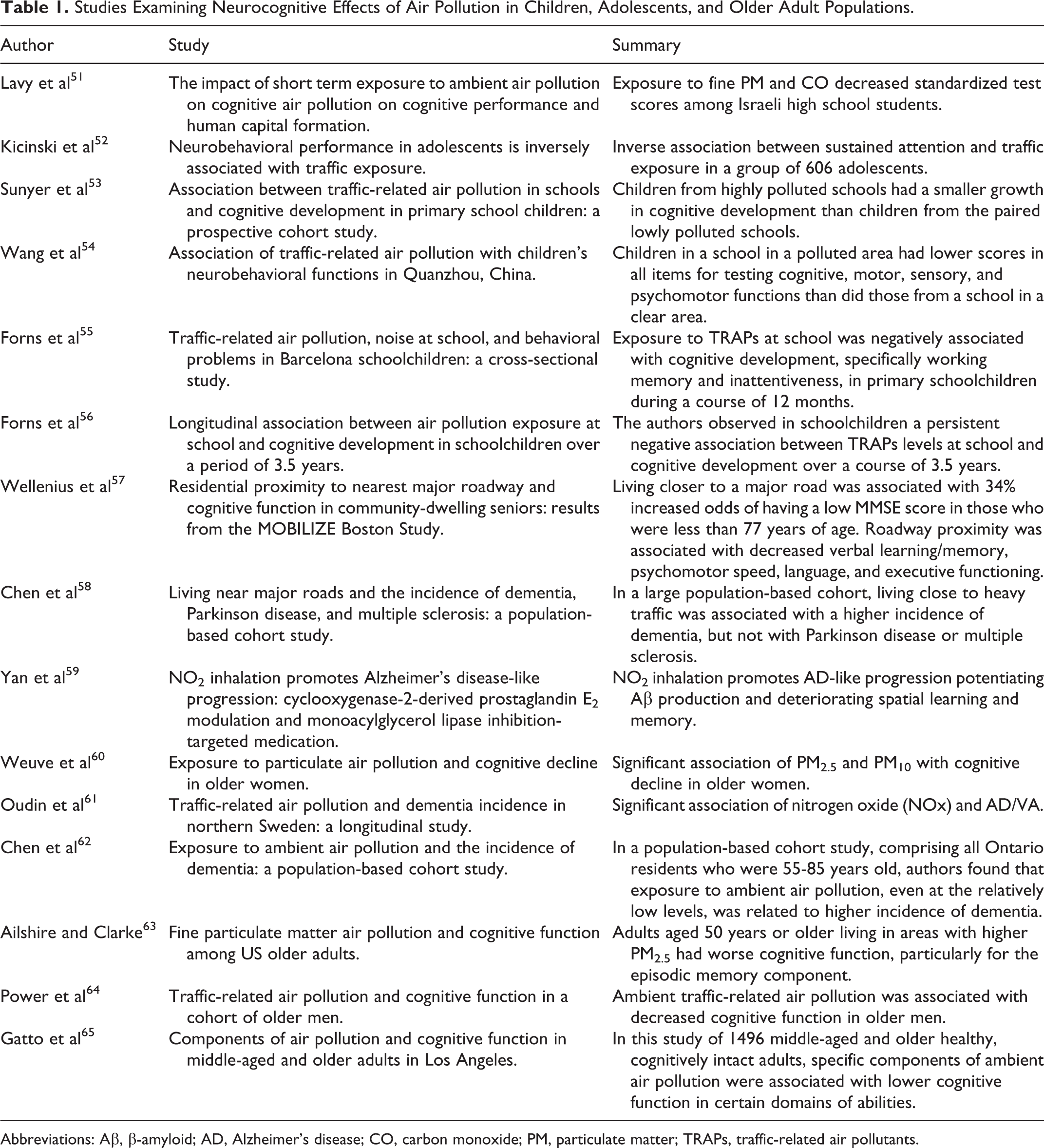
Abbreviations: Aβ, β-amyloid; AD, Alzheimer’s disease; CO, carbon monoxide; PM, particulate matter; TRAPs, traffic-related air pollutants.
Children and adolescent
Children and teenagers spend a large part of their time at school both indoors and outdoors. Many schools are located in close proximity to busy roads, and traffic air pollution peaks when boys/girls are at school. Lavy et al 51 found that exposure to fine PM and carbon monoxide decreased standardized test scores among Israeli high school students. This research was corroborated by Kicinski et al who showed an inverse association between sustained attention and traffic exposure in a group of 606 adolescents. 52 This inverse association was independent of the blood lead level and potential confounders including the level of education of the mother, the socioeconomic status, smoking, and passive smoking. Also, Sunyer and colleagues 53 demonstrated that cognitive development is reduced in children exposed to higher levels of traffic-related air pollutants (TRAPs). This association was consistent for working memory, superior working memory, and inattentiveness and robust to several sensitivity analyses. High- and low-exposed schools were comparable in terms of socioeconomic status. To assess whether a part of observed associations was due to potential residual confounding, models were adjusted for all covariates, both individual (eg, smoking at home or commuting [distance and walking mode]) and contextual (eg, greenness or noise). Wang et al 54 conducted a study in Quanzhou (China) where 2 primary schools were chosen based on traffic density and monitoring data of ambient air pollutants. After adjusting the potential confounders, the research confirmed that children in a school in a polluted area had lower scores in all items for testing cognitive, motor, sensory, and psychomotor functions than did those from a school in a clear area. For the 861 children who participated, the 2 groups had similar distribution for sex, familiarity with computer games, passive smoking, breastfeeding, and birth weight. Older adults are especially vulnerable to hazards in their immediate environment. Forns et al 55 performed a study on a population of 7- to 11-year-old children residing in Barcelona. Exposure to TRAPs at school was negatively associated with cognitive development, specifically working memory and inattentiveness during a course of 12 months. These results persisted after the researchers adjusted their final models by noise. The authors further adjusted (one at a time) their main analyses for maternal occupation, paternal education, siblings at birth (no/yes), smoking during pregnancy, alcohol consumption during pregnancy, and duration of breastfeeding. In a following study, the same researchers observed a persistent negative association between TRAPs levels at school and cognitive development over a course of 3.5 years. 56
Older adults
In a multivariable-adjusted model for global cognitive function, researchers have assessed the association of black carbon, a marker of traffic-related air pollution, with lower cognitive performance and cognitive decline in older individuals. 64 To test the sensitivity of their results to potential confounding by exposure to lead, the authors repeated sensitivity analyses to determine the influence of potential confounding by exposure to lead adjusting for bone lead concentration and imputation status (yes/no). Ranft et al 67 first demonstrated an association between long-term exposure to traffic-related air pollution and MCI in elderly people. Indicator of traffic-related air pollution was a distance of the participant’s home address of at most 50 m to the next busy road with more than 10 000 cars per day. Potential risk factors (traffic exposure, age, education, active smoker, past smoker, environmental tobacco smoke exposure, indoor air pollution, depression, chronic respiratory diseases, diabetes mellitus, hypertension, high cholesterol, ever stroke or infarction, obesity, and sporting activity) included in the regression modeling did not confound the negative association. Wellenius and colleagues too 57 performed a study to evaluate the association between residential distance to nearest major roadway, as a marker of long-term exposure to traffic pollution, and cognitive function in older adults. In all analyses, age, sex, race (white vs other), history of stroke, history of smoking (ever vs never), physical activity, education (3 categories), body mass index, household income, season of home interview (4 categories), and 2 census track-level indicators of neighborhood socioeconomic status (percentage of population that is nonwhite and percentage of population with college degree or above) were adjusted for. Residential proximity to a major roadway was associated with poorer performance on cognitive tests of verbal learning and memory, psychomotor speed, language, and executive functioning, with most tests showing evidence of a graded dose–response relationship. Chen and collaborators recently confirmed the association between residential proximity to major roadways and the incidence of dementia adjusting for individual and contextual factors such as for sex, history of diabetes, hypertension, coronary heart disease, stroke, congestive heart failure, arrhythmia, traumatic brain injury, education, and neighborhood income. 58 The authors assembled 2 population-based cohorts including all adults aged 20 to 50 years and all adults aged 55 to 85 years who resided in Ontario. Residents living within 50 m of a major road were between 7% and 12% more likely to develop dementia, depending on how long they had lived there and whether they lived in an urban or rural area. With distance from the road, the risk dissipated until, 200 m away from a major road, residents were at no more risk than those who lived further away. The associations between living near a major road and increased dementia incidence seemed stronger among urban residents, especially those living in major urban centers and those who never moved, and it was insensitive to additional controls for smoking, obesity, physical activity, and education. The researchers observed that exposures to nitrogen dioxide (NO) and PM2.5 were related to dementia and that adjusting for these 2 pollutants attenuated its association with roadway proximity, suggesting that the effect of traffic exposure might, at least in part, operate through this mechanism. According to Yan et al, 59 NO2 inhalation promotes AD-like progression potentiating Aβ production and deteriorating spatial learning and memory. From 1995 to 2001, Weuve et al 60 showed that older US women living in areas with higher levels of PM2.5 had more rapid cognitive decline over a 2-year period. They invited participants 70 years and older with no history of stroke to participate in a study of cognition (19 409 women living throughout the contiguous United States). The authors estimated recent (1 month) and long-term (7-14 years) exposures to PM2.5-10 and PM2.5 preceding baseline cognitive testing of participants. They concluded that long-term exposure to PM at levels typically experienced by many individuals in the United States was associated with significantly worse cognitive decline in older women. The authors adjusted their analyses for potential confounding variables, including age at cognitive assessment, education, husband’s education, energy expended on recreational physical, and alcohol consumption. Additional adjustment for vascular factors (body mass index, diabetes, smoking, aspirin use, and ibuprofen use) did not change their findings. Associations between dementia incidence and local traffic pollution that remained after adjusting for known risk factors were observed also in a Swedish Study.61 The magnitude of the association was similar for both AD and VD. Potential confounders such as sex, age, and education were considered as an indicator of socioeconomic status, physical activity, smoking, alcohol consumption, body mass index, stoke, diabetes, hypertension, and being an ε4 carrier of apolipoprotein E. Recently, a population-based cohort study was published 62 comprising all Ontario residents who, on April 1, 2001, were 55 to 85 years old, Canadian-born, and free of physician-diagnosed dementia (∼2.1 million individuals). In Ontario, the concentrations of pollutants are among the lowest in the world. The authors found that exposure to ambient air pollution, even at the relatively low levels, was related to higher incidence of dementia. The researchers adjusted analyses for age, sex, preexisting comorbidities, urban residency, education, and unemployment rate. Allen and colleagues 68 simulated indoor environmental quality conditions in “green” and “conventional” buildings and evaluated the impacts on cognitive function. Green buildings are aimed at energy efficiency and environmental performance but also include guidelines for improving ventilation and filtration, using low-emitting materials, controlling indoor chemical and pollutant sources. Compared with conventional buildings, environmental measurements in green buildings show lower concentrations of several key pollutants including particles, NO2, and volatile organic compounds. Office workers had significantly improved cognitive function scores when working in green environments compared with scores obtained when working in a conventional environment. Genome-wide studies for cognitive function 69 have shown that genetic variants identified explain a small proportion of the phenotypic variability, indicating the need for new approaches such as incorporating the environmental exposures in the genetic studies.
Due to the relatively higher availability of cognitive testing, a number of studies have investigated the association of cognitive test scores, indicative of cognitive function with long-term exposure to a wide variety of air pollutants: The majority of these studies reported positive associations with global cognition or different domains of cognition. 21,58,63,64,67,70,71 For example, Ailshire and Clarke 63 studying adults aged 50 years or older living in areas with higher PM2.5 suggested that the research participants had worse cognitive function, particularly for the episodic memory component. Children (mean age: 9.7 years), who were exposed to higher levels of black carbon during their life, showed a decrease in cognitive function across assessments of verbal and nonverbal intelligence and memory constructs. 72 Chen and Schwartz 21 observed very consistent associations between estimated annual ozone exposure and reduced performance in specific CNS functions: The adverse effect is more pertinent to ozone-induced impairment in memory and attention. Furthermore, exposure to higher concentrations of black carbon, a component of PM2.5, has been linked to worse cognitive function in older adults. 57,64 Nitrogen dioxide is inversely associated with logical memory abilities, and ozone exposure is associated with lower executive functioning in middle-aged and older adults. 65 Researchers 73 discovered that the adverse effect on brain structure in older women was primarily driven by smaller WM volumes associated with cumulative PM2.5 exposures. These effects were present in the WM underlying frontal, parietal, and temporal association regions as well as the corpus callosum. However, there were no differences in gray matter or hippocampal volumes by PM2.5 exposures. Wilker et al 26 also reported no association between PM2.5 exposure and hippocampal volume.
Conclusions
Advances in environmental health sciences have elucidated the myriad risk factors and mechanisms of brain damage that are associated with environmental exposures. In many regions of the world, individuals are exposed to particulate air pollution over their entire lives. The effects of air pollutants are at a high level of interest for scientific, governmental, and public communities. The problem is a major health concern for both developing and developed countries. Over the past 30 years, extensive evidence has shown that air pollution affects cardiovascular and respiratory morbidity and mortality in both adults and children across the world. In more recent years, evidence has been accumulating from human epidemiological and animal studies, suggesting that air pollution may negatively affect the CNS and contribute to adverse neurological outcomes. However, given the enormous complexity of the CNS and the complex nature of air pollution, the resulting CNS pathology can have many underlying causes and pathways and could be due to synergistic interaction of multiple pathways and mechanisms making it difficult to pinpoint a clear stimulus–response relationship. Children are at special risk because childhood is a crucial period of brain development. Studies have provided evidence of an association between particulate air pollution and cognitive decline through activation of systemic inflammatory pathways and vascular dysfunction. Minimum doses of pollution can be handled by the organism when this exposure is acute, but the same doses administered chronically lead to an oxidative stress state that can produce neurodegeneration. Although AD causality is multifactorial, air pollution could increase an individual’s risk of developing AD by accelerating age-related oxidative changes observed in the brain and hence represent a significant public health hazard. Recommending possible public health interventions and solutions and establishing international conventions/protocols for the prevention and control of pollution has become a categorical imperative. Innovative technological strategies, such as calming speed and smoothing traffic flow on highways, could also substantially reduce near-roadway concentrations of PM. 74 The identification of the specific pollutants that contribute most to health hazards could play an important role in the creation of environmental and social policies, with crucial implications for the actions taken by local authorities to reduce exposure and the risks of pollutants. More studies and more intensive collaborations are needed to generate larger and more diverse cohorts and standardized data that would allow us to draw stronger conclusions. Physicians, who are already responding to the human consequences of particulate pollution, can be effective advocates for these protections.
Footnotes
Declaration of Conflicting Interests
The authors declared no potential conflicts of interest with respect to the research, authorship, and/or publication of this article.
Funding
The authors received no financial support for the research, authorship, and/or publication of this article.
