



Abstract
Apolipoprotein E type 4 allele (ApoE∊4) is known as a risk gene for the late-onset Alzheimer’s disease, and the relationship between ApoE∊4 and cognitive function of the elderly people has drawn the attention of the scientists. In this study, we investigated the relationship between ApoE∊4 and the cognitive function of the old people. A total of 156 old people were investigated, of whom 31 were ApoE∊4 carriers. The ApoE∊4 primarily influenced the global cognitive function, perceptual speed, and work memory. The results indicate that ApoE∊4 has significant negative effect on the cognitive function of the elderly people who are 60 years and older.
Keywords
Introduction
Apolipoprotein E type 4 allele (ApoE∊4) is the most recognizable risk gene for late-onset Alzheimer’s disease (AD; LAD). In 1993, Corder and his colleagues 1 first reported that the increase in gene dose of ApoE∊4 increased the risk of AD and advanced the onset age in late-onset families. Since then, numerous studies have been conducted to investigate the effects and mechanisms of ApoE∊4 on the onset years and the progress of cognitive function loss in patients with AD. 2 -5 Recent studies also suggested an association between ApoE∊4 and cognitive function. Several elegantly designed studies found that ApoE∊4 increased the loss of cognition in the elderly people and accelerated this trend. 6 -8 Greenwood et al 9 showed that the middle-aged people carrying ApoE∊4 had worse visual–spatial attention and work memory compared to noncarriers. Caselli et al 6 found that ApoE∊4 homozygotes in their 60s have higher rates of cognitive decline than ApoE∊4 heterozygotes or noncarriers. The results of Izaks et al 10 indicated that homozygous ApoE∊4 carriers aged 35 years or older had worse cognitive function compared to age-matched heterozygous carriers and noncarriers. Considering the results of these studies, we were interested in exploring how ApoE∊4 affected cognitive function of Chinese elderly people. According to our knowledge, there was only 1 study that had explored the relationship between ApoE∊4 and cognitive function of Chinese elderly people. 11 Therefore, the current cross-sectional designed study would examine the relationship between ApoE∊4 and cognitive function in those aged 60 years or older.
Patients and Methods
Patients
Study participants were Chinese people aged 60 years or older from the community and health care institution of Tianjin, China. Face-to-face interviews were conducted by a trained investigator to collect the participants’ background information including the demographics (age, education level, job specification, marital status, and personal income), life style characteristics (smoking, alcohol, coffee, tea, and water consumption, and the frequency of fruit and vegetable consumption), medical history and use of medications, and so on. The inclusion criteria were as follows: (1) patients should be aged 60 years or older; (2) patients should have self-care ability, which would be measured by activities of daily life scale and the score should be less than 26; and (3) patients should have the ability of visual sense, auditory sense, and language expression to complete the interview and cognitive tests. The exclusion criteria were as follows: (1) subjected to Parkinson’s disease and epilepsy and had stroke history in 3 months; (2) subjected to psychiatric disorders, such as serious depression and schizophrenia; and (3) subjected to organic disease of nervous system. History of diseases was reported by the participants themselves. The study was approved by the Research Ethics Committee of the institute. All patients signed an informed consent document.
Neuropsychological Test
The global cognitive function was measured by the Mini-Mental State Examination (MMSE). The detailed cognitive function was measured using the basic cognitive aptitude test (BCAT), which was developed by the Institute of Psychology of the Chinese Academy of Social Sciences. 12 The BCAT includes 7 subtests, which were rapid digit copy (subtest 1), rapid Chinese character comparison (subtest 2), mental arithmetic (subtest 3), Chinese character rotation (subtest 4), recall answer of mental arithmetic (subtest 5), recognition of dual words (subtest 6), and recognition of meaningless figures (subtest 7). Subtests 1 and 2 were performed to measure the patient's perceptual speed that reflects the ability of reading and information processing; subtest 3 measures the efficiency of mental arithmetic that reflects individual’s thinking efficiency; subtest 4 tested the efficiency of mental rotation that reflects the patient’s spatial imagery efficiency; subtest 5 evaluates working memory; and subtests 6 and 7 test the patient’s ability of recognition memory that would reflect the ability of language memory and figure memory, respectively.
Blood Collection
Fasting cubitus venous blood were drawn from patients and immediately cooled to 4°C and centrifuged for 20 minutes at 2500 rpm within 30 minutes. The sera and blood clots were separated and kept at −35°C until assay. The blood clot was used for extraction of genomic DNA.
Apolipoprotein E Genotyping
Genomic DNA isolated from the blood clot was used for apolipoprotein E genotyping according to the method described in the Hixson and Vernier. 13 The DNA was extracted from the blood blot using the commercially available TIANamp blood DNA kit (Tiangen Biotech CO, Ltd, Beijing, China) in accordance with the manufacturer’s instruction. The primers used for DNA amplification were 5’-ACAGAATTCGCCCCGGCCTGGTACAC-3’ (forward primer) and 5’-TAAGCTTGGCACGGCTGTCCAAGGA-3’ (reverse primer). The polymerase chain reaction (PCR) conditions were predenaturation at 95°C for 12 minutes; 30 cycles of denaturation at 95°C for 1 minute, annealing at 62°C for 2 minutes, extension at 72°C for 2 minutes, and a final extension at 72°C for 7 minutes. The digestion of PCR products with HhaI was at 37°C for 1 hour. The method used to detect the ApoE genotype was the same as the one described in the study of Hixson and Vernier.
Statistical Analysis
All tests were 2-tailed and the P value lower than .05 was deemed significant. The continuous variables were described by the mean (
Results
Among the 160 participants recruited, 4 patients were excluded from this study because 2 were older than 90 years and 2 were illiterate which didn’t meet the requirements of the BCAT test. Among 156 participants analyzed (82 patients were from the institution and 74 were from the community), 31 were ApoE∊4 allele carriers, the average age was 73.58 ± 7.63 years, and 51.92% were female. The genotype distribution frequencies of ApoE met Hardy-Weinberg equilibrium (P = .453). There was no significant difference in gender, age-groups, and education levels between ApoE∊4 carriers and noncarriers (χ2 = 0.709, P = .400; χ2 = 1.499, P = .473; χ2 = 1.417, P = .492). And there was also no difference in lifestyle factors, such as marital status (χ2 = 0.016, P = .899), tea consumption (χ2 = 0.744, P = .863), coffee consumption (χ2 = 4.063, P = .255), smoking frequency (χ2 = 1.443, P = .486), alcohol consumption (χ2 = 2.649, P = .449), sleep time (χ2 = 1.286, P = .733), and water consumption (χ2 = 0.153, P = .985).
In this study, the ApoE∊4 frequency was 10.9%, which was lower than the world general level reported as ∼15% by Bu. 4 But the level almost coincides with that of Chinese mid-aged and elder people reported as 11.8% by Zhao et al. 14 So we considered the ApoE∊4 frequency of patients in our study could represent that of the general elderly Chinese individuals.
The M of MMSE score was 28, and the IQR was 26 to 29. The average score of total BCAT score was 50.24 ± 14.14. The scores of perceptual speed, mental arithmetic efficiency, space imagery efficiency, work memory, and recognition memory are shown in Table 1. Both lower education levels and older age were associated with lower scores of MMSE (P = .018, P = .000), BCAT (P = .000, P = .000), perceptual speed (P = .017, P = .031), mental arithmetic efficiency (P = .005, P = .000), and work memory (P = .000, P = .000); older age was also associated with decreased score of space imagery efficiency (P = .024). There was no significant difference in all the scores between genders (P > .05).
MMSE and BCAT Scores of the Patients.a
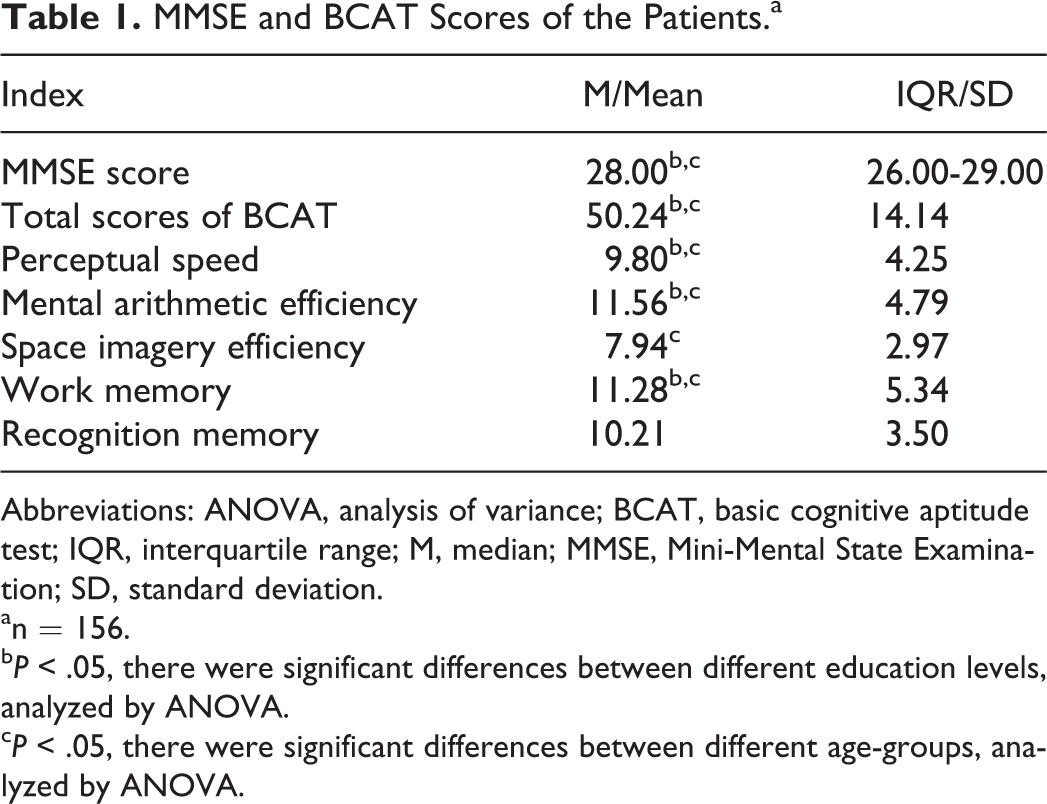
Abbreviations: ANOVA, analysis of variance; BCAT, basic cognitive aptitude test; IQR, interquartile range; M, median; MMSE, Mini-Mental State Examination; SD, standard deviation.
an = 156.
b P < .05, there were significant differences between different education levels, analyzed by ANOVA.
c P < .05, there were significant differences between different age-groups, analyzed by ANOVA.
Because the distribution of MMSE score wasn’t normal, nonparametric Mann-Whitney U test was used to compare the difference between ApoE∊4 carriers and noncarriers. Results showed that although there was no significant difference in MMSE scores between the genotypes, there was a statistical trend that the MMSE scores of noncarriers were higher than those of the ApoE∊4 carriers (P = .08; Table 2). The effect of ApoE∊4 allele on BCAT scores was further analyzed after adjustment for age and education levels using covariance, and the results showed that non-ApoE∊4 carriers had significantly higher scores of perceptual speed, work memory, and total BCAT than ApoE∊4 carriers (Figure 1). In order to evaluate the degree of ApoE∊4 affecting cognitive function, stepwise multiple regression analyses were used to measure the effects of age, education levels, and ApoE∊4 on the scores of perceptual speed, work memory, and BCAT total score. The results demonstrated that age was an influencing factor for the BCAT total score and work memory score (Tables 3 and 4). The primary influencing factor for the perceptual speed was education levels (Table 5).
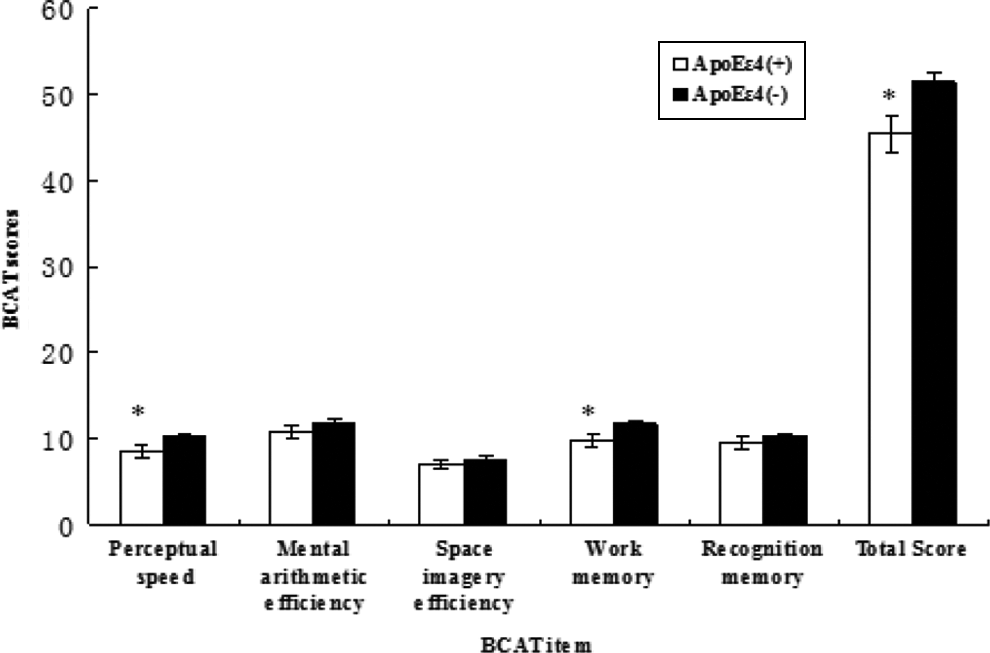
Comparison of basic cognitive aptitude test (BCAT) scores for the apolipoprotein E type 4 allele (ApoE∊4) (+) and ApoE ∊4(−) elderly people using independent sample t test. The number of ApoE ∊4(+) elderly people was 31 and that of ApoE ∊4(−) elderly people was 125. Bars represent the mean ± standard error (SE); *compared with ApoE∊4(−) elderly people, P < .05.
Comparison of MMSE Score for the ApoE∊4(+) and ApoE∊4(−) Groups Using Nonparametric Mann-Whitney U Test.
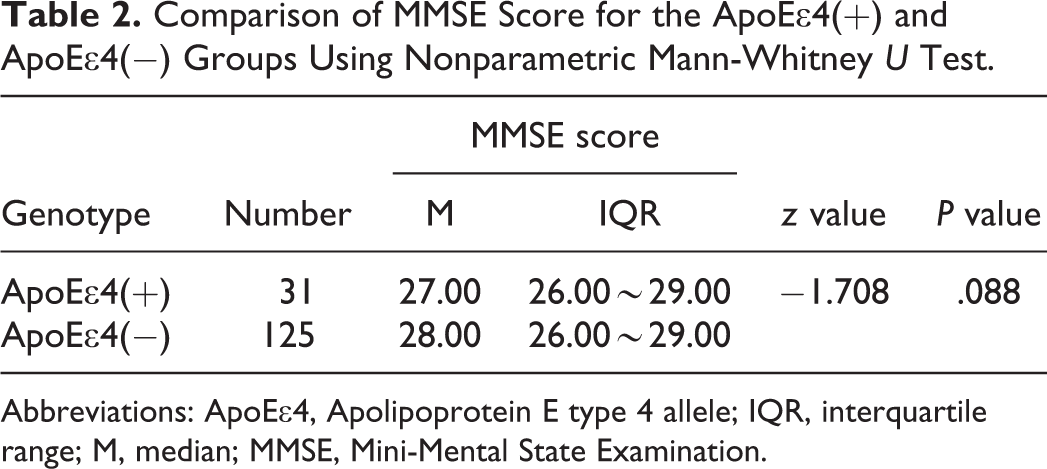
Abbreviations: ApoE∊4, Apolipoprotein E type 4 allele; IQR, interquartile range; M, median; MMSE, Mini-Mental State Examination.
Multiple Linear Regression Analysis of the Effects of Age, Education Level, and ApoE Genotype on the BCAT Total Score.a,b,c
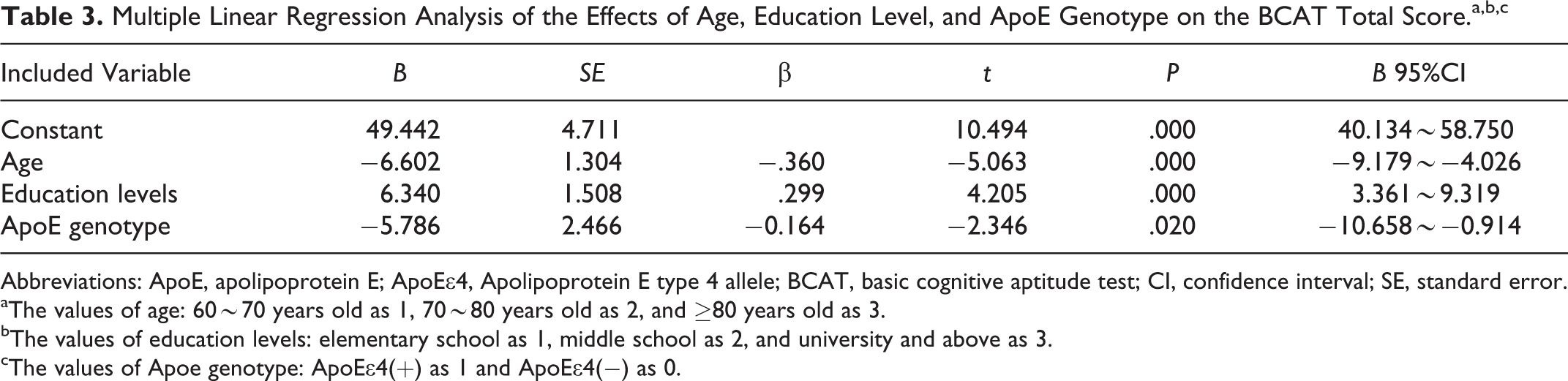
Abbreviations: ApoE, apolipoprotein E; ApoE∊4, Apolipoprotein E type 4 allele; BCAT, basic cognitive aptitude test; CI, confidence interval; SE, standard error.
aThe values of age: 60∼70 years old as 1, 70∼80 years old as 2, and ≥80 years old as 3.
bThe values of education levels: elementary school as 1, middle school as 2, and university and above as 3.
cThe values of Apoe genotype: ApoE∊4(+) as 1 and ApoE∊4(−) as 0.
Multiple Linear Regression Analysis of the Effects of Age, Education Level, and ApoE Genotype on the Work Memory Score.a,b,c
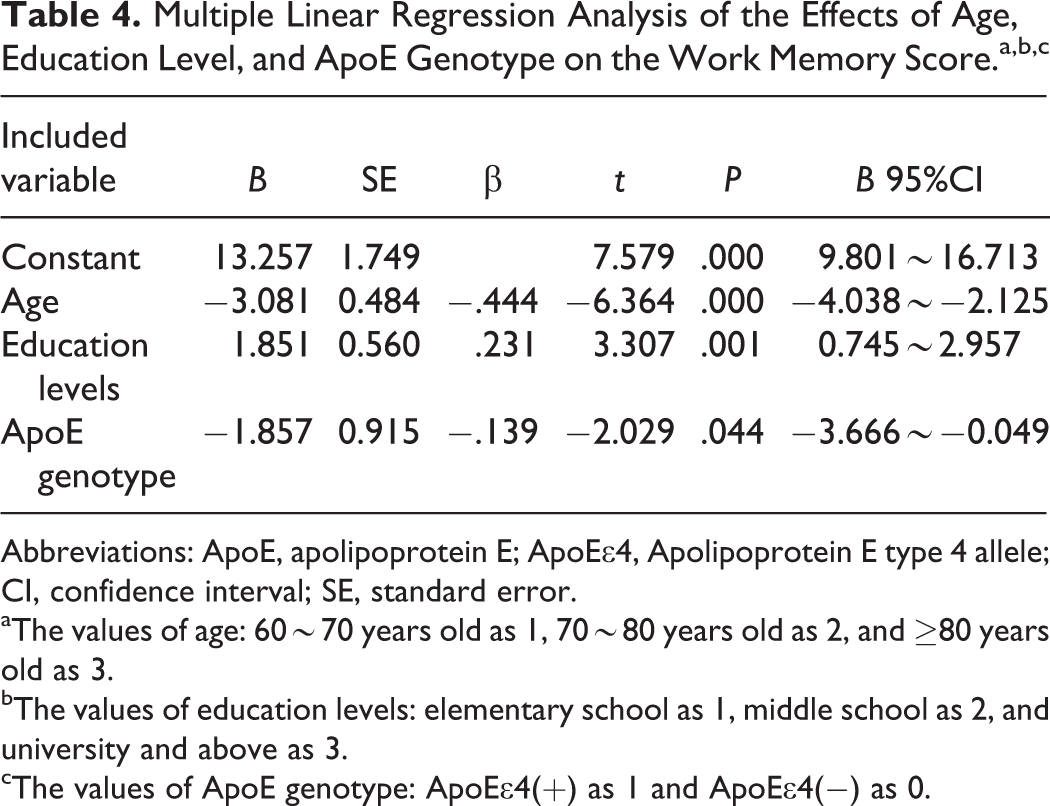
Abbreviations: ApoE, apolipoprotein E; ApoE∊4, Apolipoprotein E type 4 allele; CI, confidence interval; SE, standard error.
aThe values of age: 60∼70 years old as 1, 70∼80 years old as 2, and ≥80 years old as 3.
bThe values of education levels: elementary school as 1, middle school as 2, and university and above as 3.
cThe values of ApoE genotype: ApoE∊4(+) as 1 and ApoE∊4(−) as 0.
Multiple Linear Regression Analysis of the Effects of Age and Education Level on the Perceptual score.a
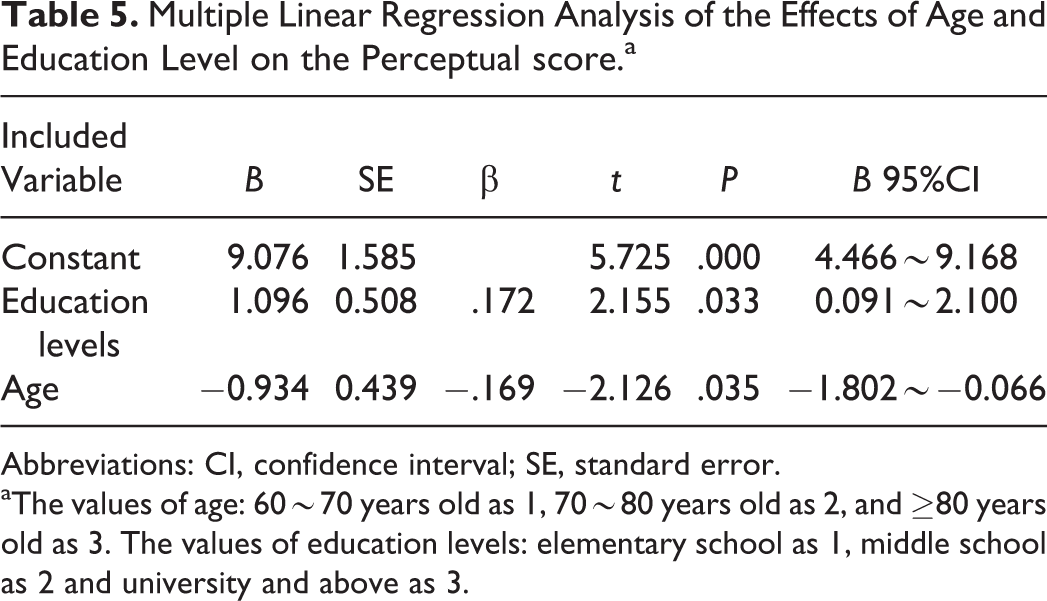
Abbreviations: CI, confidence interval; SE, standard error.
aThe values of age: 60∼70 years old as 1, 70∼80 years old as 2, and ≥80 years old as 3. The values of education levels: elementary school as 1, middle school as 2 and university and above as 3.
Discussion
Apolipoprotein E is a protein regulating the lipid metabolism. The genetic variations in ApoE gene have been related to many different diseases. In 1993, Strittmatter et al 15 first reported a relationship between ApoE∊4 and LAD and sporadic AD (SAD). Decades ago, ApoE∊4 was recognized as a risk gene for AD, while ApoE∊2 was considered as a protective one. Recently, investigators found that ApoE∊4 affected the cognition loss in the elderly individuals. Aged people carrying ApoE∊4 could be subjected to a faster cognition loss and worse cognitive function than the noncarriers. 6,7,13 However, there was only 1 study that demonstrated ApoE∊4 could accelerate cognition decline in Chinese people. 11 In this cross-sectional study, we provided convincing evidence that ApoE∊4 significantly increased the cognitive loss in ApoE∊4 carriers aged 60 years and older.
In this study, we showed ApoE∊4 mainly affected perceptual speed and work memory and global cognition, as the ApoE∊4 carriers had significant lower scores than noncarriers in the test measuring the above-mentioned 3 cognitive processes. Stepwise multiple regression analyses further clarified the degree of ApoE∊4 affecting patients’ cognitive function. Although ApoE∊4 entered in the final equations for the total BCAT score and work memory score, its strength influencing the scores was weaker than that of age and education levels and it didn’t enter the equation for the perceptual speed. Numerous studies have demonstrated a strong contribution of the age and education levels to the cognition of elderly people. One study demonstrated that the effect of ApoE∊4 on the cognition of old people increased with age 16 ; another study found that in addition to age, education levels also affected the effect of ApoE∊4 on cognitive function. 17 Therefore, the effects of age and education levels may explain the conflict results observed in the current study between the stepwise multiple regression analyses of perceptual speed and the analysis of covariance.
Although we observed a decreasing trend in tests of MMSE, mental arithmetic efficiency, spatial imagery efficiency and recognize memory in the ApoE∊4 carriers, there were no statistical differences when compared to those of noncarriers. Several other studies found ApoE∊4 could significantly affect MMSE score. 18,19 The MMSE is a roughly cognitive test used to screen dementia; it can’t measure the cognitive function accurately. Kim et al 20 examined 215 Korean individuals who were 65 years or older and didn’t find a significant effect of ApoE∊4 on MMSE score. Although BCAT is a detailed and exact cognitive test, it evaluates different aspects of cognition and maybe more sensitive to Chinese people than MMSE. When using BCAT to evaluate the patient’s cognition, we found a significant effect of ApoE∊4 on the total BCAT score reflecting the global cognitive function.
The findings from our study are highly consistent with other studies investigating the effect of ApoE∊4 on the cognitive function. Two elegant meta-analyses indicated that ApoE∊4 could affect the global cognition, episodic memory, executive function, and perceptual speed. 21,22 A large-scale prospective study conducted by Blair and his colleagues found that ApoE∊4 significantly affected the patients’ verbal memory and processing speed. 23 Greenwood et al 24 found that ApoE∊4 carriers aged 50 years and older could be subjected to a more descendent visual attention, which could affect the test for visual recognition. In another study, Greenwood et al 9 further found ApoE∊4 had an effect on the spatial and work memories.
Although our study as well as other has convincingly suggested an effect of ApoE∊4 on cognition, the related mechanisms remain unclear. Some investigations discovered that healthy older adults carrying ApoE∊4 would be more likely subjected to hippocampal atrophia and decrease in white matter in hippocampal, middle temporal lobe, and corpus callosum. 25,26 Others suggested that ApoE∊4 might affect the integrity and repair of neuron. 21 The findings from Parasuraman et al indicated that ApoE∊4 could affect the function of cholinergic transmitter system and increase the area of brain central gap. 27 In addition, several epidemiological studies demonstrated that ApoE∊4 carriers would be subjected to a higher risk of cognition impairment when coexisted with cerebral trauma, lead exposure, diabetes, atherosclerosis, hypercholesterolemia, and hyperhomocysteinemia. 28 -32
Our study might be limited by a small sample size and no attention on the mechanism influencing cognition. Further, we might recruit more aged participants to investigate the mechanism of ApoE∊4 affecting cognitive function with radiographic options.
In summary, our study indicated ApoE∊4 had significant influence on cognitive impairment in Chinese elderly people. It primarily influenced perceptual speed, work memory, and global cognition as the carriers had lower scores in the tests of rapid digit copy, rapid Chinese character comparison, and recall answer of mental arithmetic as well as the total BCAT scores.
Footnotes
Declaration of Conflicting Interests
The authors declared no potential conflicts of interest with respect to the research, authorship, and/or publication of this article.
Funding
The authors received no financial support for the research, authorship, and/or publication of this article: This work was supported by grants from the State key Program of National Natural Science Foundation of Tianjin (grant no.14JCZDJC36100).