



Abstract
Objectives:
This study aimed to identify the effects of sleep quality, physical activity, environmental quality, age, ethnicity, sex differences, marital status, and educational level on the risk of falls in the elderly individuals with dementia.
Methodology:
Data were derived from a group of 1210 Malaysian elderly individuals who were noninstitutionalized and demented. The multiple logistic regression model was applied to estimate the risk of falls in respondents.
Results:
Approximately the prevalence of falls was 17% among the individuals. The results of multiple logistic regression analysis revealed that age (odds ratio [OR] = 1.03), ethnicity (OR = 1.76), sleep quality (OR = 1.46), and environmental quality (OR = 0.62) significantly affected the risk of falls in individuals (P < .05). Furthermore, sex differences, marital status, educational level, and physical activity were not significant predictors of falls in samples (P > .05).
Conclusion:
It was found that age, ethnic non-Malay, and sleep disruption increased the risk of falls in respondents, but high environmental quality reduced the risk of falls.
Introduction
Falls are common among the elderly individuals 1,2 which cause substantial costs to both individuals and society. 3 Advanced age increases falls due to age-related changes in muscular strength, flexibility, balance control, and walking stability. 4 Dementia aggravates the risk of falls in the elderly individuals 5 because of malnutrition, cognitive decline, behavioral disorders, visuospatial impairment, motor apraxia, gait and balance disturbances, adverse effects of medications, and fear of falling. 6 It has been well documented that the risk of falls in elderly individuals associates with cognition, 7 physical activity, 8 sleep problems, 3 and environmental factors. 6,7,9 -12
Sleep disruption could increase the risk of falls in the elderly individuals 13 via the negative effects on cognitive functions. 3,14 Physical activities could also reduce the risk of falls by increasing cognitive abilities, 8 delaying age-related changes as well as maintaining and/or improving physical health. 4 Apparently, environmental hazards increase the risk of falls in elderly individuals with dementia due to a change in adaptation to their environments. 6,12 Environmental properties along with medications and comorbid conditions increase confusion and disorientation in dementia, which elevate the risk of falls. 15
However, environmental variables are able to affect the condition in a varying degree to modify the outcome. The management of falls in the elderly individuals with dementia seems to be a difficult task due to many intrinsic and extrinsic factors. 16 It is expected that a good knowledge of details and a coordinated effort can play important roles to improve the condition in those patients. This study tried to determine the prevalence of falls among the community Malaysian elderly individuals with demetia as well as to determine the effects of sleep quality, physical activity, environmental quality, and sociodemographic factors on the risk of falls among the mentioned group of individuals.
Methodology
This project was registered in the National Medical Research Register (Project Code: NMRR-09-443-4148). Approval and permission for conducting the study were received from the ethical committee of the Ministry of Health. It was a national cross-sectional survey titled “Determinants of Health Status among Older Malaysians” and carried out in cooperation with the Institute for Health Behavioral Research, National Institute of Health, Ministry of Health, and Institute of Gerontology, University Putra Malaysia.
The research participants included 1210 Malaysian elderly individuals with dementia who were of age 60 years and older, living in noninstitutional places. The elderly patients residing in institutions and bedridden patients were excluded. The data were collected by trained interviewers who had prior experiences as interviewers in projects conducted by the Institute of Gerontology. The average duration of interview was about 60 minutes. The samples represented the Malaysian population in terms of age and were collected from Peninsular Malaysia, which was divided into 4 zones of North, South, West, and Central.
This study evaluated the effects of age, ethnicity, sex differences, educational level, marital status, sleep quality, physical activity, and environmental quality on the risk of falls in respondents. Score of less than 26 in the Mini-Mental State Examination (MMSE) indicated the presence of dementia. 17 In this study, falls were defined according to the International Classification of Diseases, Ninth Revision 18 that excluded falls due to silent blow, loss of consciousness, epileptic seizure, and sudden onset of paralysis such as stroke. History of falls was referred to having at least 1 fall, at day or night time, during the past 6 months. Sleep quality was operationalized by asking, “ Do you feel fresh and relax after waking up in the morning,” 19 and the response was (1) Yes and (0) No. The short form of International Physical Activity Questionnaire (IPAQ) was used to measure physical activity in patients. 20 The respondents were divided into 2 groups based on their physical activity level: (1) respondents with low physical activity and (2) respondents with moderate to high physical activity. Environmental quality was related to the quality of living places 6,15 that was measured using 5 housing quality parameters of strength, lighting, ventilation, noise, cleanliness, and sanitation. This variable was recoded into (1) low quality and (2) high quality. In addition, the patients were divided into 2 groups based on age: (1) included patients less than 70 years old and (2) included patients aged 70 years and older.
Statistical Analysis
The prevalence of falls was computed for total samples wih regard to their age, ethnicity, sex differences, marital status, educational level, sleep quality, environmental quality, and physical activity. Bivariate analysis was carried out using a series of chi-square (χ2) tests to examine the association of each variable with the risk of falls. The multivariate logistic regression analysis was used to estimate the predictability of falls by focusing on age, ethnicity, sex differences, marital status, educational level, sleep quality, environmental quality, and physical activity among the respondents. Odds ratios (OR) with 95% confidence intervals (95% CIs) were computed. The critical level for rejection of the null hypothesis was considered to be a P value of 5%, 2-tailed. All analyses were performed using the Statistical Package for the Social Sciences (SPSS) software version 20.0 (IBM, Chicago, Illinois).
Results
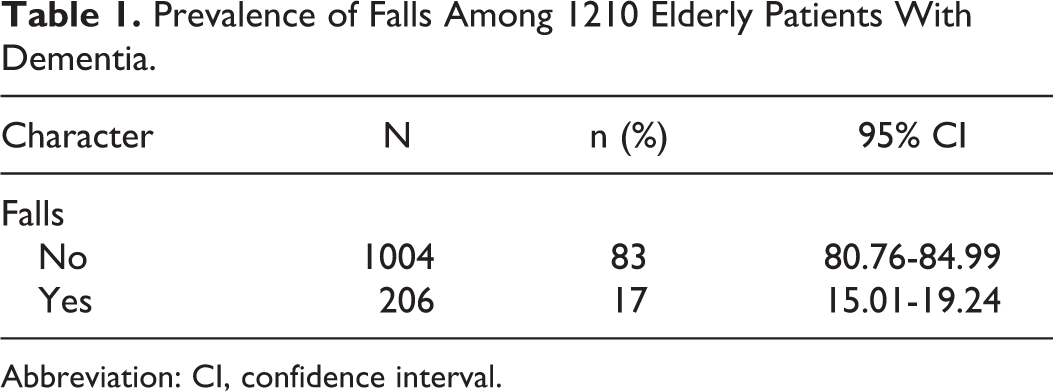
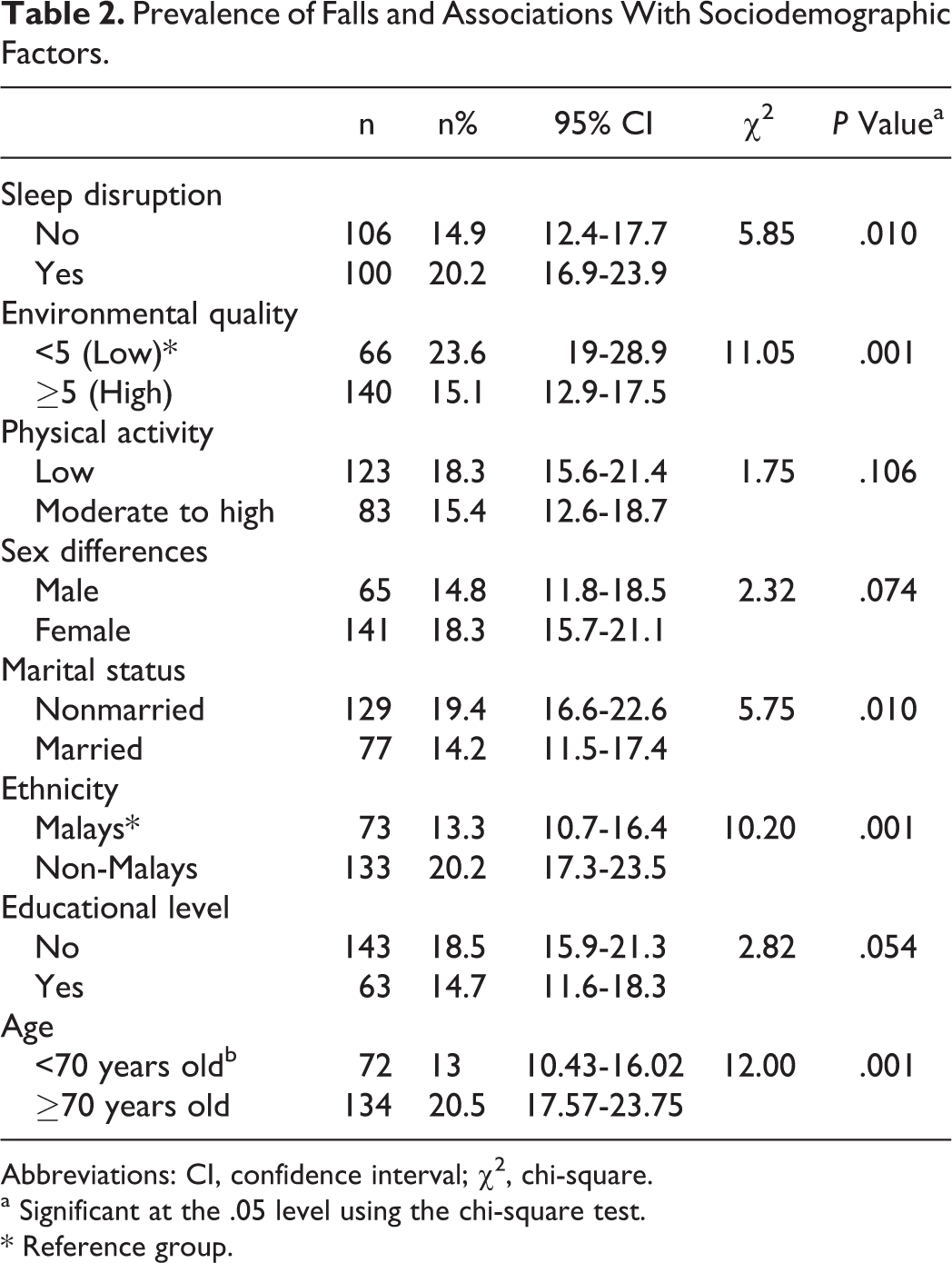
Analysis was performed on the data collected from 1210 respondents who were Malaysian elderly patients with dementia. The prevalence of falls was approximately 17% (95% CI: 15.01-19.24) in samples (Table 1). The proportion of falls was 20.2% in the subjects with sleep disturbances and 14.9% in those without sleep disturbances. A higher percentage of falls was found in the samples with low physical activity (18.3%) compared to those with moderate to high physical activity (15.4%). Furthermore, the findings showed that the risk of falls in the environments with low quality (23.6%) was greater than that in the environments with high quality (15.1%). It was found that the risk of falls in females (18.3%) was higher than that in males (14.8%). Moreover, the prevalence of falls was 18.5% in the respondents with no education and 14.7% in those with education. The results showed that the subjects aged 70 years and older (20.5%) have further risk of falls compared to those aged less than 70 years (13%). The percentage of falls was found to be as high as 19.4% for single individuals and 14.2% for married individuals.
Prevalence of Falls Among 1210 Elderly Patients With Dementia.
Abbreviation: CI, confidence interval.
Bivariate analysis showed that the risk of falls was significantly (P < .05) associated with age (χ2 = 12.00, P = .001), ethnicity (χ2 = 10.20, P = .001), marital status (χ2 = 5.75, P = .010), sleep quality (χ2 = 5.85, P = .010), and environmental quality (χ2 = 11.05, P = .001). Further results indicated that physical activity, sex differences, and educational level were variables unrelated to the risk of falls (Table 2).
Prevalence of Falls and Associations With Sociodemographic Factors.
Abbreviations: CI, confidence interval; χ2, chi-square.
a Significant at the .05 level using the chi-square test.
* Reference group.
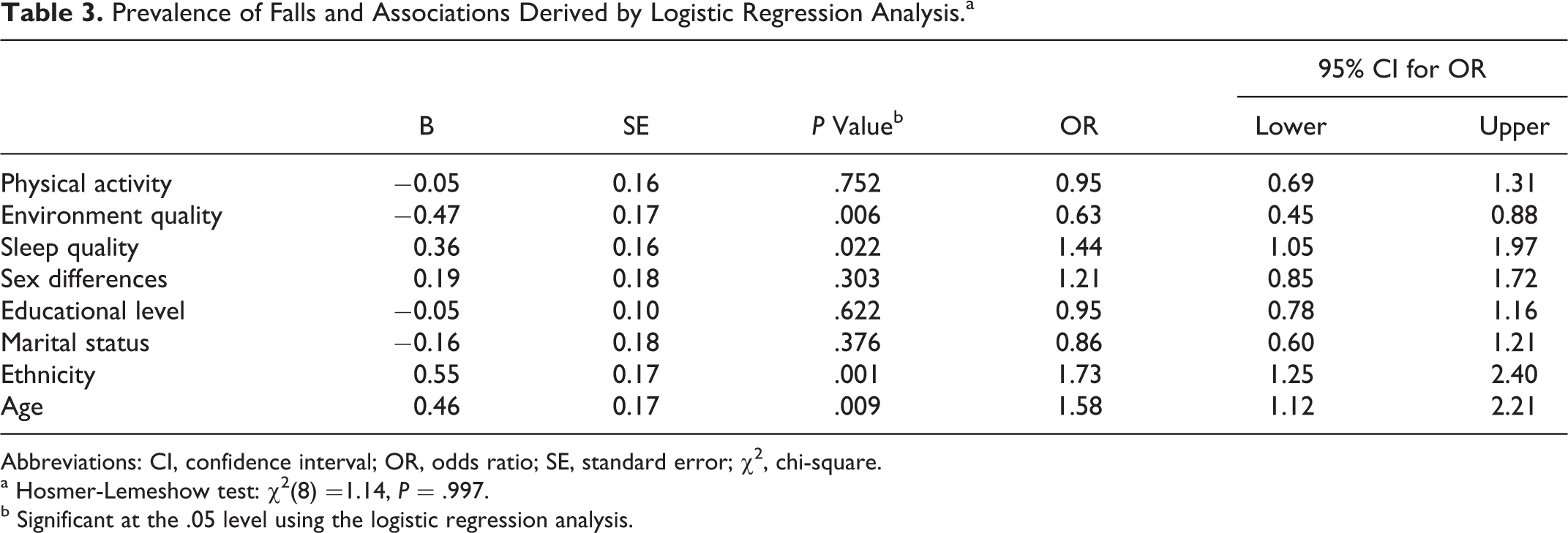
The multiple logistic regression analysis revealed that age (P = .009), ethnicity (P = .001), sleep quality (P = .022), and environmental quality (P = .006) significantly affected the risk of falls among the respondents (P < .05). The findings indicated that non-Malay ethnicity (OR = 1.73, 95% CI: 1.25-2.40), sleep disruption (OR = 1.44, 95% CI: 1.05-1.97), and age 70 or older (OR = 1.58, 95% CI: 1.12-2.21) significantly increased the risk of falls among subjects. Moreover, the results revealed that high environmental quality (OR = 0.63, 95% CI: 0.45-0.88) significantly decreased the risk of falls. It was found that sex differences, marital status, educational level, and physical activity had no significant effects on the risk of falls among samples (P > .05). Among all variables, ethnicity (OR = 1.73) was the most significant parameter to predict a higher risk of falls (Table 3).
Prevalence of Falls and Associations Derived by Logistic Regression Analysis.a
Abbreviations: CI, confidence interval; OR, odds ratio; SE, standard error; χ2, chi-square.
a Hosmer-Lemeshow test: χ2(8) =1.14, P = .997.
b Significant at the .05 level using the logistic regression analysis.
Discussion
Falls are major health problems in the elderly patients with dementia. 21 The age-related changes in the body systems, 4 sleep quality, physical activity, and environmental quality could affect the risk of falls in the elderly patients with dementia. Such effect is related to the influences of these factors on cognitive decline. 7,22 As falls aggravate burden and cost in both patients and caregivers, 14,23 the assessment of risk factors seems to be an important issue in further investigations. In this study, the effects of age, ethnicity, sex differences, marital status, educational level, physical activity, environmental quality, and sleep quality on the risk of falls were evaluated in the Malaysian elderly with dementia. The results showed that age, ethnicity, environmental quality, and sleep quality were the significant predictors of the likelihood of falls in the respondents. This study confirmed several previous research, 3,13,14 which indicated further risk of falls via sleep problems in the elderly individuals and in individuals with dementia. Such effect potentially occurs due to physical, psychological, and cognitive changes. 24 It sounds that the negative impacts of sleep disturbances on attention, cognition, mood, and motor performances 3 could increase the risk of falls in older adults with dementia.
The findings showed that the subjects surrounded by the high environmental quality had decreased risk of falls. It seems that an appropriate environmental quality helps to overcome deficits in physical fitness and cognitive abilities posed by dementia 6,12 and therefore reduces the risk of falls in elderly patients with dementia.
Although there are several studies 8,25 -28 indicating a direct link between physical activity and the risk of falls, but in our study we could not find a similar result. Such differences could be related to the choice of sample population as well as the amount and type of activities. 25 In addition, marital status, income, educational level, sex differences, 29 sleep problems, and the environmental quality are all possible confounding factors to interact between physical activity and cognition when considering the risk of falls in the respondents.
In spite of many reports 30 -32 that did not establish a relation between ethnicity and the risk of falls, our study showed a link supporting other findings. 5,7,33 This discrepancy is possibly due to differences in predisposition, lifestyle, and cultures 34 as well as the rate of comorbidities such as hypertension, ischemic heart disease, and stroke. 35 This study was consistent with other findings, 5,10,36,37 establishing a link between age and the likelihood of falls. Apparently, age-related changes in physiological mechanisms, vision, gait, memory, and strength 7,9,33,38 predispose elderly patients with dementia to the further risk of falls. Several research studies 5,7,39 show differences between sexes in relation to the risk of falls. However, our finding that is in support of a finding by Bueno-Cavanillas and colleagues 16 shows the same risk of falls for both sexes with dementia. In addition, marital status 5 and educational level 5,7,38,40 had been previously reported to influence the risk of falls in the elderly individuals, a correlation found unlikely in our research among the elderly with dementia. Nevertheless, differences in findings suggest that confounding factors such as income, 41 supplement intake, 7 social supports, 42 sleep quality, and environmental stimuli probably affect the outcomes.
Conclusion
We concluded that sleep disruption and environmental attributes were among parameters that could affect, influence, and increase the risk of falls in the elderly with dementia. Accordingly, our findings did not support the increased risk of falls in samples due to the levels of physical activity. As falls increase burden, morbidity, and mortality in elderly patients with dementia, thereby, it is warranted to assume that more investigations are needed to identify the potential risk factors in order to prevent or reduce the risk of falls in the old people with dementia. Although there are many attempts to study the predisposing factors of falls in the elderly patients with dementia, some parameters limit these studies. One of those factors can be difficulty in communication and collecting accurate self-reported data from the patients. In addition, the high prevalence of comorbidities prevents to identify the certain causes of falls in those patients. Moreover, the effect of cognitive function on the risk of falls is another aspect that needs more intervention.
Footnotes
Acknowledgment
The authors gratefully acknowledge the cooperation of all volunteers who participated in this study. In addition, the authors also thank all staff in their efforts on data collection.
Declaration of Conflicting Interests
The authors declared no potential conflicts of interest with respect to the research, authorship, and/or publication of this article.
Funding
The authors disclosed receipt of the following financial support for the research, authorship, and/or publication of this article: The authors wish to acknowledge the financial support from the Ministry of Health for this study.