



Abstract
Objectives:
This study aimed to determine the effects of social support and having a partner on sleep quality in the elderly patients with dementia.
Methodology:
This research was conducted on 1210 noninstitutionalized elderly Malaysian individuals with dementia. The effects of age, ethnicity, educational level, marital status, sex differences, social support, and having a partner on sleep quality were evaluated in the respondents. The multiple logistic regression analysis was used to predict the risk of sleep disturbances among the participants.
Results:
Approximately, 41% of the participants experienced sleep disruption. Further findings showed that ethnicity (odds ratio [OR] = 0.62), social support (OR = 1.35), marital status (OR = 2.21), educational level (OR = 0.65), and having a partner (OR = 0.45) significantly affected sleep quality (P < .05). Sex differences and age were unrelated predictors of sleep disturbances (P > .05).
Conclusion:
It was concluded that social isolation and being single increased sleep disruption among respondents, but having a partner and ethnic non-Malay decreased the rate of sleep problems.
Introduction
Advancing age 1 and dementia 2 affect sleep patterns in the elderly individuals. It has been estimated that 40% of the patients with Alzheimer’s disease and a large number of patients with dementia have sleep problems. 3 Old age, medical and psychological causes, as well as poor sleep hygiene are the main reasons of sleep disturbances in the elderly patients with dementia. 4 Common manifestations of sleep disruption in patients are increased nighttime awaking, sleep latency, daytime sleepiness, sleep-related breathing disorders, and sleep episodes. 5 Sleep disturbances increase behavioral, functional, and cognitive problems, thereby any attempts to reduce the problem would help to increase cognitive functions. 3
Social network includes having good friends, family support, and roles in the society. 6 Social support could increase abilities to cope with mental and physical health problems, 7 which improves quality of sleep 6 and maintains health in the elderly individuals. 8
Furthermore, a healthy relationship promotes a good sleep by providing the sense of safety and security, promoting healthy sleep-related behaviors, and reducing psychiatric disorders. Sleep with a partner, close physical contact, and intimacy activate several sleep-related physiological mechanisms that decrease sleep disturbances. 9
Sleep disturbances have recently gained much attention in professionals and caregivers simply because of the burden it causes and the role it plays in health and well-being of patients with dementia. 10 As older population and the people with dementia are on the rise, there is a great interest in the study of sleep quality among elderly individuals and patients who have dementia. 3 It seems that sleep disruption is not easy to be managed due to patient’s subsequent and ongoing medical and psychological problems. 4 Therefore, identifying the risk factors helps to find strategies necessary to deal with the problem. This study aimed to determine the effects of social support and having a partner on sleep quality after controlling for confounding factors in the elderly patients with dementia.
Methodology
The present study was a part of a national cross-sectional survey titled “Determinants of Health Status among Older Malaysians” and was carried out in cooperation with the institute for Health Behavioral Research, National Institute of Health, Ministry of Health and Institute of Gerontology, UPM. The project was registered in National Medical Research Register (Project Code: NMRR-09-443-4148). Approval and permission for conducting the study were received from the Ethical Committee of the Ministry of Health.
This study included 1210 elderly patients with dementia who were of Malaysian ethnicity aged 60 years and older residing in noninstitutional places. The elderly individuals living in institutions and bedridden were excluded. The data were collected by trained interviewers who had prior experience as interviewers in other projects conducted by the Institute of Gerontology. The average duration of the interview was about 60 minutes. The samples represented the Malaysian population in terms of age and were collected from Peninsular Malaysia that was divided into 4 zones, North, South, West, and Central.
In this study, the effects of age, ethnicity, sex differences, marital status, social support, and having a partner on sleep quality were evaluated. Respondents had a Mini-Mental State Examination score of less than 26 points. 11 Furthermore, the Lubben Social Network Scale 6 was utilized in measuring social support from family and friends. Scores ranged from 0 to 30. Cutoff point of 12 was used to differentiate isolated and socialized patients. 12,13 Sleep quality was operationalized by asking “ Do you feel fresh and relax after waking up in the morning” 14 and the response was (1) as Yes and (0) as No.
Statistical Analysis
The prevalence of sleep disturbances was calculated for all subjects in regard to their age, ethnicity, sex differences, marital status, educational level, social support, and having a partner. A series of chi-square (χ 2 ) tests was used to identify the association between sleep quality and each variable. The multiple logistic regression analysis was used to examine the effects of age, ethnicity, marital status, sex differences, social support, and having a partner on the risk of sleep disturbances among respondents. Odds ratios (OR) with 95% confidence intervals (95% CI) were computed. The critical level for rejection of the null hypothesis was a P value of 5%, 2-tailed. All analyses were performed using the Statistical Package for the IBM Social Sciences (SPSS) software version 20.0 (Chicago, Illinois).
Results
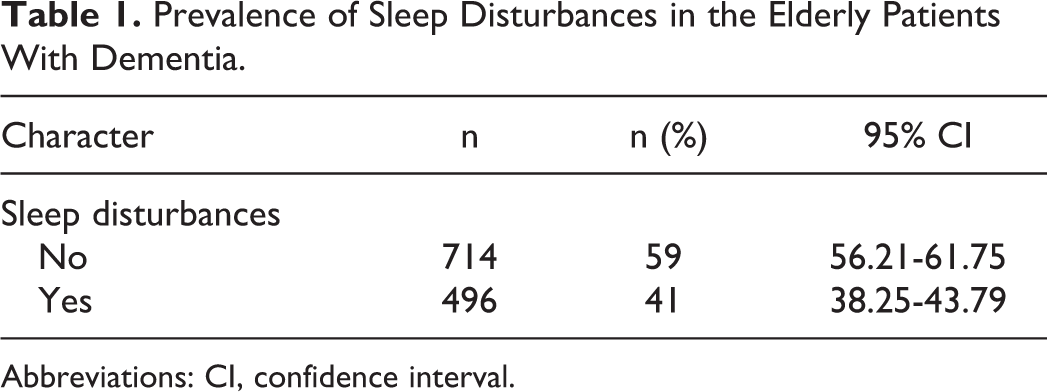
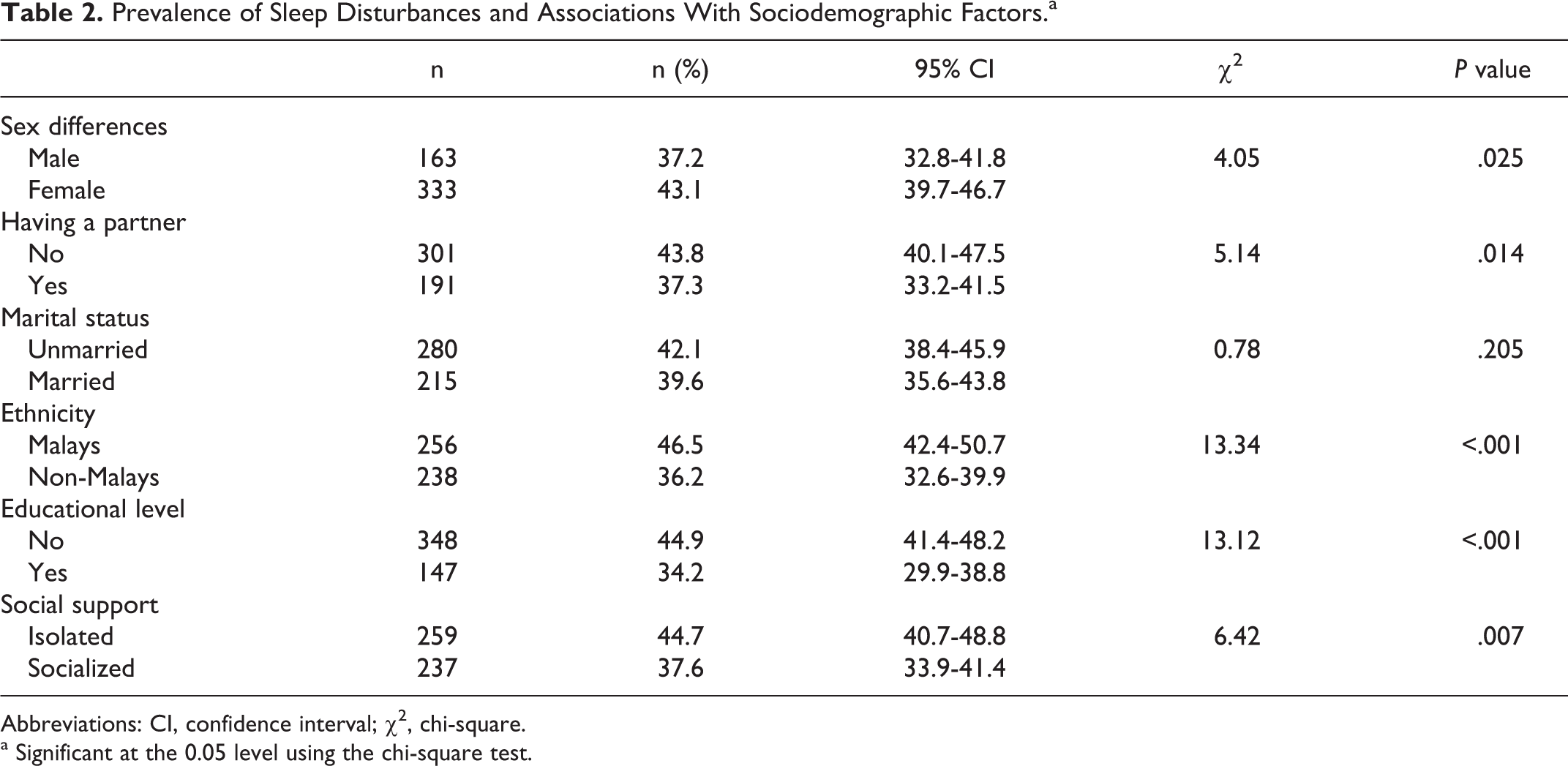
Analysis was run on data collected from the Malaysian elderly individuals with dementia. In this study, the prevalence of sleep disturbances among subjects was 41% (95% CI: 38.3-43.8; Table 1). The percentage of sleep disruption among respondents without a partner (43.8%) was higher than those with a partner (37.3%). Furthermore, the experience of sleep problems was 44.7% among isolated subjects and 37.6% among socialized ones. Moreover, the results showed that females (43.1%) experienced a greater percentage of sleep disturbances compared with males (37.2%). Among the samples, 46.5% of Malay and 36.2% of non-Malay ethnicities complained sleep disruption. Further results showed that sleep disturbances in single participants (42.1%) were higher than married participants (39.6%). In addition, the prevalence of sleep disturbances was 44.9% among respondents with no education and 34.2% among those with education.
Prevalence of Sleep Disturbances in the Elderly Patients With Dementia.
Abbreviations: CI, confidence interval.
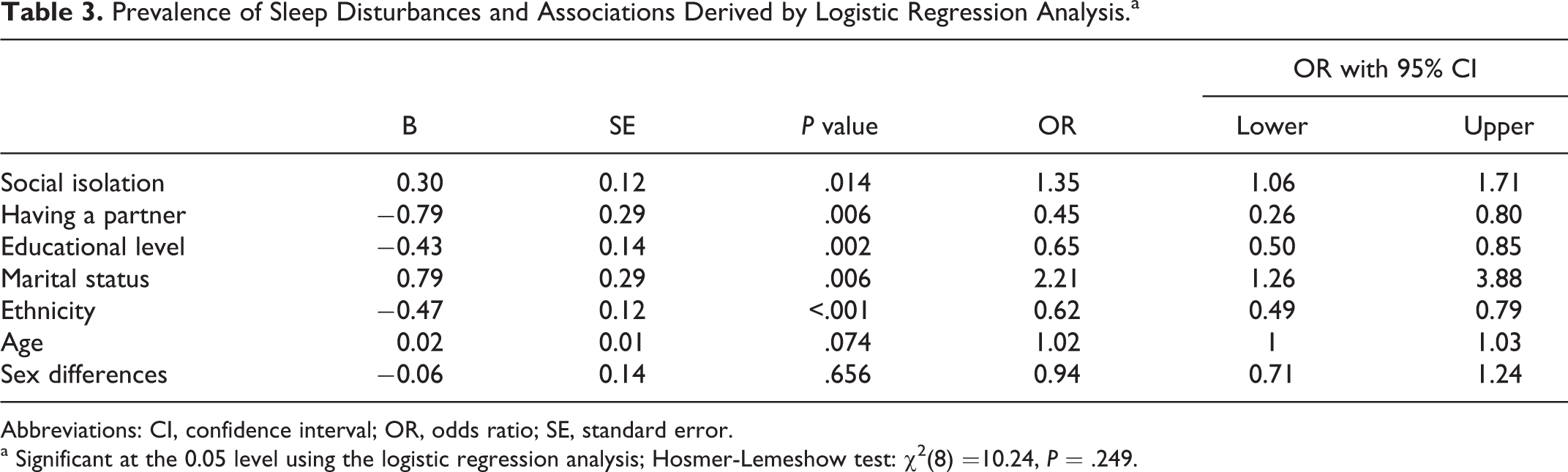
Bivariate analyses showed that sleep quality in respondents was significantly associated with ethnicity (χ 2 = 13.34, P < .001), sex differences (χ 2 = 4.05, P = .025), educational level (χ 2 = 13.12, P < .001), social support (χ 2 = 6.42, P = .007), and having a partner (χ 2 = 5.14, P = .014; Table 2). The results of multivariate logistic regression analysis revealed that ethnicity (P < .001), sex differences (P = .025), educational level (P = .002), marital status (P = .006), social support (P = .014) and having a partner (P = .006) significantly affected sleep quality among subjects. Moreover, the findings revealed that the participants who were single (OR = 2.21, 95% CI: 1.26-3.88) and isolated (OR = 1.35, 95% CI: 1.06-1.71) had a higher risk of sleep problems. Further results indicated that ethnic non-Malay (OR = 0.62, 95% CI: 0.49-0.79), educational level (OR=0.65, 95% CI: 0.50-0.85), and having a partner (OR = 0.45, 95% CI: 0.26-0.80) significantly decreased sleep disruption. In addition, the results showed no statistically significant contribution (P > .05) of age and sex differences in prediction of sleep quality (Table 3). It was found that being single (OR = 2.21) was the strongest factor to increase sleep disturbances in the respondents.
Prevalence of Sleep Disturbances and Associations With Sociodemographic Factors.a
Abbreviations: CI, confidence interval; χ 2 , chi-square.
a Significant at the 0.05 level using the chi-square test.
Prevalence of Sleep Disturbances and Associations Derived by Logistic Regression Analysis.a
Abbreviations: CI, confidence interval; OR, odds ratio; SE, standard error.
a Significant at the 0.05 level using the logistic regression analysis; Hosmer-Lemeshow test: χ 2 (8) =10.24, P = .249.
Discussion
Sleep disturbances are frequent in the elderly individuals due to age, medications, medical problems, and psychiatric illnesses. 15 Sleep quality could affect well-being, mood, 16 and cognitive abilities 3 in older people. Sleep disruption occurs in the elderly patients with dementia, 2 which may have adverse effects on body system functions. 15 Hence, further studies are needed to determine the side effects of such health problems 17 among those patients.
In the present study, the effects of age, ethnicity, educational level, marital status, social support, sex differences, and having a partner on sleep quality were evaluated. The results showed that ethnicity, social support, marital status, educational level, and being with a partner were the significant predictors of sleep quality. It was found that having a partner decreased the risk of sleep disruption in the respondents. It seems that a healthy relationship influences dementia, 18 which may have a reflective impact on sleep quality. Furthermore, emotional and physical intimacy such as hugging and massage causes a healthy, 9,19 happy, and relaxed life, which consequently results in a restful sleep. 9 In addition, lack of children and spousal support in the single elderly individuals could result in psychological stress and depression. Hence, single status could enhance the potential risk of sleep disturbances in respondents. Meanwhile, as spouses age together, death of one person causes mental stress for the other, 20 which possibly increase sleep disruption. However, a satisfying relationship most likely promotes healthy sleep patterns in the elderly patients with dementia by giving more safety, security, and vigilance as well as regulated physiological responses along with reduced psychological disorders. 9
The results showed that isolation increased sleep disturbances among subjects. Isolation negatively affects health and mental well-being 21 and activates physiological responses, thereby increasing behavioral, physical, and psychological problems 22,23 that may increase sleep disruption. In addition, the findings suggest that living as a single person is the most important variable among all determinants of sleep quality in respondents, which confirms what exists in the literature. Moreover, the findings revealed that sleep quality was associated with ethnicity, a correlation found in a similar research. 24 The influence of ethnicity on sleep quality is possibly related to religious beliefs, lifestyle, and cultures. 25 Furthermore, it was found that education decreased sleep disruption. Such effect is likely due to knowing how to cope with sleep problems through suitable expectations and sleep hygiene. In addition, education possibly helps those people to minimize the influences of risk factors and environmental conditions on sleep. 26 Moreover, our results confirmed the existing reports; 27,28 however, not all findings 24,25,29 were the same, for example, Tractenberg and colleagues 10 suggested that educational level can disrupt sleep. These conflicting findings of education on sleep quality are possibly due to different samples and their health status. In addition, our results showed no difference in sleep quality between male and female respondents. This finding was similar to Tractenberg and coworkers 30 report but was contradicted by other studies. 3,10,16 This discrepancy may be attributed to educational level, income, 31 rate of seeking help to manage sleep problems, 32 age, marital status, social support, and being with a partner. Furthermore, severity of sleep disruption is related to the progression and stages of the disease, 2 cognitive decline, 10,30 and increased psychiatric problems 33 in the elderly patients with dementia. Despite having comorbidities, elderly patients with dementia can improve their sleep with the help of appropriate cognitive interventions that could promote cognitive function and result in better sleep quality. 3
Conclusion
The results showed that ethnicity, marital status, educational level, social support, and having a partner significantly affected sleep quality in the respondents. This investigation suggests that some people have a lower risk of developing sleep disturbances, among those are ethnic non-Malay, the more educated, as well as those with a partner. We concluded that age, isolation, and being single significantly increased sleep disturbances. As sleep quality influences health and the progression of dementia, further studies with various factors are needed to clarify the roles of social support and being with a partner in the reduction of sleep disturbances in those patients.
Footnotes
Acknowledgment
The authors gratefully acknowledge the cooperation of all volunteers who participated in this study. In addition, the authors also thank all staff in their efforts on data collection.
Declaration of Conflicting Interests
The authors declared no potential conflicts of interest with respect to the research, authorship, and/or publication of this article.
Funding
The authors disclosed receipt of the following financial support for the research, authorship, and/or publication of this article: The authors wish to acknowledge the financial support from the Ministry of Health for this study.