




Abstract
Objective:
Lung cancer is one of the most common malignant tumors in humans. Finding a highly sensitive and specific marker is very important. This study investigated the clinical significance of epidermal growth factor in exhaled breath condensate and serum of patients with non-small cell lung cancer.
Methods:
From October 17, 2013, to June 5, 2017, exhaled breath condensate and blood samples from 155 patients with non-small cell lung cancer, 63 patients with benign pulmonary nodules, and 115 healthy controls were collected using a breath condenser. Each sample was analyzed by enzyme-linked immunosorbent assay.
Results:
Epidermal growth factor level in the exhaled breath condensate from the non-small cell lung cancer group (197.86 ± 60.67 pg/mL) was higher than that in the healthy group (124.75 ± 36.09 pg/mL), P < .05. Epidermal growth factor level in the exhaled breath condensate of the smoking group (208.85 ± 40.94 pg/mL) was higher than that of the nonsmoking group (185.52 ± 36.88 pg/mL), P < .05. Epidermal growth factor level in the exhaled breath condensate in phases III and IV of non-small cell lung cancer group (212.17 ± 35.41 pg/mL) was higher than that in phases I and II (173.91 ± 38.08 pg/mL), P < .05. Epidermal growth factor level in the exhaled breath condensate of the death group (241.05 ± 27.19 pg/mL) was higher than that of the survival group (188.75 ± 37.07 pg/mL), P < .05. The epidermal growth factor exhaled breath condensate levels were positively correlated with the serum epidermal growth factor levels with a correlation coefficient of 0.495 (P < .05). The sensitivity and specificity of epidermal growth factor exhaled breath condensate test were 80.0% and 89.6%, respectively.
Conclusion:
The detection of epidermal growth factor level in exhaled breath condensate exhibits is important in the diagnosis, disease monitoring, and prognosis of non-small cell lung cancer.
At present, lung cancer remains one of the most prevalent malignant tumors. 1 Approximately 85% of patients with lung cancer have suffered from non-small cell lung cancer (NSCLC). 2 The 5-year survival rate of patients with NSCLC can increase to 80% if they can be diagnosed at stage Ia. 3 Therefore, finding biomarkers with high specificity and sensitivity is important for early NSCLC diagnosis. 4 Non-small cell lung cancer can be diagnosed through the detection of tumor markers in exhaled breath condensate (EBC). 5 -7 Epidermal growth factor (EGF) is a member of the superfamily of cytokines. Epidermal growth factor plays an important role in the occurrence, development, and metastasis of tumors. 8 This study examined the value of EGF in the EBC and serum of patients with NSCLC to explore its early diagnosis, disease monitoring, prognosis assessment, and screening in high-risk groups.
Materials and Methods
Patients
We enrolled 155 patients admitted to the NSCLC group at the Second Affiliated Hospital of Nantong University from October 17, 2013, to June 5, 2017. These patients were diagnosed with lung cancer based on the pathologic data obtained by bronchofiberscopy, lung biopsy, and thoracotomy. A total of 60 patients were diagnosed with squamous cell carcinoma, whereas the remaining patients received a cytohistological diagnosis of adenocarcinoma. Among the 155 patients with lung cancer, 99 and 56 were males and females, respectively. The median age is 59 years, and the range is 33 to 76 years. Patients with other chronic diseases, such as chronic obstructive pulmonary disease, severe heart, lung, liver, and kidney dysfunction, and digestive system diseases were excluded. According to the seventh edition of the lung cancer TNM staging standard of International Union Against Cancer in 2009, 9 23, 39, 62, and 31 patients were classified into stages I, II, III, and IV, respectively. Follow-up results indicated that 27 patients died and 128 patients survived within 12 months after the samples were collected. A total of 63 patients with benign pulmonary nodules confirmed by surgical resection were selected as benign pulmonary nodules group. The normal control group was comprised of 115 healthy patients in the Second Affiliated Hospital of Nantong University during the same period. No significant differences in sex, age, and smoking status among the 3 groups were found (Table 1). The study was approved by the Ethic Committee of the Second Affiliated Hospital of Nantong University (approval no. NTYY120041). All of the patients provided written informed consent prior to enrollment in the study.
Characteristics of the Study Patients.

Abbreviation: NSCLC, non-small cell lung cancer.
Exhaled Breath Condensate Collection
Exhaled breath condensate was collected using EcoScreen condenser produced by Eric Jaeger (Friedberg, Germany. 10 The patients rinsed their mouths, used nose clips, and breathed through the mouth one-way flaps for 20 minutes. For each patient, 1 to 3 mL of EBC was collected and immediately stored at −70°C in a low-temperature refrigerator for further assays. 11 Approximately 4 mL of venous blood was obtained from the patients in an empty stomach in the morning after admission. The samples were centrifuged at 4000 rpm for 10 minutes. The serum was separated and immediately stored in a low-temperature refrigerator at −70°C for further assays.
Measurement of EGF
Epidermal growth factor level was measured using a sandwich enzyme-linked immunosorbent assay (ELISA) purchased from Shanghai Boatman Biotechnology Co Ltd (Shanghai, China) with a product number (BMH044) following the manufacturer’s instructions.
Statistical Analysis
Statistical analysis was performed using SPSS 13.0 statistical software. Measurement data were examined using normal distribution test. Data consistent with normal distribution were expressed as mean value ± standard deviation (
Results
Epidermal Growth Factor Levels in EBC and Serum Were Compared Among the NSCLC, Benign, and Healthy Groups
The EGF levels in EBC and in serum from the NSCLC group were higher than those from the benign group▲, all exhibited P < .05. The EGF levels in the EBC and serum from the NSCLC group were higher than those in the normal control group⋆, all exhibited P < .05. No significant difference were observed in EGF between the benign control group and normal control group both in EBC and serum•, all exhibited P > .05 (Table 2, Figures 1 and 2).
Comparison of EGF Levels Among the NSCLC, Benign Lesions, and Healthy Groups (
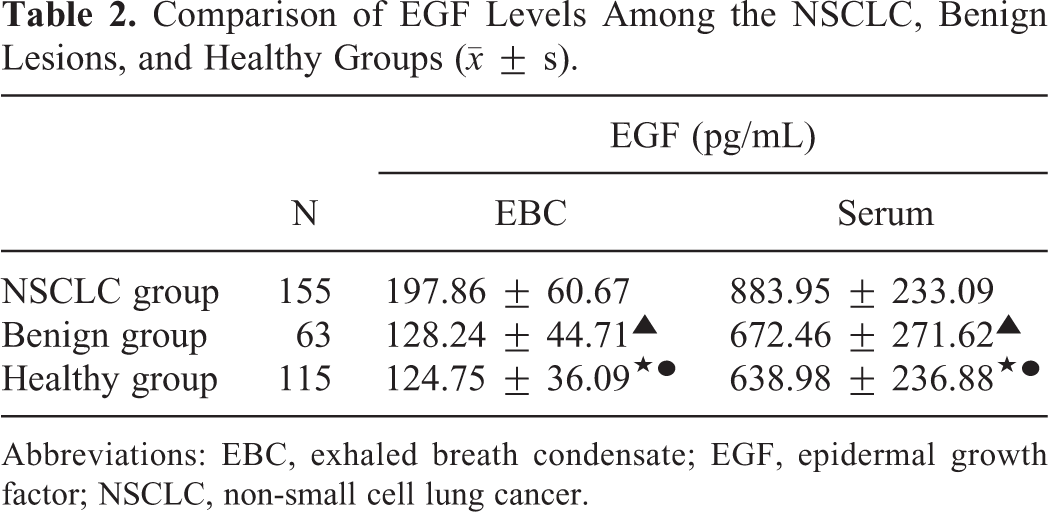
Abbreviations: EBC, exhaled breath condensate; EGF, epidermal growth factor; NSCLC, non-small cell lung cancer.

Epidermal growth factor levels in EBC were compared among the NSCLC, benign, and healthy groups. EBC indicates exhaled breath condensate; NSCLC, non-small cell lung cancer.
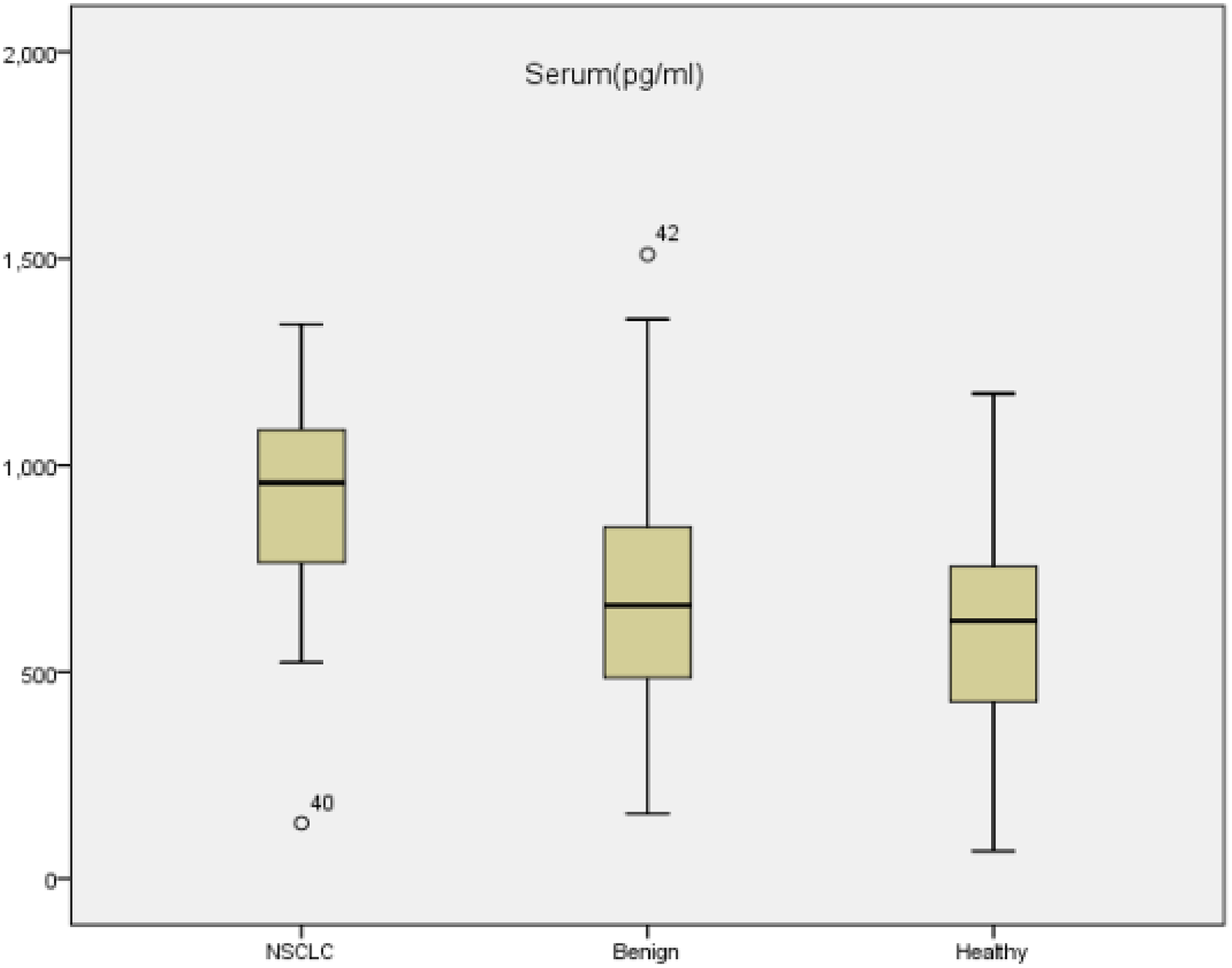
Epidermal growth factor levels in serum were compared among the NSCLC, benign, and healthy groups. NSCLC indicates non-small cell lung cancer.
Epidermal Growth Factor Levels in EBC and Serum Samples Were Compared Between the Different Clinical Characteristics
The EGF levels in the EBC and serum of the smoking group were higher than those in the nonsmoking group. The EBC and serum EGF levels in phases I and II of the NSCLC group were lower than those in phases III and IV. The EGF levels in the EBC and serum of the death group were higher than those in the survival group (Table 3).
Relationship Between EGF Levels and Patients’ Clinical Characteristics (

Abbreviations: EBC, exhaled breath condensate; EGF, epidermal growth factor.
Correlation Between EBC and Serum EGF Levels
Pearson correlation analysis was used to analyze the correlation between serum EGF and EBC–EGF levels. Figure 1 shows a positive linear correlation between EBC–EGF and serum EGF. The correlation coefficient was 0.495 (P < .05; Figure 3).

Correlation scatter diagram of EGF levels in EBC and serum (pg/mL). EBC indicates exhaled breath condensate; EGF, epidermal growth factor.
Sensitivity and Specificity of EGF in EBC and in Serum in NSCLC Diagnosis
In this study, the sensitivity and specificity of EGF in EBC and serum were analyzed by ROC curve analysis with pathological results as the standard. The sensitivity and specificity of EBC–EGF test were 80.0% and 89.6%, respectively. The sensitivity and specificity of serum EGF test were 71.0% and 71.3%, respectively (Figure 4).

Receiver operating characteristic curve of EGF levels in EBC and in serum. EBC indicates exhaled breath condensate; EGF, epidermal growth factor.
Discussion
Lung cancer diagnostic methods, such as positron emission, computed tomography, tracheoscopy, and thoracoscopy, have developed rapidly. As an emerging noninvasive detection method, 12 EBC exhibits the advantages of simple operation, good reproducibility, noninvasiveness, and an extremely wide scope of application. This method is not limited by the age, gender, and severity of the affected population. 13 With its unique advantages, the use of EBC is a potential detection method to identify tumor markers for NSCLC diagnosis. 14 -16
In this study, the correlation coefficient of EGF levels between EBC and serum in patients with NSCLC was 0.495 (P < .05). This finding indicated that EBC could be effectively used as a noninvasive and simple detection method of EGF levels in patients with NSCLC and could assist in the diagnosis of NSCLC.
The levels of EGF in the EBC and serum were detected using ELISA. The results showed that the levels of EGF in the lung cancer group were higher than those in the healthy control group. We also found that the EGF levels in the NSCLC group were higher than those in the benign pulmonary nodules group. However, no significant differences were found in EGF between the benign control and normal control groups in both EBC and serum. These results suggest that EGF detection in the EBC and serum can be used for differential diagnosis of benign and malignant lung diseases.
The EGF levels in stages III and IV were higher than those in stages I and II. Epidermal growth factor is a multifunctional cell growth regulator that can stimulate cell proliferation, promote the growth and differentiation of epidermal cells and other tissue cells, and stimulate the malignant transformation of cells. The occurrence, development, metastasis, and prognosis of lung cancer are closely related to angiogenesis. Vascular endothelial growth factor (VEGF) can promote vascular endothelial division and proliferation. 17 The physiological concentration of EGF can induce tumor cells to secrete VEGF and promote tumor angiogenesis. 18 Tumor cells secrete EGF and other growth factors, act on the EGF receptor on their own cells, and activate receptor tyrosine kinase, thereby leading to the phosphorylation of tyrosine residues in the receptor and the cells and the unlimited mitotic proliferation of tumor cells. 19
Patients with NSCLC were divided into survival and death groups according to the prognosis. The results showed that the EBC–EGF level in the death group was higher than that in the survival group. Thus, the EGF level in EBC may be used to evaluate the prognosis of patients with NSCLC.
We found that EBC and serum EGF levels in the smoking group were higher than those in the nonsmoking group. The following reasons may be considered: smoking is the main cause of lung cancer, which alters almost all the components of normal epithelial structure, including basal cell proliferation, squamous metaplasia, shortened cilia, mucus proliferation, and so on, leading to elevated EGF. 20 For the other clinical features, no significant difference in the EGF levels was found in the EBC of the adenocarcinoma and squamous carcinoma groups. This finding suggests that the EGF level is not closely related to the pathological type of lung cancer.
Pathological results were used as the gold standard, whereas the ROC curve was used to analyze the sensitivity and specificity of EGF in EBC and serum. The sensitivities of EBC–EGF and serum-EGF detections were 80.0% and 71.0%, respectively, and their specificities were 89.6% and 71.3%, respectively. These results suggest that the detection of EGF in EBC can increase the relevance ratio of NSCLC and can be used effectively for the diagnosis and treatment of patients with NSCLC to improve their cure rate and prolong their lifetime.
In conclusion, this study showed the feasibility of detecting EGF in the EBC of patients with NSCLC. The EGF level in EBC was positively correlated with that in serum, which was valuable in the diagnosis, disease monitoring, and prognosis of NSCLC. Compared with that in the serum, the detection of EGF in EBC has more advantages in the diagnosis of NSCLC.
Footnotes
Declaration of Conflicting Interests
The author(s) declared no potential conflicts of interest with respect to the research, authorship, and/or publication of this article.
Funding
The author(s) disclosed receipt of the following financial supportfor the research, authorship, and/or publication of this article: This research was supported by science and technology project of Nantong (No:GJZ17035).
