




Abstract
Long noncoding RNA ZEB1 antisense RNA 1 plays a vital role in tumorigenesis and metastasis. However, the role of ZEB1 antisense RNA 1 in gastric cancer remains unclear. This study aimed to investigate the expression level of ZEB1 antisense RNA 1 in gastric cancer tissues and evaluate its association with clinicopathological features and prognosis of patients with advanced gastric cancer receiving chemotherapy. The expression levels of ZEB1 antisense RNA 1 were examined in 224 pairs of gastric cancer and adjacent noncancerous tissues by quantitative real-time polymerase chain reaction. The associations between ZEB1 antisense RNA 1 expression and clinicopathological features or survival of patients with advanced gastric cancer were assessed. The results showed that the expression levels of ZEB1 antisense RNA 1 in gastric cancer tissues were significantly higher than those in the paracancerous tissues (P < .001). Moreover, the high ZEB1 antisense RNA 1 expression was associated with tumor, nodes, and metastases stage IV (P = .018) and loss of E-cadherin expression (P = .033). Multivariate Cox hazards regression analysis revealed that high ZEB1 antisense RNA 1 expression was an independent risk factor for predicting poor prognosis in patients with advanced gastric cancer (hazard ratio = 1.530, 95% confidence interval, 1.052-2.224, P = .026). In conclusion, the present findings suggest that ZEB1 antisense RNA 1 is an independent prognostic factor for patients with advanced gastric cancer receiving chemotherapy.
Introduction
Gastric cancer (GC) is one of the most prevalent malignant tumors, ranking third among the leading cause of cancer-related deaths worldwide. 1 Approximately more than 40% of newly diagnosed cases with GC in the world occur in China. 1 According the World Health Organization classification, gastric adenocarcinoma is the main pathological type of GC. Although the mortality of GC has an obvious decline with the improvement of clinical treatment in the past decade, the prognosis of GC is still poor, with the 5-year survival rate of less than 30%. 2 Therefore, it is necessary to identify biomarkers for GC early detection and prognostic evaluation and explore more effective and personalized treatment for patients with GC.
Long noncoding RNAs (lncRNAs) is a group of longer than 200 nucleotides in length with little protein-coding potential due to the lack of significant open reading frame. 3 Previous studies have confirmed that many lncRNAs are involved in the cancer development, invasion, and metastasis. 4,5 For example, Bo et al 6 found that actin filament associated protein 1 antisense RNA 1 (AFAP1-AS1) expression was related to distant metastasis of nasopharyngeal carcinoma, and downregulation of AFAP1-AS1 significantly inhibited invasion and metastasis of cancer cells. Chen et al 7 reported that FEZF1-AS1 was correlated with poor prognosis in colorectal cancer. BANCR functions as an oncogene and thus can promote the growth and metastasis of some types of cancer cells. 8,9 However, several studies revealed that BANCR acted as a tumor suppressor gene in some types of human cancer, including papillary thyroid cancer, 10 clear cell renal cell carcinoma, 11 and bladder cancer. 12 The roles of lncRNAs in cancer are complex and far beyond our imagination. The lncRNAs are potential novel biomarkers and therapeutic targets for cancer.
Previous studies have shown that ZEB1 antisense RNA 1 (ZEB1-AS1) is involved in the carcinogenesis and progression of some types of cancer, including hepatocellular carcinoma, 13 esophageal squamous cell carcinoma, 14 osteosarcoma, 15 colorectal cancer, 16,17 and bladder cancer. 18,19 However, it is still unclear whether ZEB1-AS1 is involved in the development and progression of GC. In the present study, we investigated the expression levels of ZEB1-AS1 in 224 GC tissues and explored the relationship between its expression and clinical characteristics and prognosis of patients with advanced GC treated with chemotherapy.
Materials and Methods
Patients
A total of 224 pairs of GC and adjacent noncancerous tissues were collected from Northern Jiangsu People’s Hospital and National Engineering Center for Biochip at Shanghai. All patients had a histologic diagnosis of GC with tumor, nodes, and metastases (TNM) stages III and IV. Patients did not receive any other anticancer treatment before tissue samples were collected. Patients were excluded if they had a history of other cancers, cancer originating from other tissues, cancer of unknown primary origin, and history of previous cancer treatment. Patients were treated with at least 2 cycles of platinum-based chemotherapy (oxaliplatin/fluoropyrimidine and oxaliplatin/paclitaxel). There were 155 men and 69 women. Written informed consent was provided by all patients before enrolling in this study, and the medical ethics committee of Northern Jiangsu People’s Hospital and National Engineering Center for Biochip at Shanghai approved the study.
Quantitative Real-time polymerase chain Reaction
The total RNA was extracted from tissue samples with Trizol reagent (Invitrogen, California) according to the manufacturer’s protocols. The concentration of total RNA was quantified by Nanodrop ND-1000 spectrophotometer (Thermo Fisher Scientific, Massachusetts, USA). The first-strand complementary DNA (cDNA) was synthesized using a PrimeScript first-strand cDNA synthesis kit (TaKaRa, Dalian, China). Subsequently, the cDNA template was amplified by quantitative real-time polymerase chain reaction (qRT-PCR) using SYBR Premix Ex Taq II (TliRNaseH Plus; TaKaRa) on an Applied Biosystems 7900 RT PCR Systems (Applied Biosystems, California). Using GAPDH as an internal control, the relative expression level of ZEB1-AS1 was determined using the 2−ΔΔCt formula. Each experiment was performed in triplicate.
Statistical Analyses
Data were analyzed using SPSS software v22.0 (IBM SPSS, California). Patients were divided into high and low ZEB1-AS1 expression groups according to the 75th percentile of expression level of ZEB1-AS1. Association between ZEB1-AS1 expression and clinic pathological factors was analyzed by the χ2 or Fisher exact test as appropriate. Kaplan-Meier method was used to determine the survival curves, and differences between curves were compared by the log-rank test. Multivariate analysis was assessed by using a Cox proportional hazards model. A P < .05 was deemed statistically significant.
Results
Expression Levels of ZEB1-AS1 in GC Tissues
To detect the levels of ZEB1-AS1 in advanced GC tissues, qRT-PCR was performed to determine the expression level of ZEB1-AS1 in GC and paracancerous tissues. As shown in Figure 1, the levels of ZEB1-AS1 in GC tissues were significantly higher than those in adjacent noncancerous tissues (P < .001).

Expression levels of ZEB1-AS1 in GC tissues were higher than those in the paracancerous tissues. GC indicates gastric cancer; ZEB1-AS1, ZEB1 antisense RNA 1.
Relationship Between ZEB1-AS1 Expression and Clinicopathological Features of Patients With Advanced GC
The 224 patients with GC were divided into high (≥75th percentile of expression level of ZEB1-AS1, n = 59) and low expression groups (<75th percentile of expression level of ZEB1-AS1, n = 165). As shown in Table 1, high ZEB1-AS1 expression was significantly correlated with TNM stage IV (P = .018) and loss of E-cadherin expression (P = .033). No difference was observed between the expression level of ZEB1-AS1 and other clinicopathological factors, including age, sex, tumor grade, histology, and drug response (P > .05).
Association of ZEB1-AS1 Expression With Clinicopathologic Parameters.

Abbreviations: TNM, tumor, nodes, and metastases; ZEB1-AS1, ZEB1 antisense RNA 1.
Association of ZEB1-AS1 Expression With Overall Survival of Patients With Advanced GC
For investigating the impact of ZEB1-AS1 expression on survival, Kaplan-Meier curves were used in patients with advanced GC treated with chemotherapy. As shown in Figure 2, patients with high ZEB1-AS1 expression had higher risk of mortality than those with low ZEB1-AS1 expression (P = .005). In univariate analysis, high ZEB1-AS1 expression (hazard ratio [HR] = 1.664, 95% confidence interval [CI], 1.159-2.388, P = .006), TNM stage IV (HR = 1.761, 95% CI, 1.154-2.688, P = .009), and chemotherapy resistance (HR = 1.458, 95% CI, 1.014-2.096, P = .042) were found to be associated with shorter survival time (Table 2). In multivariate analysis, TNM stage IV (adjusted HR = 1.703, 95% CI, 1.088-2.664, P = .020) and high ZEB1-AS1 expression (adjusted HR = 1.530, 95% CI, 1.052-2.224, P = .026) were independent risk factors for poor prognosis in patients with advanced GC (Table 2). Further analysis showed that among patients with TNM stage IV GC, those with high ZEB1-AS1 expression had the highest risk of death (adjusted HR = 3.020, 95% CI, 1.296-7.039, P = .010), whereas there was no association between ZEB1-AS1 expression and survival time among patients with patients with TNM stage III (Figure 2B and C).

Kaplan-Meier curves according to ZEB1-AS1 expression. A, Patients with high ZEB1-AS1 expression had shorter survival time than those with low ZEB1-AS1 expression (P = .005). B, There was no association between ZEB1-AS1 expression and prognosis of patients with GC with TNM stage III (P = .075). C, Among patients with TNM stage IV, high ZEB1-AS1 expression was related with a higher risk of mortality in patients with GC (P = .037). GC indicates gastric cancer; TNM, tumor, nodes, and metastases; ZEB1-AS1, ZEB1 antisense RNA 1.
Univariate and Multivariate Cox Regression Analysis of Overall Survival in 224 Patients With Gastric Cancer.
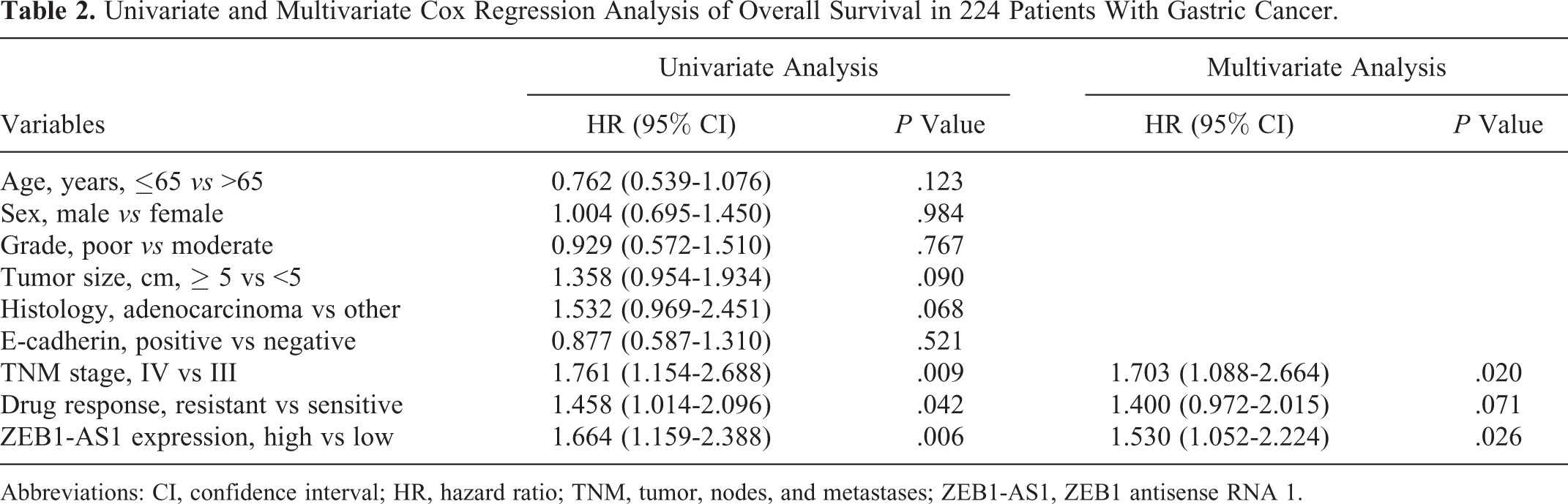
Abbreviations: CI, confidence interval; HR, hazard ratio; TNM, tumor, nodes, and metastases; ZEB1-AS1, ZEB1 antisense RNA 1.
Discussion
Most patients are diagnosed at advanced stage of GC, due to lack of specific symptoms at early stage. Early diagnosis and intervention treatment is an important means to improve the prognosis of patients with GC. Therefore, finding a new biomarker for GC is needed to improve the diagnosis and prognosis of GC.
Many studies have demonstrated the differential expression of lncRNAs in a great variety of diseases and proposed the associations with tumor progress. 4,20,21 Previous studies have confirmed that lncRNAs are important in determining the occurrence and development of GC 22 and may serve as new biomarkers for diagnosis and prognosis of cancers. 23 For example, many studies have reported that multiple lncRNA, such as LET, H19, MEG3, MALAT1, and HOTAIR, have been associated with tumor prognosis and metastasis in GC. 24 –27 However, the association between ZEB1-AS1 and GC has not yet been investigated.
ZEB1 is a crucial transcription factor for regulating epithelial–mesenchymal transition (EMT), which is an important basis for tumor invasion and metastasis. 28,29 The ZEB1-AS1 overexpression leads to decreased epithelial markers, such as E-cadherin and ZEB1, which in turn promotes the proliferation and metastasis of cancer cells. 13,15 A recent study by Liu et al 30 revealed that miR-200s overexpression can partially abolish the effects of ZEB1-AS1 on the growth and migration of cancer cells. In the present study, we found that ZEB1-AS1 expression was inversely correlated with E-cadherin expression. ZEB1 antisense RNA 1 may regulate the invasion and metastasis of GC through EMT signal pathway. Furthermore, silencing ZEB1-AS1 could promote cell apoptosis partly by increasing the expression of Bax and inhibiting the expression of Bcl-2 in glioma. 31 Gong et al 16 reported that ZEB1-AS1 may partly lead to the promotion of tumor cell growth through downregulating p15 expression in colorectal cancer. Taken together, ZEB1-AS1 functions as an oncogene in human cancer.
Previous studies showed that high ZEB1-AS1 expression was associated with poor clinical outcome in several types of cancer. 19,9 –13 In the present study, we found that ZEB1-AS1 was upregulated in GC tissues, and high ZEB1-AS1 expression was an independent risk factor for the poor clinical outcome in patients with advanced GC treated with chemotherapy, indicating that patients with low ZEB1-AS1 expression might benefit from chemotherapy. Previous studies have demonstrated that ZEB1-AS1 promotes the proliferation, invasion, and migration of GC cells, and its high expression levels are associated with poor prognosis of patients with GC. 32 –35 Therefore, ZEB1-AS1 overexpression confers GC cells more malignant behavior and resistance to chemotherapeutic treatments. These findings support the oncogenic role of ZEB1-AS1 in GC progression. However, the exact molecular mechanism of ZEB1-AS1 in drug resistance of GC is not very clear. Further studies are required to explore the underlying molecular mechanism of ZEB1-AS1 in GC.
In conclusion, this study provided the first evidence of association of high ZEB1-AS1 expression with the prognosis of patients with advanced GC treated with chemotherapy. ZEB1 antisense RNA 1 may play an important role in advanced GC and could serve as a new molecular biomarker for GC.
Footnotes
Authors’ Note
All procedures performed in studies involving human participants were in accordance with the ethical standards of the institutional or national research committee and with the 1964 Helsinki Declaration and its later amendments or comparable ethical standards. The approval number given by the ethical board is 2017KY-067.
Informed consent was obtained from all individual participants included in the study.
Declaration of Conflicting Interests
The author(s) declared the following potential conflicts of interest with respect to the research, authorship, and/or publication of this article.
Funding
The author(s) received no financial support for the research, authorship, and/or publication of this article.
