




Abstract
The Arctic Terns are six creative artists|writers|photographers|poets, who perform the paper you will encounter here. We Arctic Terns engage in collaborative writing and artmaking, connecting with each other, along with some of the other-than-human earth and animal others, through whom our own being-human is extended. We Terns become and write together as an archipelago of ‘singularities’; we have been meeting on Zoom for years, listening to and inspired by each other. We perform, here, in this paper, our approach to collaborative writing that builds on|pings off and playfully diffracts from whatever there is around us that provokes and inspires us. We invite our readers to take up the practice of emergent listening, to become with us in our archipelago of separate and connected becomings.
Keywords
Beginnings
The Arctic Terns are six humans who write, make images, and listen to each other through the media of Zoom and email. Beyond that simple description, who we are is increasingly less interesting to us that what we do. We could tell you many stories of the institutional ties that bind us, offering you a coherent account of our academic identities, credentials, and reputations that might entitle us to hold forth on the topic of collaborative writing and new materialisms. But we unruly women would rather show than tell. It is our intra-actions that undo us and that make us, cutting us together/apart.
What else would you like to know?
Confronted, in the beginning, by the advent of COVID, we chronicled our struggles with and creative use of isolation (Speedy et al., 2022). And then we kept going – drifting away, coming back, meeting monthly by Zoom in the face of whatever new or increasing insult afflicted our worlds.
Inspired by new materialists like Karen Barad (2007), Jane Bennett (2010; 2017), and Suzanne Simard (2021), we connect with an experimental|unfolding sense of being-in-the-world with each other and the other-than-human, with earth and animal others with whom we engage. What emerges in this current paper is the care and trust that have persisted among us across the hemispheres, the creative surges that animate and connect us, and the metaphors and practices these give rise to. These emergent qualities, we feel, may be where the futures of collaborative writing might lie.
We call ourselves the Arctic Terns after a species of tiny, endangered seabirds that migrate unbelievable distances across the globe and whose movements and murmurations stirred something in us (Speedy et al., 2022). More recently, we have also come to think of ourselves as interconnected islands – an archipelago of singularities. These tropes are just two of many. Air currents, undercurrents, solar winds, the elliptical motions of particles and planets, diffracting waves, flows of sap, and blood. We forage among forests of theoretical and methodological literature; pinging off fiction and science, drawn into the orbits of other writing, spinning off into multiverses of ponds and poetry and paint. We fly high on wings of thought|swim deep in oceans in which human does not mean better, or higher. We humans have assumed our exceptional status for too long, and look where it has got us.
Our writing is both collaborative and intensely personal, connecting us with ‘the irreducible singularity of each living being’ (Irigaray in Larmagnac-Matheron, 2024, p. 47).
We find ourselves deeply touched by each other’s writing and image-making: listening and responding, not only to the words but also to the vibrations of each other’s voices, not only to each other’s images but also to the sight of each other’s faces on the screen and glimpses of each other’s homes; to the tilt of the planet that is holding us, as the sun rises in the UK while it is setting in Australia. Linked into the complex separate and connected worlds we each live in, we resonate with each other (Nordstrom, 2024). We reach out through this paper hoping to touch the singularities of other readers/listeners through the emergent listening we practice at each turn.
JANE: There are Terns everywhere I turn. I am aware of our words getting stuck in all the physical and digital crevices of my life. A cumulative, iterative practice of community has crept up on us. If I had to pick one word to describe us now it would be archipelago – defined by the Oxford English Dictionary, as ‘a group of connected islands scattered in water’. Voyage of the Arctic Terns.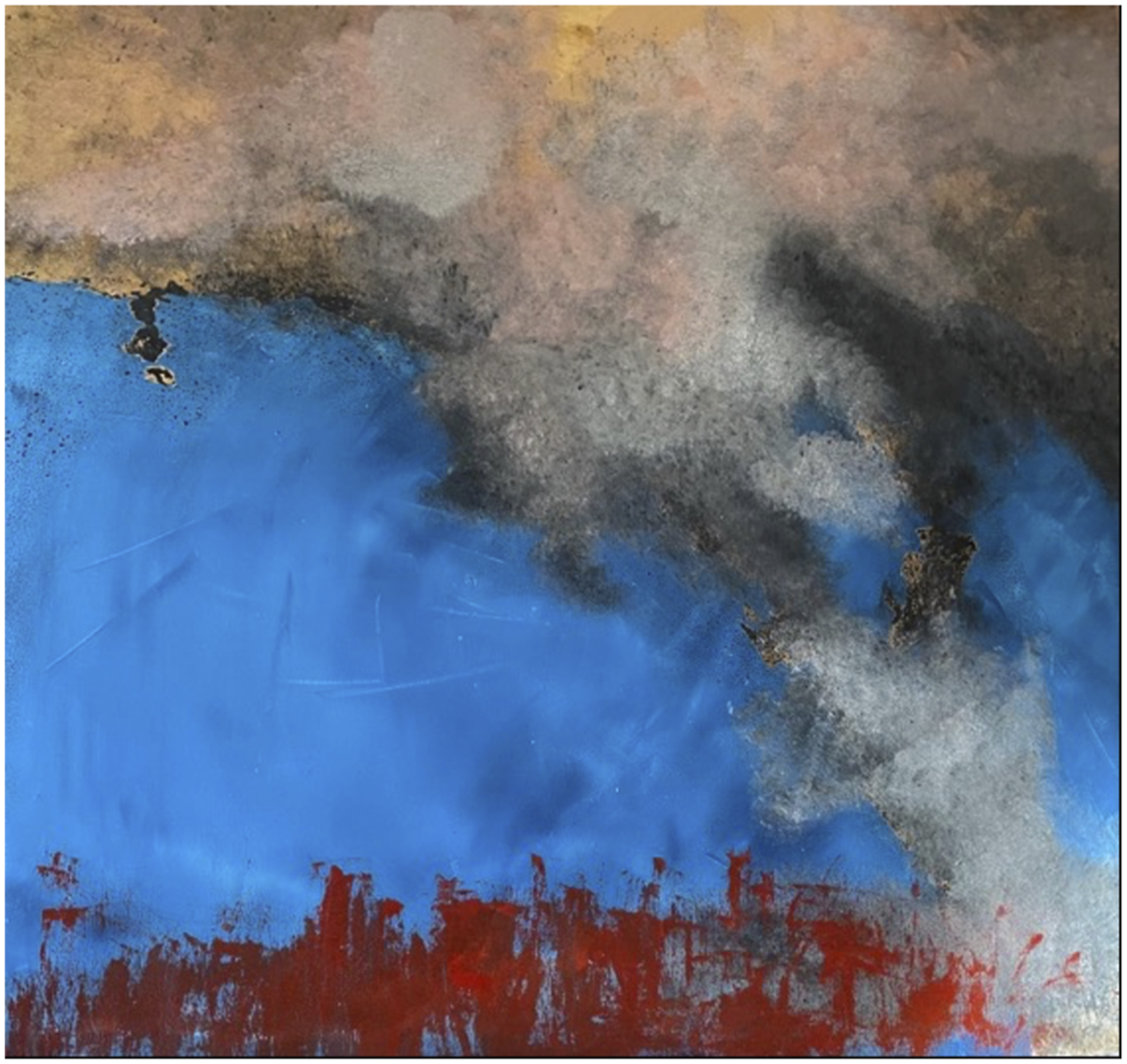
Geographically, an archipelago appears static but often presents as a cluster in the aftermath of volcanic activity or along the arc between two tectonic plates under the surface, and it has underwater sedimented or geological connectivity. Mythologically, archipelagos move swiftly; rising up out of the seas, drawn up into the skies by the gods and even break loose from their clusters and dance around each other. Conceptually, the emergence of post-colonial, archipelagic thinking on the part of Indigenous island peoples is brought together with the refrain ‘isolated above, but connected below’ (Martínez-San Miguel & Stephens, 2020). These archipelagic relations ‘may provide novel opportunities to unsettle certain tropes: singularity, isolation, dependency and peripherality; perhaps even islandness and insularity’ (Stratford et al., 2011, p. 114).
The migrating Arctic Terns collectively make up an archipelago of moving, isolating, surrounding, and diffracting intra-active currents and islands that glance and sweep on and off each other’s shores. Our accumulated pool of material or matter, including our chronological histories, surrounds us. Our migratory pattern, as the light comes up in the UK, and the sun sinks in Australia, has received some sort of account in/by/with my painting – ‘the voyage of the arctic terns’.
If she were tidier in her habits, Jane could sweep the terns up and put them all into the same folder. But Jane is a determinedly untidy woman. She is cognisant of the accidental, scholarly breakthroughs that emerge in the aftermath of hazardous landslides amongst precarious mounds of files. The Terns and life are messy, unruly, and monstrous. We have become an accumulated agglomeration of know-how – we seem isolated above, but we are intra-connected below, we are becoming/have become archipelago.
I am reading Harvey’s short novel ‘Orbital’, which gives an account of six astronauts orbiting earth in a space station (six of them and six of us). This seems to parallel the Arctic Terns’ long journey – ‘so together, and so alone, that even their thoughts, their internal mythologies, at times convene’ (Harvey, 2023, p. 1).
We bounce tangentially off one idea, character, thing or thought to another, turn from one mind, spinning and pinging diffractively off into another place or thought or story, playing all the while with social/individual thinking and dreaming and with/in time and space. We are turning: Terning.
CAROL: In the spin room, Dan with the long curly locks suggests we put a towel on the saddle for padding. It’s cold in the room and dark. Most people choose bikes along the back row. I pick out a bike in the front row, adjust the seat and handles to be as upright as possible, but it doesn’t work like that and I have to lean down onto my wrists. Someone has requested Old-People-Rock. I wince at that. The music starts and we have lift off.
Dan calls out instructions and encouragement and counts down through the fast parts to the rest points. I am euphoric. I am flying. I am dancing on the saddle and laughing out loud. I don’t want to stop. This is the point, this is the point, this is the point, my legs spell out in circles.
In the recesses of my mind I return to moments with T, cycling along tow paths, through hedgerows, at high speed down mountains. The memories are brightly coloured, vivid like the pictures shining in the cold flames held by the little match girl. T cycles close behind me shouting out, ‘Don’t brake!’ and ‘Don’t put your foot down!’ Holding the road. Going downhill fast. The joy of adrenaline. Me! Suspending everything in an exhilarating moment of action. The rush of air on my face. My legs spin round and round unlocking the memory of the sensation of joy, reconnecting those pathways.
I surface to Jail House Rock – really? Surely none of us in this room are that old?
DAVINA: ‘But where is Bronwyn? She’s never late’, I say. I can feel a thread of concern snaking around the globe wanting to tap lightly upon her door for her to open it smiling, glass of red wine in hand saying ‘oh what a glorious surprise. How did this thread arrive at my door, where does it go, who is it attached to?’
The silken rainbow threads that bind and tie us to each other grow richer in colour, deeper in patina, thicker in strands, maybe they are more braided ropes than threads now. After so many shared stories, images, and emotions.
Phew she’s here, I feel such relief to hear her tentative, ‘hello’.
BRONWYN: I am the one who likes order, who depends on the fact that every month we Arctic Terns write to each other, read our words to each other, listen to each other. We emerge diffractively with each other. Even so, we depend on a certain degree of order. Back in the radical feminist days we might have called our meetings ovulars. Nowadays, we take flight across the globe as terns, and we link together beneath the ocean’s floor becoming archipelago.
In linear, historical terms, our human ancestors made the journey over the oceans 200 or more years ago. It took months, back then, to make the journey that on Zoom is instant. Before our human ancestors, the birds and the fish had long since linked our two lands. Our northern, human ancestors, fleeing the conditions of the United Kingdom at the time, sought to recreate what they’d left behind, importing racism, sexism, rats, rabbits, English birds, and hard hooved animals, harming what was for them a new land for the taking. And so here we are now worrying about extinction, angry with the intransigence of language, of imagination, of governments who are unable to take the turn toward survivability. In Australia, the ‘imperative to sustain the conditions that enable life on our continent does not feature in [the Prime Minister’s] political imagination or vocabulary,’ Ritter fumes (2025, p. 11).
Simard (2021, p. 283), writing from her lifetime of forestry research, concludes: ‘Diversity matters. And everything in the universe is connected—between the forests and the prairies, the land and the water, the sky and the soil. The spirits and the living, the people and all the other creatures’. We need saving, she says, from our all too human, competitive, individualised, ascendant selves. The forests can save us if we let them, she says. But first we must break through the positivist stranglehold that has held the forest’s power and intelligence hidden. We must listen to each other, as we do, but more, listen to the forest, to the earth, and to its creatures.
To do that we must begin by abandoning not only the ascendance and separateness of the human species, but, I suggest, by putting such categories as ‘human’ under erasure. Could we become, simply, those who live and die, and are integral to the planet?
When my children romped in the garden with our beloved border collie, the main difference among them was that she could bark to express her joy in their playing together, otherwise they were, all four of them, four-legged, tumbling, laughing, life-full creatures. No need to say this one ‘dog’ and these ones ‘human’, but beings that can connect through sympathy, ‘circulating in the atmosphere to connect different types of beings and things’ (Bennett, 2020, p. 29).
When I came upon a glorious fishpond on my new walk to the Marina in Elizabeth Bay, I discovered goldfish, glowing red and silver, black and speckled, in a glittering stream with cascading waterfalls, I was swept up by that current of affective sympathy Bennett wrote about. As these jewelled beings milled around in the pond looking up at me, I pondered how I might talk to them. Sound matters a great deal underwater and is much louder and more vital to living beings’ relationality than airborne sound (Kingdon, 2024). Just up the road from the pond jackhammers are digging out tons of sandstone from a site where new human apartments will be built. Fish are deeply distressed by many of the industrial sounds we humans generate both under and above water. When the jackhammers start up, the fish get clumsy, bumping into each other. I had, mistakenly, and all too humanly, seen the fish as bullying each other. But they are my kin, foreign like my ancestors to this land, moving between deep distress and calm, astonishing beauty.
JANE: And what of the sorrow contained in joy and the ugliness round the edges of beauty? Fishpond.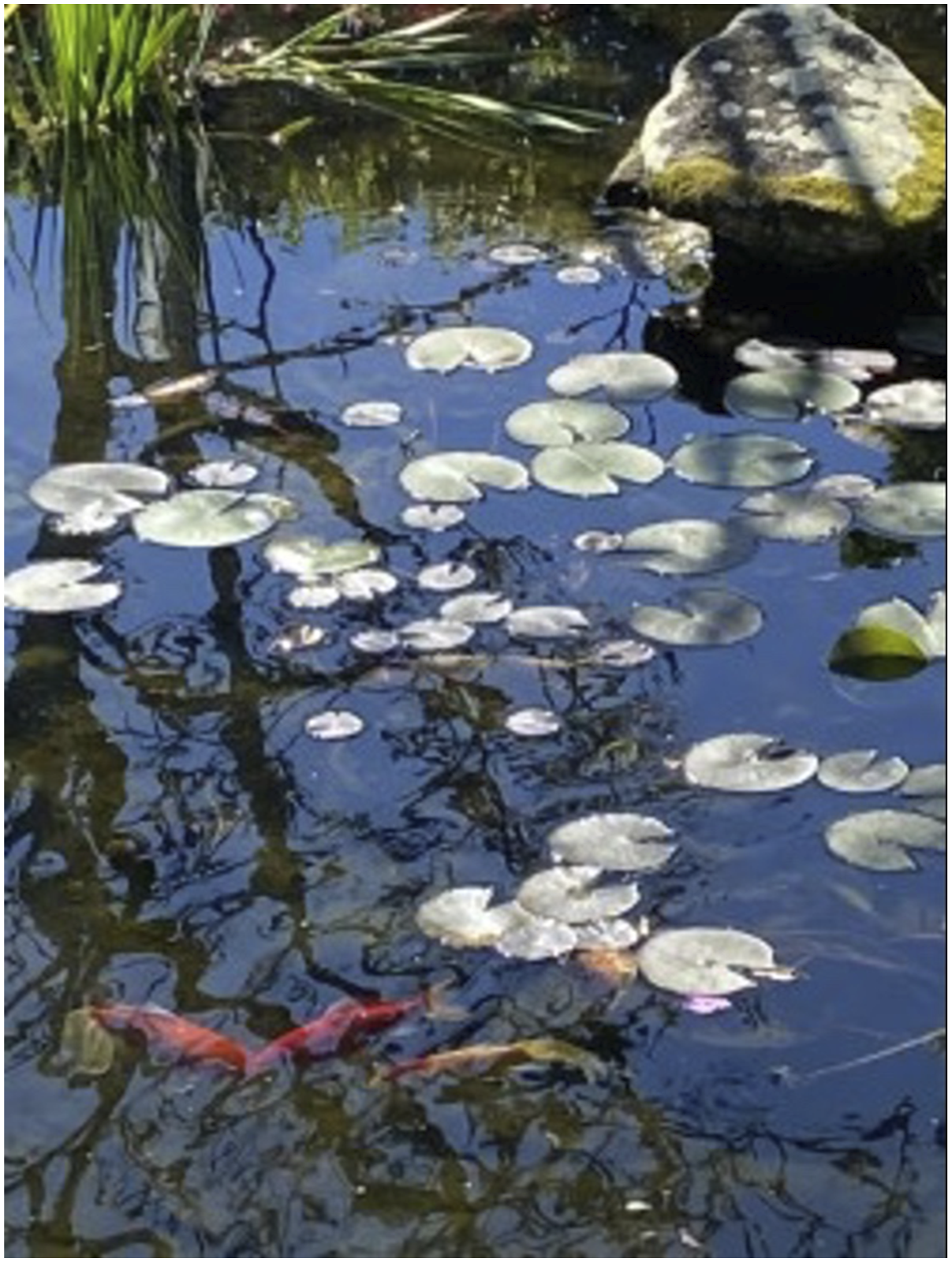
Paint even when deliberately and intentionally and carefully applied slips over its own edges and bleeds out over boundaries. There is a trace… of underbelly; undercoat, underneath, undertow, underground… and therein lies the poignancy; the sorrow; the darkness on the other side of the luminous doorway. Sorrows seep through beauty; shadows slip under luminous openings, vibrant colour and movement edge their way into monochromatic canvases. Paint…puts the stutter in and and and…
Figure 3. Kelp whisperings. CAROL: in the waking in the surrounding pillows in the air we breathe in the humming of cars in the helicopter overhead in the voices on the radio in the warm stillness of this room in the irrepressible cough in the impossible desire to sing in the ache deep in the left hip in the tingle of elbows down to fingertips in the standing in rain in the waiting at a bus stop in the smile between strangers in the smallest imaginable in the furthest away in the pull of gravity in the slow tread up the hill in the drawing of curtains in the clicking off the light in the unbuttoning in the slow outflow of air in the sigh in the fart in the succumbing in the letting go in the forgetting in the smallest details
1
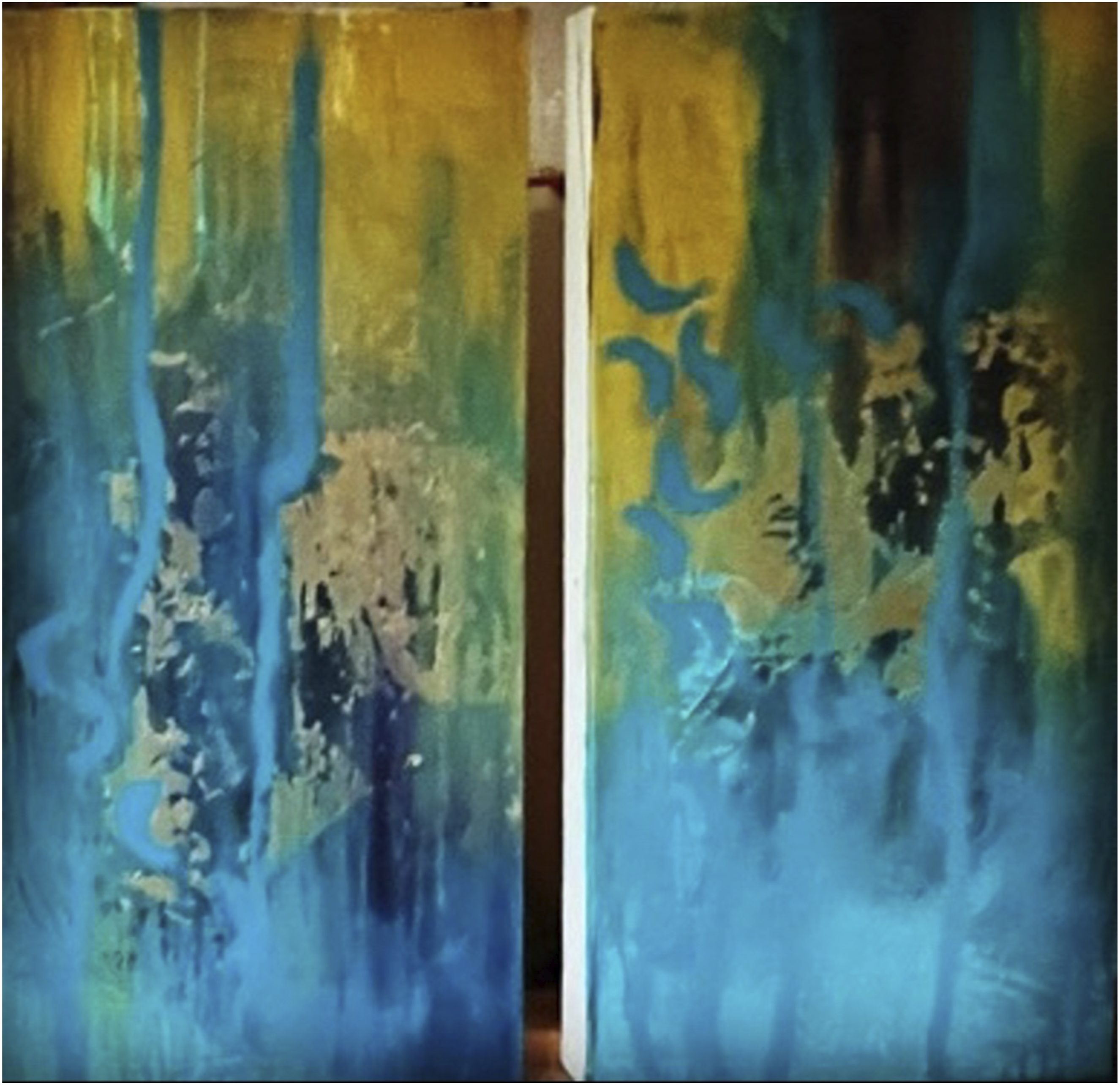
Figure 4. Ache.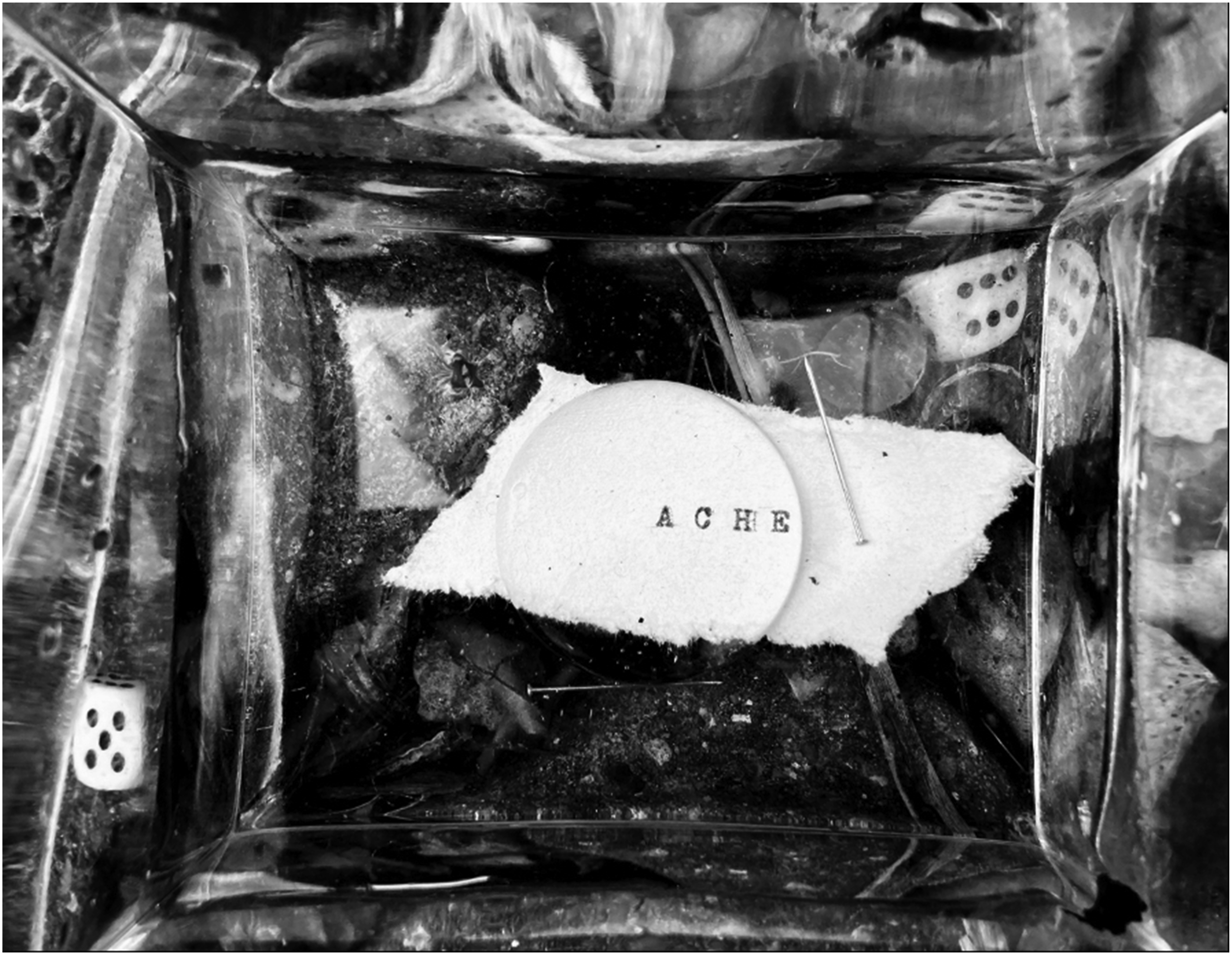
SHERIDAN: If the multitude is a whole comprised of singularities (Negri, 2002), perhaps each singularity contains multitudes? Vastly and minutely relative; ethically bound to and freed, made and undone by our relations with countless earth and space others and more. Bronwyn writes of emergent listening (Davies, 2016), a practice for attuning to the ‘ethical interimplication’ of a shared world (Mitchell & Waterhouse, 2021, p. 116). Freed from the humanist trope of active listening to attend to the whispers and raucous cries of multitudinous and singular others, ‘listening’ rustles through this paper like wind through leaves.
Figure 5. Beyond the Pail.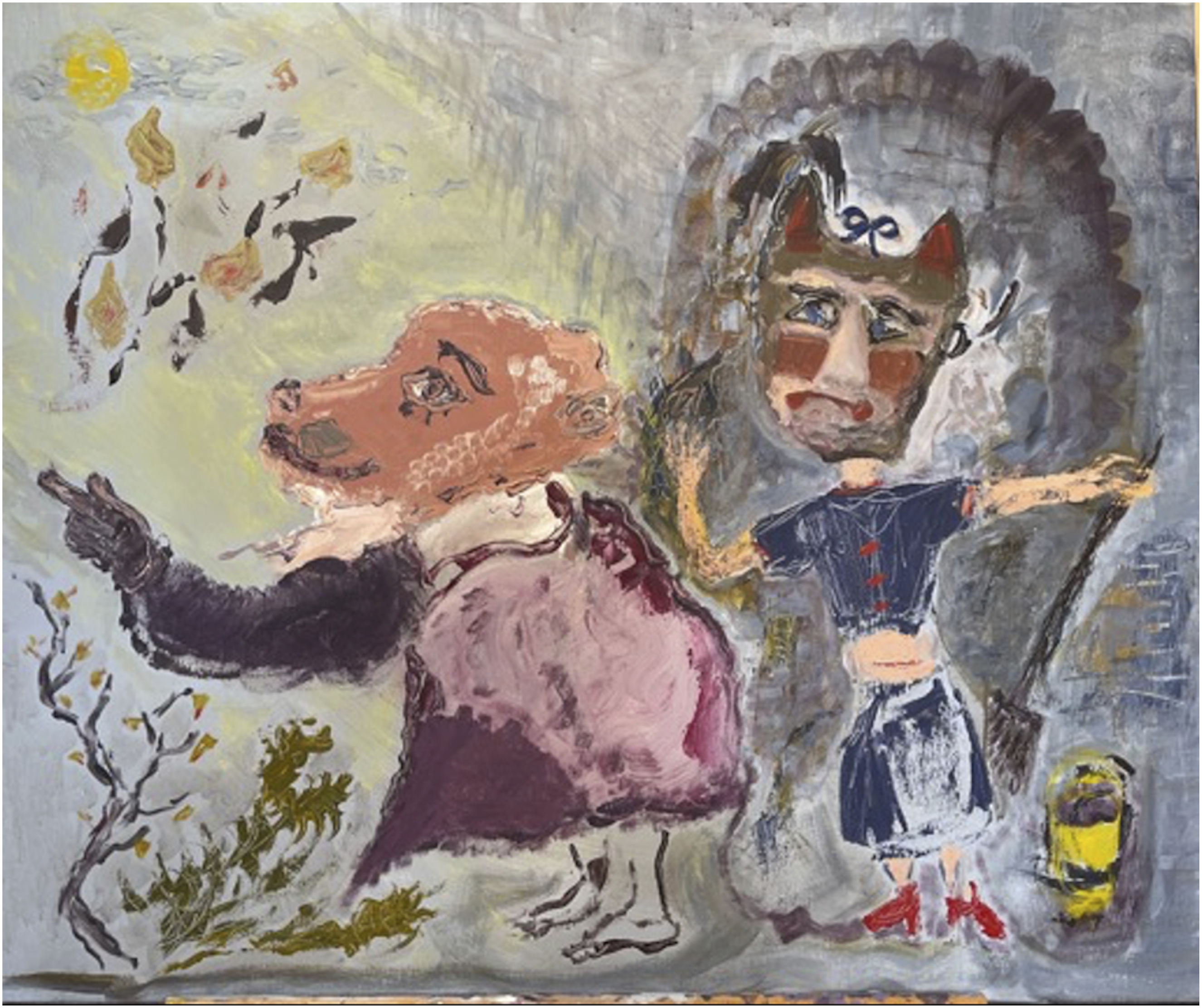
SUSANNE: What I’m impeded by is in/attention. What floats by. Detritus. Scraps of words and thoughts. Veils of sense and nonsense. How often, or - to tell the truth - how in/frequently, I pick up and put away Anne Carson’s Float (Carson, 2016), lured in, again and again, by ‘Cassandra Float Can’. Here, even Carson so eloquent and disciplined loses the thread. Sometimes I feel I spend my whole life rereading the same page, the same word, another beside it with no apparent relation. Now we would call it a portal. Breaking down in the middle is not an uncommon experience. Odd we have come to venerate breakdown and middling muddling through. What purchase might there be, not in a capitalist sense but a climbing to some sort of sense, albeit tenuous and provisional, on a ladder of writing (Cixous, 1994), or - to tell the truth - mostly not/writing. Tautologies. Circularities. Nonnarrative nonlinear beauties and rips of spacetime … caught in the corner of the eye like floaters: spider legs, drifts of kelp or jellyfish impeding vision that the doctor says I will, in time, learn not to see and so I don’t. What you don’t see is still there. To prophesise, returning to Cassandra, means learning not to see or say, or sideways glance at the same time as knowing the truth, or veer away. Tragedy is never averted in the Greeks. Ping titititi ding, the new sensory soft digital ratatatat. In|attention pulling me always in multiple directions no matter what I turn off or how I isolate... No wonder Cassandra has nothing coherent to say, war-ravaged flesh-pillage that she is, dragged here. Tearing and splitting the world with her scream (Carson, 2016). I like Carson’s style. Laddering questions, direct address, calling in the reader: you you you. Carson wanders off from untranslatability, needing a bit of a rest, to etymology, the right hand of the translator, and the pile of texts that spill from her desk beside her … Float is a collection of performance pieces, says Carson to the papers, and 'poetry is a man on fire running quite fast' through the house of prose (Kellaway, 2016, n.p.). Why only a man I can’t help myself asking. Carson prefers to draw but isn’t good at it and doesn’t see what it does to writing – a refresh, a different way of using the mind. When she’s had a gutful, tired of the endless quest in the labyrinth of language, Carson cuts to the chase. Here is the birthday cut. Perhaps there was a cake. Or people coming over. She wants to leave the desk, the books, the computer. Everything has been made unnecessarily complicated. The only way to do it is to pluck, strip, float, pull the curtains across. Walk out the door.
JANE: Cassandra/Cassandra Float float float Unbelievable prophesy Unbelievable/ Light under the door/ Can you? Cassandra can.
SHERIDAN: Walk out the door. Step barefoot on cold wet grass. Wild dogs howl. Lightning splits sky. Wind rises overnight, blows tiles off the roof. Morning light etches the outline of each cast bronze curl on the statue’s head, dark and still, everything around it moving, changing. Cracking open, spilling.
Figure 6. Twelfth Tide 7.25.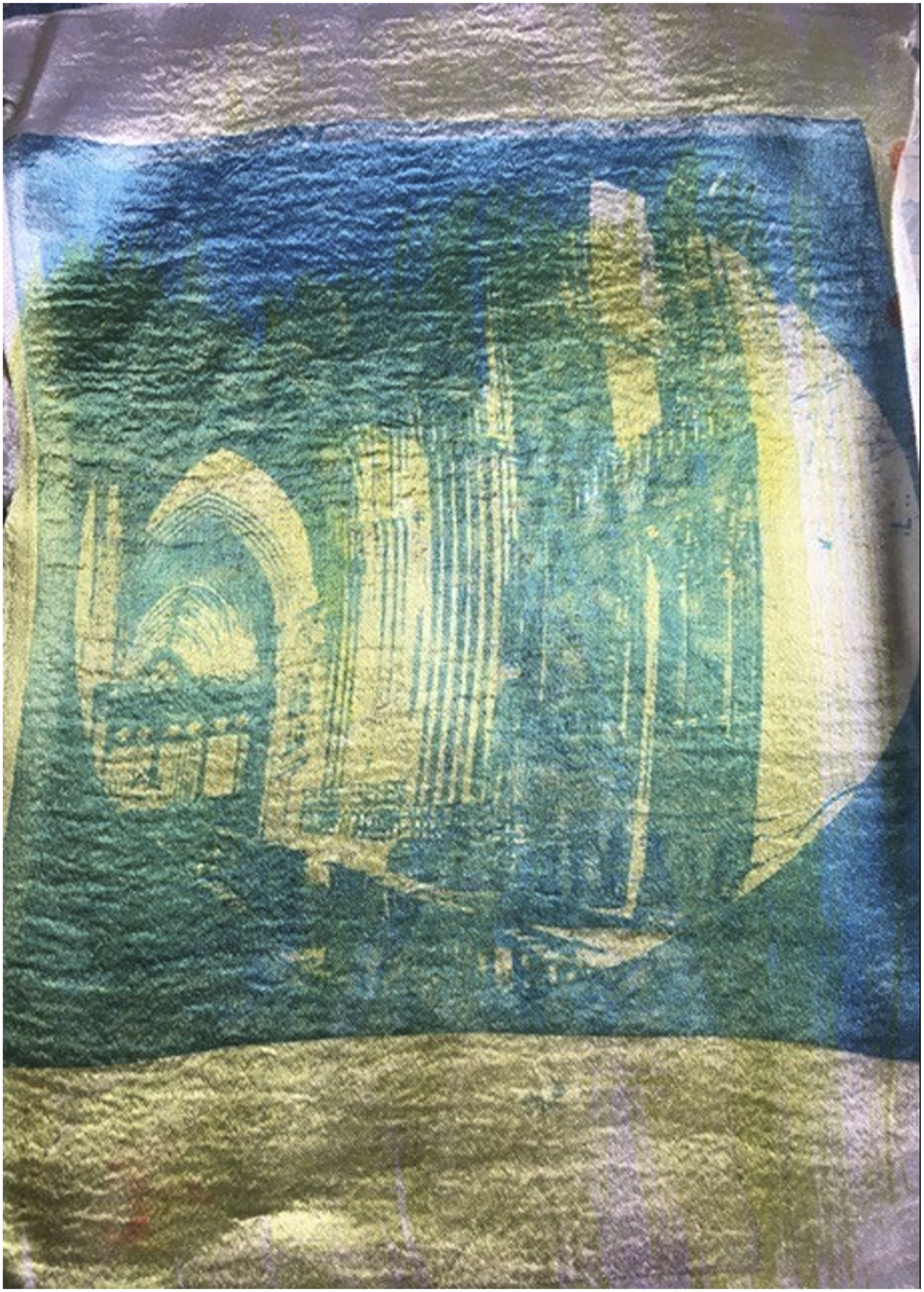
DAVINA: I have been thinking about relationships between humans and non-human animals specifically myself and Ulf and between women I know and their dogs (Haraway, 2003). When I stroke, nuzzle and kiss him I feel love that seems to flow not just from me but back to me. My ability to anthropomorphise and apply human cognitive functioning to him is emphasised by R’s different perception of Ulf’s ‘one walnut brain’ and therefore motivation for actions and inactions. I notice how his perception seeps and tints my own.
Ulf limps for a while when he gets off the sofa or the bed after being still; we have done longer walks this weekend and he has been jumping up excitedly for a ball to be thrown and collected. I wonder if 5 months of almost continual wet weather has taken a toll on him as it has on me? I think Ulf masks pain responses, takes himself away from me, some ancient wild wolf genetic memory playing out where weakness must not be displayed to the pack leader, so I must become more tuned into the subtle shifts in his behaviour and movements. He doesn’t yelp or express pain, but is he masking this because he doesn’t want to display weakness to his pack leader? Am I his pack leader? He certainly doesn’t act like I am when he is outside off the lead. I notice how other dogs stay close to their humans; he is off adventuring. It feels my imagined umbilical thread that connects us is just too long or stretched too thin, too far. He does always come back but in his own time, unless some helpful human has put him on lead assuming he is lost. There was some schadenfreude on my part after R sheepishly returned from taking Ulf out on his own, after an assertion that he just needed to take treats out with him for Ulf to be biddable. I smiled and nodded knowing that, like many Irish Terriers, he has no interest in treats beyond the boundary walls of a house.
I have no idea what cognition and emotion Ulf has. I wonder if the interpretation I put on his actions is to comfort and fill a void inside myself, left from grief and loss from human death and the constant inner critical voice that castigates me.
There seems to be what Lori Gruen (2013, 2017) calls an entangled empathy. Entangled empathy involves both affect and cognition. The empathizer is also attentive to both similarities and differences between herself and her situation and that of the fellow creature with whom she is empathizing. She must move between her own and the other’s point of view (Gruen, 2013, p. 226).
This movement and alternation between speaks to my experience of practice-based research – I am constantly shifting and changing focus as I create artwork, being both within and part of, focussing on the detail and the making and then shifting to viewer, witness, looking at the whole from different viewing distances, testing to see if it communicates what I want it to.
Gruen says, Usually what we ‘get’ is just a glimpse. We never really ‘know’, but too many people use the idea that we can't really know as an excuse to opt out of working at it. I take this to be a failure of both imagination and moral agency (Gruen, 2017, p. 461).
Maybe I can succeed at having both imagination and moral agency!
Figure 7. Twelfth Tide 4.25.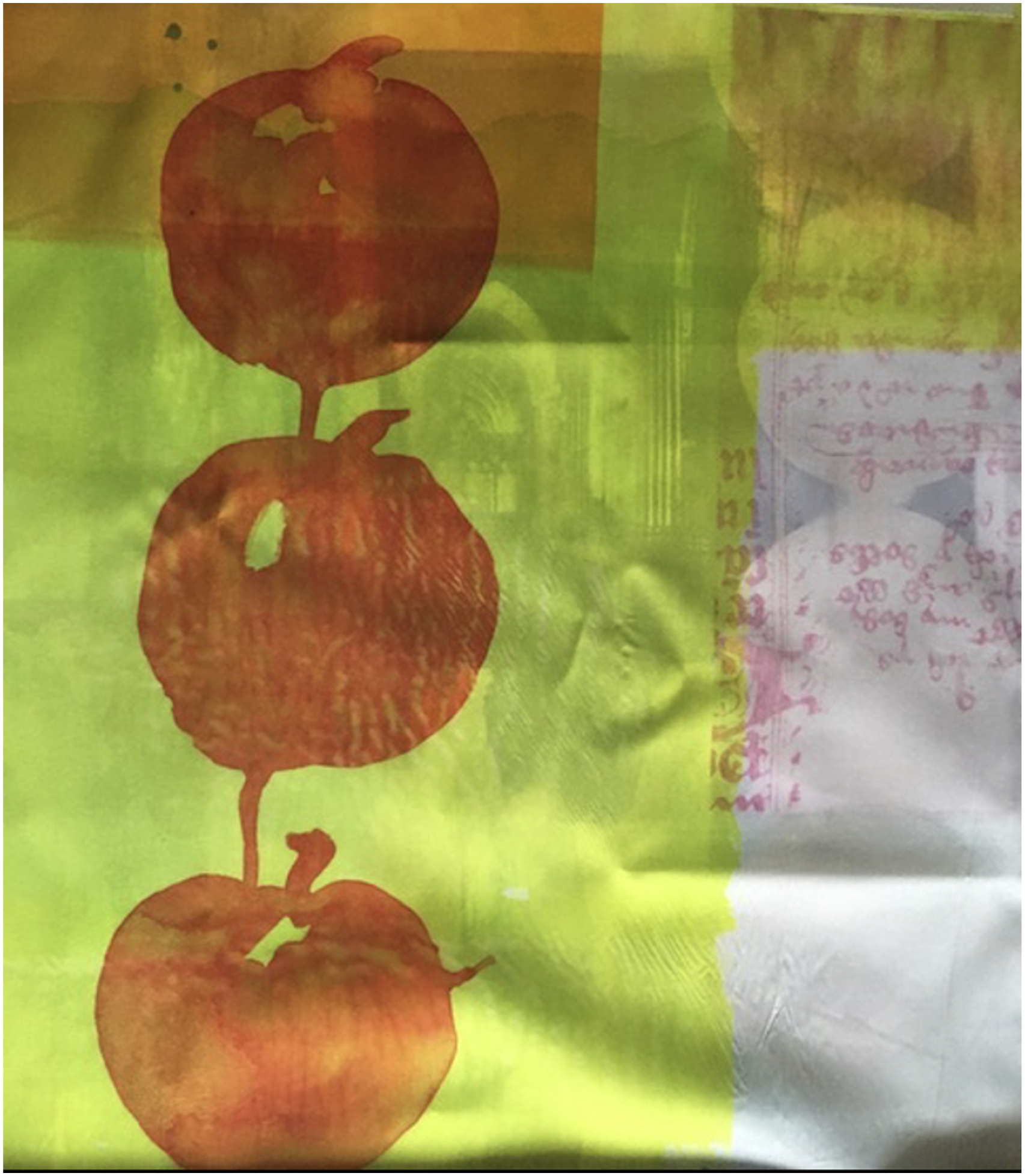
CAROL: Reading through my writing I wonder why I so often place myself at the beginning? What happens if I turn it round? Place the more-than-human first.
I write something small about an experience I had in a zoo. It takes a long time to write. I write it again and again. A lot is removed and still it falls short.
There were two reticulated giraffes confined to the narrow enclosure. Their long necks stretched up to pull at the leaves held in the wire baskets placed just above their heads. Born in captivity, they had never ranged the grasslands of the savannah, their mottled skin had never been warmed by the heat of the African sun, nor heard the sounds and smells of the Horn of Africa. Their stark patterning offered no camouflage from the crowd of people watching them behind the railings at the side. They chewed slowly and continuously turning their heads this way and that.
Then something occurred that upset everything. One of the giraffes stepped on a sparrow that had been hopping around on the ground. The tall giraffe spread her elongated forelegs apart bending down to stare at the small bird on the ground while a second bird, its mate, flew in circles making calls of distress. The giraffe stood up then bent down again nudging the frail body. The bird on the ground lay still.
SUSANNE: How like a cat I am, not coming when I’m called. Aloof, I am more absent than any other tern. I don’t do my homework. Yet, here I am. Whirling with the terns. Annabel joined the terns in our first spring, a cautious little creature I found cowering in a cage at the animal shelter. Now she lies on me in the mornings, her belly resting on mine, breathing into my face. She wakes me by pushing her feet in and out, in and out on my chest, like she’s pumping my heart or maybe reactivating it. She gazes into my eyes, pats my chin and cheek with her paws as the sun streams in. Another creature rescued, though – in these terns and turns about – perhaps all of us have been.
SHERIDAN (gathering an archipelago of moments toward the end): It is through such imaginative forms of worlding that we inhabit a messy, plentiful, and promiscuous universe and begin to fathom our entanglements in things small and large (Babette Tischleder, 2019, p. 134).
absence makes the heart
all this talk of old queens and loose stones holding a pebble holding fire holding back a turquoise sea a wood bound queen turned king stealing the children away down in the littoral zone grey slate scarred-by-empire wrapped in quartz the sting of salt crystalline air thickly scented with ghosts avuncular blackhearted voices singing them back home
no such thing as a single woman
sad things without an object embroidered intimacies an old kitchen table her grandmother’s ring a circle of stories massaging her feet she made a folly she’s dead now nothing is trivial blackberrying at end of summer caught in the brambles coming unstuck buckets overbrimming black juice running the whitest of white blossom is mist
Reclining figure
Dan’s sculpture from found materials. Reclining female figure with egg. Butterfly man kissing her breast. Christian knight with a little erection. Jane asks, ‘But what is a proportionate erection?’ I take the word ‘plinth’ between my teeth. It is thick and elevated with promise. Grandma Speedy’s Swedish teacup wrapped in undies, stockings and disapproval all these years later her disdain still uncracked. Self-portraits with wall and sign. Ideal Dairy/ Stop the City Carol flamboyant in 50’s summer gear, swelling with Lily, in a meadow with Lily blowing bubbles, a pastoral lilies of the field. Chris’s shirts on the Welsh side of the Severn, decomposing grief returning under the moon, washed by tides the highest rise and fall in all of Europe exposed submerged severed the fragments incidental remains faded cuffs never let them go. There is more than one day of the dead and anyway it was the harvest festival (Jane was there too but we don’t remember meeting) Guelaguetza Los Lunes del Cerro (Mondays on the hill but stumbling in Spanish, I thought it was the horns of the moon). Annabel’s arse yellow eye and dark arched haunches drawing blood sleeping black on black paws on the keys make ciphers nonsensically and murderously announcing the Day of the Cat.
Scent
When the cat arches in the doorway, think of me. I have sometimes been like that Inside her mother’s elegant black and gold purse spray a crystal cylinder exhales passing through the prism of spacetime Young David Bumble Bee and Beetle Boot Jack await our younger selves an orange dumbo dreams of becoming dragon the fire of red sorrow takes wing Maude, Milo, demand something more of us than a handbook for a damaged planet they like Osiris …have come home. …have entered humanhood, bound to rocks and plants, men and women, rivers and sky. One of the million things in the universe… breathing in every body.
2
No one is important, but everyone is interesting: one-armed Tom, hooked on nature, thigh-high fishing for Hawkesbury herrings to feed hungry broken-backed turtles.
No moment is too small or too far away: long sleeved blackberry picking in late summer; curling on Nanna’s lap with the gumnut babies and Mr Lizard, and curling again with my little sister and the book.
No sound is too small or too grand: screeching cockatoos and modest frog calls, the discreet knock on the door; the hammering and smashing, murmurs and whispers, breath.
Just one might be enough to change the world, to prise open the crack, to raise the sky with the feather in her hat.
Among other things…
The accumulations building among the terns include things, technologies, geographies, homes, everyday rituals, families and friends, political proclivities, worlds, grocery deliveries, cicadas, a cat, a dog, a collective dad, and a wealth of readings, writings and artworks. We inhabit a precarious, long-lasting equilibrium betwixt continuity and pinging off in multiple directions; intimacy and distance; physical/emotional space and close contact; similarity and difference.
None of this was planned. We are affecting, not just the contents of each other’s writing and art but each other’s pantries and stomachs these days. Susanne rushing back from Pilates to feed Annabel and herself at the start of our meeting. Davina sharing the benefits of intermittent fasting while Sheridan eats dark chocolate to stay awake. Carol unpacking groceries alongside our ideas. Bronwyn’s email about her birthday meal in a Japanese restaurant arriving just as Jane was doing her grocery order for the week. And so that night Jane ate sushi. There was too much sushi for her. She had ordered for about six. How mixed up is that?
Each named fragment of our writing and each image is a singular, but not single, island in the collective archipelago – unique and deeply connected with each other island, and with everything else. Our interconnected/separated archipelagic thinking, borrowed from the scholarship of small island scholars, reassembling fragments from a colonial past, binds us together. In the resonant words of Nobel laureate and poet, Derek Walcott, ‘Break a vase, and the love that reassembles the fragments is stronger than that love which took its symmetry for granted when it was whole' (Martínez-San Miguel & Stephens, 2020, p. 2). And our migratory journeys back and forth across the globe, at times in fragments; at times appearing as a reassembled whole, now bind us together with a stronger love.
Figure 8. Annabel in the garden.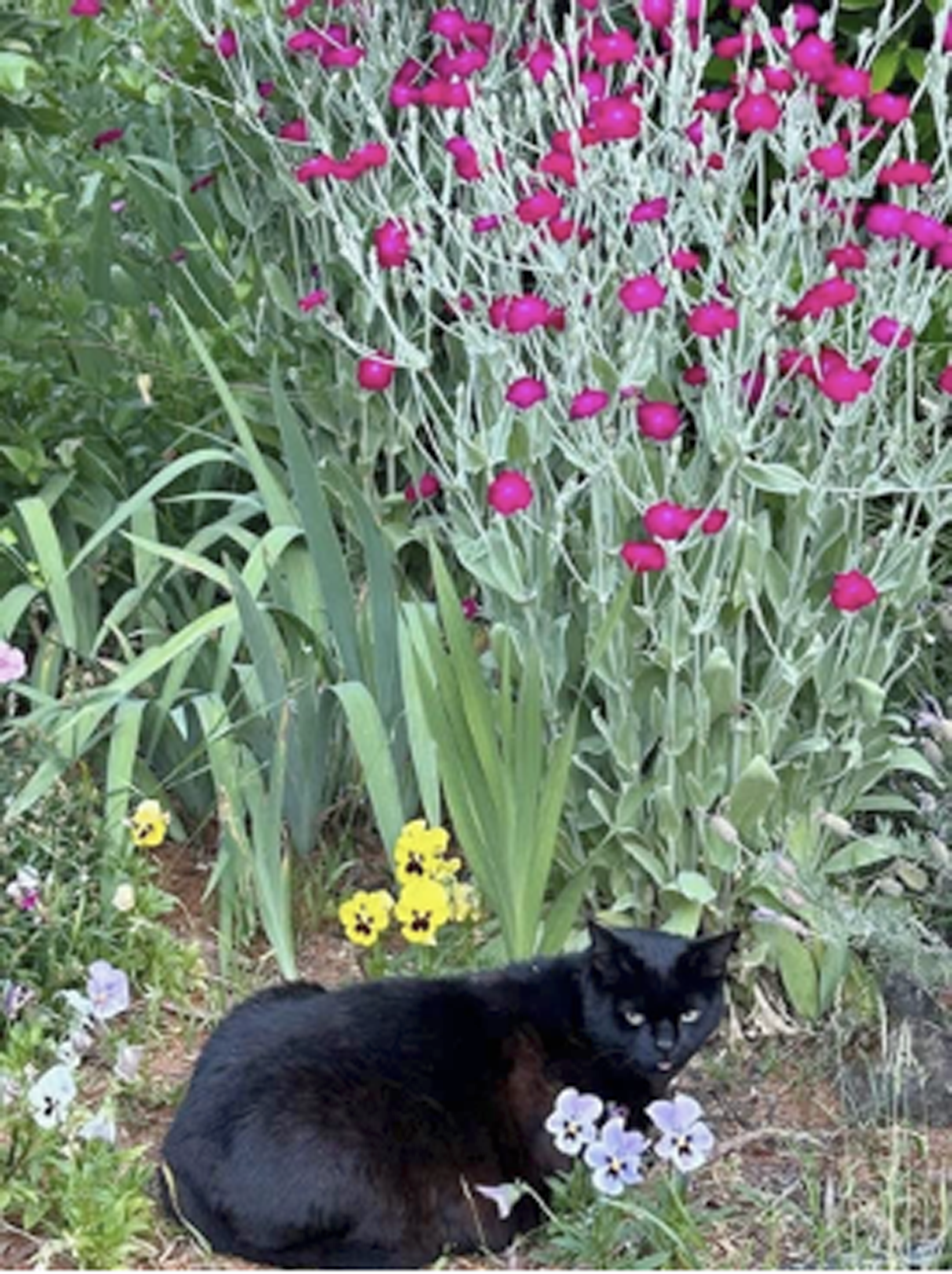
Footnotes
Ethical Considerations
No formal ethics approval was required for this article, which is composed of the creative and autoethnographic writing and artmaking of the six authors. We pay ongoing attention to the ethico-onto-epistemological stance of new materialist approaches.
Funding
The authors received no financial support for the research, authorship, and/or publication of this article.
Declaration of Conflicting Interests
The authors declared no potential conflicts of interest with respect to the research, authorship, and/or publication of this article.
Notes
Author Biographies
