




Abstract
Despite their ubiquity and ecological heterogeneity, non-pathogenic microorganisms are often lacking in accounts of more-than-human and other-than-human urbanisms. This article focuses on the use of digital technologies as practice for sensing and encountering unglamorous microbial ecologies emerging in a polluted urban river in East London. The River Lea has a dense industrial history, but today it is a site of post-industrial disuse, uneven development and burgeoning urban ecologies. In an easily bypassed segment of this urban river, microbial ecosystems bloom in and out of existence, reflecting a confluence of urban political ecological, hydrological and microbiological dynamics. These ecosystems are generally overlooked in accounts of urban ecological value, and are often framed as uncharismatic, accidental or even invasive. The aim of this work is to provide an alternative rendering of these slimy micro-ecologies. To this end, two digital approaches are explored: deployment of in situ micro-videography and attention to historical satellite imagery of the urban ecosystem. Microscopic approaches configure embodied, sensory, aesthetic and speculative encounters with microbial ecologies in urban space. In their temporal configuration, historical satellite approaches glimpse the machinations of urban political ecological dynamics as they contribute to the emergence of, and intersect with, recombinant urban ecosystems. These methods provide tools for cultural geographers studying how urban organisation affects ecological diversity, and for expanding geographic investigation into the more-than-human cultures of overlooked, unglamorous and uncharismatic urban lifeforms.
Keywords
Introduction: making sense of microbes
Cultural imaginaries of microbial life have shifted significantly over the last few decades. Single strains of pathogenic bacteria have been overshadowed by a networked, ecological and community-centric vision of microbial vitality that is understood as co-evolving with human life and variously sustaining, conditioning and disrupting it. 1 In urbanised landscapes, human-microbial co-evolution is particularly complex, characterised by zoonotic pandemics, antimicrobial resistant bacteria, and microbiota dysbiosis. 2 Microbial communities adapt deftly to the novel pressures imposed by cities (industrial pollution, sanitation, (non)human bodies) and undergo complex genetic and ecological changes as they do so. But although microbial evolution is occasionally to the detriment of larger organisms, microorganisms also play critical roles in urban socio-ecological reproduction. 3 However, the non-pathogenic, environmental, and ecological valences of microbial life tend to be overlooked in accounts of urban human-microbial relations. As cultural geographers reframe the urban realm as an ecological formation through empirical attention to large nonhuman organisms, 4 the aim of this article is to extend attention to microorganisms that are thriving ‘with and against the grain’ of anthropogenic landscapes and urban infrastructures. 5
Digital mediation may be particularly apposite for this task: as they expand the possibilities for encountering other-than-human lifeforms, the mediating capacities of digital approaches are particularly useful for staging encounters with organisms spatially and temporally displaced relative to the human. 6 This project explores experimental digital methods as a practice for sensing emerging recombinant microbial ecosystems forming in the River Lea, a contemporary urban river in East London. This work has deployed digital technologies to document how bacteria and other microbial lifeforms are responding to the fallout of human technological progress: waste, pollution, and infrastructural abandonment. I present some modest and provisional responses to these speculative questions as derived from the experimental, sensory and aesthetic mobilisation of two digital practices: micrographical video recordings of microbial habitats and analysis of historical satellite data of microbial urban environs. The aim is to explore these digital technologies as methods for becoming sensitive to and encountering those urban microbial ecologies thriving at the edges of human perception. This work contributes to and extends the methodological toolkit of cultural geographers in their study of uncharismatic, minuscule and overlooked other-than-human life, and expands our accounts of other-than-human urbanisms across multiple spatial and temporal scales.
In situ video-micrography
The project unfolded in the River Lea along its course through the densely urbanised districts of East London. The Lea begins in Hertfordshire and joins the River Thame’s as the latter’s easternmost tributary. Its lower reaches are an extensively engineered segment of the waterway that were key to the industrialisation of West Ham in the 19th century. 7 The Old Ford Lock, for instance, which sits adjacent to Fish Island in Hackney, is the point at which a canalised segment of the Lea called the Hackney Cut (or River Lee Navigation) re-joins the river’s original course. This Lock is a double lock that was once used for shuttling coal up and down the river, but which is disused on one side for navigation today, and sits as a remnant of this bustling industrial past. Yet, the disused side of the Lock is today dense with another form of liveliness; it appears less as an achievement of human hydrological engineering than an emerging recombinant ecosystem characterised by the upsurge of cyanobacteria, algae, and hydrophytes jostling for space and colonising accumulating plastic waste and debris (Figure 1).
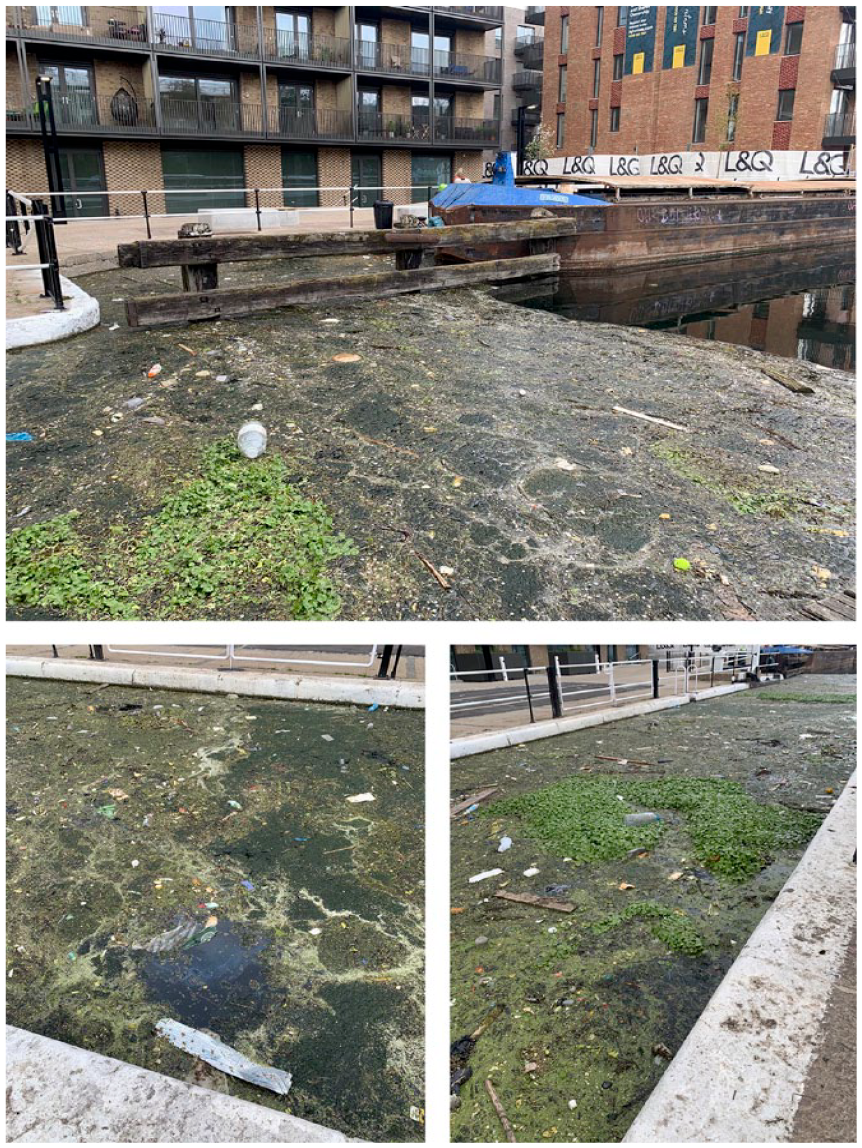
Photographs of the Old Ford Lock showing algal biofilms, debris and hydrophytes. Image by author.
My focus on the Old Ford Lock was motivated by a research interest in the microbial ecologies forming in abandoned, inaccessible, and hidden urban zones, and the use of digital methods for becoming sensitive to, rendering visible, and attuning to these microbial ecologies. Between 2021 and 2022, I spent many days engaging the landscape of the Lea, travelling back and forth from my home in Stamford Hill along the Hackney Cut to the Old Ford Lock. My initial aim was to become more intimate with the surfaces and objects colonised by microscopic life, a process that involved tracing a wireless microscope over anthropogenic detritus: plastic waste, face masks, condom wrappers and the like. The microscope was linked wirelessly to my mobile phone, and as I meandered its lens over flotsam and detritus, algal biofilms and rich vistas of microtopography snapped in and out of view, rendering visible the complex terrain colonised by microbial life (see Figure 2). Engaging in this in situ practice required a fine degree of attunement and receptivity to the surfaces being studied; it was a delicate arrangement in which small movements of my hand translated into large displacements on the objects I encountered (see Figures 3 and 4). The flow of water, its optical properties and the sticking of objects to the microscope lens similarly interfered with producing static renderings. But it is perhaps here, in the disorienting buzz of vibrating molecules and cohesive surfaces, that a clearer image of the microbial domain comes into view. Life at the microscale is governed by physical forces that have less purchase at our macroscale level of embodiment: molecular diffusion, viscosity and surface tension. 8 As they tune into anthropogenic pollution as a home, food source or temporary stopover, microorganisms navigate a physically turbulent spatial domain. And as a diversity of ecologies, lifeforms and anthropogenic matter snapped in and out of view via the microscope, my body was rendered similarly sensitive to this set of micro-forces, suggesting a partial kinaesthetic affinity across scalar boundaries.
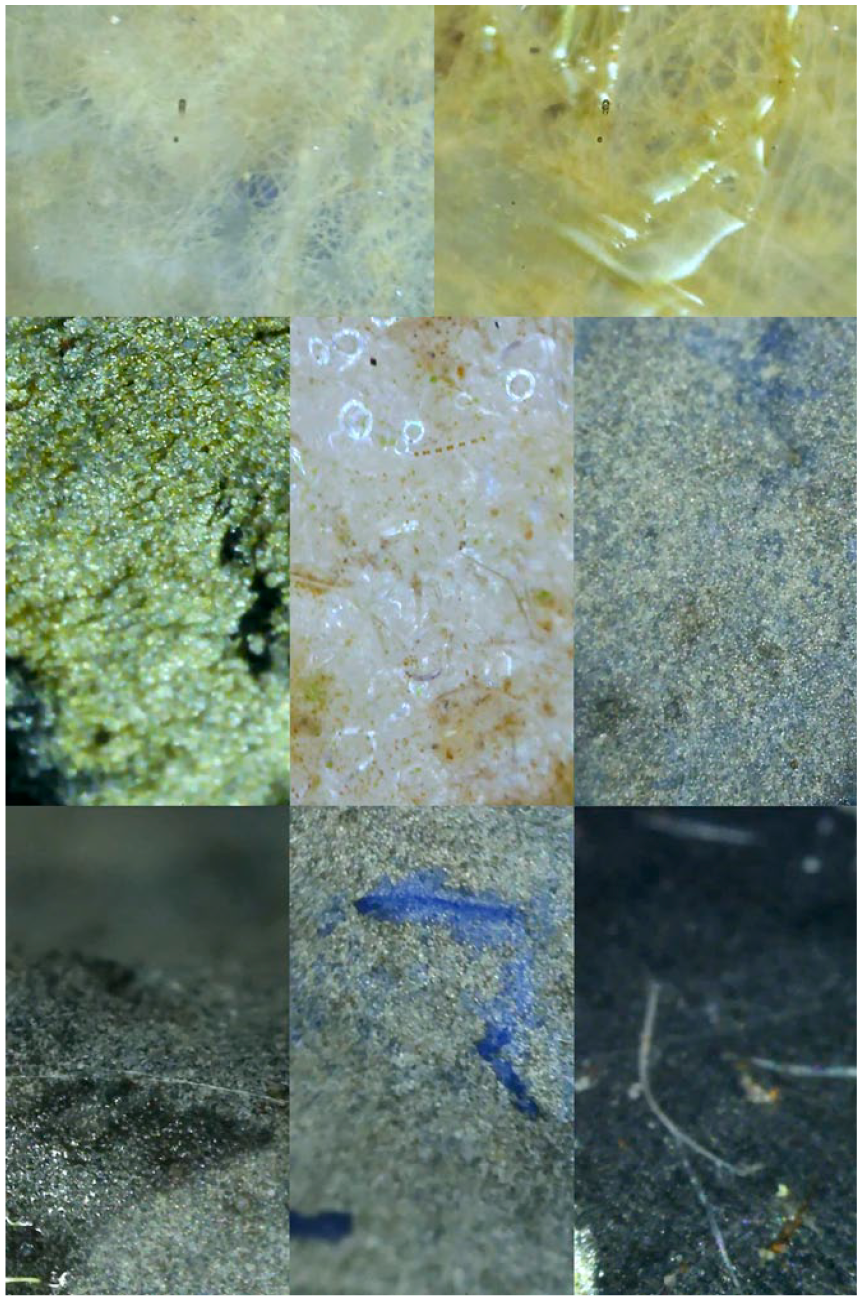
Focused micrographs of microbial colonisation substrates in the Old Ford Lock. Image by Author.
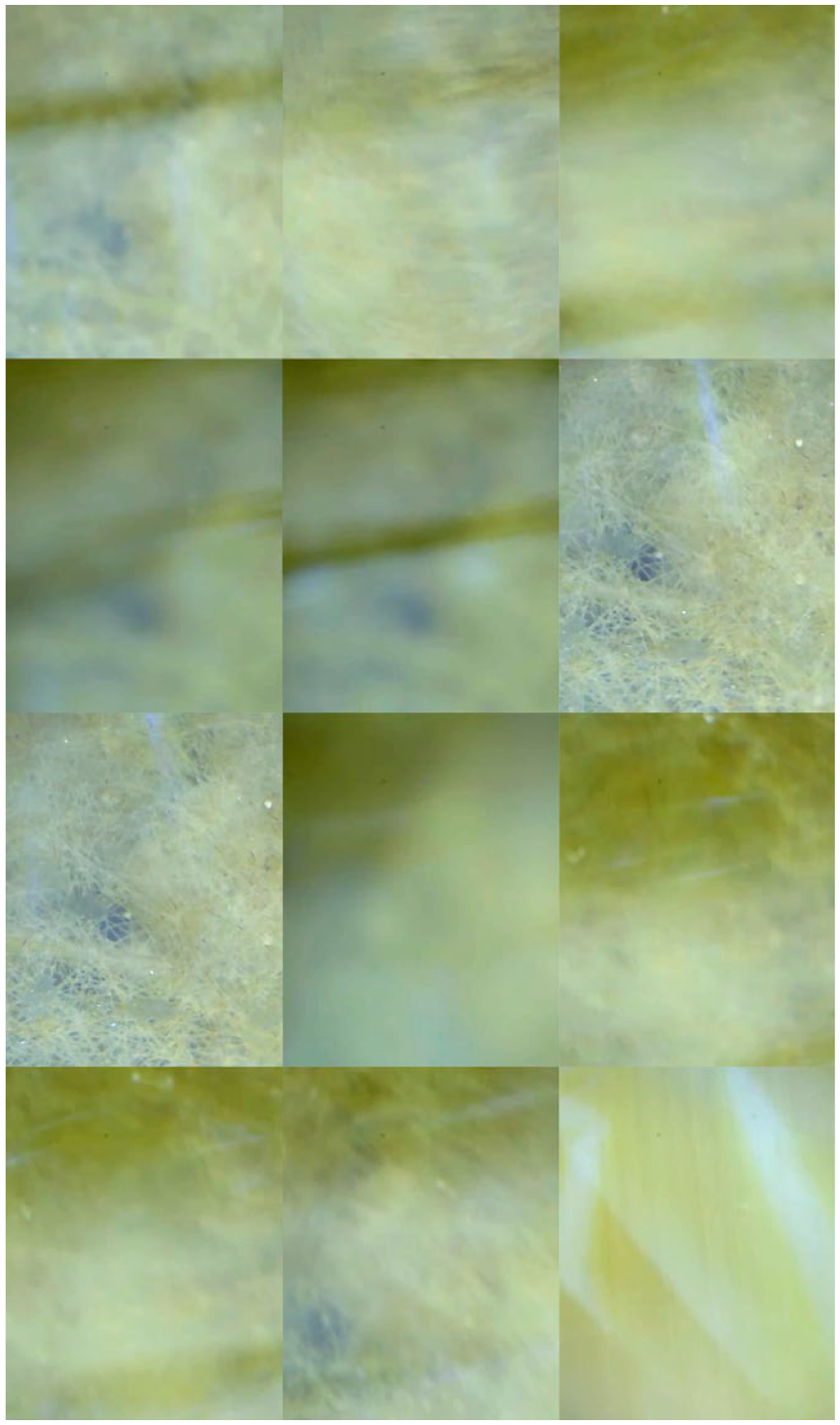
Sequence of video frames from in situ video-micrographic recordings of microbial colonisation substrates (face mask). Image by author.
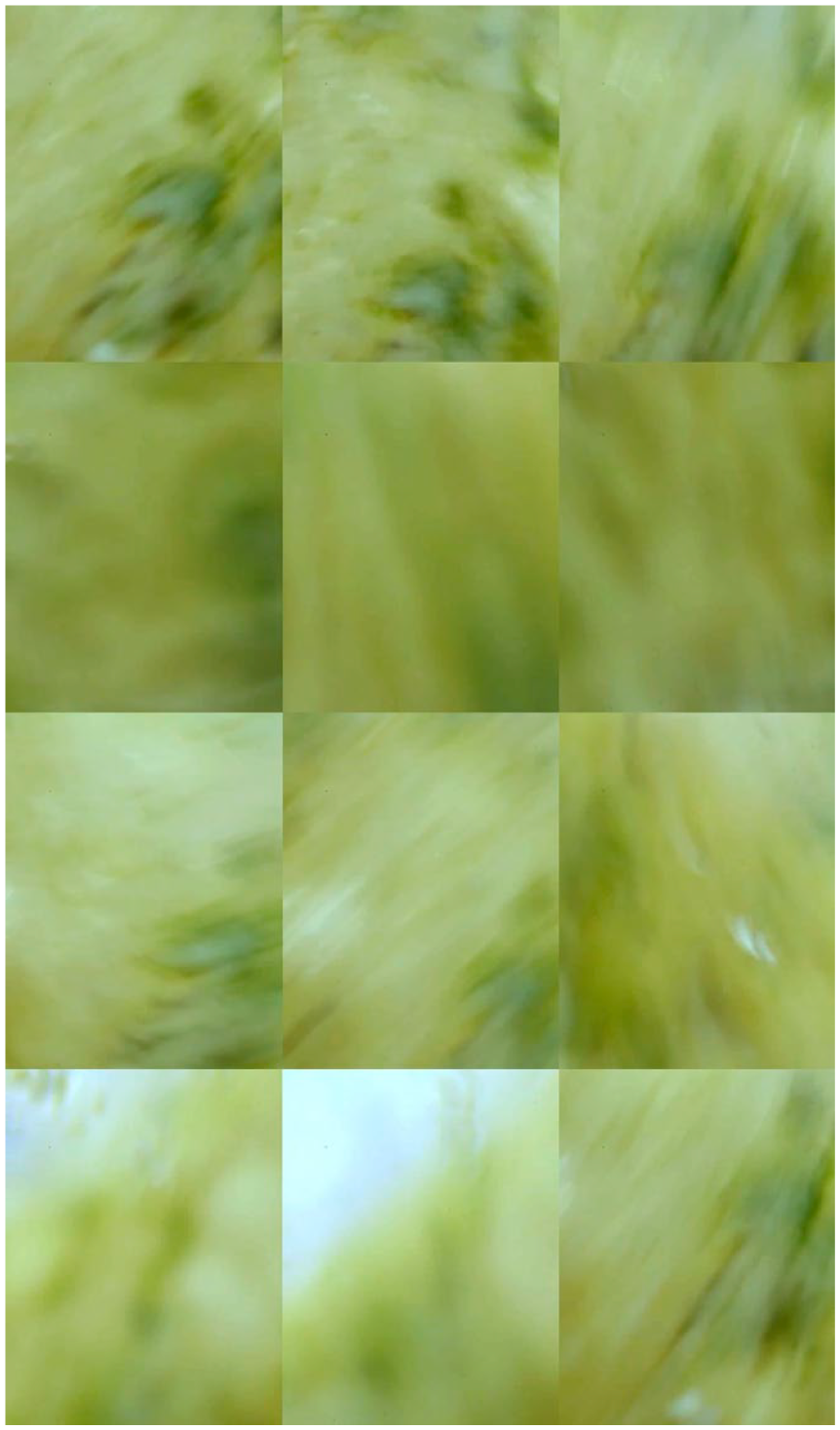
Sequence of video frames from in situ video-micrographic recordings of microbial colonisation substrates (polystyrene). Image by author.
This in situ microscopic method broadened my sensory capacities for attuning to the microscalar dimensions of urban microbial communities. Its execution took shape through a series of feedback between my visual and proprioceptive senses and through which my body was intimately connected with the function of the microscope. The microscope served as a digital ‘prostheses’ that extended my ordinary, unaided corporeality. The output of the practice was the visualisation of heterogenous and diverse relationships between microorganisms, anthropogenic waste, and physical forces. In facilitating sensitivity to a microbial liveliness that is withdrawn from everyday human perception, these aesthetic and sensory experiments also suggest that cultural imaginaries of nature that are increasingly framing abandoned and polluted zones as biotically valuable sites, might also be extended to their readily overlooked microbial communities.
Historical satellite imagery
Moving beyond the microtopographic minutia of their colonisation substrates, I next investigated the larger-scale dynamics of microbial life in the River Lea. I began exploring historical satellite data of the Old Ford Lock obtained from the Google Earth platform. For 2022 there was nearly monthly imagery, but a 14-year gap between 1985 and 1999, demonstrating how this method was both enabled and limited by digital developments. In the earliest image, taken in 1945, a faint glimmer of the lock can be seen, a black and white echo of its industrial past. This infrastructural shadow is followed by a wealth of activity over the intervening years reflecting ongoing post-industrialisation in the River Lea, from the routine mooring of hoppers to the erection of an apartment building on the West side of the Lock between 2018 and 2021. Reminiscent of the distorted images collected during my experiments ‘on the ground’, the satellite imagery was sometimes obscured by clouds, weather conditions and digital artefacts. The visual attributes of the ecological system snapped into view only idiosyncratically and unpredictably, problematising systematic data collection and interpretation (see Figure 5).
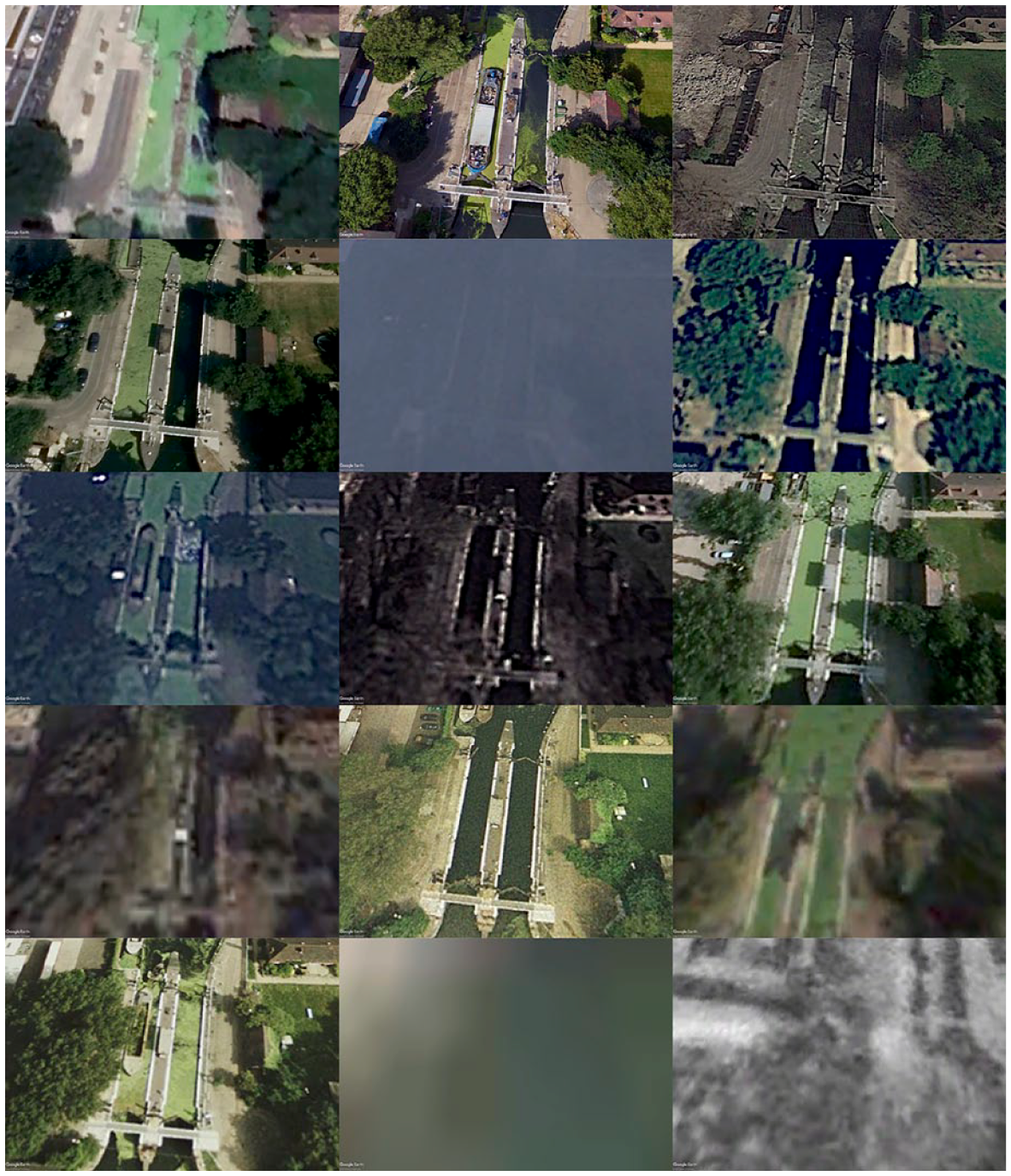
Composite of historical satellite data of Old Ford Lock. The image at the lower right was captured in 1945. Images from Google, 2023 Maxar Technologies and adapted by author.
At different points in time, green blankets appear covering the surface of the lock. These temporary blooms of algae, duckweed and other hydrophytes reflect the dynamic responses of microbial ecologies to local conditions. These points of explosive growth were often confined to the disused and thus more hydrologically sedate west side of the lock. This state of semi-stagnation allows the lock to integrate upstream water coming from a rural-urban catchment of over 1,000 km2 that is populated by around 2 million people. Here, the transient microbial ecosystems are registering, responding to, and transforming various forms of pollution gathered from sewer overflow and agri-urban runoff: fertilisers, heavy metals, microplastics, antimicrobials.
The satellite imagery provides a distinct view of the lock’s microbial communities and enables resolution of bacterial temporal dynamics over timespans (decades) that can become blurry for human perception. Spatially, these images pinpoint proximal changes in the local landscape that also characterise the lock’s repurposing as a temporary docking site for construction waste. The River Lea has undergone extensive changes over the last hundred years. From the late 1800s to the early 1900s it was transformed from a bustling logistical network at the heart of West Ham’s industrialisation to an overdeveloped, silty and contaminated river. 9 With the development of the railroad, the position of the Lea as an economically valuable transportation infrastructure diminished, but contemporary times are seeing new waves of development, most notably London’s Olympic Park, which is nestled between the Lea’s back rivers. The Lea is now a prime site for uneven development, underpinned by economic speculation and green gentrification.
The flourishing of microbial ecologies in this site emerges from a specific spatiotemporal constellation of urbanisation, pollution, infrastructural disuse and (post)industrialisation. These communities repurpose the lock for their own open-ended becomings, manifesting as a distinctly post-industrial recombinant urban ecology. But the Old Ford Lock fell out of use as a navigable conduit long before satellite imagery caught up. Its resident microbial ecology may be rendered visible by this digital approach, but the possibility for its emergence as a distinct ecology predates the development of that technology. Obscured by these images are the patterns of industrial logistics antecedent to the lock’s disuse, but whose chemical legacies linger on in the riverine sediments and continue to influence microbial ecological formations. In this recombinant ecosystem, microbial communities interface with the unintended effluent of successive social formations, and do so in spite of human plans, intentions and observation.
Concluding thoughts
As digital ecologies continue to document and examine more-than-human meetings and relations, 10 it is important to remember that the vast majority of encounters amongst the microcosmos continue to occur in our absence. 11 This inaccessibility is as much ontological as it is epistemological: the widening reach of our technological mediations are no match for the diversifying metabolism, lateral genetic transfer and transient symbioses that are business as usual for microbial communities, and which proliferate in urban contexts. The digital microscopic and satellite techniques used here approached urban microbial communities not with the aim of achieving epistemological certainty, but to sense, notice, tune in and ‘resonate’ with that microbial withdrawnness.
Cultural imaginaries of microbial life are currently in a state of profound flux, characterised by ‘antiseptic’ mentalities on the one hand, and ‘probiotic’ ones on the other, a situation further complicated by the covid-19 pandemic. Yet, the value of engaging with microorganisms goes beyond their direct effects on human health, and different cultures of socio-microbial relations extend to important environmental and ecological questions. 12 The methods deployed here shed light on how urban sociocultural organisation and its historical contexts facilitate the emergence of specific ecological formations. By practicing new approaches to tune into these ecologies, this work is also an early step in foregrounding how we value, relate to and understand the plurality of urban microbes. Human and microbial lives are connected in important ways in the urban realm and digital technologies and methods provide a strong opportunity for engaging with their ecological diversity, even in its most uncharismatic, unglamorous and recalcitrant forms.
Footnotes
Acknowledgements
I would like to thank Sammi Lynch for helping me to create the montage images. Also, a particularly big thank you to the Digital Ecologies in Practice Special Collection editors, who provided great feedback and stuck with me on this.
Funding
The author disclosed receipt of the following financial support for the research, authorship, and/or publication of this article: This research was supported by the Berlin University Alliance exploration project ‘Re-Scaling Global Health. Human Health and Multispecies Cohabitation on an Urban Planet’ funded by the Federal Ministry of Education and Research (BMBF) and the state of Berlin as part of the German Excellence Strategy.
