




Abstract
Clean air is vital to bodily, social, and planetary wellbeing. This article develops the concept of ‘atmospheric wellbeing’ as a framework for investigating the more-than-human dynamics of air through its affective and sensory qualities. Engaging the new field of critical air studies, the authors explore creative and multisensory social research methods which register the uneven distributions of air quality and the relationships between atmospheric sensing, feeling, and political action. This emerging approach offers new avenues for air quality research and seeds future-focused ideas for understanding and enhancing atmospheric wellbeing through creative means.
Keywords
Introduction
Humans and other living creatures are currently facing a clean air crisis, with contaminated air – both indoors and outdoors – presenting an urgent problem of social and planetary justice. Just as all people have ‘a right to breathe’ (Mbembe, 2021), so too do all living organisms that respire (plants and fungi as well as animals) and depend on the exchange of atmospheric gases for energy and growth. However, we do not all breathe the same air, and not all bodies are afforded the same opportunities to respire. Access to clean air and how freely a body can achieve respiration is unevenly distributed through intersectional structures of oppression and privilege (Ahuja, 2015), with air toxicity further entrenching structural patterns of disadvantage across stratifications of species, class, race, gender, sexuality, disability, and political status (Brown et al., 2020). Lower income neighbourhoods often face the health effects of mould and damp problems (Coulburn & Miller, 2022), as well as hazardous pollutant emissions from proximity to busy roads (Zosky et al., 2021) or factories that emit toxic chemicals (Gunn et al., 2017). Bodies exposed to airborne chemicals or pathogens in the course of their work are also at greater risk (Broom et al., 2022; Kelly & Fussell, 2019; Wilson et al., 2020; World Health Organization, 2023).
In all of these cases, nonhuman pathogens and pollutants which are largely indetectable to the human senses become crucial vectors within atmospheric infrastructures of intersectional oppression and toxicity (Berlant, 2016). These complex and confounding factors have made the ‘chemosphere’ a politically and affectively charged space (Shapiro, 2015), with disputes over the alleviation of airborne chemical hazards involving continuing struggles between wealthy fossil fuel and Big Tech corporations, government leaders, scientists, medical and public health professionals, researchers, activists, and community members (Braidotti, 2020; Brown et al., 2020; Kelly & Fussell, 2019). There is therefore an important environmental justice as well as a social justice dimension to acknowledging the inseparability of bodies from the air they breathe and share with other creatures (Kenis & Loopmans, 2022; Liboiron et al., 2018; Stein & Luna, 2021).
A major difficulty in taking action on improving air quality is the invisibility of many of the hazards. Emerging technologies are becoming part of human efforts to monitor, visualise and sense air quality, attempting to complement or enhance human sensory capacities. Sensors, mobile apps and algorithmic systems are now used ubiquitously to monitor the air (Gabrys, 2019, 2020). The recent expansion of large language models (LLMs) and generative AI tools have inspired ideas about how this technology might contribute to better sensing and data-driven decision making related to air quality, including monitoring air pollution in real time (Olawade et al., 2024). However, combining generative AI with digital sensors to produce more detailed information about atmospheric elements of the more-than-human world brings with it new risks. Data training, storage and processing involved in the use of these tools have significant material impacts on planetary health due to e-waste as well as energy and water requirements (Frazzoli et al., 2022; Stokel-Walker, 2023; Thirunavukarasu et al., 2023). 1
This article contributes to international efforts across the critical (post)humanities and social sciences to assemble new frameworks for studying the more-than-human dynamics of health and wellbeing through the element of air, while attending to the specificities of how these frameworks are creatively mobilised and adapted in local places. Our approach follows Andrews and Duff (2019) in viewing wellbeing as a ‘vital emergence’: a dynamic embodied and affective enactment between people and other creatures, non-organic things, places and spaces with which they share their lives. Drawing on recent (re)turns to ancient conceptions of elemental matter in feminist new materialisms (Grosz, 2017), we construct a theory of ‘atmospheric wellbeing’ which offers an affective and sensorially embodied framing for investigating complex relationships between diversely situated bodies and the air they breathe. While offering many exciting possibilities, this kind of ‘aerographic’ approach (Brown et al., 2020) has yet to be fully scoped and developed in social inquiry on human and planetary health.
In what follows, we map a series of conceptual developments in more-than-human theory, affect studies, and the interdisciplinary field of critical air studies which provide an emerging platform for this work. This leads to a critical engagement with planetary health as a framework that has gathered steam in recent years. We then propose atmospheric wellbeing as a complementary concept which situates planetary concerns and actions on air quality within the affective and sensory atmospheres of local places and communities. To illustrate this concept, we offer an example of children’s engagement with atmospheric wellbeing in an urban parkland in the city of Manchester, UK. Our conclusion draws from this creative rendering of atmospheric wellbeing as elaborated by children in their local places, offering a series of propositions for researchers and policymakers to consider in addressing the clean air crisis from a more-than-human perspective.
Entangled Atmospheres
More-than-human perspectives on kinship have been in existence for millennia across global cultures as ways of situating human life within the cosmos through relational understandings of health and wellbeing (Chandler & Reid, 2019; Kimmerer, 2013; Plumwood, 2002). These relational perspectives remain central to the cosmologies of First Nations peoples (Bawaka Country et al., 2016; Hernandez et al., 2020) as well as many ancient and contemporary cultures of the Global South (de Sousa Santos, 2016, 2018) and Global East (Satsuka, 2018). Within these cosmologies and lifeways, human health and wellbeing is inextricable from nonhuman ecologies which include other animals and living things as well as elemental formations such as the atmosphere, climate conditions, geological strata, and bodies of water. Human-built environments and technologies have also been included in more-than-human kinship circles which are recognised as sources of nourishment and health (Lewis et al., 2018). This relationality is viewed as source of knowledge (how the world is known) and an expression of the vitalities that animate bodies, supporting and nourishing life (Hernández et al., 2020; Tynan, 2021). These relational perspectives acknowledge that people can never be independent and autonomous from other living creatures and from the elemental dimensions of the Earth: the sky, the wind, rain, sun and snow, the earth, the solar system, the seas and waterways, rocks and mountains.
When viewed from a relational standpoint, it can be difficult to say with any certainty where a body begins and ends. The body takes on an atmospheric and distributed presence that is porous and open to the world rather than closed in on itself. Air performs a crucial role in relational body-environment configurations as a series of entangled connections between microbial flora, chemical compounds, precipitation, and other particulate matter. These body-environment relationships involve metabolic dependencies on shared infrastructures such as clean air, drinkable water, and nourishing food. And yet these entangled dependencies are unstable, constantly changing through time and space as bodies drift together and apart under shifting atmospheric conditions. It is in understanding how these entanglements of bodies come together and what agencies and capacities for learning and transformation are generated through these assemblages that a more-than-human approach offers a way forward in addressing the clean air crisis (Rousell & Cutter-Mackenzie-Knowles, 2022).
As Abram (2021, p. 51) points out, all things are part of a ‘breathing cosmos’, but the needs of other living organisms for clean air are often subsumed under the human-centric focus that pervades the cultures of the Global North (see also de Sousa Santos, 2018). Acknowledging the entanglements of body and environment through the sensory and affective dynamics of air, the concept of atmospheric wellbeing positions air not as something that exists ephemerally (and neutrally) ‘out there’, but as something material and tangible, political and agentic, situated and embodied, with the capacity to touch and transform. This concept hinges on the plural significations of ‘atmosphere’ as simultaneously a site of meteorological envelopment and socio-affective circulation (McCormack, 2014, 2018). The former refers to the envelope of gases that surround the planet and combine with a vast spectrum of chemical and organic pollutants to produce highly specific material conditions for respiration (Brown et al., 2020). The latter refers to ‘atmosphere’ as used in common parlance to denote a ‘vibe’ but also in cultural theory to describe the composition and transmission of an affective quality: an aesthetic mood, feeling, character, or tone that inheres to particular places and times of encounter (Berlant, 2017, 2019).
There is now an established literature on affective atmosphere as a felt sense that coalesces, lingers, circulates, or disperses as bodies migrate and gather in time and space (Anderson, 2009; Hohti et al., 2023). This includes recent scholarship focused on identifying the affective atmospheres generated with and through the use of digital platforms designed for human health and wellbeing (De Freitas & Rousell, 2021; Downing et al., 2021; Lupton, 2017b, 2018, 2021; Tucker & Goodings, 2017). Bringing the second meaning of atmospheres into contact with this literature, the question arises of how air operates as an elemental medium through which bodily affects, sense perceptions, and digital computations intertwine and generate new connections and capacities to act.
This article takes up this question by introducing ‘atmospheric wellbeing’ as a concept for exploring how bodies sense and respond affectively to the vital materialities of air and its elemental agency in sustaining bodily, social, and planetary wellbeing. By drawing attention to the elemental qualities of air as a medium of bodily contact, circulation, and exchange, atmospheric wellbeing offers an expanded framework for understanding the more-than-human complexities of structural inequalities and injustices transmitted through air (Mbembe, 2021). The following section considers how ancient understandings of air as elemental matter offer important precursors to atmospheric wellbeing, while also engaging with contemporary permutations of this work in the emerging interdisciplinary field of critical air studies.
Attuning to Atmospheres Through Critical Air Studies
Air, together with fire, water and earth, is one of the four elemental forms of matter recognised in cultures across the world since ancient times. First Nations cosmologies have long emphasised the distributed agencies of elemental matter as the basis for more-than-human ‘manifestings’ of kinships (Hernández et al., 2020), health and wellbeing (Redvers et al., 2020), and relations of care and custodianship for the Earth (Tynan, 2021). The Western humoural model of medicine, stemming from the early Greek physicians, also understood the four elements as strongly related to the four humours, requiring balance in the human body as it interacted with the natural environment for good health. Since ancient times, fresh air (especially that found near the sea or at high altitudes) has been viewed as healthier and even as a cure for some lung diseases (including tuberculosis in the nineteenth century) (Hickman, 2022). In the pre-Enlightenment era in Europe the miasma theory of disease positioned foul-smelling air as the source of infection (Classen et al., 2002). Arabic and Chinese models of health and medicine have also treated air as an essential element of human and planetary wellbeing for millennia (Hartnell, 2018).
In current humanities and social inquiry, the field of critical air studies contributes to a broader ‘elemental’ turn which is resituating contemporary knowledge practices according to shared environmental milieus rather than traditional disciplines or social categories. In recent years, feminist new materialist and posthumanist theorists have returned to these ancient metaphysical understandings of the elements to remap contemporary knowledge practices through their ecological milieus (Braidotti, 2020; Grosz, 2017). This has led to a proliferation of new fields such as cultural studies of oceans (DeLoughrey, 2019) and waterways (Giannoulatou et al., 2023; Wooltorton et al., 2022), plants (Marder, 2013), fungi (Tsing, 2015), the microbiome (Greenhough et al., 2020), soil (Krzywoszynska & Marchesi, 2020), and forests (Rousell & Tran, 2024), which are bringing (post)humanities, arts, social and physical sciences into critical conversation through their shared entanglements with the elements of water, earth, air, and fire (Rousell et al., 2024).
Similarly, the field of critical air studies has emerged over the past decade as a distinctive body of work that is generating transdisciplinary encounters between historical, creative, philosophical, sociocultural, scientific, and medical knowledges of air (Engelmann, 2020, 2021, 2023, 2024; Brown et al., 2020; Dutton, 2022; Garnett, 2020). These emerging perspectives do not treat air as a homogeneous entity. Rather, air is considered metaphysical, meteorological, differentially distributed throughout the biosphere, and continuously shaped by the political conditions of daily life for creatures of all kinds (McCormack, 2017). Atmospheric scholarship opens up specific onto-epistemological and axiological questions which are responsive to the elemental matters in which they are immersed and around which they are organised. For instance, questions relating to thermal pressure differentials (McCormack, 2018), influx and efflux (Bennett, 2020), particulate matter and aerotoxicity (Dutton, 2022), citizen sensing (Gabrys, 2022), and First Nations sky rights (Noon & De Napoli, 2022) have emerged as key touchpoints within critical air studies which are distinct from critical studies of hydrological and terrestrial environments. In this way, the questions being asked and research projects being undertaken in critical air studies are driven by specific foci, urgencies, and boundary conditions inherent to the element of air, rather than being driven by constructed social categories or disciplinary fields.
The current emergence of critical air studies provides novel opportunities for researchers to establish new theoretical and methodological frameworks for addressing the intractable problem of poor air quality at planetary scale. Denial of the risks posed by airborne environmental and health hazards continues to be a significant barrier to encouraging governments, organisations, and communities to make changes to improve air quality and mitigate health risks (Haltinner & Sarathchandra, 2018). A major stumbling block hindering the development of public policy to improve air quality is that airborne hazards are often invisible and difficult to discern without technical intervention. Many forms of air pollution are highly detectable by the senses: bushfire smoke haze, cigarette smoke and car exhaust, for example, can be both seen and smelt and even felt on the skin as larger particulates from air pollution settle. But a multitude of other risks carried in the air are not as readily sensible: pollens, mould spores, chemicals, and pathogens are examples of invisible airborne threats.
A recent systematic review by Wang et al. (2020) identifies around 350,000 toxic chemicals which are commonly found in air samples around the world but remain largely undetectable to the human senses. Davies (2022) further argues that the distribution of sensibility and awareness of aerotoxicity is also mediated through intersectional structures of access to knowledge and information. This is confounded by a growing climate of misinformation and disinformation perpetuated by poor or biased news reporting, the affordances of social media and the influence of vested corporate interests in challenging the science around such important topics as pollution, climate change, and public health measures for mitigating the spread and impacts of airborne pathogens such as SARS-CoV-2 (Broom et al., 2022; Fischer, 2019; Haltinner & Sarathchandra, 2018; Lupton et al., 2021).
The field of critical air studies offers alternative angles to addressing these complex problems, particularly in its capacity to bring different sensory modalities, technologies, and knowledge practices together to generate new forms of attunement and response to airborne hazards. Recent critical studies of air are yielding distinctive methodological affordances for sensory experience and experimentation, such as explorations with aerosolar dirigibility (Engelmann & McCormack, 2018), chemical kinship (Balayannis & Garnett, 2020), citizen toolkits for open-air sensing (Gabrys, 2022), or smell walks which map human capacities for sensing aerotoxicity (Xiao et al., 2021).
A number of recent project have taken a community activism approach by equipping people to deploy digital-sensor toolkits to monitor environmental aspects of their region such as air pollution and then make use of these data to fight for climate justice as part of environmental citizenship activities (Gabrys, 2022). One example is the Climatewalk initiative (Climatewalks, 2024), piloted in 16 cities across the world. People are equipped with a portable weather station formatted as a backpack which they can use to monitor micro-climate conditions in their neighbourhoods as they walk or cycle through. These technologies assess climate risk at the neighbourhood scale, identify priority areas for intervention and provide ways to monitor and evaluate community adaptation initiatives that meet the needs of local people.
Engaging critically and reflexively with digital devices and apps that can help to ‘know’ the body and its surrounding environment offers an extension of pre-existing modes of tracking and learning about bodies and ecosystems that have been employed across time to manage and predict health and wellbeing (Lupton & Watson, 2021). In this respect, the use of technical devices to extend the perceptual and pedagogic affordances of atmospheric wellbeing is in congress with First Nations as well as Western process philosophies which understand the nexus of body and environment as the ground of knowledge, health, and political agency (Redvers et al., 2020).
The capacity to sense, feel, and critically engage with the vital differences between qualities of air therefore lies at the heart of contemporary methodological discussions in critical air studies. Engelmann and McCormack’s (2018) proposal for a ‘sensory ethology’ of air affirms that aerographic relations and dependencies are also ethical and political engagements which can potentially reshape governmental, organisational, and community capacities to act. Varying assemblages of bodies and technical devices for sensing differential qualities of air are central to this affirmative argument, but these assemblages need to be considered zones of experimentation and inquiry rather than prescriptive technical solutions which predetermine action (Coleman, 2017).
Our concept of atmospheric wellbeing resituates the body’s sensorial and affective relations with air within a pedagogy and ethics of care rather than techno-managerial solutionism (Rousell & Tran, 2024). We suggest that affective forces generated with and through sensory engagements with air can inspire public pedagogies that re-orientate understandings of wellbeing in planetary terms (De Freitas & Rousell, 2021). Bringing methods from critical air studies into social research can open vibrant ways for people to creatively express the embodied, sensate dimensions of shifting health states and how these are pedagogically modulated through atmospheric encounters within built and outdoor environments.
Atmospheric Wellbeing and Planetary Health
As a concept for orientating methodological work, atmospheric wellbeing incorporates insights from planetary health with that of critical air studies to recognise the crucial intersections between the two fields of inquiry. As Gabrys (2020) notes, the wider public consideration of health and wellbeing as a collective, planetary endeavour has developed over many years through ongoing struggles around the politics of public health. Planetary health is now an established discipline and methodological paradigm which combines various dimensions of medical, social, public, geographical and environmental research into an expanded, multi-disciplinary field (Hinchliffe et al., 2021). There is also a move towards the development of a planetary health humanities, incorporating the arts, philosophy, history, and literature into the planetary health perspective (Lewis, 2021).
In recent years, digital devices and apps have become key agents in how the interventional politics of planetary health are being played out through the digitisation and datafication of human bodies (Lupton et al., 2022). These critical insights have wider implications for understanding how diverse publics and communities make use of digital technologies to modulate physical, social, and environmental health in everyday life contexts: including how they ‘feel’ or ‘sense’ the quality of the air through which they are moving (Moretti, 2021). When people are making sense of data about their bodies through engagements with digital technologies, they often consider a variety of bodily and nonhuman factors in the moment when these data are gathered. For example, people who self-track their bicycle rides using digital devices are always moving through environments that are populated with other human and nonhuman bodies as well as elements of built and natural environments. They are dealing with fluctuating weather conditions – wind, hot sun, rain, snow – which affect the biometrics generated by the digital monitoring devices. Air temperature, flows and quality are crucial to the cycling experience (Lupton et al., 2018). In this example, the digital data which are often the focus of health interventions only form one element of a far more distributed pedagogy of more-than-human knowledge and sense-making that people assemble when monitoring and enhancing their wellbeing (Lupton, 2019a).
The concept of atmospheric wellbeing offers a way of describing and orienting toward these more elemental place-based pedagogies and expressions of bodily experience. From the perspective of atmospheric wellbeing, the data generated with and through people’s use of digital devices for self-monitoring are seen as lively, environmentally distributed, and atmospheric in nature (De Freitas & Rousell, 2021). These atmospheric dynamics are always changing, responding to the shifting vicissitudes of body-environment relations and reassembling with other data modes with varying degrees of proximity to the body itself (Lupton, 2017a, 2019b; Lupton et al., 2022). An atmospheric wellbeing approach acknowledges that people ‘feel their data’ when they are engaging in sense-making about their personal and environmental health, and that multidimensional approaches to collecting and materialising these data can help people learn through these endeavours (Lupton, 2017a; Rousell, 2021).
While these analyses offer important insights into the human embodied and sensory experience of air and the other elements of landscapes, there have been few critical analyses of the role played by digital technologies in contributing to or detracting from planetary wellbeing (Lupton, 2022). This perspective on atmospheric wellbeing can be extended to examine the more-than-human bioethical implications of digital technologies in relation to the atmospheres people inhabit every day (Lupton, 2020) as well as the ways that atmospheres are impacted using these technologies (Butler & Lupton, 2024; Lupton, 2022). In the following section, we describe an example where atmospheric wellbeing offers a nuanced ecological framing for learning about the more-than-human dynamics of air toxicity, sensing, and breathability with local children in an inner urban neighbourhood.
Sensing Place in Hulme Park
In 2017, the first author established Local Alternatives as a collaborative, interdisciplinary research platform for seeding community-based research projects exploring how cities are adapting to climate change, biodiversity loss, and the urgencies of decolonisation. The platform has since generated more than fifteen distinctive projects in eight cities around the world. Each project has been guided and framed by community experiences and orientations toward critical issues of social and environmental justice in public spaces such as urban parklands, streetscapes, community spaces, and museums (see https://www.localalternatives.org).
One of the first collaborative projects, Sensing Place (2017–18), involved working with local children at a community arts centre in the urban neighbourhood of Hulme in Manchester, UK. The centre has provided free, multi-arts educational experiences for children in the community for over 30 years and continues to be a hub for cultural expression, activism, and social solidarity within the neighbourhood. Hulme is a diverse community with a rich history of Afro-Caribbean and South Asian migration and many waves of urban demolition, government housing experiments, and more recently, gentrification following the development of a new university campus where author 1 was based as a postdoctoral fellow (Rousell et al., 2022).
In Sensing Place, children (aged 10–12) developed a series of art-based experimentations with sensing the atmospheric dynamics of a small grove of trees in Hulme Park, just across the street from the community arts centre and nearby the government school which many of them attended. The project involved the creative use of biometric and environmental sensors to generate data that children could use to expand their atmospheric perceptions and understandings of local places. Fieldwork took place during a heat wave in the summer of 2018, which turned out to be the hottest summer ever recorded in UK history. The air was saturated with smoke and ash which had drifted into the city from regional forest fires, and the particulate matter sensors the children had brought along were constantly beeping to indicate unsafe air. Nonetheless, the project continued with a series of weekly experiments exploring the atmospheric wellbeing of Hulme park through a range of sensory methods, such as listening to the trees through sensitive microphones; hanging ribbons to sense the atmospheric flows of wind; drawing felt sensations of place while wearing electro-dermal skin sensors; making air pollution maps by walking with sensors; using poetry to score the atmospheric dynamics of place; and creating an ecological artwork using fabrics and donated food from local charity shops (Figure 1). Montage of Imagery From Author 1’s Creative Experiments With Children in Sensing Place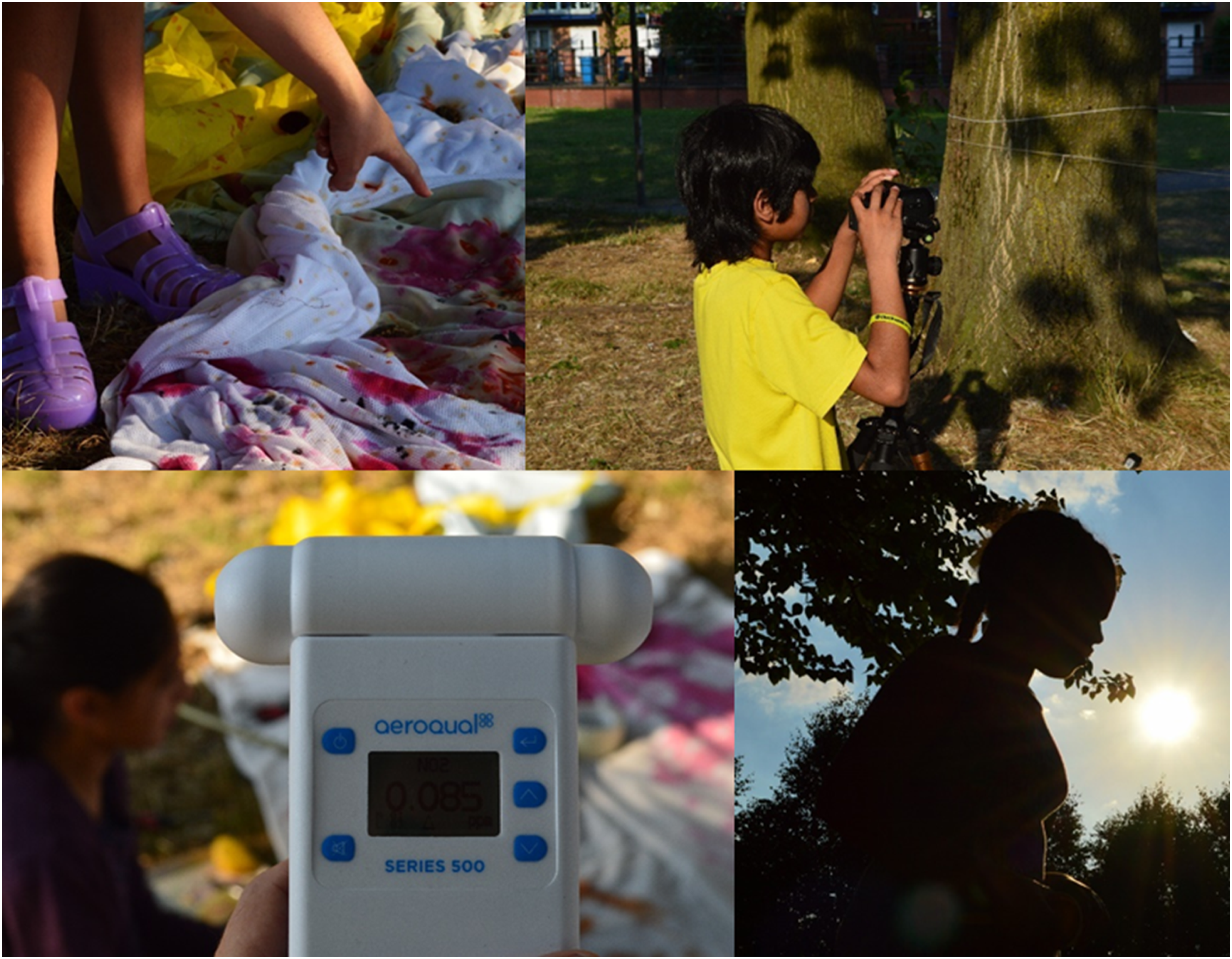
The use of ‘poetic scoring’ emerged as a new method while exploring children’s sense of atmospheric wellbeing. This method involved writing short phrases and sentences that evoked the atmospheric sense of what we experienced during each fieldwork event in Hulme Park. The turn to poetics enabled children to contribute their own felt sense of atmospheric wellbeing, including their affective responses, into a shared writing and making process. Some of the atmospheric affordances of poetic scoring include its capacity to enable words and phrases to ‘breathe’ through spatial relationships that are dispersed, fragmentary, non-linear, and multi-perspectival. The poetic scoring of events works to break up linear narratives and agent-centred description, evoking a distributed sense of agency that is not reducible to any one perspective or body. These writing and making experiments were documented on the Local Alternatives website using a mix of photographic imagery and poetic scoring co-created with children: https://www.localalternatives.org/place. A re-edited version of the poetic score is offered below. each week we return to this little grove of trees on a little hill in Hulme Park at first we thought the trees were all the same species but as we return again and again through different seasons we notice they are multispecies of ash and oak maple and beech as we cross Stretford Road the pollution sensor sets off its alarm for toxic gases and particulate matter but then it stops when we enter the grove of trees it’s as if Hulme Park is an island of wellbeing and all the roads surrounding it are invisible rivers of pollution today’s the hottest day ever on record we can smell the drift of forest fires smoke and ash from distant events we wire up the trees with sensors sticky cameras and microphones a meshwork of string we can play this tiny forest like an instrument or perhaps we’re just part of its orchestra? the alarm beeps on our pollution sensor again triggered by the invisible drift of the day our sense of atmospheric wellbeing is characterised by this drift an invisible nexus of currents and flows always so much more than what we can see, hear, taste, or smell today we gather used fabrics from local charity shops imbued with people’s lives and sensations saturated with the feelings of Hulme we lay them down beneath the trees and play with different mixtures organic colours and textures from donated foods composting new and strange consistencies an edible landscape an atmosphere you can metabolise and digest
This poetic vignette offers an illustration of mulitsensory methods for exploring children’s relationships with atmospheric wellbeing in local places, building on and contributing to work at the intersect of childhood studies and more-than-human geographies (Banerjee & Blaise, 2013; Kraftl, 2020). By working creatively with children to explore atmospheric wellbeing through a combination of air sensing technologies, creative writing, cameras and microphones, reclaimed foods, and found materials, our example shows how atmospheric modes of attunement can become powerful techniques for engaging and learning about more-than-human wellbeing. With this poetic reformulation of the children’s sensory and affective responses to the creative activity, we have highlighted how materialities of living matter, place, and time come together with human bodies in developing a more-than-human sensing assemblage that can help people to discover the ways that toxic air affects not only their own bodies, but that of other living creatures and environments.
Conclusion
Drawing on emerging transdisciplinary perspectives in critical air studies, this article has introduced ‘atmospheric wellbeing’ as both a concept and method for attuning to the nexus of air toxicity, planetary health, and more-than-human wellbeing. We have contextualised this development in relation to First Nations, non-Western and pre-Enlightenment Western cosmologies which have long emphasised the vibrancies and distributed agencies of elemental matter (Grosz, 2017), including through more-than-human ‘manifestings’ of kinships (Hernández et al., 2020) and intergenerational custodianship of planetary and local ecosystems (Tynan, 2021). We have outlined an alternative approach to addressing the planetary crisis of aerotoxicity. We have shown how the affective forces generated through multisensory engagements with air can inspire pedagogies that open capacities for new ways of thinking and responding to this critical challenge. This has been exemplified through a range of methods which bring the bodily senses together with digital sensing technologies to generate place-based modes of critical inquiry, creative experimentation, and poetic expression.
We propose that further critical social and cultural inquiry building on this theoretical standpoint and bringing in creative modes of sensing can begin to discern how human bodies become attuned to the vital and vibrant relationships that animate their interdependencies with air. Bringing these methods into social research on health and wellbeing can open vibrant ways to creatively express the embodied, sensorial dimensions of wellbeing and how these are entangled with the largely invisible atmospherics of breathable or toxic air. Such approaches can contribute to enhanced ways to discern the entangled dependencies that generate the ‘vital emergence’ (Andrews & Duff, 2019) of wellbeing. They bridge a vibrant sensory methodology and pedagogy into a complex assemblage of more-than-human bodies, places, forces, and feelings of atmospheric wellbeing. By offering new ways of rendering the intangibility of atmospheric phenomena, multisensory experiments and materialisations have the potential to deepen human awareness and connection with the elemental matter(s) of air and inspire action to achieve better social and environmental justice.
Footnotes

Funding
The authors disclosed receipt of the following financial support for the research, authorship, and/or publication of this article: Lupton’s contribution to this article was funded by the Australian Research Council Centre of Excellence for Automated Decision-Making and Society (grant ID CE200100005).
Declaration of conflicting interests
The authors declared no potential conflicts of interest with respect to the research, authorship, and/or publication of this article.