




Abstract
This article extends understanding of the underground city and the workings of the urban backstage through a critical analysis of water infrastructure maintenance and repair. It is based on analysis of ethnographic work undertaken with water maintenance operatives on-site at 11 water infrastructure repair jobs between 2015 and 2016 in Bristol, England. In this article, we argue that water infrastructure maintenance and repair constitutes an important but largely unrecognised form of care work. We extend existing conceptual work by arguing that nonhumans can be vital participants within practices of care.
Introduction
Like many in the Global North, we wake on a winter morning to the ever-strange sounds of water moving through domestic radiators. We begin to come to life with a cup of tea or coffee, and then claim full consciousness a little while later after a hot shower. In one way or another, life as we know it is dependent on water infrastructure. Yet for most living in modern Western cities, water infrastructures are a taken-for-granted part of daily life. This article considers the work done ‘backstage’ to keep systems of urban water infrastructure going from the perspective of care. We approach the work of urban water infrastructure maintenance and repair as an assemblage of care, and build on the work of Puig de la Bellacassa 1 to explore the role of the nonhuman within these assemblages. We mobilise this critique to posit the urban backstage (where water infrastructure maintenance and repair largely takes place) as a site in which myriad forms of care take place.
Our article makes two key contributions. First we extend current understandings of the underground city, advancing research on the ‘urban backstage’ by considering the practices of water infrastructure maintenance and repair within these spaces. These systems are both crucial for survival and lie at the foundation of a range of comfort-giving activities (baths, showers, cups of tea) on which the well-being of many depend. Our second contribution is to advance thinking about the concept of care. We argue that maintenance and repair can function as an (often hidden) care practice within the urban backstage, accomplished through different kinds of collaborations with nonhumans. Indeed, building on existing conceptual work we argue that nonhumans are vital participants within infrastructures of care.
In so doing we challenge humanist understandings of care and care practices as activities exclusive to humans, and extend understanding about the urban backstage as an entanglement of caring bodies. By ‘thinking with care’ in such a way draw attention to its pervasiveness in the make-up of urban infrastructure in the production of healthy bodies. In considering assemblages of infrastructural maintenance and repair, we draw on Maria Puig de la Bellacasa’s speculative project into ‘the meanings of care for knowing and thinking with more than human worlds . . .’. 2 Moreover, our interpretation of urban water infrastructural activities as care practices draws on and extends advances in Feminist Theory, 3 Ecological Theory 4 and Feminist Science and Technology Studies 5 in which care has been conceptualised in ways beyond its associations with the feminine, private and face-to-face encounters. Following Joan Tronto, we conceptualise care as not limited to feminised, domestic, unpaid or low-paid activities, but instead as both a disposition and practice which permeates social relations. Such a distributed approach challenges reductionist notions of care as exclusively women’s work or (emotional) labour in the service of needy others. After Tronto, we seek to further the process of destabalising the conceptual gender and spatial binisms through which care work often continues to be codified. With Puig de la Bellacasa we build on existing theory by challenging the ontological limits of who (and what) can participate in care relations by drawing attention to the myriad care practices that occur within the urban backstage. Rather than weakening the usefulness of the concept, we argue this wider, speculative form of engagement usefully shows the pervasiveness of (often unrecognised) care in the world. Moreover, our work continues Puig de la Bellacasa’s framing of care where the ‘doing’ – the ‘labors of mundane maintenance and repair’ – is a ‘more than human entanglement’ which, as she argues, ‘requires agency’ (though . . . not necessarily intention)’. 6
Some may resist our referral to invisible and (sometimes) disengaged (or non-emotional) and non-intentional maintenance and repair work as care. But we suggest that positing these relations as care is necessary if we are to thoroughly understand the interdependencies which make up urban life, including the ways in which water ‘users’ are dependent upon the work of more than human infrastructural assemblages.
The article is structured as follows. First, we situate this research in relation to existing scholarship, reviewing literature that takes seriously the ways in which social lives are caught up in mundane and seemingly invisible infrastructures in the urban backstage. We draw specific attention to those scholars who approach the social lives of cities through the lens of water infrastructure. Subsequently we examine the growing body of scholarship on maintenance and repair, considering this scholarship in relation to the concept of care. We then turn to outline our research methods and present our analysis of the maintenance and mending of urban water infrastructure in three parts. The article concludes with a short summary of key contributions and relevance for geographic and urban research.
Infrastructure and the urban backstage
Our interest in infrastructure and desire to think critically about the urban underground is inspired by a cross-disciplinary range of explorations into the urban backstage. 7 These are the unseen, unrecognised or taken-for-granted aspects of urban life that, while commonly lying outside conscious awareness, 8 nevertheless contribute directly to the social and material well-being of urban inhabitants. Amin 9 refers to the urban backstage as things such as of ‘roads, pipes, cables, broadband, [and] code’ which make up contemporary cities. As Graham 10 notes, infrastructures and technical systems such as water, sewer and electricity have been ‘burrowed underground into the dark, dirty and dusty worlds of the subterranean city’. Crucially, it is their apparent invisibility that frames these objects and socio-technical systems as part of a backstage. Invisibility, in this sense, represents more than out of sight but how infrastructures are ‘black boxed’, 11 taken for granted and merged into the background of everyday life.
However, there is now a diverse, cross-disciplinary literature that looks at the ways in which human lives are mediated and affected by seemingly mundane systems of urban infrastructure. Within this body of work, urban political ecologists have examined relations between urban/social processes and nature 12 where infrastructure is understood to be both political and ecological. 13 Part of the broader emergence of the concept of natureculture, this scholarship challenges nature–culture binaries and embeds urban development and programmes of modernisation within environmental and ecological systems. 14 Within this literature, the concept of modernity is framed as a contextual (and precarious) achievement, where modern lives are sustained by a set of technological systems which are always susceptible to disruption. 15
A significant amount of work has focused on the vulnerability and failure of infrastructural systems 16 together with the role of infrastructure in producing uneven and unequal social experiences. 17 Crucial here have been the impacts of privatisation 18 and the bypass strategies that work to separate and segregate society. 19 Reflecting on the ways infrastructural systems ‘determine the character of urban wellbeing and sustainability’, 20 this scholarship has highlighted the tragic effects of failing or inadequate infrastructures. In these cases, the lives of the most vulnerable communities are made manifest via neoliberal and/or revanchist city infrastructural policies that produce and exacerbate social divisions. 21
Of course, there is a politics to infrastructural systems as their ‘construction, maintenance and operation . . . tends to privilege certain more powerful spaces and users over others’. 22 When black boxed and taken for granted, these imbalances are not always evident. However, during moments of failure and disruption – for example, in the case of Flint, Michigan where austerity policies resulted in a contaminated water system 23 – inequalities become more evident. As such, this scholarship argues that rendering components of the urban backstage visible not only works to reveal their importance and centrality to urban life, but also demonstrates how their unequal provision and distribution (differently) shapes social prospects. 24
In a related stream, studies have drawn on anthropological methods to understand the everyday experiences of urban infrastructure. This work has highlighted the fine-grain of urban experience through close attention to relations with socio-technical systems such as drinking water systems, waste management and other forms of infrastructure. 25 This scholarship is interested in ‘how infrastructures are implicated in the human experience of the city’ as well as the role of the (often taken-for-granted) ‘urban backstage’ of cities to set out capacities for life. 26
For instance, Filip de Boek considers how infrastructural failures, an everyday part of life in Kinshasa, punctuate and contribute to urban experience in surprising ways. He notes how a common infrastructural breakdown such as a pothole affords new prospects for gathering (and informal commerce) via mechanisms of deceleration and delay. Here, failed infrastructures facilitate a ‘thickening of publics’ where ‘alternative spheres of social interaction . . . and regimes of knowledge and power’ can emerge. 27 These nuanced examinations and reflections on human engagement with all things infrastructural helps us to understand how human lives are caught up in – and dependent upon – the machinic workings of urban socio-technical systems. Our project contributes to this emerging scholarship by examining instances of maintenance and repair of urban water infrastructures in the UK, revealing practices of care and nurturance within this work.
Maintenance, repair and care
In this section, we explore the relations between maintenance, repair and care. We are particularly interested in refining understandings of how practices such as maintenance and repair can be understood as care practices. Within the context of the urban backstage, research has examined the nature and practices of maintenance and repair. 28 Recognising the instability and ‘flux’ of these systems, 29 infrastructural maintenance practices contribute to systems of order and stability in that they ‘provide things with a level of permanence they do not possess “naturally”’. 30 Those involved with infrastructural maintenance thus contribute to stability and order (or the appearance of order) through regular processes of engagement and tinkering 31 with things. Maintenance workers are thus skilled, improvisational 32 and attentive to material decay and degradation. 33 Often hidden or out of sight, maintenance work is recognised as a crucial part of what ‘keeps infrastructural systems . . . working’. 34
In contrast to the preventive notion of maintenance, repair is generally understood to centre on those moments of failure and disruption when an object or infrastructure breaks down and becomes present-at-hand. 35 However, Henke 36 draws further distinctions where repair as maintenance reflects those practices associated with problem solving and tweaking without major systemic overhaul. In contrast, repair as transformation involves a more comprehensive or structural reordering of relations which may challenge accepted ways of operating. Reflecting on the failure of New Orleans’ flood defenses, Henke draws attention to how decisions to maintain infrastructures and the existing paradigm of flood control were embedded within contextual dependencies and power relations which constrained the possibilities for a much needed transformation of the city’s approach to flood risk. Together this scholarship details some of the labour practices, politics and decision-making associated with infrastructural maintenance and repair and how these activities, while often hidden and out-of-the-way, ‘keep modern societies going’. 37
Within the last few years some scholars have begun to approach the work of infrastructure maintenance and repair through the lens of care, 38 whether this care is provided by public sector workers, entrepreneurs, children or others. Building on more traditional understandings of care and care work as looking after and attentiveness towards vulnerable others, 39 this scholarship has explored how people care for different forms of matter. This move has occurred alongside a more general turn in recent years across a range of disciplines to recognise the pervasive – if often unrecognised – role of care in everyday life more generally. 40 This work is based upon Joan Tronto’s understanding of care as ‘everything that we do to maintain, continue and repair our world so that we can live in it as well as possible . . . that world includes our bodies, ourselves and our environment, all of which we seek to interweave in a complex, life-sustaining web’. 41
Drawing on this wider understanding of care, scholarship has begun to explore infrastructure maintenance and repair as a form of care in the sense that infrastructure needs attention in order to avoid breaking down. Work in this vein includes the exploration of mobile phone repair in Uganda 42 ; the way children care for urban walkways and pavements 43 ; caring for streets through surveying 44 ; how waste is cared for in industrial settings in Chile 45 ; and the practices of caring for signage with the Paris metro. 46 This scholarship has done a good job of showing how the work of looking after infrastructure – including repair and maintenance work – can be viewed as a form of care across a range of different settings. 47 However, the focus here is very much on human activity, and how humans care for different kinds of infrastructure. We seek to extend this scholarship both by expanding analysis from the way humans care for the matter of infrastructure to how humans and nonhumans inter-relate and collaborate within assemblages of care more broadly conceived; as well as by considering the (agentic) role of nonhumans within these assemblages. Thus, our definition of care is based on Tronto’s definition (focused on the activity done to maintain and repair the world), but expanded to include the actions of nonhumans within assemblages of care.
Our approach is informed by conceptual work which, over the last decade, has called for scholarly attention to the vibrancy of matter and the doings of nonhuman actants. 48 Building on Actor Network Theory as developed in Science and Technology Studies by Callon and Latour in the 1980s and falling under the conceptual banner of the New Materialism, this work has sought to extend ontological concern from humans to recognise the agentic power of the more than human forces that make up our world. This scholarship recognises materials as ‘specific, relational, agential, and importantly political’ with the capacity to ‘affect and indeed reframe social processes’. 49 Building on this work and responding specifically to provocations to attend to the role of the more than human within relations of care, 50 we seek to extend understanding of who (and what) can participate in care relations. 51 Through attunement to nonhuman actants within networks of water infrastructure, we build on existing work by exploring how and under what conditions nonhumans become implicated in care relations and the ways in which human participants work with these in order to effect care.
Project background and approach
This article is based on research undertaken for a 3-year research project funded by the UK AHRC’s Connected Communities programme. 52 Several strands of research and collaboration were developed including focus areas on Bristol’s tides, eels, river day-lighting and ‘lost’ rivers and care for urban water infrastructures. This last strand – on infrastructure and care in the city of Bristol – forms the research on which this article is based.
Our research involved building relationships with partner organisations and getting to know the teams by shadowing workers and recording events and practices. The kinds of work we analysed included: community engagement and public liaison (above ground); rubbish removal; sewer maintenance and inspection work; specialist mine-work (all underground) and project management (underground part of the time). Researchers 53 were allowed to accompany operatives to worksites but for health and safety reasons were not allowed to accompany teams underground. Underground work was filmed by operatives via go-pro cameras worn on the body and then viewed and discussed between researchers and operatives. 54
The participants in this study related to water infrastructure in a range of different ways and occupied a range of different social positons. From the perspective of gender, participants in community engagement dealt with the public as a main part of their job (so-viewed as ‘clean work’ requiring people skills) and were all women. In contrast all maintenance workers and managers with whom we worked were men. Across these jobs there were also significant differences in wages. At the low end of the pay scale were the culvert cleaners, paid an average of £16,000/year (compare with average wages for a nursery childcare worker at £10,000–£13,000). So, although low-wage within this sector this work still out-earns feminised caring labour (these workers tended to shift in and out of this sector). Miners served these companies as highly skilled labourers performing dangerous yet highly paid work that, nonetheless, was often irregular as it is often based on temporary contracts and assignments. Managers had the salaries, qualifications and job security typical of engineering-based management professions and were typically deeply embedded within their careers in water infrastructure. For example, one manager with whom we spoke had been designing and building Bristol’s sewers and storm water systems for the past 30 years and was a lead designer on several major projects. As Sewer Rehabilitation Programme Manager, he undertook forward planning regarding the maintenance and upkeep of Bristol’s system as whole. As such he had significant responsibility and highly valued skills including design of sewer liners and robots to assist with sewer cleansing and repair. With his long years of service and position of responsibility he felt significant pride and sense of responsibility for Bristol’s water infrastructure. All participants were white British.
In the course of this work, researchers went along to 11 repair and maintenance jobs across Bristol between October 2015 and April 2016. Each field site visit lasted between 4 and 6 hours during which time researchers asked questions about the work being performed. These conversations were audio and video recorded and reflections were recorded in a field notebook. As noted we also facilitated first-person video by means of head cameras which were worn by maintenance workers when they went underground. This generated over 100 hours of video and audio of workers narrating their activities while undertaking infrastructure repair. This article does not seek to give a full account of every theme to emerge in this data, but instead makes a ‘cut’ through it to explore the maintenance and repair of urban water infrastructure as a care practice, drawing on both a limited number of quotes from study participants and our analysis of observed practices and human–nonhuman interactions.
Relations of care in the maintenance and repair of urban water infrastructure
We will now turn to explore the work of water infrastructure maintenance and repair through the framework of care. We first argue how this form of care work can be proximate yet largely invisible. Secondly, we explore how it is realised thorough the management of material flows. The third section highlights particular forms of more than human caring evident within these contexts.
Proximate yet invisible care
In much of the Global North, cities do not typically stop for the maintenance of urban infrastructure. Instead, this work must fit itself in around the rhythms of city life. Here, we reflect on site observations and fieldwork with a sewer repair team from Wessex Water. On the day we visited (23 March 2016), a team was repairing a section of sewer that had collapsed in the Bristol neighbourhood of Clifton. On the surface, the work looked like a simple building site in the middle of a small road (e.g. safety fencing, a few cabins, a digger). Yet, we quickly noticed that something very interesting was happening underground. Recently, Wessex Water has reintroduced mining 55 as a means of accessing underground pipes through relatively small holes in the street or pavement in order to speed up repair work and minimise disruption to residents and services in the vicinity of sewer infrastructure (which is often co-located with water and telecommunications). Miners are thus often working in sewers that are still partially in use. As such, they are sometimes in direct contact with human waste and other out-flows of domestic water (see Figure 1). Underground (and unseen), operatives are yet close enough to in-home water usage that the water they feel coming from houses is sometimes still warm, as we learned when one operative commented – approvingly – that ‘someone was having a nice hot bath’ nearby based on the hot water that was coming into the sewer in which he was working on a job in the well-heeled neighbourhood of Clifton during one of our field visits. Thus, at any given time in Bristol (as in many places) mending occurs ‘alongside’ showering and bathing, largely unseen yet proximate in distance, and sometimes even ‘right beneath our feet’.
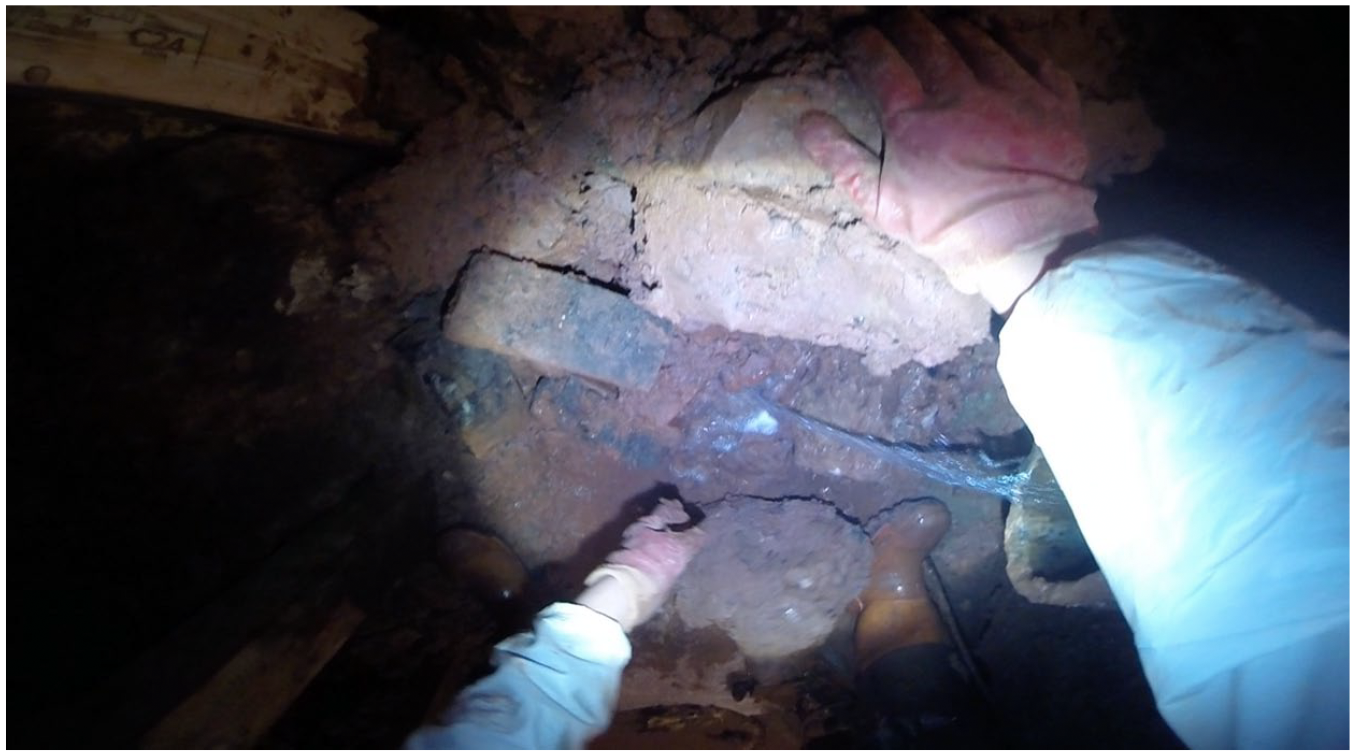
Invisible yet proximate: a miner clearing earth at a broken sewer underneath a street in Clifton, Bristol. Notice the waste water flowing into the tunnel from the pipe on the right. Photo by participant GoPro video capture.
Approached as a relation of care, we suggest that the figure of sewer maintenance workers sharing the warmth of a stranger’s bath makes a provocative image. As end-users 56 we are not generally cognisant of what happens to water after it leaves the home, nor less that there might be a human being there (a possibly startling revelation). Instead, the figure of a repair operative feeling the warmth of bathwater destabalises ‘common-sense’ ideas about the limits of the home; and boundaries between spaces, bodies and practices considered public and those considered private. This vignette suggests an expanded understanding of home-as-assemblage by revealing the vibrancy of the flows which connect homes, and the intimate bodily practices that take place in them, to the broader urban fabric. We suggest that the figure of a repair operative feeling warm bathwater flowing from the domestic water systems (he) is mending both highlights the lack of clear boundaries between ‘homes’ and ‘the urban backstage’ and shows how closely the activities taking place in the latter are linked to intimate forms of bodily care work. While this example draws attention to the shared (if unrecognised) spaces and connections between bather and maintenance worker, it also highlights the ways in which modern urban wastewater systems have been extensively ‘black boxed’. This process of ‘invisibilization’ explains how once innovative and exciting technologies ‘become part of the unconscious backdrop of everyday life’. 57 When infrastructure works properly ‘we often stop seeing it’. 58 For the operative, feeling still-warm bathwater conjures an awareness of the bodily comfort of another. Yet, bather and operative are unseen and unknown to each other. And while they are arguably sharing something quite intimate, the bather is quite unaware of it.
To be clear, we are not arguing that the maintenance worker necessarily cares ‘about’ the bather (in the sense of a disposition). Rather, we position his activities within a wider assemblage of urban water infrastructure that enables wastewater to flow out of the city, thus enabling modern lifestyles and comforts. In this sense we argue that the repair work described here can be understood as care in the form of a doing, an action that results in care. Although proximate, this form of care is largely invisible, indirect and unreciprocated.
We have argued thus far that this vignette suggests how practices of urban water maintenance and repair taking place in the urban backstage function as a form of (proximate yet invisible) caring. Yet, building on this we would like to speak to the point that this activity is not recognised as a form of care, and trace out how disavowing such activities as forms of care fits with broader logics about vulnerability and dependency.
As the critical care literature points out, positing care as a relation of dependence is problematic in that it diminishes the agency of the care-recipient. In this formulation to need care is to be vulnerable, diminished (and potentially stigmatised). As Fine and Glendinning note, ‘in the public realm . . . dependency has been made to appear shameful’, as ‘needy’ bodies are often assumed to reflect some form of individual deficiency or personal failure. 59 In this context, water infrastructure repair (and other kinds of work taking place in the urban backstage) are normally cast as services opposed to practices of care. For example, in the UK, relations between user and provider are transactional as water and sewage services are supplied by the privatised water industry to ‘customers’.
Yet this formulation fails to recognise both the fact that to need care is a ‘normal aspect of human existence’ 60 and that (even self-) care is dependent on networks which connect the body to myriad other human and nonhuman actors and actants beyond the (immediate) space of care. As our example shows, events such as hot baths are possible because of the work of water infrastructure maintenance and repair. However, end-users are not only not made to feel ‘needy’ or dependent on such work, they are generally not even aware of the amalgam of human (and nonhuman) activity on which their water depends. Finally on this point, we suggest that disavowing care relations in the context of water need and dependencies is problematic because water is a fundamental human need and that it shapes how water provision is viewed in particular (often neoliberal) ways. Whereas a mother providing clean water for a child is recognised as an act of care, private water companies performing work that achieves the same goal is cast in the framework of consumption, service provision and exchange. As noted, to be human is to be dependent on others, and the urban backstage is an important space in which some of that dependency takes place. Water provision is a mundane yet crucial aspect of everyday life and in this context we argue that to posit this work as an act of care both recognises the dependencies inherent in all social relations and opens the possibility of a more expansive understanding of care.
Drawing on our fieldwork and experiences of Wessex Water’s sewer repair team, this section has explored the work of urban water repair as proximate yet invisible caring, discussing some of the reasons this activity is not typically viewed as caring work. In the next section, we consider how water maintenance and repair is achieved through the management of flows of both water and other forms of matter.
Caring through managing flows
Water infrastructure maintenance centres on working with myriad forms of matter which get in the way of water flowing where and how it has been designed to. Litter collects in underground rivers (and must be removed to minimise blockages and flooding), a range of materials wind up in pipes, culverts and trash screens which must likewise be removed. Generally, this work of removing out-of-place matter is part of a routine – a rhythm and repetition of looking after water infrastructure via regularly-scheduled maintenance activity. While taking place at a greater distance to service users than the work described in the previous section, we aver that this activity can still be considered as caring work as it both serves to maintain and repair the world as it is known as well as provide a vital resource to the citizenry. 61
In Bristol, this work is undertaken at critical blockage points in the system – both above-ground and below. The image above shows a maintenance worker for the Environment Agency clearing out debris from the River Frome. As is evident from the picture, this portion of the Frome is buried underground (it was channelled and covered over as part of the city’s flood defence schemes). The Environment Agency is responsible for monitoring and maintaining this infrastructure. On this day of fieldwork (20 January 2016), we toured Bristol stopping off at a number of critical infrastructural junctions – points in the underground urban water system where rubbish is known to collect and where regular maintenance checks and cleaning is needed to limit blockages and the potential for flooding. These infrastructure checks take place every 2 weeks and follow a standard route across Bristol. Workers employed by the Environment Agency, earning less (and carrying less social status) than the miners doing repair work for Wessex Water described in the previous example, remove things like rubbish, logs, footballs and shopping trollies from grates in urban rivers (see Figure 2). Although this work serves the important function of keeping river-water moving freely (thus preventing culverts from flooding and damaging nearby homes), it is low-wage, low-prestige work, and we were struck by how workers thus employed spoke freely about this being just one of the (entry-level) jobs they shifted into and out of. 62
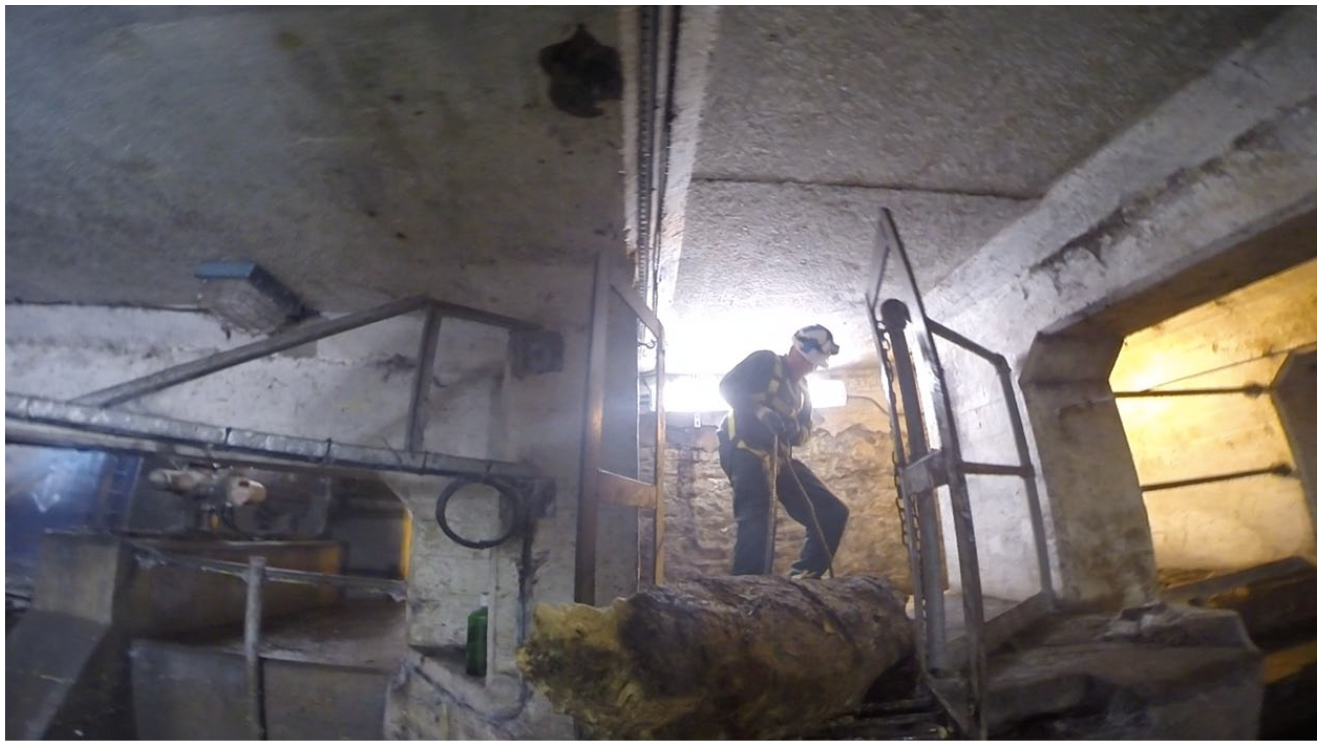
Repetitive, mundane, yet vital maintenance: pulling a log out of the River Frome (underneath Bristol City Centre). Photo by participant GoPro video capture.
Maintaining flow is, of course, critical to the management of urban sewage systems. In order to better understand the process, we spent a day (23 February 2016) at the Avonmouth waste-water treatment facility (run by Wessex Water) on the outskirts of Bristol. It is now well-documented how the build-up of cooking oils and fat in combination with non-decomposable items such as wet wipes likewise poses major challenges for the flow of wastewater. 63 Reflecting on (and lamenting) increased use of disposable wipes (particularly those sold as ‘flushable’), a Wessex Water manager 64 noted: ‘. . .the nation’s culture is changing. We are affecting an asset base that is very old, weakening, vital, but “out of sight, out of mind” . . . but this problem is making it worse’. This comment both echoes the disposition of care towards infrastructure on the part of maintenance workers noted in the literature, as well as a tacit indictment of a citizenry that is insufficiently caring towards the (aging) structures on which it depends. Meanwhile, it also suggests the significant role that matter plays in compromising infrastructural systems. Above ground, oils and wet wipes enable cooking and early infant care (both easily-recognised forms of care work), yet below ground this same matter hinders the smooth passage of waste water and must be manually removed or broken up in work that is – sometimes – shockingly awful. 65 Finally, at the end of the sewage system, there are always ‘the remains’ – those items that have not degraded on the journey from toilet to sewer to treatment plant. At the Avonmouth, Wessex Water has begun to compost these items, rather than send them to a landfill (as is the common practice). As Puig de la Bellacasa 66 notes, composting is the epitome of ‘natureculture interdependency’ – a relational practice of care for the earth that involves both knowledge about soil and processes of decomposition as well as the active involvement of nonhuman collaborators (e.g. microorganisms).
Despite best efforts to cycle waste back in the ecosystem however, some impurities remain (such as non-degradable plastic sticks from cotton buds), that limit some of the Avonmouth waste product to compost-like output (CLO) status and hence, not suitable for agricultural purposes (the CLO is used for land reclamation and power generation in the region). The compost manager narrated this issue thus: ‘this is my biggest bugbear . . . the cotton buds, the sticks, because they’ll go through. These plastic sticks . . . don’t break down’. As we stood with him about 50 yards from the compost, he began to laugh and point ‘I can see it now, you see . . . there’s loads of ‘em. It just annoys me, yes’. 67
In these vignettes we see how the practices involved in the work of water infrastructure maintenance and repair consists in part of managing flows of matter. Indeed some of the operatives that we met who were involved in this work displayed a notably ‘caring disposition’ towards the matter of water infrastructure. 68 Operatives expressed appreciation of both found-artefacts (such as candle wax, clay pipes, pick marks in the rock) and notable sites (e.g. particularly deep tunnels), and a curiosity about the ways material had changed from call to call. The matter of water infrastructure is constantly degrading and part of this work concerns documenting, diagnosing (and remediating) this change. During our observations, this included individual and collective speculation about what might have caused a leak, running tests on equipment such as water pumps, as well as simply narrating processes of decay. When inspecting some of Bristol’s drinking water pipes underneath the River Avon, the Bristol Water team meticulously examined and documented the deteriorating condition of the thousands of bolts holding the tunnel together (see Figure 3). While on the one hand this speculation and diagnosis served to help avoid similar problems from happening in future, talk of this kind also revealed a deep interest in the materials themselves, seemingly ‘for their own sake’, and a desire to understand what various matter had gone through: in other words, caring about infrastructure in itself.
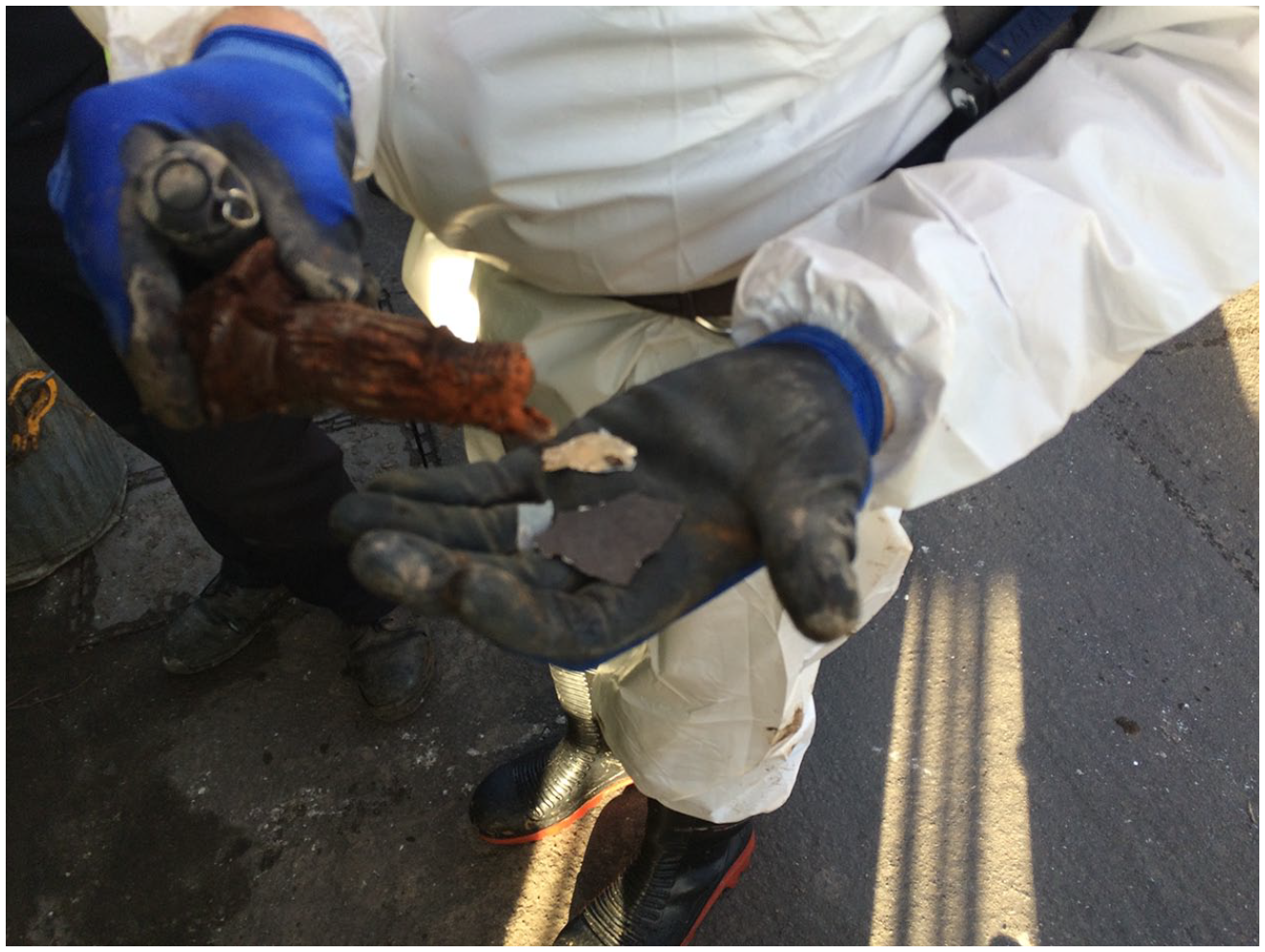
Deterioration: one of the thousands of bolts used to hold the tunnel under the River Avon together. Photo by Antony Lyons
In an even more pointed example of this, Sam, an inspector with Bristol Water, referred to himself as a ‘gold plated engineer’ who felt that the tunnels and underground spaces he inspected should be treated like cherished heirlooms. He later explained, ‘what I’d like is to go in there and make it nice and pretty, it needs TLC, just like a lot of Victorian and 1930s assets’ 69 (emphasis added). As part of a team charged with maintaining the city’s drinking water infrastructure, Sam both expressed a meticulous, almost fussy care for the materials he inspected, and saw his work as central to the health of the wider population. In these expressions we see not only caring for water infrastructure (a doing), but also caring about it (a disposition).
Meanwhile in another register, returning to the sewage treatment plant we also see how objects that play a role in practices of bodily care at one stage (cooking oil, wet wipes, cotton buds) can morph into barriers to efforts to ‘care for the planet’ farther down the line. Wet wipes congeal with cooking fat, faeces and other matter to form diabolical ‘fatbergs’ underground that must be broken up. Non-biodegradable cotton buds slip through sorting devices, rendering a certain amount of matter non-compostable. The management and removal of this matter requires attention, care and time, sometimes eliciting feelings of annoyance and frustration on the part of water maintenance operatives towards users whose (uncaring) actions compromise the system.
This section and the last have explored proximate and distant forms of care work taking place through the management of different kinds of material flows. Together these vignettes show various care practices found within the urban backstage and point to the ways in which care itself can be thought to flow in complex and asymmetrical ways. 70 As we have shown, this care work is realised through different kinds of human–nonhuman interactions and transformations, including matter that is intimately involved in care work ‘upstream’ later becoming a problem that has to be dealt with by water operatives later on. In turn, in the example of the repair of a sewage pipe considered in the first example, the Wessex Water team provides crucial care for Bristol residents. Yet there is no direct, reciprocal exchange of care. Though proximate, sewer work is kept, to the greatest extent possible, out of sight with limited opportunities for connection between carer and cared for. Indeed, the practice of mining, rather than excavation, further reduces the visibility of infrastructure maintenance in urban settings. As we suggest, the ‘invisibalising’ of urban infrastructure repair work serves, in part, to protect service providers from feeling needy. It also helps to maintain existing transactional relations between provider and user, with water as a commodity, rather than something that is essential to life. 71 On this point we have also noted how disavowing these activities as care work supports dominant logics about dependency and vulnerability, and how challenging such formulations enables us to conceptualise care in a more expansive way.
As we have shown, some of the work that goes in to looking after water infrastructuctures in the urban backstage has a caring disposition, and some of it does not. However, we suggest that even practices that do not have a caring disposition (such as pulling rubbish out of rivers) contributes to human and planetary health. As part of wider infrastructural provisioning services, the maintenance of urban water infrastructures are critical aspects of securing healthy cities and healthy publics. The maintenance and repair teams (directly involved in looking after and sustaining physical assets) are part of care assemblages whether they have a caring disposition, feel an emotional connection or not. In the final part of our analysis we will expand conceptions of caring further by considering the role of the nonhuman as caring agents within assemblages of water infrastructure maintenance and repair.
More than human caring in the urban backstage
‘Soil inhabitants and other
We begin this section with a return to Puig de la Bellacasa’s nonhumanist and disruptive engagement with care as ‘everything that is done (rather than everything that “we” do) to maintain, continue and repair “the world”’. 73 As she argues, such an approach pushes at the human and subjective boundaries of Tronto’s definition and allows us to ‘consider the many ways in which nonhuman agencies are taking care of many human and nonhuman needs’. 74 In particular we note that caring in this formulation is not predicated on intent. As noted earlier, the work of maintaining water infrastructure takes place through incessant inter-relations with the more than human. In addition to working alongside bio-matter such as rocks, earth and (especially when working underground) other species (e.g. rats, spiders, worms, etc.), this work involves nearly continuous collaborations with various kinds of non-organic others. In this section we discuss two field visits with Bristol Water and highlight various forms of human-more than human caring we observed in the context of water maintenance and repair. As managers of much of the city’s drinking water, Bristol Water conducts regular inspection, maintenance and repair of reservoirs, pipes, pumps and other infrastructural components. Below, we refer to our field observations from two operations: a reservoir maintenance and inspection (5 February 2016) and a water distribution tunnel inspection and pump repair (9 December 2015).
Within the secondary literature the main form of caring that is discussed in the context of infrastructure maintenance and repair is that of maintenance workers and others caring for different kinds of matter. 75 Yet, following conceptual innovations from the New Materialism and the work of Puig de la Bella Casa we were struck in our research by the work – including caring work – that matter itself does within assemblages of infrastructure maintenance and repair. First, ‘matter’ (of course) played an active role in completing maintenance work itself. In the teams we shadowed rakes, axes, pneumatic drills, high-pressure water jets and other tools broke up earth, cleared pipes and helped operatives haul debris out of rivers.
In addition to this, infrastructure workers were also themselves looked after and kept safe by various kinds of matter. Air quality monitors protected workers’ lungs from noxious gases underground and hardhats protected heads. Steel-tipped boots protected feet, and special gloves protected hands. Radios enabled operatives to stay in touch with one another (and thus stay safe), and protective ear defenders guarded operatives’ hearing. Winches and special tripods kept workers from falling as they climbed up and down ladders, and emergency escape kits (containing a 10-minutes of oxygen supply) served as a back-stop against asphyxiation in case of emergency.
Thus, one of the ways matter functions as a caring agent within assemblages of water infrastructure maintenance and repair is in how it keeps operatives’ bodies safe. In turn, in addition to keeping operatives safe, sometimes matter keeps other kinds of matter safe from humans. For workers with Bristol Water for example, maintenance often requires being in contact with drinking water itself. As such, a range of different kinds of nonhuman matter protects water from contact with humans. For example, sewers are ‘jetted’ clean, rebuilt and lined with new materials and disinfectants treat reservoirs to keep that water safe to drink. Similarly, before entering areas through which unused tap-water flows operatives change out of boots designed to protect their feet, into special footwear that has been dipped in a chlorine solution in order to both protect operatives’ feet and the drinking water in which they need to work. In these examples we see some of the ways nonhumans are called upon to protect both human bodies and bodies of water (sometimes both at once) in the context of water infrastructure maintenance and repair.
And finally, in addition to looking after humans and mediating interactions between humans and the rest of the system, nonhuman actants also ‘look after’ other parts of water maintenance assemblages. These include both ‘lower-tech’ relations such as bolts holding pipes together as well as more complex monitoring systems. For example, in hard to reach areas such as infrastructure lying under the River Avon, monitoring relies heavily on nonhuman actants. These include CCTV cameras to ‘see’ areas of possible blockage along culverted (underground) rivers, as well as WI-FI-enabled meters which produce telemetry of river levels and the condition of monitoring devices. These devices provide managers, engineers and maintenance teams with knowledge about underground conditions and minimise the need to enter confined and often dangerous spaces. In addition to keeping workers out of harm’s way these more than human collaborators facilitate the regulation of water flows in and out of the city – be that drinking water in or sewage and storm water out – that supports the health and wellbeing of the city and its inhabitants more generally.
In a further example, during high tide events of the river Avon, (non-potable) water enters a distribution tunnel underneath the river that contains a 27″ water main (a pipe that delivers drinking water to much of Bristol). When this occurs, a pump automatically engages and shifts river water out of the tunnel and back to the river (see Figure 4). As one of Bristol Water’s operatives explained ‘we need to keep it [the tunnel] dry, we don’t want contamination from river water’. 76 In-between periodic (and, in truth, infrequent) bouts of mending or replacement, this device keeps the city’s water supply safe without human interference for years at time. We suggest that these examples show some of the ways ‘things’ actively participate in assemblages of care and, building on the work of Puig de la Bellacasa, propose that attending to such activity helps bring forth a conceptualisation of more than human caring.
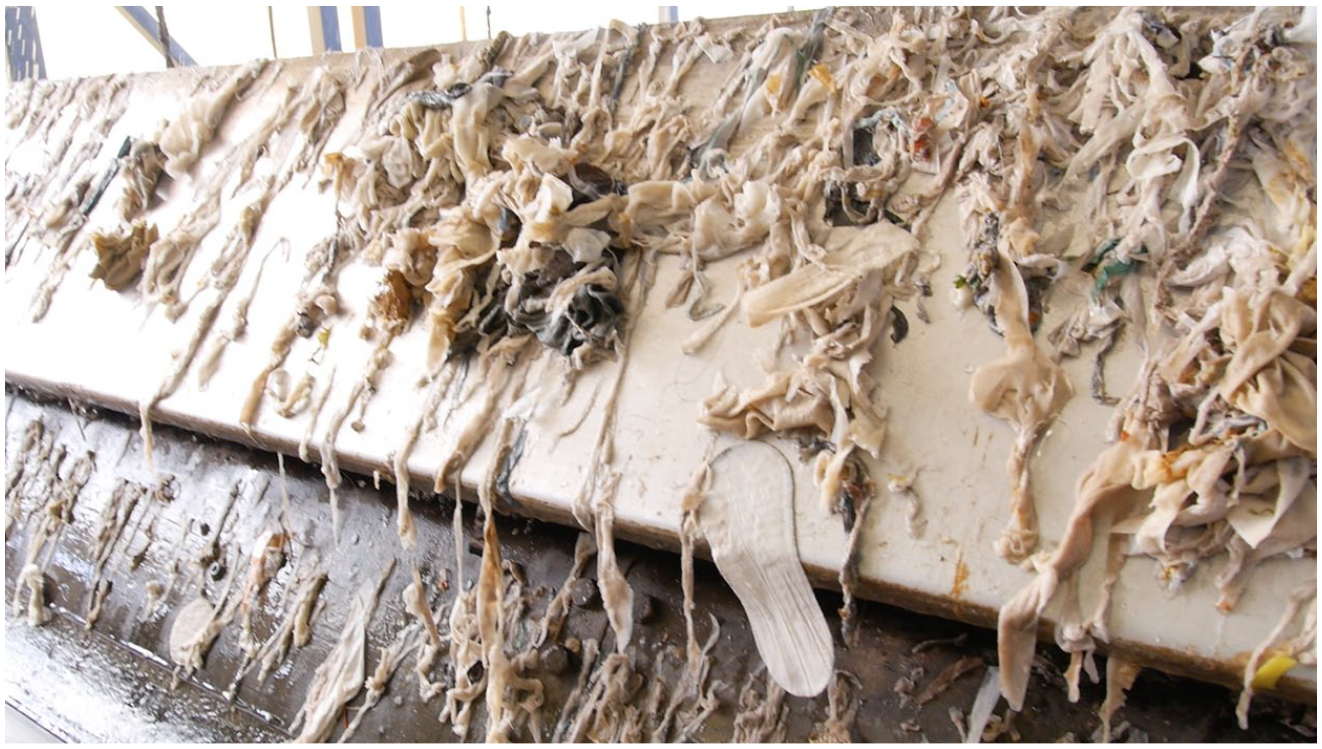
Accumulation: materials that have not degraded or decomposed in the sewers. These will be composted and eventually used for land reclamation. Photo by Antony Lyons
That these objects are plugged into the urban backstage by human operatives does not diminish their role and agency within assemblages of care. After Puig de la Bellacasa, we approach the nonhuman actants in the preceding vignettes as participating in an unintentional taking-care. We do not suggest that these nonhumans care about humans or human comforts, but argue that they are nevertheless part of a ‘circulation of care as everyday maintenance of the more than human web of life’. 77
In this section, we have expanded conceptual understanding of care through an exploration of the urban backstage. We have argued that the kind of care practices that take place herein are (largely) invisible, ‘unbalanced’ and involve complex flows of activity between humans and nonhumans. We have suggested that care occurs by engaging with (and attempting to forestall) the material degradation of infrastructure in both in rhythmic and episodic ways, and that this work is also often about managing the flow of matter that is itself involved in care work ‘upstream’, material such as cotton buds and wet wipes (that then stubbornly fail to degrade). Taking current conceptual work forward, we have argued that nonhumans also play an important role in these care practices. In addition to protecting the bodies of operatives (and protecting other kinds of mater from humans), the nonhuman protects other parts of the material infrastructure (and, inter alia, users) without human intervention, sometimes for years. In all of these ways, caring for water not only involves caring for the more than human, it precipitates caring relations with and amongst the infrastructure itself.
Conclusion
In this article, we have made two main contributions. First, we have argued that the practices of urban water infrastructural maintenance can represent active and crucial sites of care. Our exploration of the underground city extends understanding of some of the mundane practices of care that are central to contemporary urban life. As we have argued, that these relations are variously non-proximate, hidden, waged and more than human does not diminish their importance or their role in processes of caring for humans and nonhumans alike. While urban water maintenance is performed by operatives and more than human collaborators who may not/cannot demonstrate a care disposition or moral intention (i.e. they are not always aware that what they are doing is in the service of another), the fact remains that they are caught up in the ‘doing’ of care. This is work performed in support of healthier environments and people, contributing to ‘the intellectual, physical and emotional capabilities of recipients’. 78 Although indirect and more than human, the benefits are acutely felt by Bristol’s inhabitants. Clean drinking water and safe environments – these are the (all too often unrecognised) benefits of infrastructural care practices set in the urban backstage.
Second, we argue that nonhumans are vital participants within the workings of infrastructures of care. In this way our investigation of the maintenance and mending of urban water infrastructures in the underground city highlights ways in which we might denaturalise the concept of care itself. Through this investigation we have advanced an expanded notion of care that extends beyond traditional framings of feminised labour, and even of caring as an exclusively human activity. In the urban backstage care is both a felt emotion (caring about) and a doing (caring for/taking care). This non-moralistic stance draws attention to the ‘unnatural alliances’ 79 – those more than human assemblages – that make up caring worlds. In our examples, nonhumans are regularly plugged in to water assemblages in order to facilitate modern lifestyles, to maintain flows and to care for human bodies. Clearly, these actants do not ‘care about’ human wellbeing and do not express intentionality. Nevertheless, they are essential components of the ‘doing’ of care work.
Going forward, we suggest that geographical research that takes seriously the role of the nonhuman is well suited and much needed in drawing attention to the myriad forms of care involved in the maintenance of the world. The ways in which both care-practices and caring dispositions infuse life constitutes a rich area of study. In coming years, we hope to see much more work on these themes so that we may more-fully understand the extent to which the quality of our lives is always integrated with and dependent upon the care of non-proximate (and more than human) others.
Footnotes
Funding
The author(s) disclosed receipt of the following financial support for the research, authorship and/or publication of this article: The project was funded by an AHRC Connected Communities grant ref: AH/L008165/1.
